
International SEO Services: Rank in Every Country and Language You Sell To
International SEO services for businesses that sell across borders: market-by-market keyword research, the right site structure for each country, hreflang and geotargeting done correctly, localisation rather than word-for-word translation, technical SEO that holds up across regions, and link building in the markets that matter. Run by one international SEO consultant, reported in writing every week, priced as a flat monthly fee with no long contract.
What international SEO services are, and why domestic SEO stops working at the border
International SEO is the work of making a website perform in organic search across more than one country or language. It covers everything a normal SEO campaign covers, keyword research, technical SEO, content, links, local search, and adds a layer that domestic campaigns never have to think about: which version of your site each search engine should show to which searcher, in which language, with which currency, on which domain. Get that layer wrong and the best content in the world ranks in the wrong country, competes with itself as duplicate content, or never gets indexed for the market you built it for.
International SEO services, as offered here, are that layer plus the campaign underneath it. One international SEO consultant plans the market strategy, chooses the site structure, implements hreflang tags and geotargeting, runs keyword research in each target language with native-speaking reviewers, localises the content so it reads as if written for that market, fixes the technical issues that multiply when a site has five language versions, builds links from the countries you sell to, and measures the results country by country in Google Search Console and analytics. The work is done remotely for businesses based anywhere, reported every week in plain English, and billed as a fixed monthly fee.
This page explains what the service includes, who it is for, the decisions that make or break an international website (domain structure, hreflang, translation versus localisation), the process from market research to reporting, what it costs in pounds and dollars, how it compares with a translation agency or a global SEO agency, the mistakes seen on almost every multi-country site, and the questions businesses ask before expanding their search presence abroad. If you want the short version first: request the free international SEO audit at the bottom of the page and you will get a written summary of how your site currently performs in each market and what is holding it back.
The businesses that need international SEO rather than one more domestic campaign
UK businesses selling into the US, Europe or the Middle East
- An ecommerce store, software company or service business with orders arriving from abroad and no plan for them
- A single English site that ranks at home and barely appears in the target markets
- Needs country targeting, US and Australian English variants, currency and shipping clarity, and links from each market
US companies entering the UK, Canada, Australia and Europe
- Strong domestic authority, weak presence outside the US because the site says dollars, zip codes and US spelling everywhere
- Needs localised English versions, hreflang between the English variants, and country-specific pages that search engines can tell apart
Multilingual websites
- Two to twenty language versions, often machine translated, often with hreflang missing or broken
- Rankings in the second language are a fraction of the first, and the translated pages compete with the originals
- Needs a localisation review, hreflang repair, and keyword research done in each language rather than translated from English
Ecommerce brands with multiple storefronts
- Separate stores per country, or one store with a currency switcher, and duplicate product content across all of them
- Needs canonical strategy, market-specific category pages, structured data with the right currency and availability, and a crawl that does not waste budget on parameter URLs
SaaS and B2B companies with a global audience
- Buyers in every time zone search in their own language and expect pricing in their own currency
- Needs a market prioritisation model, localised landing pages, and international link building that supports each region rather than one global homepage
Sites that have already been “translated” and lost traffic
- A plugin or agency added language versions and organic traffic fell instead of rising
- Usually duplicate content, wrong canonicals, hreflang pointing at redirects or 404s, or auto-redirects that block crawlers
- Needs an international SEO audit and a repair plan before any more markets are added
The full list of international SEO services
Market research and prioritisation
Which countries and languages are worth targeting first, based on search demand in each market, competition, your ability to serve customers there, margins, shipping or delivery, and the regulatory realities. A market with high search volume and no way to fulfil orders is not a priority; a smaller market where you already have customers usually is.
- Demand sizing per country and language
- Competitor analysis in each target market
- A phased rollout plan with one market at a time
International keyword research
Keyword research carried out in the target language, not translated from the English list. People in Spain, Germany or Brazil search with different words, spellings, plurals and intent than a dictionary would suggest, and the US and UK differ more than most businesses expect. Native-speaking reviewers check every keyword set.
- Search volume and intent by country and language
- Local phrasing, slang, regional spelling variants
- Keyword mapping to pages for each market
Site structure and domain strategy
The decision that shapes everything else: country-code domains, subdomains, subdirectories or a single site with language parameters. Each has consequences for authority, cost, hosting, hreflang and geotargeting, and the wrong choice is expensive to reverse. The recommendation is written up with the reasoning, not delivered as a preference.
- ccTLD, subdomain and subfolder comparison for your case
- URL architecture for languages and regions
- Migration planning if the structure has to change
Hreflang and geotargeting
Hreflang tags tell search engines which language and regional version of a page to show to which searcher. They are the most commonly broken element of international sites: missing return tags, wrong language codes, tags pointing at redirected or noindexed pages, no x-default. Implementation, validation and monitoring are all part of the service.
- Hreflang in HTML, HTTP headers or XML sitemaps as the site requires
- x-default, canonical and hreflang alignment
- Country targeting in Search Console where applicable
Localisation, not translation
Translated pages rank badly because they read like translations. Localisation adapts the content to the market: the keywords people actually use, the currency, units, dates, address formats, legal wording, cultural references, examples, and the calls to action that work in that country. The service covers briefing, reviewing and optimising localised content, working with your translators or native-speaking writers.
- Localisation briefs per page and market
- On-page optimisation in each language
- Review of machine-translated content before it goes live
Technical international SEO
Multi-country sites multiply technical risk: duplicate content across versions, crawl budget spent on parameter URLs, IP-based redirects that lock crawlers out, slow performance for distant markets, inconsistent canonicals, structured data with the wrong currency. The technical work is the same discipline as any technical SEO engagement, applied across every version of the site.
- Crawl, indexation and canonical review per version
- Performance and CDN configuration for each region
- Structured data with market-specific currency, availability and locale
Content strategy by market
Not every page needs to exist in every market. The service maps which pages to localise, which to create fresh for a market, which to leave in English, and which to consolidate. Category pages, service pages, guides and comparison content are prioritised by demand and commercial value in each country.
- Market-specific content gaps
- Localised landing pages for paid and organic
- Editorial calendar per language
International link building and digital PR
Authority is partly regional. A site with links only from UK publications will struggle to rank in Germany or the US against local competitors with local links. Link building per market means outreach to publications, directories, partners and industry sites in that country, in that language, with content that suits that audience.
- Country-specific link prospecting
- Digital PR angles adapted per market
- Local citations and business listings where local search matters
Local search in each market
Businesses with physical locations abroad need the local layer as well: a Google Business Profile per location, local listings in each country’s ecosystem, reviews in the local language and location pages that pass the same consistency checks as the domestic ones.
- Business Profile setup and optimisation per country
- Local citation building in each market
- Review strategy in the local language
Measurement and reporting by country
One report a week, covering each market separately: impressions, clicks and positions from Search Console filtered by country and language, organic sessions and conversions per market, indexation and hreflang health, links gained, and the next steps. Numbers are given per country because a global total hides the market that is failing.
- Search Console properties or filters per market
- Rank tracking by country and language
- Revenue or enquiries attributed by market
How an international SEO campaign runs, from first market to full rollout
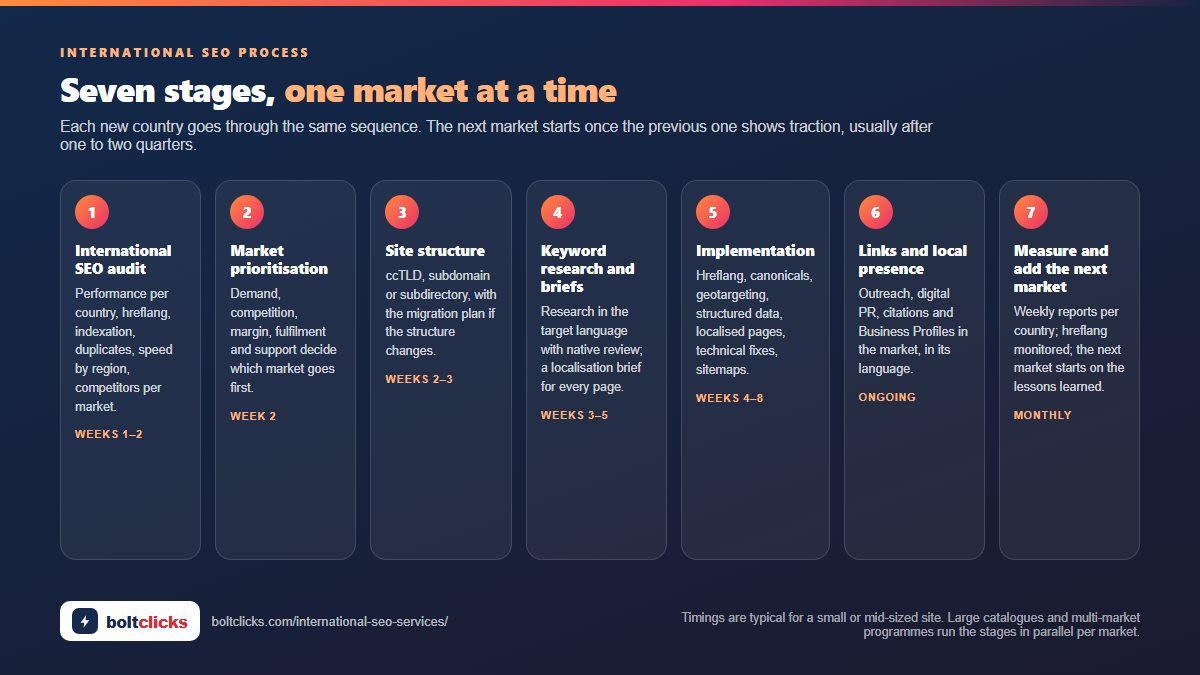
- International SEO auditHow the site performs in every country it currently receives traffic from, which versions are indexed, whether hreflang exists and validates, where duplicate content is competing, how fast pages load from each region, and what competitors in each market are doing. The audit produces a written report with a fix list and a recommendation on which markets to pursue first.
- Market prioritisationSearch demand per country and language is sized and set against competition, margin, fulfilment, payment methods, customer support hours and legal requirements. The output is a phased plan: usually one new market per quarter for smaller businesses, two or three for larger ones, never all at once.
- Site structure decisionccTLD, subdomain, subdirectory or a mix, decided against your hosting, budget, authority and growth plan. If the current structure has to change, a migration plan with redirects, hreflang updates and a monitoring period is written before anything moves.
- Keyword research and localisation briefsResearch in each target language with native review, mapped to the pages that will exist in that market. Each page gets a localisation brief: target keywords, intent, local terminology, currency, units, legal wording and the examples that make sense in that country.
- ImplementationHreflang and canonical tags, geotargeting settings, structured data per locale, localised pages published and optimised, technical fixes across all versions, performance tuned for each region, internal links between language versions checked, and a sitemap per language or market.
- Links and local presence per marketOutreach and digital PR in the target country, local citations and Business Profiles for physical locations, partner and supplier links, and content designed to earn coverage in that market rather than recycled from the home site.
- Measurement, iteration and the next marketWeekly written reports by country. Hreflang and indexation monitored continuously, because they break when developers touch templates. Once a market shows traction, typically three to six months, the next one starts with the lessons applied.
ccTLD, subdomain or subdirectory: the decision that shapes everything
The structure of an international site determines how authority flows, how search engines geotarget, what hosting and maintenance cost, and how easy it is to add the next market. There is no universally correct answer; there is a correct answer for your situation, and it depends on how much authority the main domain has, how many markets you plan, whether you have local teams, and how different the offer is per country.
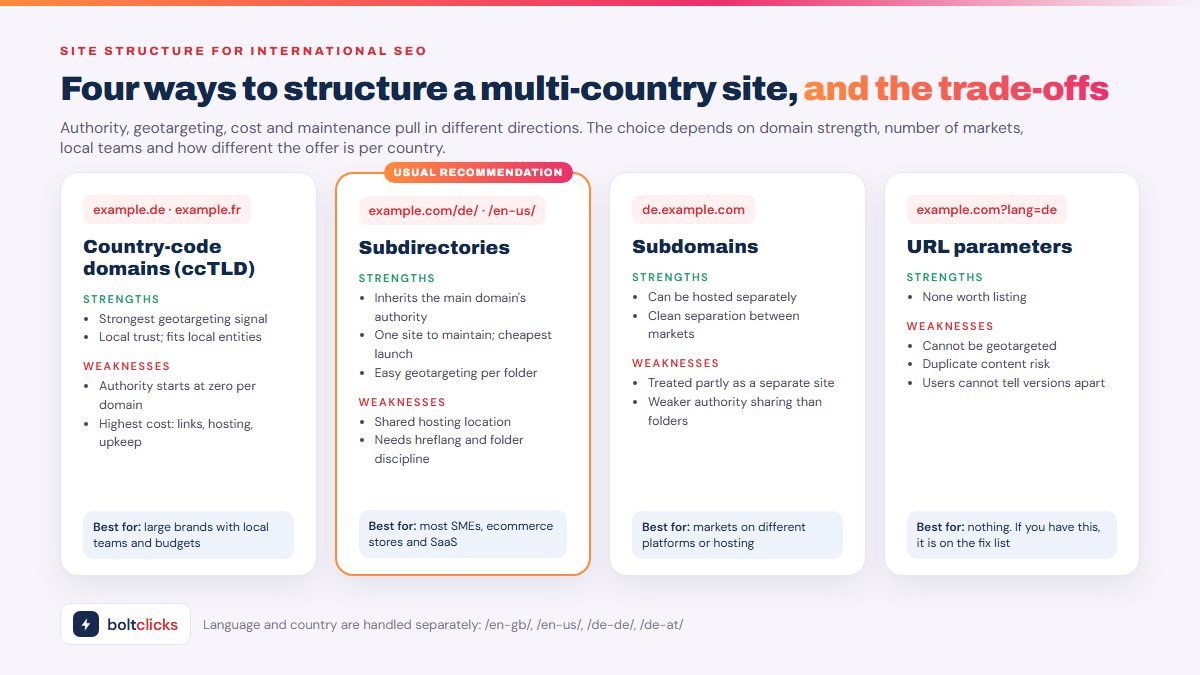
| Structure | Example | Strengths | Weaknesses | Best for |
|---|---|---|---|---|
| Country-code domain (ccTLD) | example.de, example.fr | Strongest geotargeting signal; users trust a local domain; separate legal entities fit naturally | Authority starts from zero on each domain; highest cost; each domain needs its own links, hosting and maintenance | Large brands with local teams and budgets; markets where domain trust matters |
| Subdirectory (subfolder) | example.com/de/, example.com/fr/ | Inherits the main domain’s authority; one site to maintain; cheapest to launch; easy geotargeting per folder | Hosting location is shared; less local trust than a ccTLD; needs careful hreflang and folder discipline | Most small and mid-sized businesses, ecommerce stores and SaaS companies |
| Subdomain | de.example.com, fr.example.com | Can be hosted separately; clean separation between markets; can be geotargeted | Treated partly as a separate site, so authority sharing is weaker than a subfolder; more setup work | Sites where markets need different platforms or hosting |
| URL parameters | example.com?lang=de | None worth listing | Cannot be geotargeted; duplicate content risk; users cannot tell versions apart | Nothing. If you have this, it is on the fix list |
The usual recommendation: subdirectories on the main domain for the first two to five markets, moving to country-code domains only when a market has its own team, its own legal entity and enough revenue to justify building authority from scratch. Language and country are handled separately: /en-gb/, /en-us/, /de-de/, /de-at/ rather than a single /de/ folder for every German-speaking market when the offer differs.
Hreflang and geotargeting: the tags that decide which version ranks where
Hreflang is an annotation that tells search engines the language and, optionally, the region of a page, and lists the equivalent versions of that page in other languages and regions. When it is correct, a searcher in Austria sees the German-language page priced in euros for Austria, a searcher in the US sees the US English page with dollars, and the versions do not compete with each other. When it is wrong, the wrong version ranks, or none of them do, or search engines treat the set as duplicate content and pick one at random.
The rules are simple and the implementation is fragile. Every version must reference every other version and itself. Language codes must be valid two-letter codes, region codes valid two-letter country codes, and the combination must make sense: en-gb is British English for the UK, en-us is US English, es-mx is Spanish for Mexico. An x-default should point to the page shown when no version matches. Tags must reference the canonical, indexable, 200-status URL of each version, never a redirect, a noindexed page or a URL that differs from the canonical. And the whole set has to survive developers changing templates, which is why it is monitored rather than set once.
Where hreflang goes
- HTML head: link elements on every page, the most common method, fine for small sites
- HTTP headers: for non-HTML files such as PDFs
- XML sitemaps: the cleanest option for large sites, keeping the annotations out of page templates and easy to regenerate
The errors found on most sites
- Missing return tags, so the relationship is one-directional and ignored
- Wrong codes: “uk” instead of “gb”, “en-eu”, invented regions
- Tags pointing at redirects, 404s or non-canonical URLs
- No x-default, or x-default pointing at a country page
- Hreflang on some templates and not others after a redesign
- Canonical tags pointing all versions at the English page, which cancels the hreflang entirely
Geotargeting is the related but separate signal: telling search engines that a section of the site is intended for a specific country. Country-code domains carry it automatically. Subdirectories and subdomains can be targeted in Search Console when the site is set up for it. Server location, local links, local currency and address details all reinforce it. IP-based redirects that force visitors to the version for their location are the wrong way to do it: they stop crawlers, which mostly visit from the US, from ever seeing the other versions. A banner suggesting the local version, with the choice left to the user, is the correct pattern.
Localisation versus translation: why translated pages do not rank
Translation converts words. Localisation converts a page into something a person in the target market would have written. The difference decides whether the page ranks, because search engines rank pages that match how people in that market search and behave, and people do not search in translated English. A UK page about “trainers” becomes a page about “sneakers” for the US and a page about “Turnschuhe” for Germany, but the keyword change is only the start.
Localisation adjusts the target keywords to the phrases people actually use, including regional spelling and vocabulary within the same language. It changes currency, units, sizes, date formats, phone number formats and address fields. It rewrites examples, case studies and cultural references so they land. It adapts legal and compliance wording, returns policies, delivery promises and payment methods to the market. It changes the tone: the directness that sells in one market reads as rude in another. And it keeps the on-page SEO intact in the new language: titles, headings, internal links, image alt text, structured data, all in the target language with the target keywords.
Machine translation has a place. It is a first draft for a native-speaking editor, and it is acceptable for large catalogues of low-value pages where the alternative is nothing. It is not acceptable for the pages that earn money: category pages, service pages, pricing, checkout flows and the guides that build authority. Those are reviewed line by line by someone who lives in the market, and the international SEO service includes writing the briefs those reviewers work from and checking the optimised result before it goes live.
- Keyword research in the target language first, then the page, never the other way around
- Native review of every commercial page, with the reviewer told what the page has to rank for
- Local currency, units, formats and legal wording on every version, not just the homepage
- Titles, metas, headings, alt text and structured data localised, not left in English behind a translated body
- Internal links between versions checked, so each language links within itself and not back to the English site
International keyword research: demand, intent and competition by market
Keyword research is where most international campaigns are decided before they start. The common mistake is to take the English keyword list, translate it, and build pages around the translations. The words are often right and the demand is wrong: the phrase people use in Spain is not the dictionary translation, the volume sits on a synonym, the intent behind the same phrase differs by country, and the competition in the target market is a different set of sites with different strengths.
The research is therefore done from scratch in each market. Seed terms come from native speakers, competitor sites in that country, the search engine’s own suggestions in that locale, and the language customers use in support tickets and reviews. Volumes are pulled per country and language. Intent is checked against the live results in that market, because a phrase that returns product pages in the UK can return guides in Germany. Competition is assessed against the sites that actually rank there. The output is a keyword map per market: which searches each localised page targets, which need a new page, and which are not worth chasing in that country at all.
| What changes between markets | Example | What it means for the page |
|---|---|---|
| Vocabulary within one language | Trainers / sneakers; solicitor / attorney; car hire / car rental; holiday / vacation | Separate en-gb and en-us pages with their own keyword sets, not one English page |
| Spelling | Optimisation / optimization; colour / color; centre / center | Consistent spelling per version; mixed spelling reads as careless and dilutes relevance |
| Intent | The same product phrase returns comparison guides in one market and stores in another | Page type follows the market’s results, not the home market’s |
| Seasonality | Summer sales in the northern and southern hemispheres are six months apart; tax deadlines differ | Editorial calendars per market |
| Units and formats | Inches versus centimetres, pounds versus kilos, 12-hour versus 24-hour time | Product data and filters localised, not just copy |
| Competition | A marketplace dominates one country, local brands another | Different content and link priorities per market |
| Search engine share | Google leads almost everywhere, but China, Russia, South Korea and Japan have significant local engines with their own rules | Market-specific technical and content requirements where those markets are targeted |
Technical international SEO: the problems that multiply with every version
A domestic site with a technical flaw has one problem. An international site with the same flaw has one problem per language version, plus the interactions between versions. The technical review covers the whole site as one system and then each version as its own site.
Crawling and indexation
- Every version indexable, reachable from internal links and listed in a sitemap for its language or market
- Crawl budget not wasted on currency and language parameter URLs, faceted navigation or session IDs
- Robots rules that do not accidentally block a whole folder or subdomain
- Log file checks to confirm crawlers reach every market, not just the home one
Duplicate content and canonicals
- Versions in the same language for different countries handled with hreflang, not canonicals pointing at one version
- Product and category content varied enough per market to avoid consolidation
- Self-referencing canonicals on every version; no canonical to the English page from translated pages
- Parameter handling and pagination consistent across versions
Performance by region
- Core Web Vitals measured from each target country, not from the home office
- CDN configuration and edge caching for distant markets
- Image, font and script weight reviewed per template, because the same template is served everywhere
- Server response times monitored per region
Structured data and on-page signals
- Product, offer, organisation and local business markup with the correct currency, availability, language and address per version
- Page language declared consistently in the HTML, the hreflang and the content
- Titles, descriptions and headings localised, with no English leaking into other versions
- Internal linking that keeps users and crawlers inside the right language version
Redirects and detection: automatic redirects based on IP address or browser language are the single most damaging pattern on international sites. They hide versions from crawlers, break hreflang, frustrate travellers and expatriates, and are almost always a fix-first item. The correct pattern is a dismissable suggestion banner and a visible language and country switcher that links to the equivalent page, not the homepage.
International link building: authority is partly regional
Search engines assess authority with a regional lens. A site with a thousand links from UK sources is authoritative in the UK; in Germany it is a foreign site with no local endorsement competing against domestic brands that have hundreds of German links, German press coverage and German directory listings. International link building addresses that gap market by market.
The work is the same as domestic digital PR and outreach, translated into the target market’s ecosystem: industry publications and trade bodies in that country, local business directories that matter there, suppliers, partners and distributors with sites in that market, comparison and review sites the local audience trusts, guest contributions to publications in the local language, and data-led content designed to be picked up by local media. Anchor text and landing pages are localised, so a German publication links to the German version of the relevant page rather than to the English homepage.
Local search adds its own layer for businesses with locations abroad: a Google Business Profile per location, citations in each country’s directory ecosystem, reviews in the local language, and location pages with consistent names, addresses and phone numbers in local formats. The same rules as domestic local SEO apply, market by market.
- Link prospecting per country, using the target market’s publications and directories
- Outreach in the local language by native speakers where the market requires it
- Localised anchor text and landing pages, never all links to the English homepage
- Digital PR angles adapted to local news cycles, statistics and seasonality
- No paid link schemes or link farms, in any market, in any language
Which pages to localise, which to create, and which to leave alone
Localising an entire site for every market is the expensive way to fail. Not every page has demand in every country, and some markets need pages the home site never had. Content strategy by market starts from the keyword map and the commercial value of each page type in that country.
Localise first
- Category, service and product pages with proven demand in the market
- Pricing, delivery, returns and payment pages, because they decide conversion
- The homepage and the pages that carry the site’s authority
- Guides that already rank at home and have equivalent search demand abroad
Create fresh for the market
- Pages for regulations, standards, sizes or products that exist only there
- Comparison and buying guides that reflect local competitors and local prices
- Location pages for physical presence in that country
- Content for market-specific seasons and events
Leave in English or consolidate
- Low-demand informational pages where a localised version would earn nothing
- Technical documentation read in English by the target audience
- Thin pages that should be merged before being multiplied
Retire
- Auto-translated pages with no traffic that dilute the site
- Duplicate versions for markets you no longer serve
- Language versions with no fulfilment or support behind them
International ecommerce SEO: catalogues, currencies and marketplaces
Online stores carry the heaviest international SEO load because every product, category and filter multiplies across markets. A catalogue of two thousand products in four countries is eight thousand product pages plus their variants, and the duplicate content, crawl budget and structured data problems scale with them. The service treats an international store as a data problem first and a content problem second.
Product descriptions are localised in priority order: the products that sell in each market get native-quality copy with local search phrasing; the long tail gets reviewed machine translation with localised titles, attributes and specifications. Category pages are the main ranking asset in most markets and receive the same treatment as service pages elsewhere on this page: keyword research in the language, a localised opening section, filters that match how local shoppers narrow choices, and internal linking that stays inside the market. Product feeds for shopping placements are built per country with local currency, tax-inclusive pricing where the market expects it, availability, shipping cost and delivery time, so paid and organic listings agree.
Structured data carries the currency, price, availability, shipping and review markup for each version, which is what makes rich results show the right price to the right shopper and lifts click-through rates in the results. Site speed is measured from each market on mobile devices, because the store that loads in two seconds in London may load in seven in Sydney without a content delivery network and image optimisation. Marketplaces are assessed per country: where a marketplace dominates the results for your category, the plan targets the searches marketplaces answer badly, such as comparisons, sizing, compatibility and after-sales questions, and builds the brand searches that bypass them.
Store structure that scales
- Market folders with self-contained category trees and internal links
- Parameter handling for currency, sorting and filters so crawl budget goes to real pages
- Canonical rules for variants, colours and sizes consistent across versions
- Sitemaps per market, regenerated as the catalogue changes
Conversion signals per market
- Local payment methods and trust marks shown on category and product pages
- Delivery times, returns and customs information written for the country
- Reviews collected and displayed in the local language
- Local phone numbers, addresses and support hours where they exist
Entering the US from the UK, and the UK from the US: the same language, different market
The most common international project is also the one businesses underestimate: expanding between the United Kingdom and the United States. Both markets speak English, so the site “already works”. It does not. Spelling, vocabulary, units, currency, tax presentation, date formats, phone formats, shipping expectations, legal wording, seasonality and the competitive landscape all differ, and search engines rank the version that fits the market. A UK page with pounds and British spelling ranks in the US behind every domestic competitor with dollars and US spelling, and the reverse is equally true.
The correct pattern is separate versions: en-gb and en-us folders with hreflang connecting them, an x-default that makes sense for other English-speaking visitors, and a keyword map per market. US searches are larger, more competitive and more mobile-heavy; UK searches use different phrases for the same products and services and reward local trust signals such as registered addresses, UK reviews and UK press. Paid search in the target country often runs alongside the organic launch to learn which localised phrases convert before the organic pages have had time to rank, and those learnings feed back into the keyword strategy.
| Area | UK version | US version |
|---|---|---|
| Spelling and vocabulary | Optimisation, colour, enquiry, solicitor, car hire, flat, trainers, postcode | Optimization, color, inquiry, attorney, car rental, apartment, sneakers, zip code |
| Currency and tax | Pounds, VAT-inclusive prices for consumers | Dollars, sales tax added at checkout and varying by state |
| Units and formats | Metric with imperial habits, dd/mm/yyyy, 24-hour time, +44 numbers | Imperial, mm/dd/yyyy, 12-hour time, +1 numbers |
| Trust signals | Company registration, UK address, UK reviews, trade bodies | Business address in a state, US reviews, Better-known accreditation schemes |
| Seasonality | Bank holidays, Boxing Day, UK tax year, school terms | Thanksgiving, Black Friday scale, July 4th, fiscal calendars |
| Local search | Business Profile per UK location; UK directories | Business Profile per US location; US directories and review platforms |
| Competition | Fewer, often smaller competitors; local links matter | Larger, deeper competitors; content depth and authority matter more |
International SEO and AI search: being the source in every market
AI Overviews, AI Mode and chat-based assistants now answer a share of searches in every major market, and they answer in the searcher’s language using sources from the searcher’s country. A business with strong AI visibility in the UK can be invisible in AI-generated answers in Germany, because the sources those answers draw on are German pages, German directories and German reviews. International SEO therefore includes the AI layer per market: localised pages written as clear, factual, quotable statements, structured data in each locale, consistent business details across each country’s ecosystem, brand mentions and citations in local publications, and monitoring of how AI answers describe the business in each language.
Generative engine optimisation is not a separate service; it is the same inputs applied with a market lens. Clear definitions, direct answers to buyer questions, comparison tables, pricing and process pages, and author and organisation information all help language models and answer engines understand and cite a page. Voice search and conversational queries follow the same pattern, in the local language, with local phrasing. The measurement is per market: which questions AI answers mention the brand for in each country, which competitors appear instead, and whether the descriptions are accurate.
- Localised entity clarity: who you are, what you offer and where, stated plainly on every version
- Answer-ready content per language: definitions, FAQs, comparisons and process pages that can be quoted
- Structured data per locale with the right language, currency and address details
- Local brand mentions and citations, because AI answers lean on third-party sources in each market
- Monitoring per market of AI-generated answers for the buying questions in that country
Working with your developers, translators and marketing team
International SEO touches more people than a domestic campaign: developers who own templates and hosting, translators or native writers, the marketing team running paid advertising and social media in each market, customer service teams who hear how customers describe products, and finance, who decide which markets get funded. The service is designed to slot into that group without adding meetings.
Developers get specifications, not requests
- A written hreflang specification with the exact tags per template
- Redirect maps for migrations with the monitoring plan
- Structured data templates per locale
- Performance targets per region with the changes that meet them
Translators get briefs, not raw pages
- Target keywords and intent per page in the target language
- Terminology lists and the phrases to avoid
- Formatting rules for titles, headings, alt text and structured data
- A review pass on the optimised result before publication
Marketing teams get shared data
- Localised keyword sets reused for paid search in each market
- Landing pages built to serve paid and organic traffic
- Content calendars aligned with local campaigns, launches and seasonality
- Digital PR angles coordinated with social media and email in that market
Leadership gets numbers per market
- Visibility, traffic, enquiries or revenue by country
- Cost per market against the return it produces
- A recommendation each quarter on which market to fund next
- Plain statements when a market should be paused
The international SEO audit checklist: what is checked before anything changes
Structure and targeting
- Domain and URL structure per market and language
- Geotargeting settings and signals per section
- Language and country switcher: visible, crawlable, linking to equivalent pages
- No forced IP or browser-language redirects
- x-default set and sensible
Hreflang
- Present on every version of every page
- Valid language and region codes
- Return tags complete
- Targets are canonical, indexable, 200-status URLs
- Consistent between HTML, sitemaps and headers if more than one method is used
Indexation and duplicates
- Each version indexed in the right country’s results
- Self-referencing canonicals per version
- Parameter, currency and session URLs excluded from crawling
- Sitemaps per language or market, referenced in robots rules
- Wrong-version rankings checked in Search Console by country
Content and localisation
- Keyword research done in each language, not translated
- Titles, meta descriptions, headings, alt text and structured data localised
- Currency, units, formats, legal wording and examples adapted
- Commercial pages reviewed by native speakers
- Machine-translated pages identified and prioritised for review or removal
Technical and performance
- Core Web Vitals from each target market
- CDN and caching configured for distant regions
- Structured data per locale validated
- Mobile rendering checked per version
- Log files confirm crawlers reach every market
Authority and local presence
- Referring domains by country compared with local competitors
- Business Profiles and citations per physical location abroad
- Reviews per market and language
- Brand mentions in local publications
- Competitor content and link gaps per market
The audit is free at summary level and £850 as a full project with the fixes implemented. Either way, the output is a written document you can hand to a developer, a translator or another agency: the findings, the priority order and the reasoning, not a score.
Changing structure without losing rankings: the migration plan
Many international projects begin with a structure that has to change: subdomains folded into subdirectories, a set of country-code domains consolidated onto one domain, a platform migration that touches every language version, or a rebrand across markets. Rankings are lost in migrations through missing redirects, changed URLs without updated hreflang, canonicals left pointing at old addresses, sitemaps that still list retired URLs, and analytics that stop tracking the new structure. The migration plan exists to prevent each of those.
- Benchmark every marketRankings, traffic, indexed pages, links and conversions per country and language recorded before anything moves, so the effect of the migration can be measured honestly.
- Map every URLA one-to-one redirect map from every old URL in every version to its new equivalent, including images, PDFs and parameter URLs that carry traffic.
- Rebuild hreflang for the new structureThe full annotation set regenerated for the new URLs, validated before launch, with x-default reviewed.
- Stage and testThe new structure crawled on a staging environment with search engines blocked: redirects, canonicals, hreflang, sitemaps, structured data, internal links and performance all checked per version.
- Launch in a quiet windowOutside the market’s peak season, with developers available, sitemaps submitted for each market and Search Console settings updated the same day.
- Monitor for twelve weeksDaily indexation and error checks in the first two weeks, weekly afterwards, with the benchmark compared per market and any lost rankings traced to the URL that lost them.
Regional search engines, app stores and the platforms that matter locally
Google leads search in most countries, and everything on this page applies to it. A few large markets are different: China, Russia, South Korea and to a lesser extent Japan have domestic search engines with significant or dominant share, their own webmaster tools, their own ranking preferences and, in some cases, hosting and licensing requirements that decide whether a foreign site can rank at all. Targeting those markets is a distinct project: local hosting or content delivery, registration with the local webmaster tools, content and technical work adapted to that engine’s documented preferences, and often a local partner for legal and payment requirements.
Regional platforms matter in every market beyond the search engine itself. Marketplaces, review sites, business directories, professional networks and app stores differ by country, and AI answers in each market draw on those local sources. The market research stage maps them so that the local presence work covers the places customers in that country actually look, rather than the directories that matter at home.
International SEO for service businesses and remote providers
Not every international business ships products. Consultancies, software providers, agencies, training companies, recruiters and professional firms sell services across borders, often delivered remotely, and their international SEO has its own shape. The questions are about trust and fit rather than delivery: is this provider allowed to operate in my country, do they understand my regulations, do they work in my time zone, do they invoice in my currency, do they have clients like me.
Service pages per market answer those questions directly: which countries are served, the hours covered, the currency and payment terms, the regulatory position stated plainly, and the local phrasing for the service itself, which varies more than product names do. Case studies and examples are chosen for their relevance to the market where possible. Where the business has a real local presence, a registered address, staff or a partner, the local search layer is added; where it does not, the page says so, because claiming an office that does not exist is both a trust problem and, in some markets, a legal one. Local links and mentions still matter: coverage in the market’s trade press and listings in its professional directories build the regional authority that a remote provider otherwise lacks.
International SEO pricing, in pounds and dollars
International SEO is priced per market rather than per site, because each country is its own campaign: its own research, content, links and reporting. The plans below are the published fees; multi-market programmes are quoted from them, in writing, before any work starts. Ad budgets, translation costs and hosting are always separate and always paid by you directly.
| Plan | What it covers | UK | US |
|---|---|---|---|
| Free international SEO audit | Written summary of performance per market, hreflang and indexation status, duplicate content, the competitor gap and a recommended first market | Free | Free |
| SEO Foundation (one-off) | Full technical and international audit with the fix list implemented: hreflang, canonicals, sitemaps, structured data, redirects, crawl issues across all versions | £850 | Quoted in USD |
| Starter: one market | Ongoing SEO for one additional country or language: research, localisation briefs, on-page, technical monitoring, link building in that market, weekly reports | £650 / month | $800 / month |
| Growth: two markets or SEO plus paid search | Two markets in parallel, or one market with paid search in that market handled alongside organic | £1,200 / month | $1,500 / month |
| Full Stack: multi-market programme | Three or more markets, ecommerce at scale, multilingual content programme, digital PR per market, paid search and paid social where wanted | from £4,000 / month | from $5,000 / month |
| Projects | Site structure migrations, hreflang repair, one-off market launches, audits for agencies | Quoted | Quoted |
Terms: month to month, invoiced in advance, cancel with a month’s notice. Partner or delegated access to Search Console, analytics and the CMS; passwords are never requested. Every fee is agreed in writing before work begins, and the full price list is on the pricing page.
International SEO consultant, global agency, translation agency or in-house
| Option | Strengths | Weaknesses | Typical cost |
|---|---|---|---|
| International SEO consultant (this service) | One accountable specialist across strategy, technical, content and links; flat fee; direct access; native reviewers brought in per language | Capacity limits the number of markets run in parallel; large enterprise programmes need a bigger team | £650 to £4,000+ a month; $800 to $5,000+ |
| Global SEO agency | Offices or staff in several countries; capacity for many markets at once; enterprise processes | Account management layers; junior execution; retainers priced for enterprise budgets; slow to change course | £5,000 to £30,000+ a month |
| Translation or localisation agency | Native linguists; volume; quality control for language | Not SEO: no keyword research, no hreflang, no technical work, no links; translated pages that do not rank | Per word; £0.08 to £0.25 plus review |
| Marketplace freelancers per market | Cheap; native speakers available in every language | No overall strategy; inconsistent quality; nobody owns hreflang, structure or the technical layer; coordination becomes your job | £15 to £80 an hour |
| In-house international SEO | Deep knowledge of your products and markets; always available | One person cannot cover every language; salary plus tools plus translation costs; recruitment is slow | £45,000 to £80,000 a year plus tools; $80,000 to $150,000 in the US |
| Translation plugin only | Fast; cheap; every page in every language overnight | Machine output, duplicate content, hreflang often broken, no localisation, no links; frequently reduces traffic | £0 to £100 a month |
The practical combination for most growing businesses is a specialist to own the strategy, structure, technical layer, links and measurement, with translators or native writers producing the localised content from the specialist’s briefs. That gives native-quality language and SEO-quality pages without an enterprise retainer.
How results are measured, country by country
A global traffic number hides everything that matters. International SEO is reported per market, so a market that is failing cannot be masked by one that is growing. The weekly report covers each country and language separately, and the measures are chosen to reflect business outcomes rather than vanity.
| Measure | Where it comes from | Why it matters |
|---|---|---|
| Impressions, clicks and average position per country | Search Console, filtered by country and by folder or property | Shows whether each market is gaining visibility on its own terms |
| Rankings by locale | Rank tracking with the correct country, language and device settings | Confirms the right version ranks in the right market |
| Organic sessions and conversions per market | Analytics segmented by country, language and landing-page folder | Ties visibility to enquiries, orders and revenue |
| Indexation and hreflang health | Search Console indexing reports and hreflang validation runs | The first thing that breaks after a deploy, so it is checked every week |
| Duplicate and wrong-version clicks | Search Console queries by page and country | Detects the UK page ranking in the US and vice versa |
| Links and mentions per market | Backlink tools filtered by referring domain country and language | Regional authority growth |
| Page speed per region | Field data by country; lab tests from target locations | Distant markets often have the slowest experience and the worst conversion |
| Revenue or pipeline by market | Your sales data or CRM, attributed to organic entry per country | The number that decides whether the next market is funded |
Timelines are honest: technical and hreflang fixes usually show in Search Console within four to eight weeks as versions are recrawled. New localised pages in a market with real competition take three to six months to settle. Link and authority work in a new country compounds over six to twelve months. A new market with no existing presence should be given at least two quarters before judging it.
The international SEO mistakes found on almost every multi-country site
- Automatic IP or browser-language redirects that lock crawlers into one version and hide the rest
- Hreflang without return tags, with invented region codes, or pointing at redirects and noindexed pages
- Canonicals from every language version to the English page, which tells search engines the translations do not exist
- Machine-translated commercial pages that read as foreign and rank behind every local competitor
- Translated keywords instead of researched keywords, targeting phrases nobody in the market uses
- One English page for the UK, US, Australia and Canada, with pounds, US spelling and mixed formats on the same page
- Country-code domains launched with no links, no content plan and no budget to build authority from zero
- Language switchers that link to the homepage instead of the equivalent page, or that live behind scripts crawlers cannot follow
- Currency and language parameters creating thousands of duplicate URLs that eat crawl budget
- Structured data with the home currency on every version, so rich results show the wrong price
- Global reporting that averages a growing market with a collapsing one and shows a flat line
- Launching five markets at once with the budget for one, so none of them gets enough to move
International SEO by business type
Ecommerce and retail
- Product feeds, currency, shipping and returns per market
- Category pages localised for local search phrasing and filters
- Marketplace competition assessed per country before investing
SaaS and software
- Pricing pages per currency and tax regime
- Localised feature, integration and comparison pages
- Documentation often left in English; marketing pages localised
Manufacturing and B2B exporters
- Distributor and partner pages by country
- Standards, certifications and compliance content per market
- Links from trade bodies and industry press in each region
Travel, hospitality and education
- Source-market pages in the languages of the visitors, not the destination
- Seasonality and booking behaviour per market
- Local search for physical locations abroad
Professional and financial services
- Regulatory wording and disclaimers per jurisdiction
- Service pages that reflect what is legally offered in each country
- Trust signals: local registrations, local reviews, local addresses
Agencies and resellers
- International SEO delivered under your name for your clients
- Audits, hreflang repair and market launches as projects
- Written reports you can pass straight to the client
Remote delivery for businesses in the UK, the US and anywhere else
International SEO does not need an office in every country; it needs the right process and the right native reviewers. The service is delivered remotely, working UK and US hours, with native-speaking linguists and reviewers engaged per language as the plan requires. There is no office in London, New York or Berlin, and none is claimed. What you get is one specialist who is accountable for the whole programme, a written report every week, and a plain answer when a market is not worth pursuing.
The tools used are the standard ones: Search Console and analytics for measurement, rank tracking by locale, crawlers and log analysis for the technical layer, backlink data per market, and hreflang validators. Access is always partner or delegated access to your own accounts; nothing is set up in accounts you do not control, and passwords are never requested.
- Weekly written report per market with what was done, what moved and what is next
- Fixed monthly fee, month to month, agreed in writing before work starts
- Native reviewers per language, briefed by the specialist who owns the strategy
- Your accounts, your data, partner access only
- Honest market advice: if a country is not worth the spend, the report says so
International SEO terms, defined
| Term | Meaning |
|---|---|
| Hreflang | An annotation listing the language and regional versions of a page so search engines show the right one to each searcher |
| x-default | The hreflang value for the page shown when no language or region version matches the searcher |
| ccTLD | Country-code top-level domain such as .de, .fr or .co.uk; a strong geotargeting signal with no shared authority |
| Subdirectory / subfolder | A folder on the main domain used for a language or market, such as /de/ or /en-us/ |
| Subdomain | A prefix on the main domain, such as de.example.com, treated partly as a separate site |
| Geotargeting | Signals that a site or section is intended for a specific country: domain, Search Console settings, local links, currency, addresses |
| Localisation | Adapting content, keywords, formats, currency and tone for a market, as opposed to translating the words |
| Transcreation | Rewriting marketing copy for a market so the effect is preserved rather than the words |
| Duplicate content | Substantially similar pages across versions that search engines may consolidate or ignore; managed with hreflang, canonicals and differentiated content |
| Canonical tag | The declared preferred URL of a page; on international sites each version should reference itself |
| Crawl budget | How much of a site search engines will crawl in a period; wasted by parameter and duplicate URLs on multi-country sites |
| Multilingual SEO | SEO for a site in more than one language, regardless of country |
| Multi-regional SEO | SEO for a site targeting more than one country, possibly in the same language |
| International keyword research | Keyword research done in each target language and country rather than translated from the home list |
| CDN | A content delivery network that serves pages from locations near the user, improving speed for distant markets |
| Local search | The map and Business Profile layer of search, run per location in each country |
International SEO services: frequently asked questions
What is international SEO?
International SEO is the practice of optimising a website so it ranks in organic search across multiple countries and languages. It adds market prioritisation, site structure decisions, hreflang and geotargeting, localisation and per-market link building to the normal SEO disciplines of technical work, content and authority.
What does an international SEO consultant do?
Plans which markets to target and in what order, chooses the domain and URL structure, implements and monitors hreflang and geotargeting, runs keyword research in each language, briefs and reviews localised content, fixes technical issues across every version, builds links in each market, and reports results country by country.
How much do international SEO services cost?
Here, £650 a month or $800 a month for one additional market, £1,200 or $1,500 for two markets, and from £4,000 or $5,000 for multi-market programmes. Audits with fixes are £850 one-off. Global agencies typically charge £5,000 to £30,000 a month or more. Translation costs are separate and paid by you.
Should I use country-code domains or subdirectories?
Subdirectories on your main domain for the first few markets in almost every case: they inherit the domain’s authority, cost the least and are easy to geotarget. Country-code domains make sense when a market has its own team, legal entity and enough revenue to fund building authority from scratch. URL parameters for language are never the answer.
What is hreflang and do I need it?
Hreflang tells search engines which language and regional version of a page to show to which searcher. Any site with more than one language, or more than one country in the same language, needs it. Without it the versions compete with each other or the wrong one ranks in the wrong country.
Can I just translate my site with a plugin?
You can, and organic traffic often falls when businesses do. Machine translation produces pages that read as foreign, target phrases nobody searches, duplicate the original, and frequently ship with broken hreflang. Plugins are fine as a first draft for native review of the pages that matter.
Do I need a different site for the US and the UK?
Not a different site, but different versions: en-gb and en-us folders with hreflang between them, each with its own spelling, vocabulary, currency, formats and examples. One page trying to serve both markets usually serves neither well.
How long does international SEO take to work?
Technical and hreflang fixes show within four to eight weeks. Localised pages in competitive markets take three to six months to settle. Authority in a new country builds over six to twelve months. A new market should be given at least two quarters before it is judged.
Does Google treat each country differently?
Yes. Rankings are calculated per country and language, using the geotargeting signals, hreflang, local links, local content and user behaviour in that market. Some countries also have significant local search engines with their own requirements.
Do you work with our translators?
Yes. The service writes the localisation briefs, reviews the optimised result and handles everything technical; your translators or native writers produce the language. If you do not have translators, native reviewers are engaged per language as part of the plan.
Can you fix an international site that has already lost traffic?
Yes, and it is one of the most common starting points. The audit finds the causes, usually redirects, canonicals, hreflang errors or duplicate translated pages, and the SEO Foundation project implements the repairs before any new markets are added.
Do I need local links in every country?
To compete with local businesses, yes. Authority is assessed partly by region, so a market with no local links, mentions or citations will lag however strong the home domain is. Link building is planned per market from the start.
Will you need my passwords?
No. Partner or delegated access to Search Console, analytics, the CMS and any advertising accounts is all that is ever used, and everything stays in accounts you own.
Where are you based?
The work is delivered remotely for businesses in the UK, the US and elsewhere, on UK and US hours, with native reviewers engaged per language. There is no office in any of the markets, and none is claimed.
Seven things to know before expanding your search presence abroad
1. Start with one market, not five
Every market needs its own research, content, links and attention. Spreading one budget across five countries usually produces five failures. The first market should be the one where you already have customers, fulfilment and support; it becomes the template for the rest.
2. The site structure decision is hard to reverse
Moving from subdomains to subfolders or from a ccTLD to a subdirectory is a migration with redirects, hreflang changes and a monitoring period. Decide with the growth plan in view, and get the reasoning in writing.
3. Hreflang will break again
Template changes, plugin updates and redesigns break hreflang constantly. It is monitored weekly for that reason, and any developer touching templates should have the hreflang rules in their brief.
4. Translation is a cost; localisation is an investment
Pages that read as if written for the market rank, convert and earn links. Translated pages do none of those reliably. Spend the localisation budget on the pages that make money and leave low-value pages in English.
5. Local competitors have local links
Authority does not travel across borders on its own. Budget for outreach and digital PR in each market from the start, or expect to rank behind domestic sites that do.
6. Measure per market or you will not see the problem
A global report that shows growth can hide a market that is collapsing. Reports here are per country and language, with the numbers a finance director would ask for.
7. Some markets are not worth it
High search volume in a country you cannot serve, or where a marketplace owns the results, is not an opportunity. Part of the service is telling you which markets to skip, and it is reported plainly when that is the case. A full SEO audit of the current site is the usual way to find out which markets are ready and which are not.
Start with a free international SEO audit
Send your website and the countries you sell to, or want to. You will get a written summary of how the site performs in each market, whether hreflang and indexation are working, where the duplicate content is, what competitors in each country are doing, and which market to start with. No jargon, no lock-in, no passwords.