SEO Consulting Services: One Specialist, Strategy Through to Results
SEO consulting services for businesses that want a strategy written by the person who will be accountable for it: a full audit, a prioritised roadmap, technical and content direction, link and authority planning, and either the implementation done for you or your own team guided through it. One SEO consultant, weekly written reports, fixed fees agreed in advance, no long contracts.
What SEO consulting is, and how it differs from buying a package
SEO consulting is advice and direction from a specialist who has diagnosed your site, understands your market and takes responsibility for the plan. It is different from an SEO package, where a fixed list of tasks is applied to every client regardless of what their site actually needs. A consultant starts by finding out what is wrong and what is possible, writes the strategy, decides the order of work, and then either carries it out or guides your developers, writers and marketing team through it. The value is in the judgement: which fixes matter, which pages to build, which searches to target, which links are worth earning and which activity is wasted money.
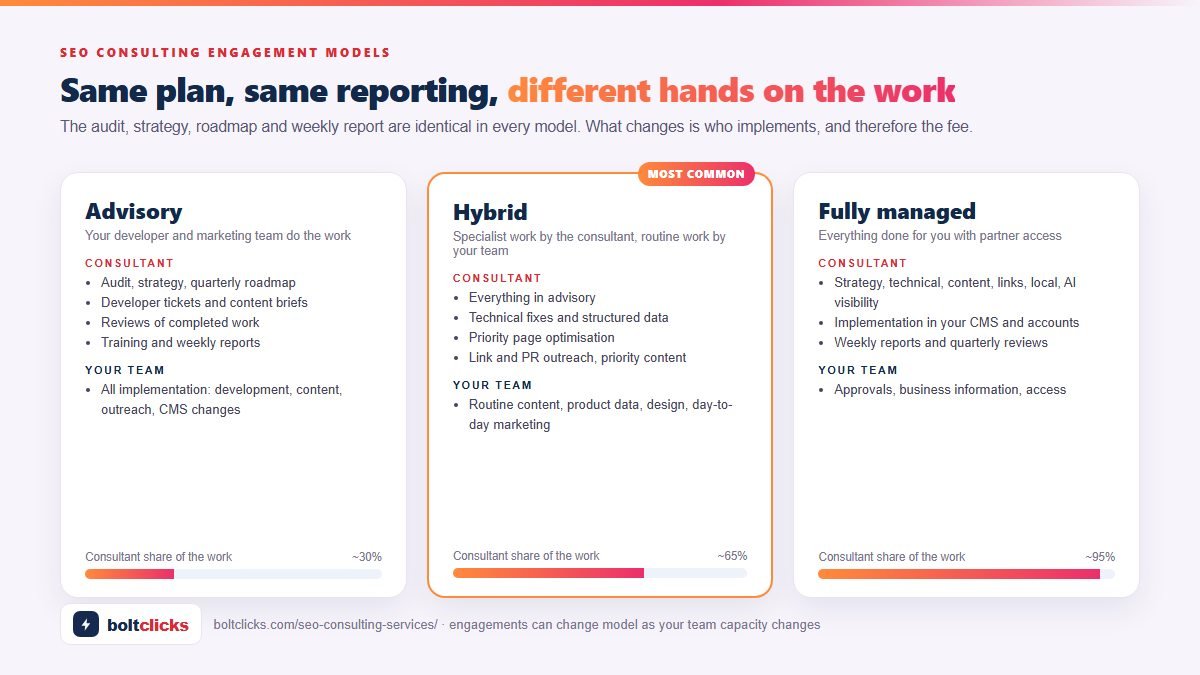
The SEO consulting services on this page cover the whole discipline: technical SEO, keyword strategy, content planning, on-page optimisation, link building and digital PR direction, local SEO, ecommerce SEO, migrations and redesigns, recovery from algorithm updates and traffic drops, visibility in AI search, and training for in-house teams. The consultant is the same person from the first audit to the monthly report; there is no handover to an account manager or a junior executive after the sale. Engagements are structured three ways: advisory only, where your team does the work from the consultant’s plan; hybrid, where the consultant does the specialist parts and your team the rest; or fully managed, where everything is done for you. All three are reported in writing every week and priced as fixed fees.
This page explains who SEO consulting suits, what the service includes, how an engagement runs from audit to roadmap to results, what it costs in pounds and dollars, how a consultant compares with an agency, a freelancer from a marketplace or an in-house hire, what a consultant actually does month to month, how results are measured, how to choose a consultant and the questions asked before businesses commit. If you would rather start with a look at your own site, the free consultation at the bottom of the page begins with a written summary of the biggest problems and opportunities.
The businesses that get the most from an SEO consultant
In-house teams that need direction, not another agency
- A marketing team or developer who can do the work but has no SEO strategy to follow
- Needs an audit, a roadmap, prioritised tickets and someone to answer questions as the work happens
- Consulting keeps the knowledge in your business rather than in an agency’s
Businesses that have paid for SEO and seen nothing
- Months of retainer fees, reports full of rankings, no change in enquiries or revenue
- A consultant reviews what was actually done, what the reports hid and what should have happened
- Often the fix is a strategy, not more activity
Sites facing a migration, redesign or platform change
- Traffic is lost in migrations through missing redirects, changed URLs and dropped content
- A consultant plans the migration, specifies the redirects and monitors the recovery
- Cheaper than rebuilding rankings afterwards
Traffic drops and algorithm updates
- Rankings fell after a core update, a manual action or a technical change nobody noticed
- Needs diagnosis against dates, crawl data and the pages that lost, then a recovery plan
- Guessing at fixes makes it worse
Ecommerce and larger sites
- Thousands of URLs, faceted navigation, duplicate product content, crawl budget problems
- Needs technical architecture decisions and a category strategy, not blog posts
- Consulting scales to the site without scaling the fee to enterprise levels
Founders and small businesses that want a second opinion
- Before signing an agency contract, launching a site or committing a budget
- A consultant reviews the proposal, the site or the plan and says what is worth doing
- A one-off audit often saves a year of the wrong retainer
The full list of SEO consulting services
SEO audit and diagnosis
Every engagement starts with an audit: crawl and indexation, technical health, site speed and Core Web Vitals, on-page signals, content quality and gaps, internal linking, backlink profile, local search presence, analytics and Search Console data, and the competitor landscape. The audit is a written report with findings ranked by impact and effort, not a tool export.
- Technical, content, link and local audit in one document
- Findings tied to the pages and searches that matter commercially
- A fix list a developer can work from
SEO strategy and roadmap
The strategy sets the target searches, the pages that will win them, the technical foundation they need, the content to create or improve, the links and mentions to earn, and the order in which all of it happens. It is written as a roadmap by quarter with the reasoning, so anyone in the business can see why each item is there and what it is expected to move.
- Quarterly roadmap with priorities and dependencies
- Keyword strategy mapped to pages
- Resource plan: who does what, in-house or consultant
Technical SEO consulting
Crawlability, indexation, site architecture, internal linking, canonicals, structured data, page speed, JavaScript rendering, international setup, migrations. Specifications are written for developers in their language, with acceptance criteria, and the results are checked after deployment. The same discipline as a full technical SEO engagement, delivered as guidance or as implementation.
- Developer-ready tickets and specifications
- Pre- and post-deployment checks
- Ongoing monitoring of the things that break
Keyword strategy and content planning
Keyword research grounded in search intent and commercial value, not volume alone. Existing pages are mapped to the searches they should win, gaps are turned into a content plan, and each brief states the intent, the structure, the questions to answer and the internal links to include. Content is written by the consultant, your writers or a mix.
- Intent-led keyword mapping
- Content briefs with structure and questions
- Editorial calendar tied to the roadmap
On-page optimisation
Titles, meta descriptions, headings, body content, images, internal links, schema markup and page structure reviewed and improved page by page, starting with the pages that carry revenue. Done as specifications for your team or applied directly in the CMS with partner access.
- Page-level optimisation in priority order
- Templates for scaled changes on large sites
- Structured data for the page types that earn rich results
Link building and digital PR strategy
A plan for earning authority that fits the business: which pages need links, which publications, directories, partners and trade bodies are realistic, what content will earn coverage, and what to refuse. No paid link schemes, no link farms, no placements bought on marketplaces.
- Link gap analysis against competitors
- Outreach and digital PR planning
- Local citations where local search matters
Local SEO consulting
Google Business Profile optimisation, local citations, reviews strategy, location and service-area pages, and the map-pack signals that decide local rankings. For single locations, multi-location businesses and service-area businesses.
- Business Profile audit and optimisation plan
- Location page strategy
- Review and citation programme
Ecommerce SEO consulting
Category and product page strategy, faceted navigation and crawl budget, duplicate content across variants, product schema, internal linking at scale, seasonal planning and marketplace competition. For stores on any platform.
- Site architecture for large catalogues
- Category-first keyword strategy
- Technical rules for filters, pagination and variants
Migration and redesign consulting
Planning, redirect mapping, template reviews, staging checks and post-launch monitoring for platform migrations, redesigns, domain changes and consolidations. The aim is to keep every ranking the old site had and fix what it lacked.
- Migration plan and redirect map
- Staging audit before launch
- Twelve-week recovery monitoring
Algorithm update and traffic-drop recovery
Diagnosis of what fell, when and why, against update dates, crawl data, content quality signals and links; then a recovery plan that addresses the actual cause rather than the symptom.
- Drop analysis by page, query and date
- Content quality and relevance review
- Recovery roadmap with realistic timelines
AI search visibility
How the business appears in AI Overviews, AI Mode and chat-based assistants, what those answers cite, and the entity, content and structured data changes that improve it. Covered inside the strategy rather than sold as a separate product.
- AI visibility check for buying questions
- Answer-ready content and structured data
- Brand mention and citation planning
Training, mentoring and reporting
Sessions for in-house teams on the parts of SEO they will own, question-answering as work happens, and a written report every week that says what was done, what moved, what did not and what happens next, in language a business owner can read.
- Team training and playbooks
- Weekly written reports
- Quarterly strategy reviews
How an SEO consulting engagement runs, from audit to results
- Free consultation and written summaryYou send the website and the searches you most want to win. You get a short written summary of the biggest problems, the competitor gap and a straight answer on whether SEO consulting is worth funding for your situation.
- Full auditTechnical, content, links, local and analytics, reviewed against your market and competitors. Delivered as a written report with findings ranked by impact and effort and a fix list your developers can start on immediately.
- Strategy and roadmapTarget searches mapped to pages, the technical foundation, the content plan, the authority plan and the order of work, laid out by quarter with the reasoning. Reviewed with you before anything starts.
- Engagement model agreedAdvisory, hybrid or fully managed, decided by who in your business can do what. Fees fixed in writing, month to month.
- ImplementationSpecifications and briefs for your team, or the work done directly with partner access to your CMS, Search Console and analytics. Technical fixes first, then the pages that carry revenue, then content and authority.
- Weekly reportingWhat was done, what moved, what did not and what is next, every week, in plain English. Rankings, impressions, clicks, enquiries and revenue where you share it, with the reasons behind the numbers.
- Quarterly reviewThe roadmap re-planned against results: what to double down on, what to stop, and whether the engagement should change shape. If SEO is no longer the right spend, the review says so.
Advisory, hybrid or fully managed: who does the work
| Model | Consultant does | Your team does | Suits |
|---|---|---|---|
| Advisory | Audit, strategy, roadmap, specifications, briefs, reviews of completed work, weekly reporting, training | All implementation: development, content, outreach, CMS changes | Businesses with a capable developer and marketing team who need direction and accountability |
| Hybrid | Everything in advisory plus the specialist work: technical fixes, on-page optimisation of key pages, structured data, link and PR outreach, priority content | Routine content, product data, design changes, day-to-day marketing | Most small and mid-sized businesses |
| Fully managed | Everything: strategy, technical, content, links, local, reporting, with partner access to your accounts | Approvals, business information, access | Owners and teams with no time or SEO capacity |
| Project | A defined piece of work: audit, migration plan, penalty or traffic-drop diagnosis, second opinion on an agency proposal, training day | Whatever follows from it | One-off decisions and emergencies |
The engagement can change shape. Many businesses start with an audit project, move to hybrid while their team learns the work, and reduce to advisory once the foundations are in place. The fee changes with the model; the reporting and the accountability do not.
Technical SEO consulting: the foundation that decides whether anything else works
Technical problems cap what content and links can achieve. A site that search engines cannot crawl efficiently, that indexes thousands of duplicate URLs, that renders its main content only through scripts or that takes five seconds to load on a phone will underperform however good the writing is. Technical SEO consulting finds those problems, explains them in terms a developer can act on, specifies the fix and checks that the fix worked.
The review covers crawlability and crawl budget, indexation and canonicalisation, site architecture and internal linking, URL structure, redirects, status codes, XML sitemaps and robots rules, page speed and Core Web Vitals, mobile rendering, JavaScript-dependent content, structured data, hreflang for international sites, log file analysis on larger sites, and the specific traps of each platform. Findings become tickets: what to change, where, why, how to test it, and what the expected effect is. On sites with a development backlog, the consultant prioritises the tickets by SEO impact so the two or three that matter most ship first.
Typical technical findings
- Parameter, filter and session URLs consuming crawl budget
- Canonical tags that cancel each other or point at redirects
- Important pages three or more clicks from the homepage with no internal links
- Slow templates from unoptimised images, fonts and third-party scripts
- Structured data missing or invalid on the page types that earn rich results
- Redirect chains and soft 404s left from previous redesigns
What the consultant delivers
- A prioritised technical fix list with acceptance criteria
- Specifications developers can implement without SEO knowledge
- Staging and post-deployment checks
- Monitoring for regressions after releases
- Platform-specific guidance for the CMS or store you use
Keyword strategy and content planning: choosing the searches worth winning
Most SEO strategies fail at the keyword stage: they chase volume, ignore intent, and build pages nobody with money is searching for. Keyword strategy consulting starts from the business, not the tool: what you sell, what margin it carries, who buys it, how they describe it and what they search before, during and after the decision. Search demand is then sized and filtered by intent, competition and commercial value, and every target search is mapped to a page, existing or new, with a clear job.
The content plan follows the map. Service and category pages come first, because they convert. Supporting content, guides, comparisons, cost pages and question pages, is planned to earn authority for those pages and to capture the research stage of the buying journey. Each brief specifies the intent, the structure, the questions to answer, the internal links, the calls to action and what would make the page better than everything currently ranking. Briefs are written for your writers or executed by the consultant; either way the page is reviewed against the brief before it is published.
| Stage of the plan | What is decided | Output |
|---|---|---|
| Demand and intent | Which searches carry buying intent, which are research, which are noise | Filtered keyword set with intent labels |
| Competition | Who ranks, how strong they are, where the gaps are | Winnable list by effort and authority required |
| Mapping | Which page targets which search; what is missing; what cannibalises | Keyword-to-page map, consolidation list |
| Content plan | Pages to improve, pages to create, pages to merge or retire | Editorial calendar with briefs |
| Measurement | How each page’s success is judged | Targets per page: position, clicks, enquiries |
Migrations, redesigns and traffic drops: the consulting work that saves rankings
Two events cause most of the emergency calls a consultant receives: a redesign or platform migration that went live without an SEO plan, and a traffic drop after an algorithm update. Both are recoverable, and both are far cheaper to prevent than to fix.
Migration consulting starts before the build: URL strategy, template reviews, redirect mapping, content parity checks, structured data and internal linking carried across, a staging audit with search engines blocked, a launch checklist and twelve weeks of monitoring against the pre-launch benchmark. Where the migration has already happened, the work is forensic: which URLs lost traffic, which redirects are missing or chained, which content was dropped, what changed in templates and speed, and the fastest route to recovery.
Traffic-drop diagnosis compares the dates of the fall with algorithm update dates, technical changes, content changes and link changes, then looks at which pages and queries lost. Core updates tend to hit sites with thin or unhelpful content, weak expertise signals, or pages that no longer match intent; technical drops show as indexation or crawl changes; manual actions appear in Search Console. The recovery plan addresses the cause, and the report is honest about timelines: recovery from a core update typically waits for the next update to be assessed, while technical recoveries show within weeks.
- Migration plan before the build, with a redirect map and a staging audit
- Benchmark of every ranking and page before launch, so losses can be traced
- Post-launch monitoring for twelve weeks with weekly reports
- Drop diagnosis against dates, pages and queries, not guesses
- Recovery roadmap with realistic timelines, including when to expect nothing until the next update
Ecommerce SEO consulting and enterprise-scale sites without the enterprise fee
Large sites have different problems from small ones. A ten-page service business needs the right pages, clear content and some authority. A store with twenty thousand products or a publisher with a decade of articles needs architecture: rules for which URLs exist, how they link, what gets indexed, how templates generate titles and structured data at scale, and how to keep crawl budget on the pages that earn. Ecommerce SEO consulting sets those rules and the category strategy that drives most ecommerce organic revenue.
The work covers faceted navigation and filter URLs, pagination, product variants and canonicals, out-of-stock and discontinued product handling, category page content and internal linking, product schema with price and availability, site search pages, seasonal category planning, marketplace competition, and the templated on-page rules that let thousands of pages improve at once. For enterprise sites with in-house teams, the consultant works as the strategist and specialist the team escalates to, writing the standards, reviewing releases and owning the roadmap without the cost of an enterprise agency retainer.
Ecommerce priorities
- Category pages as the primary ranking asset
- Filter and facet rules that prevent index bloat
- Product content that is unique enough to rank and complete enough to convert
- Structured data for products, offers, reviews and breadcrumbs
- Internal linking from guides and blog content into categories
Enterprise and in-house support
- SEO standards and playbooks for development and content teams
- Release reviews before deployment
- Ticket prioritisation by SEO impact
- Training sessions for new team members
- Escalation point for technical questions
What an SEO consultant actually does each month
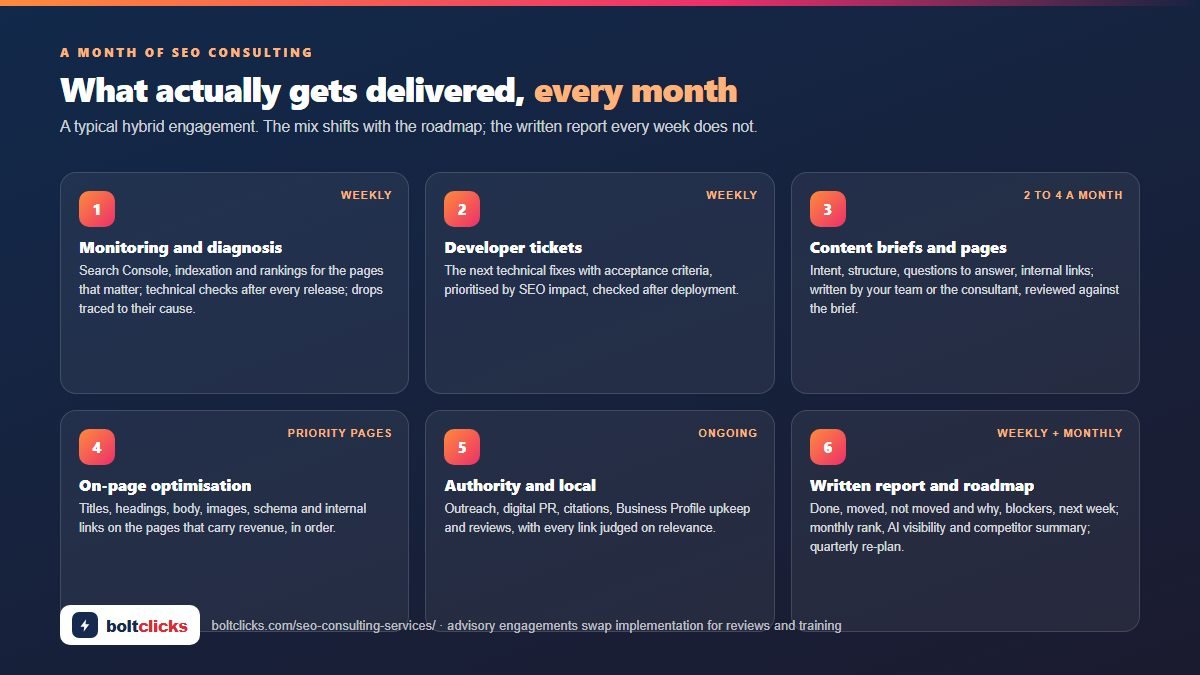
Consulting is often sold as strategy and delivered as meetings. The work here is concrete and reported weekly. A typical month on a hybrid engagement includes monitoring of Search Console, indexation and rankings for the pages that matter; technical checks after any release; the next set of developer tickets with acceptance criteria; two to four content briefs or finished pages; on-page optimisation of the priority pages; link and mention outreach or digital PR activity; local search maintenance where relevant; a check on how AI answers describe the business; and the written report each week with the quarter’s roadmap kept current. Advisory engagements replace the implementation items with reviews of your team’s work and answers to their questions; fully managed engagements add everything the team would otherwise do.
| Week | Advisory | Hybrid | Fully managed |
|---|---|---|---|
| Week 1 | Search Console and rankings review; ticket priorities for the month; report | Same, plus technical fixes shipped | Same, plus all content and outreach in progress |
| Week 2 | Content briefs issued; review of last month’s pages; report | Same, plus priority page optimisation | Same, plus pages written and published |
| Week 3 | Link and PR plan reviewed; local search checks; report | Same, plus outreach carried out | Same, plus citations, reviews, PR |
| Week 4 | Results review; roadmap updated; questions answered; report | Same, plus AI visibility and technical monitoring | Same, plus next month’s content queued |
SEO consulting fees, in pounds and dollars
Consulting is priced as fixed monthly fees or fixed project fees, agreed in writing before work starts. There are no hourly meters running in the background and no percentage of anything. Ad budgets, tools you choose to buy and third-party costs are always separate and paid by you directly.
| Engagement | What it covers | UK | US |
|---|---|---|---|
| Free consultation | Written summary of the biggest problems, the competitor gap and whether consulting is worth funding | Free | Free |
| SEO Foundation (project) | Full audit with written report, roadmap, and the technical and on-page foundation fixes implemented | £850 | Quoted in USD |
| Starter (advisory or hybrid, one channel) | Ongoing consulting on SEO: monitoring, tickets, briefs, priority optimisation, weekly reports | £650 / month | $800 / month |
| Growth (hybrid, SEO plus paid search) | SEO consulting with paid search run alongside, so the two channels share keyword data and landing pages | £1,200 / month | $1,500 / month |
| Full Stack (fully managed) | Everything done for you across SEO, paid search and paid social, with content and digital PR | from £4,000 / month | from $5,000 / month |
| Projects | Migration plans, traffic-drop diagnosis, second opinions, training days, agency proposal reviews | Quoted | Quoted |
Terms: month to month, invoiced in advance, cancel with a month’s notice. Partner or delegated access only; passwords are never requested. The full price list, including what each plan includes, is on the pricing page.
SEO consultant, agency, marketplace freelancer or in-house hire
| Option | Strengths | Weaknesses | Typical cost |
|---|---|---|---|
| SEO consultant (this service) | One accountable specialist; strategy and execution by the same person; direct access; fixed fees; knowledge stays with your team | Capacity is finite; very large programmes need a team around the consultant | £650 to £4,000+ a month; $800 to $5,000+; projects from £850 |
| SEO agency | Capacity; a team of specialists; process; can scale content and outreach quickly | Account managers between you and the work; junior execution; packages applied regardless of need; retainers that outlast results | £1,000 to £10,000+ a month in the UK; roughly double in dollars |
| Marketplace freelancer | Cheap; fast for defined tasks | No strategy; no accountability for outcomes; quality varies; nobody owns the whole picture | £15 to £80 an hour |
| In-house SEO | Deep product knowledge; always available; builds internal capability | One person cannot cover every discipline; salary plus tools; recruitment is slow and the market is competitive | £35,000 to £70,000 a year plus tools; $70,000 to $130,000 in the US |
| SEO tools alone | Data; audits at the click of a button | Tools list issues, they do not prioritise them or decide strategy; most findings are noise without judgement | £50 to £400 a month |
| Consultant plus in-house team | Strategy and specialist work from the consultant; execution and product knowledge from the team; lowest cost per outcome for most businesses | Needs a team willing to do the work | Consultant fee plus existing salaries |
What the first ninety days of SEO consulting look like
The first quarter sets the foundation and finds the quick wins. It is deliberately front-loaded with diagnosis and technical work, because content and links built on a broken site are wasted, and because the fastest results usually come from fixing what already ranks rather than creating something new.
| Period | Focus | Deliverables | What you should see |
|---|---|---|---|
| Weeks 1–2 | Audit and diagnosis | Written audit; competitor analysis; keyword map; roadmap by quarter | A clear picture of the site’s technical issues, content gaps and authority gap, ranked by impact |
| Weeks 3–6 | Technical foundation and quick wins | Developer tickets shipped: crawl and index fixes, redirects, broken links, speed, sitemaps, robots rules; title tags and meta descriptions on the pages that already rank on page two | Indexation cleaned up in Search Console; early movement on pages that were close to page one |
| Weeks 7–10 | Revenue pages and structure | Priority service, category or product pages optimised; internal linking and site structure improved; structured data added; local search presence fixed | Impressions rising for target searches; click-through rates improving on rewritten titles |
| Weeks 11–13 | Content and authority begin | First briefs and pages from the content plan; outreach and digital PR started; AI visibility baseline recorded; quarterly review | New pages indexed; first earned links and mentions; the roadmap for the next quarter agreed |
What you should not expect in ninety days: page-one rankings for the most competitive searches in your market, or enquiries from pages that have only just been published. Those arrive in the second and third quarters as authority compounds, and the weekly reports show the leading indicators, impressions, positions and indexed pages, moving first.
Content audits, pruning and consolidation: doing less, better
Many sites do not need more content; they need less of it, organised properly. A content audit reviews every indexed page against its purpose: does it target a search, does it rank, does it earn traffic and conversions, does it duplicate another page, does it demonstrate expertise, and would the site be better without it. The output is a decision for each page: keep and improve, consolidate into a stronger page, redirect, or remove. Sites carrying hundreds of thin blog posts, duplicate service pages for every town with the same text, or old news pages nobody reads typically gain from pruning, because search engines assess the quality of a site as a whole and topical authority is built by depth on the subjects that matter, not by volume.
The audit also finds cannibalisation, where two pages compete for the same search and neither wins, and fixes it by merging, re-targeting or re-linking. It finds the pages that rank on page two with a small improvement away from page one, which are the fastest results available on most sites. And it sets the content standard for everything new: what a page has to contain, how it demonstrates experience and expertise, how it is structured for readers, search engines and AI answers, and how it links to the pages that carry revenue.
- Every indexed page assessed for purpose, performance, duplication and quality
- Keep, improve, consolidate, redirect or remove decided per page, with the reasoning
- Cannibalisation resolved so each search has one page
- Page-two opportunities prioritised for quick wins
- A written content standard for your writers going forward
SEO consulting alongside paid search and the rest of your marketing
SEO does not operate alone. Paid search proves which searches convert before organic pages have had time to rank, and its search-term data feeds the keyword strategy. Landing pages built for paid campaigns are often the fastest organic wins when they are optimised properly. Social media and email drive the branded searches and return visits that search engines read as trust. Conversion rate improvements multiply the value of every organic visit. Consulting therefore looks at the whole customer journey: where the traffic comes from, what it does on the site, and where the enquiries are lost, and the roadmap is coordinated with whoever runs the other channels.
On the Growth plan the consultant runs paid search alongside SEO, so the two share keyword data, landing pages and conversion tracking, and budget can move between them as the organic pages start to rank. Businesses with an in-house or agency paid team get the same coordination through shared documents and the weekly report. Either way, the measure is the total cost per enquiry across channels rather than the performance of one channel in isolation.
What paid search gives SEO
- Proof of which searches convert, within weeks
- Search-term data that reveals real customer language
- Landing pages that can be optimised for organic
- Cover for target searches while organic pages mature
What SEO gives the rest of marketing
- Pages that convert traffic from every channel
- Lower blended cost per enquiry over time
- Content that email, social and sales can reuse
- Brand visibility in search and AI answers that supports every campaign
What the weekly report contains, and why it is written, not dashboarded
Dashboards show numbers; reports explain them. Every week the report states what was done, what moved, what did not and what happens next, in plain English, with the numbers behind each statement taken from your own Search Console, analytics and the roadmap. It is written for a business owner or a marketing manager, not for another SEO, and it is the record you would hand to a new team member or a new agency if you ever needed to.
| Section | Contents |
|---|---|
| Done this week | Technical tickets shipped, pages optimised or published, outreach sent, local search work, monitoring checks |
| What moved | Impressions, clicks and positions for the target searches; organic sessions and enquiries; indexed pages; links and mentions earned |
| What did not, and why | Pages that fell or stalled, with the likely cause and the response |
| Blockers | Anything waiting on your team, a developer, access or a decision |
| Next week | The next items from the roadmap and who owns them |
| Monthly additions | Rank tracking summary, AI visibility check, competitor movements, roadmap progress against the quarter |
SEO consulting for startups, new websites and businesses launching a new service
A new site has no authority, no history and, usually, no data. Consulting for a launch is about making the right decisions before they become expensive: the site structure and URL plan, which pages to build first, how the service or product pages are written, what technical foundation the platform needs, how analytics and Search Console are set up, and which searches are realistic in the first year against the competition. The plan usually pairs a small number of well-built commercial pages with paid search to generate enquiries immediately, while the organic foundations and the first authority-building content are laid.
For an established business launching a new service or entering a new sector, the same discipline applies at smaller scale: demand sized, competition assessed, the page built to the content standard, linked from the existing site’s authority, supported by content that answers the questions buyers ask, and measured from launch. Consulting keeps the new page from being buried in a site structure built for the old business.
The mistakes that waste SEO budgets, seen in audit after audit
- Buying a package before a diagnosis, so the tasks do not match the problems
- Chasing search volume instead of intent, building pages for searches that never convert
- Publishing content on a site with unresolved technical issues, so nothing ranks whatever is written
- Ten town pages with the same text, which search engines treat as one page and rank as none
- Reports built from the keywords that went up, hiding the ones that fell
- Paid links and directory packages that add risk and no authority
- Redesigns launched without a redirect map, losing years of rankings in a weekend
- Judging SEO at month three, before the compounding starts
- No conversion tracking, so nobody knows whether organic traffic produces enquiries
- Treating AI search as a separate project instead of the same clarity, structure and authority work
- Handing passwords to a provider instead of granting partner access
- Never asking whether SEO is the right spend for the offer, the site and the market as they are
How results are measured, and what realistic timelines look like
A consultant is judged on outcomes, so the measures are chosen to reflect the business rather than the vanity of a ranking chart. The weekly report covers visibility, traffic and the commercial result, with the reasons behind each movement, and every number is taken from your own accounts.
| Measure | Source | Why it matters |
|---|---|---|
| Impressions and clicks for target searches | Search Console, by page and query | Whether the strategy is gaining visibility where it was meant to |
| Rankings for mapped keywords | Rank tracking with the correct location and device | Confirms the right page ranks for the right search |
| Organic sessions and landing pages | Analytics, segmented by page type | Ties visibility to real visits on commercial pages |
| Enquiries, calls, orders and revenue from organic | Analytics conversions, CRM or sales data you share | The number the engagement exists for |
| Indexation and technical health | Search Console coverage, crawl checks after releases | The foundation that everything else depends on |
| Links and mentions earned | Backlink data and coverage tracking | Authority growth against competitors |
| AI answer visibility | Monthly checks of buying questions in AI search | Whether the business is named where customers now ask |
| Work completed against the roadmap | The weekly report | Accountability for the plan, not just the outcome |
Timelines are stated honestly. Technical and on-page fixes usually show in Search Console within four to eight weeks. New pages in competitive markets take three to six months to settle. Authority work compounds over six to twelve months. Recovery from a core update is usually assessed at the next update. A consultant who promises page one in thirty days is describing a search nobody wants or a method that will cost you later.
How to choose an SEO consultant: eight questions and the red flags
Anyone can call themselves an SEO consultant. The questions below separate a specialist from a salesperson, and the answers should be specific to your site rather than generic.
- Who will actually do the work?The person you speak to should be the person who audits, plans and reports. If the answer involves a team you will never meet, you are buying an agency package with a consultant’s label.
- What did you find on my site?A consultant worth hiring has looked before the call and can name two or three specific problems and one opportunity. Generic answers about “improving rankings” mean nobody looked.
- What would the first ninety days contain?Expect a sequence: audit, priorities, technical foundation, the pages that carry revenue, then content and authority. Expect the order to be justified.
- How will you report, and what will the report contain?Written, regular, with what was done and what moved, in language you understand. Dashboards without commentary are not reports.
- Where will the links come from?A clear answer about outreach, PR, partners and directories. Vague answers or “our network” usually mean paid links that create risk.
- What happens to the work if I leave?Everything should stay in accounts you own, with documentation your next person can use. Consulting that leaves nothing behind was never consulting.
- What will you tell me if SEO is not the right spend?The honest answer is that some businesses should spend on paid search, their site or their offer first. A consultant who never says no is selling, not advising.
- How is success measured?Enquiries, orders and revenue from organic, with rankings and traffic as leading indicators. Rankings alone are not success.
- Guaranteed rankings or timelines, which nobody controls
- Asking for your passwords instead of partner access
- Long contracts with no exit, or fees that continue after work stops
- Reports built from the keywords that went up and silent on the ones that fell
- Link “networks”, packages of links or bulk directory submissions
- No written audit before the proposal, just a price
SEO consulting by business type
Professional services
- Law, accountancy, finance, consultancy, architecture
- Service pages, expertise signals, local presence
- Content that answers the questions clients ask before instructing
Trades and home services
- Plumbing, heating, electrical, roofing, building
- Local search first: Business Profile, service-area pages, reviews
- Service-plus-town keyword strategy
Healthcare and clinics
- Dental, medical, physiotherapy, aesthetics, veterinary
- Treatment pages, trust and qualification signals, local rankings
- Compliance-aware content
Ecommerce and retail
- Stores on any platform, from one product line to large catalogues
- Category strategy, technical architecture, product schema
- Seasonal and promotional planning
Software and B2B
- Feature, integration, comparison and pricing pages
- Long buying cycles and research-stage content
- Authority through data and thought leadership
Agencies and in-house teams
- White-label consulting, audits and strategy for your clients
- Standards, training and escalation for in-house teams
- Second opinions on proposals and plans
Remote SEO consulting for businesses in the UK, the US and beyond
Consulting is delivered remotely, on UK and US working hours, through written reports, shared documents, video calls when they are useful and direct messaging when they are not. There is no office in London or New York and none is claimed; what you get is one specialist who is available, accountable and clear. Access is always partner or delegated access to your own Search Console, analytics, CMS and advertising accounts; nothing is built in accounts you do not control, and passwords are never requested.
The tools used are the standard professional set: crawlers and log analysis for technical work, Search Console and analytics for measurement, rank tracking, backlink data, keyword research data and AI visibility checks. Tool costs are included in the consulting fee; you do not need to buy anything to work with a consultant, though in-house teams are shown how to use the tools they already have.
- Weekly written report in plain English, every week, without being asked
- Fixed fees agreed in writing, month to month
- Direct access to the consultant, not an account manager
- Your accounts, your data, your documentation
- Honest advice, including when to spend elsewhere
Local SEO, authority and AI search: the three areas consulting most often changes
Local SEO consulting
For businesses that serve a place, the map pack decides the phone calls. Consulting covers the Google Business Profile in full: categories, services, attributes, photos, posts, questions and answers, and the review programme that keeps it moving; citations across the directories that matter in your country; location and service-area pages that pass consistency checks; and the on-site signals that tie a page to a place. Multi-location businesses get a structure for every branch; service-area businesses get pages that name the towns without faking addresses.
Authority and link building strategy
Authority is earned from sites that already have it. Consulting sets the plan: which pages need links, what content will earn them, which publications, trade bodies, partners, suppliers and directories are realistic targets, how digital PR angles are built from your own data, and what to refuse. Outreach is carried out on hybrid and managed engagements and specified for your team on advisory ones. Every link is judged on relevance and the real site behind it, never on a metric alone.
AI search consulting
AI Overviews, AI Mode and chat-based assistants now answer a share of buying questions with a shortlist of names. Consulting checks whether yours is among them, what the answers cite, and what needs to change: entity clarity on the homepage and service pages, answer-ready content, structured data, consistent business details across the web, and mentions on the third-party sources AI answers draw from. It is measured monthly as part of the report rather than sold as a separate product.
Content quality and expertise signals
Search engines and AI systems reward pages that demonstrate experience and expertise: named authors, credentials, first-hand detail, original data, and pages that answer the question better than the competition. Consulting reviews existing content against those signals, prunes or consolidates what drags the site down, and sets the standard for everything new.
SEO consulting terms, defined
| Term | Meaning |
|---|---|
| SEO audit | A structured review of a site’s technical health, content, links and local presence, producing prioritised findings and a fix list |
| SEO roadmap | The ordered plan of work by quarter, with priorities, owners and expected outcomes |
| Advisory engagement | The consultant plans, specifies and reviews; your team implements |
| Retainer | A fixed monthly fee for ongoing consulting and work |
| Keyword mapping | Assigning each target search to one page so pages do not compete with each other |
| Search intent | What the searcher wants: information, comparison, a local provider, a purchase |
| Cannibalisation | Two or more pages on one site competing for the same search, weakening both |
| Crawl budget | How much of a site search engines will crawl in a period; wasted by duplicate and parameter URLs |
| Core Web Vitals | Google’s page-experience measures for loading, interactivity and visual stability |
| Structured data | Schema markup that describes a page’s content to search engines and AI systems |
| Core update | A broad change to Google’s ranking systems, typically several times a year, that reassesses site quality |
| Manual action | A penalty applied by a human reviewer, reported in Search Console, for violating guidelines |
| Migration | A change of platform, domain, URL structure or design that risks rankings if unplanned |
| Digital PR | Earning coverage and links from publications through newsworthy content and outreach |
| E-E-A-T | Experience, expertise, authoritativeness and trust: the qualities Google’s quality guidelines look for in content and sites |
| Partner access | Delegated access to your own accounts, so the consultant can work without holding your passwords |
SEO consulting services: frequently asked questions
What does an SEO consultant do?
Audits the website, writes the strategy and roadmap, specifies technical fixes for developers, plans keywords and content, directs link and authority work, handles local and ecommerce specifics, monitors results and reports in writing. On hybrid and managed engagements the consultant also does the implementation.
What are SEO consulting services?
Professional advice and direction on search engine optimisation, delivered by a specialist who diagnoses the site and takes responsibility for the plan, as opposed to a package of fixed tasks. They can be advisory only, mixed with implementation, or fully managed.
How much does an SEO consultant cost?
Here, consulting starts at £650 a month in the UK and $800 a month in the US, £1,200 or $1,500 with paid search alongside, and from £4,000 or $5,000 fully managed across channels; audit projects are £850. The wider market runs from £50 to £150 an hour for consultants and £1,000 to £10,000 a month for agencies in the UK, roughly double in dollars.
Is a consultant better than an agency?
For most small and mid-sized businesses, yes: one accountable specialist, strategy and execution by the same person, fixed fees and direct access. Agencies suit programmes that need large teams producing high volumes of content and outreach at once.
Do you do the work or just advise?
Either, or both. Advisory engagements give your team the plan and reviews; hybrid engagements add the specialist work; fully managed engagements do everything. The model is agreed at the start and can change as your team’s capacity changes.
How long before SEO consulting shows results?
Technical and on-page changes usually show within four to eight weeks. New pages in competitive markets take three to six months. Authority compounds over six to twelve months. Recovery from a core update is typically assessed at the next update.
Can you help my in-house team instead of replacing them?
Yes; that is the advisory model. The team gets an audit, a roadmap, specifications, briefs, reviews and training, and a specialist to ask questions of. The knowledge stays in your business.
Do you work with ecommerce sites?
Yes. Category strategy, technical architecture for large catalogues, faceted navigation rules, product schema, internal linking at scale and seasonal planning are part of the service, on any platform.
What if my traffic dropped after an update?
The engagement starts with a diagnosis: which pages and queries fell, when, and what changed. The recovery plan targets the cause. Timelines are honest: core update recoveries usually wait for the next update to be assessed.
Will you need my passwords?
No. Partner or delegated access to Search Console, analytics, the CMS and any advertising accounts is all that is used, and everything stays in accounts you own.
Do you offer a free SEO consultation?
Yes. Send the website and the searches you most want to win and you receive a written summary of the biggest problems, the competitor gap and whether consulting is worth funding, before any conversation about fees.
Can you review a proposal from another agency?
Yes, as a project. The review says what in the proposal is worth paying for, what is padding, what is missing and what the site actually needs, so you can negotiate or decide with evidence.
Where are you based?
The work is delivered remotely for businesses in the UK, the US and elsewhere, on UK and US hours. There is no office in either country and none is claimed.
Is there a contract?
Month to month, invoiced in advance, cancel with a month’s notice. Fees are agreed in writing before work starts and do not change without agreement.
Seven things to know before hiring an SEO consultant
1. The audit comes first, and it should be written down
A proposal without an audit is a price without a diagnosis. Insist on a written audit, even a short one, before agreeing a fee. The free summary offered here exists for exactly that reason, and a full SEO audit is available as a standalone project.
2. Strategy is the product; tasks are the delivery
Two consultants can do the same tasks and get different results, because one chose the right pages and searches and the other did not. Judge a consultant on the quality of the plan and the reasoning behind it.
3. Your team can do more than you think
With clear specifications and briefs, a developer and a writer with no SEO background can implement most of a roadmap. Advisory engagements cost less and leave capability behind.
4. Technical debt caps everything
No amount of content compensates for a site search engines cannot crawl or render. Expect the first weeks to be technical, and expect them to be boring.
5. Rankings are not the goal
Enquiries, orders and revenue from organic search are. A report that shows rankings without the commercial result is hiding something.
6. Timelines are long and the compounding is real
The first months move slowly; the later months move faster, because authority and content accumulate. Businesses that stop at month three pay for the slow part and leave before the fast part.
7. Sometimes the answer is not SEO
A weak offer, a site that does not convert or a market with no search demand should be fixed first, and paid search may be the better first channel. A consultant who tells you that on the first call is the one to hire.
Start with a free SEO consultation
Send your website and the three searches you most want to win. You will get a written summary of the biggest problems, the competitor gap and a straight answer on whether SEO consulting is worth funding, before any conversation about a plan. No jargon, no lock-in, no passwords.