
Facebook Ads Agency Canterbury: Meta Ads That Skip Tourists
Canterbury district holds roughly 157,400 residents, around 40,000 students across two universities and two colleges, and 8.1 million visits a year, inside one small walled city — and only one of those groups can become your customer. This page is by Moeez Abbas, one Meta Ads specialist working remotely from Lahore on UK hours, with no Kent office and so no office overhead inside the fee, about separating your real catchment from everyone else.

Canterbury is four audiences in one small city, and only one of them can buy from you
The city itself is small, at roughly 55,000 people. The district that shares its name held 157,400 residents at the 2021 Census, up 4.1% on 2011 while England grew 6.6%, and more than half of them do not live in Canterbury at all: they live in Whitstable, Herne Bay and villages like Sturry, Blean, Chartham and Bridge. The resident buyer is ageing too, with over-65s up 20.2% in ten years while under-15s fell 2.2%.
Stacked on that base are three populations that look identical to Meta’s targeting tools and behave nothing like each other. Around 40,000 students attend the University of Kent on the hill north of the walls, Canterbury Christ Church University in the centre, UCA Canterbury and EKC Canterbury College — one of the highest student-to-resident ratios in Britain, worth roughly 9,900 jobs and about 16% of Canterbury employment. The district took 8.1 million visits in 2023, worth about £520 million, increasingly day trips rather than overnight stays. And for two months a year, blocks of juniors arrive for the dozen or so English language schools around the city.
Four populations, the same postcodes, one radius. Nothing in a default campaign separates them, and separating them is the entire job of advertising here.
- 157,400 district residents, and for most businesses the only group that can become a customer.
- Around 40,000 students, who arrive in a fortnight and are gone by June. Either your whole market or pure waste, with little in between.
- 8.1 million visits a year, increasingly day trips. Visible, expensive to reach, mostly unable to come back.
- Language-school juniors, present in July and August only, and the customer for almost no local business.
Why a ten-mile radius from the Cathedral is mostly estuary, farmland and Thanet
Drop a pin on the Cathedral, set a ten-mile radius, leave everything else alone. That default build fails in Canterbury for three separate reasons.
First, the circle is the wrong shape. A ten-mile ring centred on CT1 throws a large share of its area over the Thames Estuary to the north, and over thinly populated farmland towards Chartham, Bridge and the Elham valley to the south. The people who actually spend money sit in a lobe running north up the A290 and A291 to Whitstable and Herne Bay. No circle from the Cathedral matches that shape, so a symmetrical radius pays for water and fields on two sides.
Second, it catches the wrong people even where it is populated, because of the location setting covered below. Third, a radius cannot tell 40,000 students from 157,400 residents. For a lettings agent, a takeaway, a barber or a late bar, the students are the market. For a private dentist, a roofer or a wedding venue they are waste, and inside the walls they are a very large share of everybody in the circle.
Include by name
- Canterbury, CT1 and CT2
- Whitstable, CT5, and Herne Bay, CT6
- Sturry, Hersden and Blean
- Bridge, Chartham, Littlebourne and Bekesbourne
Exclude or bid down
- Ashford, about 15 miles away, with its own centre and the Designer Outlet
- Margate, Broadstairs and Ramsgate, held by Westwood Cross
- Faversham, Sittingbourne, Dover and Deal
- Open farmland in the southern half of the default ring
September in Canterbury: forty thousand students arrive in a fortnight, and leave in June
No other stretch of the Canterbury year looks like mid-September. Around 40,000 students arrive inside roughly a fortnight, most of them new to the city and buying everything from scratch: a barber, a takeaway, a gym, a phone repair shop, a pub, a room for next year. That fortnight is the biggest acquisition window in the city, and it is over before most businesses have finished writing the ad.
The other half of the fact is the one people ignore: the same audience largely disappears in June. A lookalike built on last year’s student customers is modelling people who have already left Kent, and a retargeting pool from the spring is half-empty by August. Audiences here have to be rebuilt annually, on a fixed calendar, not refreshed when someone notices performance sliding.
Late August
Rebuild from scratch: new customer lists, new lookalike seeds, retargeting windows shortened so the pool reflects who is in the city now rather than a year ago.
Early to mid-September
Spend hard and short. Arrivals week and the fortnight after carry the year for student-facing businesses, and the creative has to speak to someone four days into Canterbury.
November to December
The lettings push for next academic year. Viewings start well before Christmas, so a student housing campaign runs nine months ahead of the tenancy it sells.
Eight million visits a year, and the one Meta setting that stops you paying for them
Canterbury Cathedral is Kent’s most-visited paid attraction and part of a UNESCO World Heritage Site with St Augustine’s Abbey and St Martin’s Church. It takes no routine government or Church of England funding, costs over £20,000 a day to run, and lives on visitor income. That visitor economy is real money, about £520 million across 8.1 million visits in 2023, and tourism supported roughly 15% of district employment in 2019. It is also, for most local advertisers, the largest single source of wasted spend in their account.
The reason is one dropdown. Meta’s location option defaults to people living in or recently in this location, which is exactly the setting that hands a slice of eight million day visitors your budget. Changing it to people living in this location is usually the largest saving available in a Canterbury ad account, and almost nobody changes it. It is one of the first things I check in an account review, alongside the pin, the radius and the exclusions, because there is no point improving creative shown to a coach party that will be back on the motorway by five.
Day visitors break the back half of the funnel too: they are not there tomorrow, cannot be retargeted usefully, and quietly poison the signal your campaign learns from.
The exception is any business whose customer genuinely is the visitor: an attraction, a city-centre cafe, a hotel, a gift shop on the tourist route. For those the eight million are the point, and the settings above get reversed on purpose.
Selling to Whitstable and Herne Bay from a Canterbury postcode
The council area is effectively three towns: the walled cathedral city, Whitstable about seven miles north with its harbour, oyster trade and second-home money, and Herne Bay about eight miles north-east. A trade or service business calling itself a Canterbury business almost always works all three, yet the ad account is usually built as though the city were the whole district.
For trades, private clinics, home improvement and hospitality, the coastal towns frequently convert better than the packed city centre, for a simple reason: nearly everybody there lives there, so there is no day-visitor crowd diluting the audience. A roofer or bathroom fitter working conservation-area and listed-building stock inside the walls, plus the older coastal housing at Whitstable and Herne Bay, is selling to homeowners in a district where the over-65s grew 20.2% in a decade. Name CT5 and CT6 explicitly rather than hoping a radius sweeps them in.
Whitstable also behaves differently from the city. Weekend and second-home money means the buyer may not be there on a Tuesday, and the August Saturday fills itself anyway. Independent hospitality along that coast makes its margin Tuesday to Thursday and in the shoulder months, and that is demand you have to create rather than wait for.
Whitefriars or the King’s Mile: two advertising problems inside the same city walls
Retail inside the walls splits cleanly in two, and the halves need opposite campaigns. Whitefriars is 474,000 sq ft anchored by Fenwick, M&S, Zara, Primark, Next and Boots. The King’s Mile, running through Palace Street, Sun Street, Orange Street, Guildhall Street, The Borough and Northgate, is the independent quarter of makers, galleries, jewellers, booksellers and small food businesses. Out-of-centre trade sits at Wincheap on the A28 and at Lakesview International Business Park at Hersden, the district’s largest strategic employment site at 22 hectares.
An independent on the King’s Mile cannot win footfall against national anchors a few minutes’ walk away, and search volume for what they sell is tiny, so there is little for a search campaign to capture. What they can do is put a product in front of a Whitstable or Herne Bay resident, or a returning visitor, who would never have walked that street. That is demand creation, and where Meta earns its place most clearly here.
King’s Mile independents
- Product-led creative, one object per ad, not a shop-front photo
- Residents only, with CT5 and CT6 weighted as heavily as CT1
- The street named in the copy, because locals navigate by Palace Street and Northgate, not postcodes
- Heavier weighting into late October and the Christmas run
Wincheap, Hersden and out-of-centre
- Car-borne catchment, so the radius can be wider than a city build
- Whitstable, Herne Bay and Sturry named rather than swept in by a ring
- Trade and B2B buyers reachable at Lakesview and along the A28
- Weekday daytime works here, unlike commuter-heavy city audiences
Canterbury loses its shoppers in four directions, not one
Most towns have one dominant neighbour pulling their trade away, and the targeting answer is simply to exclude it. Canterbury leaks in four directions at once, which is why spending to cover Kent from a Canterbury postcode wastes money faster here than in a town with one obvious rival.
One of those four, London, takes something other than shopping as well. Canterbury West runs high-speed trains to London St Pancras in about 55 minutes, while Canterbury East runs the slower Victoria service, so a real slice of the higher-earning working-age audience is physically in London between 09:00 and 18:00 on weekdays. Dayparting therefore matters more here than in a town where everyone is local all day: evenings, weekends and the Sunday planning window are when that audience is reachable, and a campaign pushing hard at 11am on a Wednesday is talking to an empty chair.
| Where the spend goes | Who it pulls | What to do about it |
|---|---|---|
| Westwood Cross, Thanet | Margate, Broadstairs and Ramsgate keep their everyday trade | Exclude the Thanet towns unless you sell to people who live there |
| Ashford Designer Outlet | Brand and outlet shoppers, about 15 miles off, plus Ashford’s own centre | Exclude Ashford, with the wedding exception below |
| Bluewater, Dartford | The planned weekend trip, not the weekly shop | Never worth paying for from a CT postcode |
| London | Weekend spending, plus the weekday hours of your highest-earning residents | Keep the location, change the schedule |
Wedding and event suppliers are the one Canterbury category where widening the radius is correct rather than lazy. The venue stock here sells to buyers living in London, Ashford and Medway, not CT1, so geography follows the buyer, not the building. That is the opposite of every other instruction on this page, and a venue running a resident-only CT1 build is advertising to the smallest slice of its own market.
The Canterbury advertising year, month by month
Canterbury does not have one season. It has four, and they almost never line up. A flat monthly budget is wrong here more than in most towns, because the crowd outside your window and a resident-only business’s real demand run in near-opposite directions.
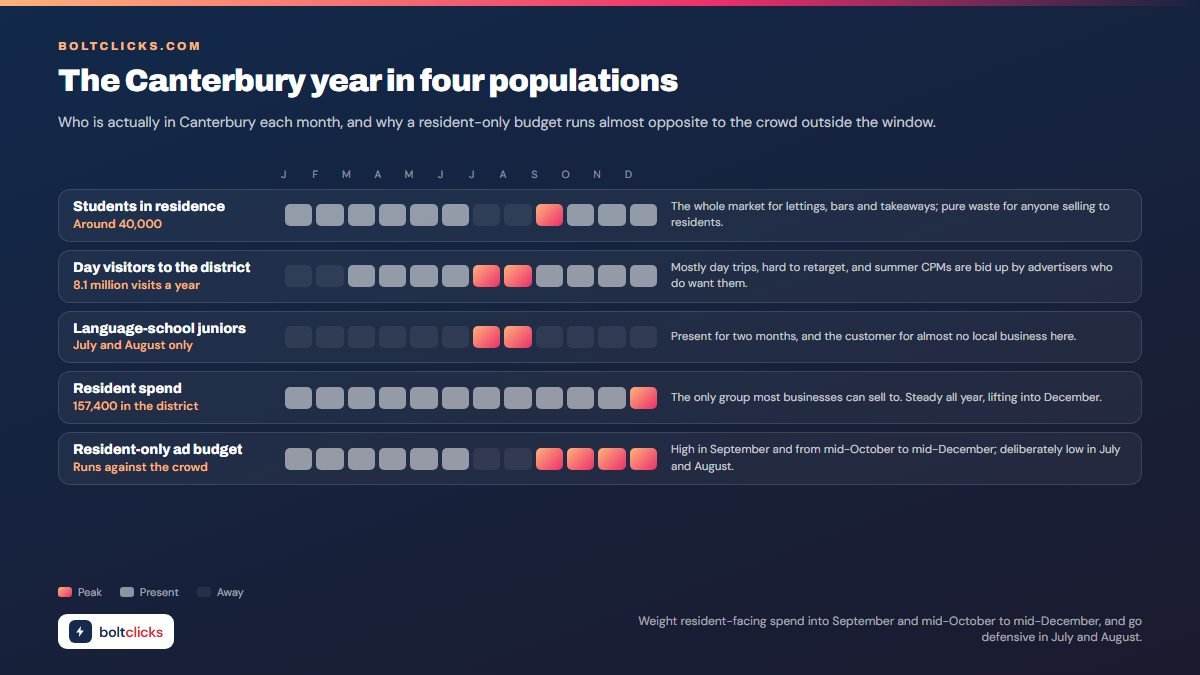
| Period | What is happening | Resident-facing budget |
|---|---|---|
| January to February | Genuinely thin: students and visitors are scarce at once. | Low, and the cheapest testing of the year |
| March to June | Students in residence, visitors building, resident spend steady. | Steady, the strongest value stretch for most local businesses |
| July to August | Students gone, day visitors and language-school juniors filling the streets. Canterbury Cricket Week at the St Lawrence Ground, the oldest cricket festival week in England, has moved to June under the modern fixture list, so it no longer lands in this window. | Deliberately defensive. Worst value of the year for resident-only advertisers |
| Mid-September | Around 40,000 students arrive inside a fortnight, most of them new to the city. | The biggest acquisition window, for the businesses it applies to |
| Second half of October | The Canterbury Festival, with 130-plus events across the city and surrounding towns, alongside the Marlowe Theatre’s autumn season. | High. The one stretch where residents and visitors both spend in the evening |
| November to December | The Marlowe pantomime, Christmas trade split between Whitefriars and the King’s Mile, and lettings viewings for next September. | High, and the King’s Mile independents should be loudest here |
Student-facing and visitor-facing businesses invert all of that: if your customer is a fresher or a coach party, July and August are the trade, not a trap. The mistake is running a flat monthly spend regardless of which business you are.
Which Canterbury businesses Meta Ads suits, and which are better served by Google
Google captures demand that already exists: someone types emergency plumber Canterbury, and the job is to be there. Meta creates demand that was never searched for, which fits a city where much of the footfall is passing through and much local spending never reaches a search box. The useful question is which one you need first.
If your customers already search for you by name or by service, the honest answer is often that a well-built Google Ads account comes first and Meta second, and you will get that in the free audit rather than after three months of retainer.
Meta usually first
- King’s Mile independents, makers and galleries with tiny search volume
- Independent hospitality filling Tuesday to Thursday and the shoulder months
- Student lettings and purpose-built student accommodation
- Home improvement across CT1 to CT6, sold to homeowners who were not looking yet
- English language schools, where the buyer is a parent or agent abroad, so the build is country-level with lead forms and a long lag
Google usually first
- Emergency and reactive trades
- Private clinics and dentists in the New Dover Road and hospital belt, where the decision is slow, high-value and strictly local
- Professional services with a defined search term
- Anyone whose customer already knows what they need and is comparing suppliers today
Working with one remote specialist instead of an agency with a Kent address
There is no Canterbury office here, no desk on Palace Street, no Kent phone number and no local team, and none is claimed. This is one person, Moeez Abbas, working remotely from Lahore on UK hours with UK and US businesses. The agencies above this page hold Kent addresses, which is a real thing they have and I do not.
What it buys you is no office overhead inside the fee, and the person reading your ad account being the person you spoke to. You get a written report every week, in plain English: what was spent, what happened, what changed and what happens next, rather than a dashboard login you never open. The Facebook and Instagram ads service runs the same way at every retainer level.
Access works one way only: partner access to your Business Manager (now called a business portfolio in Meta’s help centre), or delegated access to your ad account. I never ask for and never hold your passwords. Your Page, ad account, pixel and audiences stay yours and stay with you on the day you leave. If your account is already restricted, Meta Business Manager recovery is separate work, and it is a common problem for micro-businesses that have been running ads from a personal profile rather than a proper business account.
The only result on this site: one Meta campaign for an independent UK artist, £25 of spend, 500-plus Spotify saves and 10 followers across five days, with a verified five-star review. That is one campaign in one niche. It is not a prediction of what your Canterbury business would get, and there are no other figures to show yet.
What it costs, what you keep, and how to end it
Prices are published, so you can decide whether this is worth a conversation before you have one. Management starts at £650 a month, with £1,200 and £4,000-plus levels above it, plus a one-off SEO Foundation at £850. Work outside the UK is priced in dollars, at USD 800, 1,500 and 5,000. Every level is paid in advance, month to month, cancel any month, and never a percentage of your ad spend, so the fee does not rise because I talked you into spending more with Meta. The full pricing page sets out each level.
Your ad budget is separate and paid straight to Meta by you. There is a practical floor in a district of 157,400 people: narrowed by postcode, age and interest the audience is small, and the spend still has to be enough for Meta to get a campaign out of the learning phase. The free written audit says whether your budget clears that bar here, and says so if it does not rather than taking the retainer anyway.
That audit is where it starts. If you already run ads, it covers the pin, the radius, the location setting, the exclusions, the audiences and the creative, with a list of what is wasting money. If you do not, it answers whether Meta is the right first move at all. Either way you keep the document.
- Paid in advance, month to month, cancel any month, with no minimum term.
- Never a share of ad spend, so there is no incentive to talk you into a bigger budget than Canterbury can absorb.
- A written report every week, in plain English, not a dashboard invitation.
- Partner or delegated access only, never your passwords, with every asset in your own Business Manager.
- A free written audit first, including the answer that Google would serve you better.
What a client said, and what you can check
“Great communication and very helpful throughout the process. Took the time to explain everything clearly and set up the campaign professionally. Focused on quality results rather than just numbers. Highly recommended.”
This is one of three client reviews published so far; the other two, from a UK SEO client and a US Google Ads client, are on the home page. Every figure comes from the client’s own ad account, and a review goes on this site only when it is real.
What you can check before you pay
- Prices published in full on the pricing page, not hidden behind a sales call
- Month to month, with one month’s notice and no lock-in contract
- Every account, profile and file stays in your name; I work through partner access
- A written report every week, in plain English
- One specialist does the work, from the audit to the report
Canterbury Meta Ads: frequently asked questions
Most of my customers are students. Does Meta Ads still work when the whole audience changes every September?
Yes, but only if the account is rebuilt on the academic calendar rather than left running. Audiences, retargeting pools and lookalikes have to be recreated each year, because a lookalike built on last year’s customers is modelling people who have left Canterbury. The rebuild happens in late August, before arrivals fortnight, not in November when performance has already slipped.
How do I stop my ads being shown to tourists?
Change the location setting from the default of people living in or recently in this location to people living in this location, and stop pinning the radius on the Cathedral. In a district taking 8.1 million visits a year, that one dropdown is usually the largest saving available in a Canterbury ad account.
Should I include Whitstable and Herne Bay in my targeting?
For trades, private clinics, home improvement and hospitality, usually yes. They are the same council area, about seven and eight miles out, and more than half the district’s 157,400 residents live outside the city. They also often convert better than the city centre, because nearly everyone in CT5 and CT6 lives there.
Is it worth advertising in July and August when Canterbury is at its busiest?
If your customer has to live locally, that is the worst value period of the year. The students have gone, the visible crowd is day visitors and language-school juniors, and CPMs are bid up by advertisers who genuinely do want those people. Go defensive, and put the money into September, mid-October to mid-December and the spring instead. If your customer is the visitor, invert all of that.
I’m just outside the city, in Sturry, Chartham, Bridge or Blean. Does that change the setup?
Yes. The pin moves off the Cathedral and onto you, and excluding Ashford and the Thanet towns matters more, not less, because a symmetrical radius drawn from a village throws a far larger share of your budget into open country. Named settlements beat a ring for any business outside the walls.
Meta Ads or Google Ads for a Canterbury business?
Google captures demand that already exists. In a city where much of the footfall is passing through, a lot of genuine local demand is never searched for at all, and that is where Meta earns its place. For emergency trades, legal and accountancy work and anything urgent, the honest answer is Google first, and the free written audit will say so before you commit to anything.
Will Canterbury customers trust ads run by someone who isn’t in Kent?
The ad carries your business name, your photos and your Page, not mine. There is no Canterbury office here and none is claimed: this is one specialist working remotely on UK hours, with a written report every week and partner-level access so everything stays in your own Business Manager.
What is a realistic monthly ad budget for a Canterbury business?
Management starts at £650 a month, paid in advance, month to month, cancel any month, and never a share of your ad spend. Your ad budget is separate and paid to Meta by you. The constraint is that a district of 157,400 people narrowed by postcode, age and interest is a small audience, so the spend has to be enough for Meta to leave the learning phase.
What results can you actually show?
One, stated plainly: a single Meta campaign for an independent UK artist, £25 of spend, 500-plus Spotify saves and 10 followers over five days, with a verified five-star review. That is one campaign in one niche, the only result on this site, and a small one. It is not a prediction of what your campaign would do.
A free account review, before anything is agreed
Send over the ad account, or just the website if there is no account yet, and you get a written review of what is set up, what is leaking and what I would change first. It costs nothing and there is nothing to sign. If the honest answer is that ads are not the right spend for a business your size in Canterbury, that is what the review will say.