
What does PPC management cost in the UK?
You have been quoted a figure for managing your Google Ads, and you have no way to tell whether it is fair — because almost nobody in this industry publishes what they charge. This page explains the pricing models actually used, the incentive each one builds in, what sits inside a fee and what gets billed on top, who owns the account when it ends, and the tests you can run on a quote without knowing what anyone else pays.

Why a PPC quote is so hard to check
You have a number in front of you. It might be a monthly retainer, it might be a percentage of your ad spend, it might be both with a setup fee bolted on the front. The problem is not that the number is high or low. The problem is that you have nothing to hold it against.
There is no published, methodologically sound UK average for PPC management fees. The percentages and retainer ranges that circulate online sit on agency marketing pages with no named survey, no sample size and no method behind them. Repeating one of those figures here would lend it weight it has not earned, so this page does not quote any of them. What it does instead is set out the pricing models that are actually used, the incentive each one creates, what is normally inside a fee and what is charged on top, and the checks you can run on a quote using nothing but your own ad account and the platform’s own published rules.
The gap matters because search advertising is a substantial line in a lot of business budgets, while the service layer sitting on top of that spend has no transparent price at all. That combination is what lets a small advertiser be quoted almost anything and have no way to sanity-check it.
One line to keep sharp as you read: this page is about what an agency charges to manage ads. That is a separate question from what the ads themselves cost to run, and the two get blurred in sales conversations far more often than they should.
How management is priced, and what each model rewards
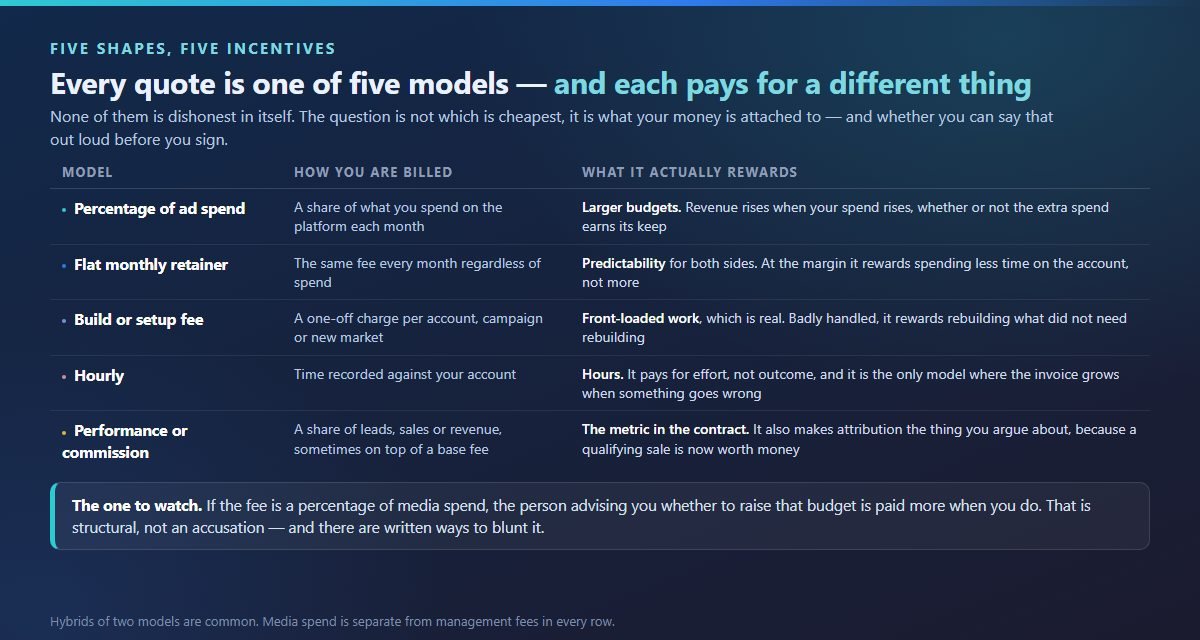
Almost every quote you will see is one of five shapes, or a hybrid of two of them. None of them is dishonest in itself. Each one simply pays the agency for a different thing, and it is worth knowing which thing your money is attached to.
| Model | How you are billed | What it rewards |
|---|---|---|
| Percentage of ad spend | A share of what you spend on the platform each month | Larger budgets. Revenue rises when your spend rises, whether or not the extra spend earns its keep |
| Flat monthly retainer | The same fee every month regardless of spend | Predictability for both sides. At the margin it rewards spending less time on the account, not more |
| Build or setup fee | A one-off charge per account, per campaign or per new market | Front-loaded work, which is real. Badly handled, it rewards rebuilding things that did not need rebuilding |
| Hourly | Time recorded against your account | Hours. It pays for effort, not outcome, and it is the only model where the invoice grows when something goes wrong |
| Performance or commission | A share of leads, sales or revenue, sometimes on top of a base fee | The metric in the contract. It also makes attribution the thing you will argue about, because the definition of a qualifying sale is now worth money |
Hybrids are common and often sensible: a floor fee that covers the baseline work, plus a smaller percentage above an agreed spend threshold, or a build fee followed by a lower ongoing retainer. What matters is that you can name the shape you have been offered and say out loud what it pays the other side to do.
Percentage of spend pays more when you spend more
This deserves saying without euphemism. If your agency is paid a percentage of your media budget, then the person advising you on whether to raise that budget is paid more when you do. That is a structural conflict. It does not mean the advice is wrong — scaling a campaign that is genuinely profitable is exactly the right call — but you are taking that advice from someone with a financial interest in one of the two answers.
The conflict shows up in specific, recognisable ways: pressure to raise budgets going into a quiet month, enthusiasm for broad targeting that spends quickly, reluctance to pause campaigns that are burning money but keeping the fee up, and campaign types that absorb budget with little granular control being presented as the obvious next step. None of those is proof of anything on its own. Together, in an account where the budget only ever moves upwards, they are a pattern worth asking about.
There are workable ways to blunt it, and a straight agency will have already thought about at least one of them:
- A stepped percentage. The rate falls as spend rises, so the incentive to inflate the budget weakens at exactly the point where it would cost you most.
- A cap. The percentage stops applying above an agreed ceiling, and anything beyond that is covered by the base fee.
- A floor plus a share. A flat fee that pays for the work of running the account, with a smaller percentage on top only where extra spend genuinely creates extra work — new markets, new product sets, more creative.
- A written rationale for every increase. Not a verbal nudge on a call. A short note saying what evidence in the account justifies the rise, which you can check later against what actually happened.
The opposite failure exists too. A flat retainer on a small account can quietly become a fee for doing very little, because nothing in the arrangement pays for the extra hour. That is why the verification points further down this page matter more than the model you pick.
What sits inside the fee and what is billed separately
The largest sum in the whole arrangement is usually not the fee at all. Media spend is money paid to the platform, and in a clean arrangement it never touches the agency’s bank account. Google Ads offers three payment settings — automatic payments, where your card is charged after ads run; manual payments, where you pay before they run; and monthly invoicing, where Google extends a line of credit. Google states that availability depends on your billing country and currency, so check what your own account actually offers.
Monthly invoicing is easy to assume you can have. Google’s published eligibility says otherwise for a younger or smaller business: it includes “Being registered business for a minimum of one year”, “Having an active Google Ads account in good standing for a minimum of six months”, and “Spending a minimum of $5,000 USD per month (or the equivalent in your local currency based on exchange rates) for any 3 of the last 12 months”. Where a business cannot meet those criteria, media spend sits on a card with you as Google’s customer.
Two invoice lines surprise people. First, Google adds a country surcharge to UK invoices: “As of 1 November 2020, a 2% UK DST Fee will be added to your next invoice or statement for ads served in the United Kingdom.” It sits on top of the budget you set, not inside it, and any applicable tax is charged on top of that again. This is Google’s own surcharge passed on to advertisers — it is not the same thing as the UK Digital Services Tax, which is levied on the large platform operators themselves rather than on you. Second, UK accounts are served by Google Ireland Ltd, and Google’s tax page states it “can’t charge VAT if your billing address is in a country that’s not part of the European Union”, telling advertisers to “Check with your local tax authority to know if you’re required to self-assess VAT in your country”, with the help of a tax adviser. Take that point to HMRC guidance or your accountant rather than to your agency.
Commonly inside the fee
- Campaign structure, bidding and budget management
- Keyword and search term work, negatives
- Writing and testing ad copy
- Conversion tracking upkeep
- Monthly reporting and a review call
Commonly charged on top
- Initial account build or migration
- Landing pages, design and development
- Image, video and feed production
- Third-party tool and call-tracking subscriptions
- Additional platforms beyond the one quoted
Get that split in writing before you sign, not after the first invoice arrives with a line on it you did not expect.
Who owns the ad account and the data
This is the question that costs the most when it is left vague, because you only discover the answer on the day you want to leave. Fortunately it has a binary test you can run yourself in about a minute.
A Google Ads account has five access levels: Email only, Billing, Read only, Standard and Admin. Only Admin can “give account access, change access levels and cancel invitations from other users”, and only Admin can “accept and reject manager account link requests”. Standard access can edit campaigns but cannot add or remove users and cannot accept a manager link. So open your account and check whether your own email address is listed as Admin. If it is not, you do not control the account, whatever the proposal says.
A manager account is not the same thing as ownership. Google describes one as an account that “enables you to link and manage multiple separate Google Ads accounts from one location”. The agency sends a link request to your customer ID and someone on your account has to accept it. That is access you granted and can revoke. It becomes a problem only when the agency’s manager account is the thing that created your account and no one at your end ever held Admin.
Google’s own advertiser guide for working with third parties is blunt about the setup: “The third party agency must setup a separate Ads account for you to represent you fairly”, and “You have a right to know, at a minimum, the number of clicks, impressions and cost of your Google ads.”
Two more things to hold on to:
- Analytics is a separate lock. Google Analytics 4 access is governed independently of Google Ads, with its own roles — Administrator, Editor, Marketer, Analyst and Viewer — and only an Administrator can assign roles, at account or property level. You can hold Admin on the ad account and still lose every measurable thing you own if the agency created and controls the GA4 property.
- Change history tells you what you bought. It “lists the changes made to your account, campaigns and ad groups during the past two years”, and “The ‘User’ column will show the email address of the person who made the change if it was done through the Google Ads interface”, with automated changes appearing as Google Ads system, the API or a named tool. It is free, it works retrospectively, and it is a direct way to see what an hourly or retainer fee actually paid for.
What Google already requires an agency to tell you
You are not the first person to ask for transparency on fees, and you are not relying on goodwill to get it. Google’s third-party policy opens by stating its scope: “This policy applies to all third parties that purchase or manage Google advertising on behalf of their customers.” That covers every PPC agency, freelancer and reseller managing someone else’s Google Ads, including whoever is quoting you.
The transparency requirements are published and testable. If a third party charges a management fee separate from the cost of Google Ads, Google says “you must clearly inform customers” — “At a minimum, inform new customers in writing before each first purchase and disclose the fee on all customer invoices.” Monthly performance reporting “must include data on costs, clicks, and impressions at the Google advertising account level”, and the cost reported must be “the exact amount charged by Google, exclusive of any fees that you charge”. Google adds that the reporting requirement can be met “by allowing your customers to sign in to their Google advertising accounts directly”. Fee opacity is not merely poor practice; it is against the platform’s own published standard.
There is an extra rule aimed squarely at the small end of the market. Google applies it where “80% or more of your customers spend less than $1,000 USD (or local currency equivalent) per month on Google Ads”, in which case the third party is required to share Google’s advertiser disclosure notice with all customers. If you are a small advertiser, that notice may be something your agency is obliged to put in front of you.
The same advertiser guide flags behaviour to treat as a warning sign: third parties who withhold performance data, who promise a specific ad position, who claim to work for Google, or who claim that advertising improves your organic rankings — Google states the two are completely separate.
And on badges. A Google Partner badge certifies things you can look up: a “minimum optimisation score of 70%” on the registered manager account, maintaining “a 90-day ad spend of $10,000 USD across managed accounts”, and a “minimum of 50% of your account strategists certified in Google Ads (capped at 100 users), with at least one certification in each product area with campaign spend of $500 USD or more in 90 days”. Premier Partner is the “top 3% of participating companies within a given country (determined annually)”. Read plainly, the badge evidences managed spend volume, an optimisation score and certifications. It does not evidence results for a business like yours, and it says nothing at all about price.
What the minimum budget question actually depends on
This one is a media question rather than a management question, and it earns its place here only because it decides whether a management fee makes any sense at all. “What is the minimum I need to spend?” is usually answered with a round number and a confident tone. It should be answered with a question back, because the honest answer depends entirely on your own numbers.
Start with what the platform says. Google itself sets no floor. Its own help page says: “There’s no minimum spending commitment, and you set and control your own budget.” Any minimum you are quoted therefore comes from the agency, or from the arithmetic of the auction — not from the platform.
The arithmetic is where the real answer lives. A budget has to buy enough clicks, at whatever clicks cost in your market, to produce enough enquiries to tell signal from noise. Google’s guidance on Target CPA bidding says: “For evaluation, we recommend that you measure performance for the last 30 days, including at least 30 conversions.” The same page notes that “Advertisers can start using Target CPA with no conversion history”. That is an evaluation recommendation, not an entry requirement, and it should never be repeated to you as a rule that you need thirty conversions a month to advertise at all. What it does explain is why a budget producing two or three enquiries a month is genuinely hard to steer or to judge fairly — and why a management fee sitting on top of that budget can end up larger than the media itself.
So the factors that decide your floor are:
- What a click costs in your market. Competitive commercial terms cost multiples of long-tail informational ones, and that varies by sector and by geography.
- What a lead is worth to you. Average order value, close rate and repeat purchase decide how much you can afford to pay for an enquiry before the campaign stops making sense.
- How many conversions you need to learn anything. Not to break even — to make a decision with any confidence about which keyword, ad or audience is working.
- How wide you are casting. One town, one service and one campaign is a far smaller floor than national coverage across several product lines.
- How long your sales cycle is. A six-week cycle means you are judging this month’s spend on next quarter’s revenue, and the budget has to survive the wait.
- The fee sitting on top. If management costs more than the media, the whole arrangement has to clear a much higher bar before it pays.
What a management contract should say
Performance is what gets negotiated in advance. Exit is what the contract has to survive. A short agreement covering the following will save you far more than a long one that covers none of it.
- Notice, stated in both directions. A fixed notice period that applies equally to you and to the agency, with no automatic rollover into a new minimum term, and a clear statement of what is owed for the notice month.
- Account access at exit. Who holds Admin during the engagement, and the written commitment that the manager account link is removed and your access is left intact when it ends. Ownership of the account should be named, not implied.
- Data on exit. Under UK GDPR, a contract between a controller and a processor must contain eight minimum terms set out in Article 28(3). The ICO’s guidance includes that at the end of the contract the processor must, “at the controller’s choice, delete or return to the controller all the personal data it has been processing for it”; that “the processor should not engage another processor (a sub-processor) without the controller’s prior specific or general written authorisation”; and that the processor must “allow for, and contribute to, audits and inspections carried out by the controller, or by an auditor appointed by the controller”. Where your agency processes personal data on your behalf, that is the floor your contract has to reach.
- Who signs off ad copy. The ASA’s remit covers paid search: the CAP Code applies to “‘pay per click’ ads on search engines” but not to natural listings, and the non-broadcast Code states it “must be followed by all advertisers, agencies and media”. Responsibility is shared, so the contract should say plainly who writes the copy and who approves it before it runs.
- Ownership of what was built. Landing pages, creative, feeds, tracking configuration and audience lists. Say in writing which of those stay with you.
- Payment terms. Where nothing else is agreed, GOV.UK gives default payment terms of 30 days for public authorities and 60 days for business-to-business transactions, with statutory interest on late business-to-business payment of “8% plus the Bank of England base rate”. Those are the statutory defaults that apply absent agreed terms, not automatically the terms in your contract — but they are worth knowing in both directions before you sign a monthly retainer.
The questions to ask, and what I charge
Send these in an email rather than asking them on a call. Written answers are the point.
- Which model is this, exactly? Percentage, retainer, build fee, hourly, performance, or a hybrid — and if there is a percentage, what happens to the rate as spend rises.
- What is in the fee and what is billed on top? Ask for the two lists, itemised, including any tool subscriptions.
- Whose Google Ads account will this run in? And will my own email address hold Admin from day one.
- Who creates the GA4 property? And who holds Administrator on it.
- Where does media spend get paid? To Google on my card, or to you.
- Will I get cost, clicks and impressions at account level each month? Or direct sign-in access to the account, which satisfies the same requirement.
- What is the notice period, and what happens to the account on the last day?
- What justifies a budget increase? Ask what evidence would have to appear in the account before you are asked for more money.
For the sake of consistency, my own fees are published rather than quoted privately. Management is £650, £1,200 or from £4,000 a month depending on scope, with a £850 one-off SEO Foundation for businesses that need the organic groundwork laid as well. Businesses billing in dollars are $800, $1,500 or $5,000 a month. Media spend is always separate and is paid to the platform on your own card, in an account where you hold Admin. I am one person — Moeez Abbas — working remotely from Lahore for businesses in the UK and the United States, which is part of why the pricing is what it is.
You will probably never find out what the business down the road pays for PPC management. You can find out, in under an hour, whether the quote in front of you is transparent about its fee, leaves you owning your account, and survives being asked eight written questions.
PPC management fees, answered plainly
Is a percentage of ad spend ever a fair way to charge?
It can be, where the work genuinely scales with the budget — more campaigns, more markets, more product sets, more creative to produce. The conflict described above does not disappear, it gets managed: a rate that steps down as spend rises, a cap above an agreed ceiling, or a base fee plus a smaller share. What makes it workable is a written rationale for every budget increase that you can check afterwards against the account’s own change history.
Should the agency create my Google Ads account, or should I?
Google’s advertiser guide states that the third party must set up a separate Ads account for you in order to represent you fairly. Whoever clicks create matters less than the test that follows: open the account and confirm your own email address is listed at Admin level, because that is the only level that can manage users and accept or reject manager account links.
Is a one-off setup or build fee legitimate?
Yes. Building an account properly — structure, tracking, conversion definitions, negatives, copy, feeds — is real front-loaded work that does not repeat every month, and charging for it separately is more honest than hiding it in an inflated first quarter. Ask two things: what the deliverable is in concrete terms, and whether everything built stays yours if the relationship ends.
Does a Google Partner badge justify a higher fee?
No. As set out above, the published requirements certify managed spend volume, an optimisation score and certifications held by staff. They are real criteria and worth knowing about, but none of them measures results for a business of your size in your sector, and none of them relates to what the agency charges.
Can an agency refuse to show me the raw account?
They should not, and Google’s transparency requirements say otherwise: monthly reporting must include cost, clicks and impressions at account level, with cost reported exclusive of the agency’s own fee, and Google explicitly allows that requirement to be met by letting customers sign in to their own accounts. A refusal to give either the data or the access is the point at which to stop.
Do I pay Google directly, or pay the agency and let them pay Google?
For a small advertiser, media spend on your own card with you as Google’s customer is the cleanest arrangement — the invoice, the surcharge and any tax are visible to you. Where an agency buys through its own account and rebills you, you are buying advertising from the agency rather than from Google, and the written fee disclosure and account-level reporting rules become considerably more important.
How do I tell whether a retainer is being earned?
Change history covers the past two years and names the user behind each change made through the interface, with automated changes attributed to the system, the API or a named tool. Pull it for the last three months. It will not tell you whether the decisions were good ones, but it will tell you whether anyone actually touched the account.
What results can you point to?
One, and it is a small one. An independent UK artist spent £25 on Meta Ads and saw 500+ Spotify saves and 10 new followers over five days, verified in a 5-star Fiverr review. That is paid social on a tiny budget over a short window — it is not a benchmark for Google Ads, not a benchmark for SEO, and not a prediction of anything for your business. I would rather show you one verifiable thing than a page of claims.
Send me the quote before you sign it
Paste the quote into an email, with the agency name taken out if you would rather. You get a written answer naming which of the five models it is, what the fee is attached to, what is missing from it, and which of the eight questions it has already answered. It costs nothing and there is nothing to sign. If the quote is a fair one, that is what the answer will say.