Facebook ads agency in Gloucester: the audience is too narrow
Most Meta accounts from a city this size share one fault, and almost nobody names it right. The creative is fine. The targeting is too narrow, and a pool that small never lets the delivery system finish learning. Here is how a sensible-looking setup shrinks to almost nobody, and what to widen first.

The problem is not your creative. It is your audience size
Most Meta accounts I am sent from a city this size have the same underlying fault, and almost nobody names it correctly. The ads are fine. The targeting is the problem, and not in the way people expect — it is too narrow, not too broad.
Meta’s delivery system is a learning machine. It needs a pool of people large enough to test against and enough conversions to learn from. Starve it of either and it never settles, costs stay high and results swing wildly from week to week for no visible reason.
In a mid-sized city, a tight radius stacked with three or four interests produces exactly that starvation. This page is about why that happens here specifically, and what to do instead.
One note before the detail: I am Moeez Abbas, one specialist working remotely from Lahore, Pakistan, on UK hours. There is no Gloucester office and no team behind this page; the ad account stays in your name, and you get a written report every week.
How a sensible-looking setup shrinks to almost nobody
Watch what happens when each filter looks perfectly reasonable on its own.
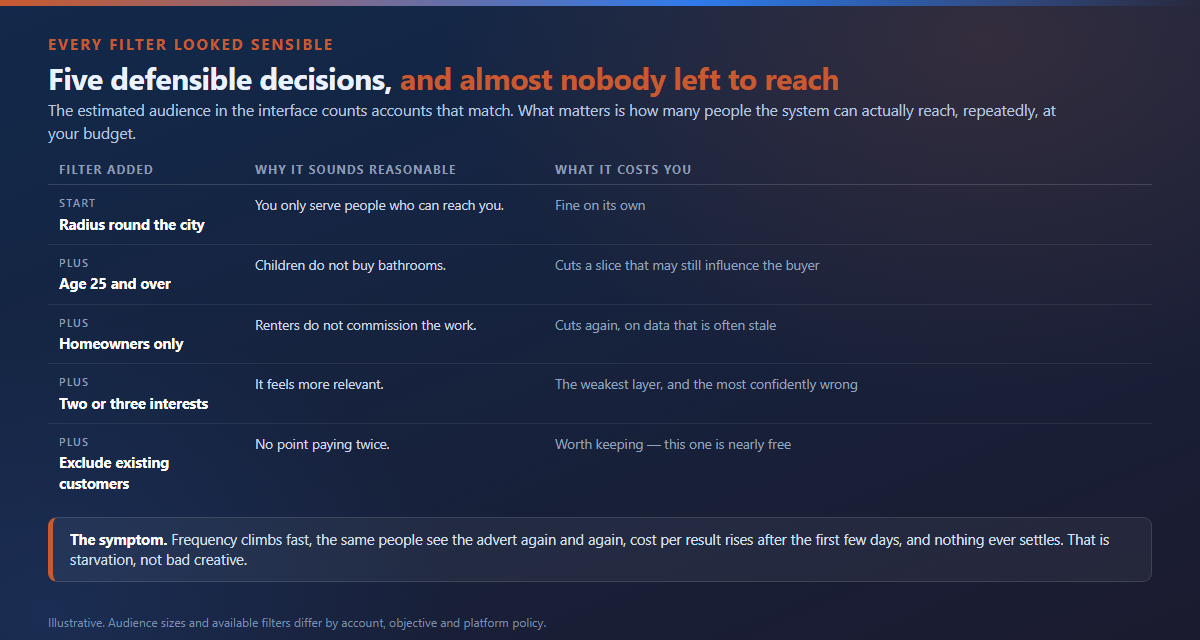
You start with a radius around the city. Reasonable. You cut it to adults over twenty-five, because children do not buy bathrooms. Reasonable. You add homeowners, because renters do not either. Still reasonable. Then two interests to make it relevant, then exclude existing customers.
Every one of those decisions is defensible, and together they have reduced a workable pool to a group so small that the system cannot run a meaningful test inside it. The estimated audience number shown in the interface still looks like a lot of people. What matters is not how many exist but how many Meta can actually reach, repeatedly, at your budget — and that is a far smaller number.
The symptom is distinctive once you know it. Frequency climbs fast, the same people see the advert again and again, cost per result rises after the first few days, and results never stabilise.
Learning never finishes, so nothing ever settles
When a new ad set starts, delivery is unstable while the system works out who responds. It leaves that state once it has accumulated enough conversion events in a short enough window. Until then, every result you see is provisional.
Two things stop a small local account ever getting there. The audience is too small to find enough responsive people. And the budget, split across several ad sets because that felt thorough, means no single one accumulates anything.
So the account sits permanently in the unstable state. Costs look erratic, and the owner responds the way anyone would — by changing something. Every meaningful edit restarts the process. A month of diligent fiddling can produce an account that has never once been allowed to finish learning.
Discipline is the unglamorous fix. Fewer ad sets, more budget in each, and leave them alone long enough to resolve.
Give it room, then let it narrow itself
The counterintuitive answer, and the one that takes most persuading, is to remove filters rather than add them.
- Drop the interest stack first. Interests are the weakest layer and the most confidently wrong. The delivery system finds responsive people better than a list of hobbies does, provided you give it room to look.
- Widen the geography past the city boundary to the area you would genuinely travel to. Not the county, and not the country — the honest limit of where you would actually take the job.
- Loosen age and demographics unless there is a hard reason. “Probably not students” is not a hard reason; it is a guess that costs you reach.
- Run one ad set, not five. Concentrating the budget is what lets it exit learning at all.
- Keep exclusions — existing customers and recent enquirers are worth removing, and that costs you almost nothing in size.
What you lose is the comfortable feeling of precision. What you gain is a system that can actually optimise, which beats your guess about who the customer is almost every time.
Where narrow is right, and it is a short list
This is not an argument that narrow targeting is always wrong. There are cases where it is the only sensible option, and they share one feature: the constraint is real and physical rather than assumed.
A business that can only serve a handful of postcodes because of travel time should say so, and accept that the audience is small and the cost per result will reflect it. A service with a genuine legal or age restriction has to apply it. A retargeting audience is deliberately small, because it is made of people who already came to you — and that is the one place tight beats broad reliably.
What does not qualify is a hunch about demographics. “Our customers are mostly women in their forties” is usually a description of who has bought so far, which is partly a description of who you advertised to before. Encoding it as a hard filter makes it permanently true.
None of this works without the tracking
Everything above depends on the system knowing what a good outcome looks like. If it cannot see conversions, it cannot learn from them, and widening the audience just buys more of nothing.
That means the pixel installed and firing, the Conversions API alongside it so events still register when browser tracking is blocked, domain verification done, and conversion events defined around the thing you actually want — an enquiry, a booking, a sale. Not a page view.
This is also where restricted accounts stop everything dead. If the ad account or Business Manager (now called a business portfolio in Meta’s help centre) is disabled, no amount of targeting work matters until the access problem is sorted out first, and that is a separate job with its own process.
The order is fixed: tracking, then audience, then creative, then budget. Working on the later ones while an earlier one is broken is the most common way small accounts waste a quarter.
Paid social creates demand. It does not harvest it
Worth being clear about what this channel is for, because a lot of disappointment comes from expecting the wrong thing.
Nobody on Facebook or Instagram is looking for you. They are looking at their family, their friends and whatever the feed served them, and your advert is an interruption. That makes it excellent at creating awareness and demand where none existed, and poor at catching somebody who has a problem right now.
Somebody with a burst pipe is not scrolling. They are searching, and that is a search campaign’s job, not this one. A business selling an urgent service that puts its whole budget into paid social is fighting its own customers’ behaviour.
Where paid social earns its place is the considered purchase: the bathroom being thought about, the clinic treatment being researched, the service somebody did not know existed. If that is what you sell, this is the right channel, and the monthly mechanics of running it are set out separately.
If what you are actually shopping for is posting rather than paid campaigns, the social media marketing agency Gloucester page separates the two jobs.
What a client said, and what you can check
“Great communication and very helpful throughout the process. Took the time to explain everything clearly and set up the campaign professionally. Focused on quality results rather than just numbers. Highly recommended.”
This is one of three client reviews published so far; the other two, from a UK SEO client and a US Google Ads client, are on the home page. Every figure comes from the client’s own ad account, and a review goes on this site only when it is real.
What you can check before you pay
- Prices published in full on the pricing page, not hidden behind a sales call
- Month to month, with one month’s notice and no lock-in contract
- Every account, profile and file stays in your name; I work through partner access
- A written report every week, in plain English
- One specialist does the work, from the audit to the report
Gloucester Facebook ads questions, answered plainly
My audience number looks big. Why is it still too small?
The estimate shown in the interface counts accounts that match your filters, not people the system can realistically reach with your budget at a sensible frequency. A pool of a hundred thousand accounts with fifteen pounds a day behind it is not a hundred thousand chances. The number that matters is how many distinct people actually saw the advert last week, which is in the reporting, and it is usually a fraction of what the estimate implied.
Is boosting a post ever worth it?
For reach on something that is already doing well organically, occasionally. For getting customers, no. Boosting optimises towards engagement, which is why boosted posts collect likes and comments and rarely produce enquiries. It is the same platform running a completely different objective, and it is the single most expensive habit in small business advertising.
How much budget does a Gloucester business need to start?
Enough to generate conversion data inside four weeks, which depends entirely on what an enquiry is worth to you and how often people buy. I will not put a number on it without seeing the account and the offer. What I will say is that splitting a small budget across several ad sets is worse than putting the same money behind one, and that if the budget cannot produce a fair test, the honest answer is to say so rather than take a retainer.
Why did my results get worse after I changed the targeting?
Because the change restarted learning. Every meaningful edit puts the ad set back into the unstable phase where results are provisional and costs are usually worse. If you edit weekly, the account never leaves that phase. Agree what you are testing, then leave it alone for the agreed period, however uncomfortable the third day looks.
Should I use lookalike audiences?
Only once you have enough source data for them to mean anything. A lookalike built from a handful of customers is a lookalike of statistical noise, and it will perform like one. Build the customer list first through ordinary campaigns, then use it. Starting with lookalikes on a new local account is a step out of order.
Do I need new creative every month?
You need new creative when the numbers say so, not on a calendar. The signal is frequency climbing while results fall — the same people seeing the same thing too often. On a small local audience that happens faster than it would nationally, which is another consequence of being narrow. Widening the audience slows creative fatigue as a side effect.
Can you run ads if my page has very few followers?
Yes. Paid delivery does not depend on your follower count; the audience is bought, not owned. A page with a handful of followers can run perfectly well. What does matter is that the page looks like a real business when somebody taps the name — current information, real photos, and something posted recently enough that it does not look abandoned.
Do you handle the day-to-day posting as well?
No. I manage paid campaigns. Day-to-day posting, replies and community management are a different job and I do not pretend otherwise. If somebody offers you both for one small monthly fee, ask how many hours each actually gets, because one of them is usually being done badly to justify the other.
Find out how small your audience really is
Send the ad account, or the page you would advertise from if nothing is running yet. You get a written answer: how many people the campaigns actually reached last week as against the estimate, whether the ad sets ever exited learning, whether the tracking is recording anything usable, and what I would widen first. It costs nothing and there is nothing to sign.