
Social media marketing agency in Gloucester: two different jobs
Businesses shopping for a social media agency are usually buying one of two completely different things without knowing which: somebody producing posts, or somebody running paid campaigns that can be measured against enquiries. They share a platform and almost nothing else. This is how to tell them apart before you spend anything.

“Social media marketing” is two different jobs
When a Gloucester business goes looking for a social media agency, it is usually shopping for one of two completely different things without knowing which.
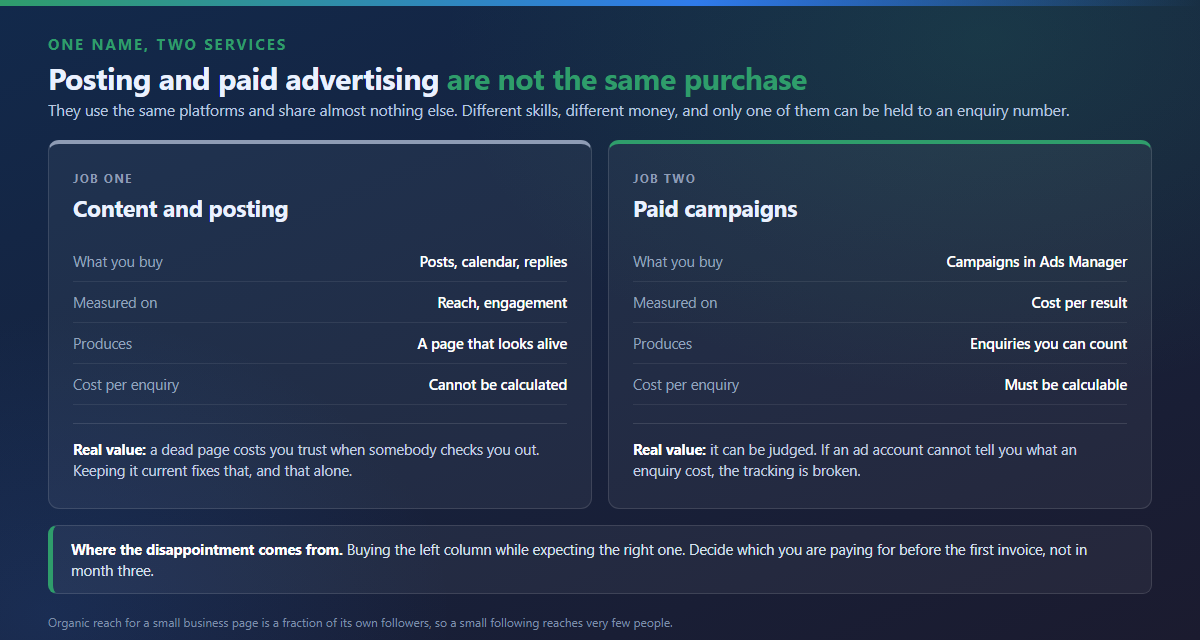
The first is content: somebody producing and publishing posts, keeping the page alive, replying to comments and messages. Real work, and time-consuming.
The second is paid: campaigns built in Ads Manager with a conversion objective, a tracked event, a defined audience and a budget, aimed at producing enquiries you can count.
They use the same platforms and almost nothing else in common. They need different skills, they are worth different money, and only one of them can be measured against enquiries. Most disappointment with social media agencies comes from buying the first while expecting the results of the second.
This page is about telling them apart before you spend anything. I should say plainly up front: I do the second one only.
For the record, I am Moeez Abbas, one specialist working remotely from Lahore, Pakistan, on UK hours. There is no Gloucester office and no content team; the paid campaigns run in an ad account that stays in your name.
What a posting retainer actually buys you
The standard small-business offer is some number of posts a month across two or three platforms, a content calendar, and a monthly report.
Here is the arithmetic nobody does out loud. Take the monthly fee and divide it by the number of posts. Then ask how long one genuinely good post takes — the idea, the photograph or graphic, the copy, the scheduling. If the answer means each post is getting twenty minutes, you now know what you are buying: stock imagery, generic captions and a calendar being filled.
That is not fraud. It is what the price supports. The problem is the expectation attached to it, because organic reach for a small business page is a fraction of its own followers, and a fraction of a small follower count is almost nobody.
So the honest description of a low-cost posting retainer is that it keeps the page from looking abandoned. That has real value — a dead page costs you trust when somebody checks you out. It is simply not a customer acquisition channel, and it should not be sold as one.
Reach and engagement are not results
The monthly report is where the confusion becomes permanent. It shows followers gained, reach, impressions, likes, comments and shares, and every arrow points up.
None of those is a thing you can bank. A business can grow its following steadily for a year and take no additional money at all, because nothing in that list is an enquiry.
Ask for one number instead: how many enquiries came from this, and what did each one cost? If the answer is that it cannot be measured, that is a legitimate answer for organic content — and it is also the reason organic content should not be the thing you rely on for leads.
Paid campaigns do not get that exemption. If an ad account cannot tell you the cost per enquiry, the tracking is broken, and every decision made on that report has been a guess.
What I do, and what I do not
Being specific about this is more useful than a longer service list.
What I do. Paid campaigns on Facebook and Instagram, built in Ads Manager: pixel and Conversions API installed and tested before any spend, conversion events defined around real outcomes, audience and campaign structure built inside your own ad account, three to five genuinely different creative angles written and produced, testing with losers cut weekly, and a written report each week with spend, results and cost per result. The month-by-month detail is set out here.
What I do not. Day-to-day organic posting. Comment and message moderation. Community management. Influencer coordination. TikTok content production. Those are real jobs that take real hours, and I would be doing them badly while charging you for something else.
If you need both, the sensible arrangement is somebody local doing the content while the paid side is run properly, rather than one small fee stretched across both. In practice the business itself often produces better organic content than any agency will, because it has the photographs, the finished jobs and the actual voice.
If the business is in Cheltenham rather than Gloucester, the marketing agency in Cheltenham page covers search, content and paid social for that town, including what you can get for free.
How to judge a content agency before you sign
I am not trying to talk you out of it. If you want the page kept alive by somebody else, here is what separates the ones worth paying from the ones filling a calendar.
- Who takes the photographs? If the answer is a stock library, your page will look like every other page in your trade. The business’s own photographs of its own work are the whole advantage.
- Who writes the captions, and do they ever visit? Content about a Gloucester trade written by somebody who has never seen a job reads exactly like it.
- What happens to a message at seven in the evening? Response time on messages is the part that actually converts, and it is the part most posting retainers quietly exclude.
- What does the report measure? If it is reach and engagement only, agree in advance that you are buying presence, not leads. That way nobody is disappointed in month three.
- Who owns the account? Your page, your Business Manager (now called a business portfolio in Meta’s help centre), your access. Always.
Which of the two you probably need
A short way to decide, before anybody quotes you.
You need paid if you want more enquiries, this quarter, and you can say what a customer is worth. Paid is measurable, it starts working in weeks rather than quarters, and it stops when you stop.
You need content if people already find you and the page undermines you when they check — nothing posted in two years, no photographs of recent work, questions unanswered. That is a trust problem, and no advert fixes it.
You may need neither. If the people buying what you sell are actively searching for it rather than discovering it in a feed, your money is better spent where they are looking. For an urgent trade, the map pack does more than any amount of posting, and search campaigns catch the ones who cannot wait. Social is for demand you have to create, not demand that already exists.
Send me the website and say which of those three sounds like you. If the honest answer is that social is not your channel, that is the answer you will get, and it costs nothing to find out.
What a client said, and what you can check
“Great communication and very helpful throughout the process. Took the time to explain everything clearly and set up the campaign professionally. Focused on quality results rather than just numbers. Highly recommended.”
This is one of three client reviews published so far; the other two, from a UK SEO client and a US Google Ads client, are on the home page. Every figure comes from the client’s own ad account, and a review goes on this site only when it is real.
What you can check before you pay
- Prices published in full on the pricing page, not hidden behind a sales call
- Month to month, with one month’s notice and no lock-in contract
- Every account, profile and file stays in your name; I work through partner access
- A written report every week, in plain English
- One specialist does the work, from the audit to the report
Gloucester social media questions, answered plainly
How many times a week should a small business post?
Less often than most advice suggests, and better. Three posts a month containing real photographs of real work will do more for a Gloucester trade than daily filler, because the filler trains people to scroll past you. Frequency matters far less than whether anything you post is worth stopping for.
Do followers matter?
Much less than people think. Organic reach for a small business page is a fraction of its own followers, so a bigger number multiplies a small fraction. Followers matter as social proof when somebody checks you out, not as a distribution channel. Buying followers makes that worse, because the engagement rate collapses and the page looks bought.
Can you just run ads without me posting anything?
Yes, and it often works. Paid delivery does not depend on your posting schedule. What does matter is that somebody tapping through to your page finds a business that looks real and current — accurate information, genuine photographs, and nothing that makes them wonder whether you are still trading.
Which platform should a Gloucester business be on?
The one your customers use, which is usually fewer than you have been told. A local trade or clinic is generally Facebook and Instagram and nothing else. Spreading a small budget and a small amount of time across five platforms produces five neglected accounts. Being genuinely good on one beats being present on all of them.
Is TikTok worth it for a local service business?
For most, no. It rewards volume and a particular style of production, and a service business that can only manage occasional posts will not get traction. There are exceptions where the work is visually dramatic and somebody genuinely enjoys making the videos, and that enthusiasm is the deciding factor rather than the platform.
What is the difference between boosting and a campaign?
Boosting optimises for engagement. A campaign built in Ads Manager can optimise for a conversion you define, with a tracked event, a structured audience and creative built for that outcome. Same platform, completely different mechanism. Boosted posts collect likes; campaigns can be judged on cost per enquiry.
Will you take over our existing page?
I take partner access to your Business Manager, which is the method Meta designed for this. Your login stays private, your page and ad account stay owned by your business, and you can remove access yourself in about ten seconds. Anybody who wants your password instead of partner access is a reason to stop the conversation.
How soon would we see enquiries from paid social?
You usually get a readable signal within seven to fourteen days — whether the audience responds, whether the creative stops the scroll, and roughly what an enquiry costs. Four weeks is a fair first test. I cannot promise you a number of leads or a cost per lead before we start, and neither can anyone else who has not seen the account.
Tell me which of the two you actually need
Send the website address and say what you want more of: enquiries this quarter, or a page that stops undermining you when somebody checks. Those are different purchases and I only sell one of them. You get a written answer saying which fits, what it would take, and whether social is your channel at all. If the honest answer is that your customers are searching rather than scrolling, that is what the answer will say.