
SEO for gas and heating engineers: four real differences
Most SEO advice written for heating engineers is plumbing advice with the word swapped, and it misses what makes the trade different. A legal registration a plumber does not carry. Two businesses in one. A year with a steep shape. And a recurring compliance job almost nobody markets properly.

Plumbing advice misfires here, and for four specific reasons
Most SEO advice written for heating engineers is plumbing advice with the word swapped. It misses what makes this trade different, and the differences are not cosmetic.
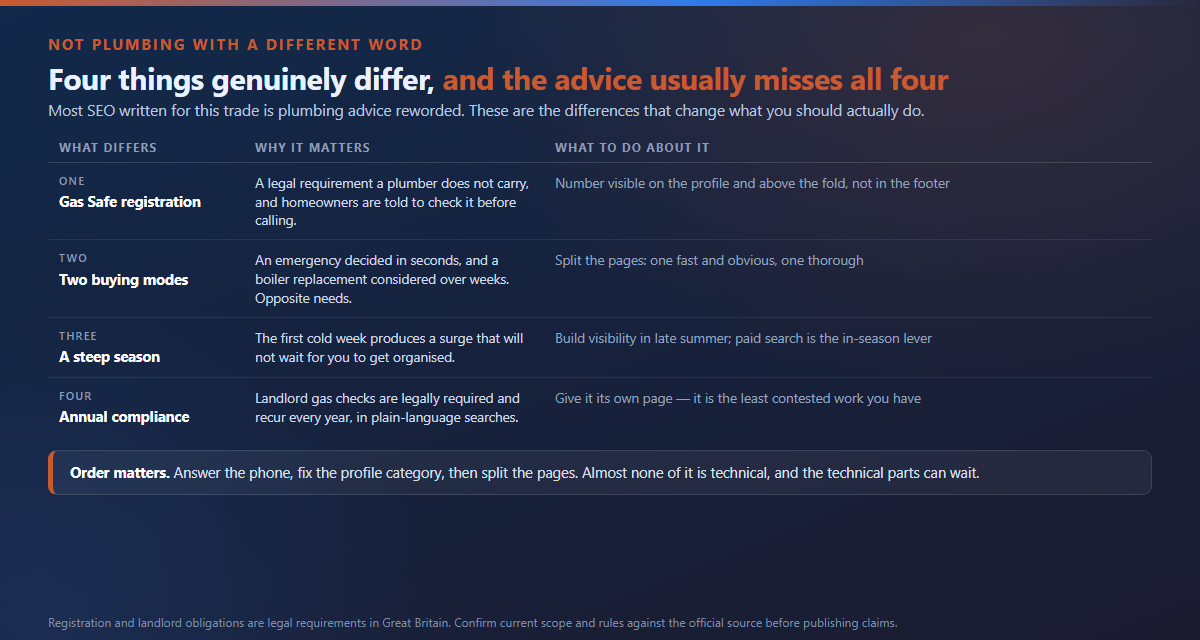
A gas engineer carries a legal registration a plumber does not. The work splits into an emergency business and a high-value considered purchase that behave nothing alike. The year has a shape most trades do not have. And there is a recurring compliance job that arrives on a predictable annual cycle and that almost nobody markets properly.
Get those four right and the ordinary SEO work — the profile, the pages, the reviews — does far more than it does for a general plumbing business. This page is about the four.
Gas Safe registration outranks anything you write
Gas work in Great Britain must be done by an engineer on the Gas Safe Register. Homeowners are told this repeatedly, and many check before they call. That single fact makes registration your strongest trust asset, and most heating businesses bury it.
Where it should appear, in order of how much it does:
- On the page the advert or search result lands on, visible without scrolling. Not in the footer, not on an about page nobody opens.
- On the Google Business Profile, in the description and in the services, because the profile is what most urgent searchers actually read.
- In the review replies, naturally, where it reinforces rather than announces.
Two cautions. Put the registration number where it can be checked, because a claim without a number is worth less than no claim. And do not overstate scope — being registered for one type of appliance is not being registered for all of them, and a customer who discovers the gap will say so publicly.
This is the cheapest credibility available to this trade and it costs nothing but placing it correctly.
You are running two different businesses
A heating engineer sells an emergency service and a considered purchase, and the same website usually tries to serve both with one message.
The emergency. No heat, no hot water, a leak, a smell of gas. The customer decides in about thirty seconds, they are not comparing anybody, and they press a call button. Nothing on your website is involved in that decision except how fast the page loads and how obvious the number is.
The replacement. A new boiler is a large, planned purchase. That customer reads, compares, asks for two or three quotes, and takes days or weeks. They want to understand what they are buying: why one size rather than another, what the warranty actually covers, what the installation involves, what it will cost.
These need different pages. A single “boiler services” page that tries to be urgent and reassuring at once is too slow for the first and too thin for the second. Split them, and let each one do its own job — the urgent half is decided on a different screen entirely.
The year has a shape, and it is steeper than you think
Breakdown demand follows the weather. The first genuinely cold week produces a surge of people whose heating has not been touched since spring, and that surge does not wait for you to get organised.
Three things follow from that.
The visibility has to exist before the cold does. Organic rankings and profile work take weeks to months to move. Starting in November is starting for next year. The work that pays in December is done in September.
Paid search is the lever that responds in-season, because it can be turned up the week the temperature drops. It is also the week everybody else turns theirs up, so costs rise exactly when you need it. Budget for that rather than being surprised by it.
Summer is not dead time, it is replacement season. Nobody plans a boiler swap in a cold snap. The planned, higher-value work is sold in the quiet months, to people who are thinking rather than panicking — which is exactly when the considered-purchase page earns its keep.
Landlord certificates: recurring demand nobody markets
Landlords must have gas appliances in a let property checked annually by a registered engineer. That is a legal obligation, it repeats every year, and it is searched for in plain language: gas safety certificate, landlord gas check, and the local variants.
It is the most predictable demand this trade has, and it is routinely left as one line on a services page.
What it deserves instead is its own page answering what a landlord actually wants to know: what the check covers, how long it takes, what happens if something fails, how quickly you can attend, and what it costs. Landlords with several properties are looking for somebody reliable and repeatable rather than cheapest, which makes them unusually good customers.
The second advantage is quieter. This work recurs on a known date, which means a customer list with renewal dates on it is a marketing asset most heating businesses never build. That is not SEO, but it is worth more than most of what is.
What to do first, and what can wait
- Answer the phone. Free, and it decides more emergency jobs than any ranking. Settle who covers evenings and what happens when they cannot.
- Profile category and services. Heating engineer and plumber are not the same category, and the wrong one quietly excludes you from the searches you want. Free, takes an afternoon.
- Registration visible, with the number, on the profile and above the fold on the landing page.
- Split the emergency page from the replacement page. One fast and obvious, one thorough and reassuring.
- Build the landlord certificate page before the others, if letting agents are anywhere in your area. It is the least contested and the most repeatable.
- Reviews flowing steadily — and for this trade, ask after the planned jobs rather than the emergencies, because that customer is calm and remembers you well.
Almost none of that is technical, and the parts that are can wait. If you also do general plumbing, that side has its own considerations, and the profile work underneath both is the same afternoon either way.
Bathroom refits behave differently again, because the customer decides over weeks rather than minutes. The guide to SEO for bathroom fitters covers those searches, the Business Profile categories listed for the trade, and the photos and reviews customers check.
What a client said, and what you can check
“Great communication and very helpful throughout the process. Took the time to explain everything clearly and set up the campaign professionally. Focused on quality results rather than just numbers. Highly recommended.”
This is one of three client reviews published so far; the other two, from a UK SEO client and a US Google Ads client, are on the home page. Every figure comes from the client’s own ad account, and a review goes on this site only when it is real.
What you can check before you pay
- Prices published in full on the pricing page, not hidden behind a sales call
- Month to month, with one month’s notice and no lock-in contract
- Every account, profile and file stays in your name; I work through partner access
- A written report every week, in plain English
- One specialist does the work, from the audit to the report
Heating engineer SEO questions, answered plainly
Should I market as a plumber or a heating engineer?
As whatever you actually want more of. They are different Google Business Profile categories and different searches, and choosing the broad one to cover both usually means ranking well for neither. If gas work is the profitable half, lead with heating engineer and let plumbing sit as a secondary service rather than the other way round.
Where should the Gas Safe number go?
Somewhere a customer can see it without hunting: the landing page above the fold, and the Business Profile description. Put the number itself, not just the claim, because the number is what makes it checkable. Keeping it only in the footer wastes the strongest trust signal the trade has.
Do I need separate pages for boiler repair and boiler replacement?
Yes, and it is probably the highest-value split available to you. They are different customers in different states of mind. Repair needs speed and an obvious phone number; replacement needs detail, comparison and reassurance. One page trying to do both is too slow for the emergency and too thin for the purchase.
When should I start SEO if I want to be visible in winter?
Late summer at the latest. Organic rankings and profile changes take weeks to months to settle, so work started when the cold arrives is work for the following year. What does respond in-season is paid search, and that is also when it costs most, because every competitor turns theirs up in the same week.
Is it worth chasing boiler grant and scheme searches?
Only with caution. Eligibility rules and scheme names change, and a page built around a specific scheme dates quickly and can end up misleading people about what they qualify for. If you do write about it, write about the process and the questions rather than the current rules, and check anything you state against the official source before publishing.
How many reviews do I need to compete locally?
There is no threshold and anybody quoting one is inventing it. What matters more is that they keep arriving, because a profile with nothing posted for two years reads as dormant however good the average is. For this trade, ask after planned work rather than emergencies — that customer is calm, remembers the job, and writes a better review.
Should I list every town I cover?
Only the ones you would genuinely attend, and for emergency work only the ones you could reach in time. The map pack ranks on distance from the searcher regardless of what your service area claims, so over-claiming does not extend reach. What it does produce is urgent calls you cannot get to, which turn into cancelled jobs and poor reviews.
Do landlord gas certificate pages actually bring work?
They are usually the least contested thing this trade can rank for, because most heating businesses leave it as one line on a services page. The demand is legally required, it recurs annually, and multi-property landlords value reliability over price. It will not produce the volume that boiler repair does, but the customers repeat, which most emergency customers do not.
Send the website before the cold does
Send the website address and say whether breakdowns or replacements pay you more. You get a written answer: whether the profile category is the right one, whether the registration is visible where it counts, whether one page is trying to serve two different customers, and what I would build first. It costs nothing and there is nothing to sign. If the honest answer is that the phone rather than the website is losing you jobs, that is what the answer will say.