
SEO in the Jewellery Quarter: two jobs on one square mile
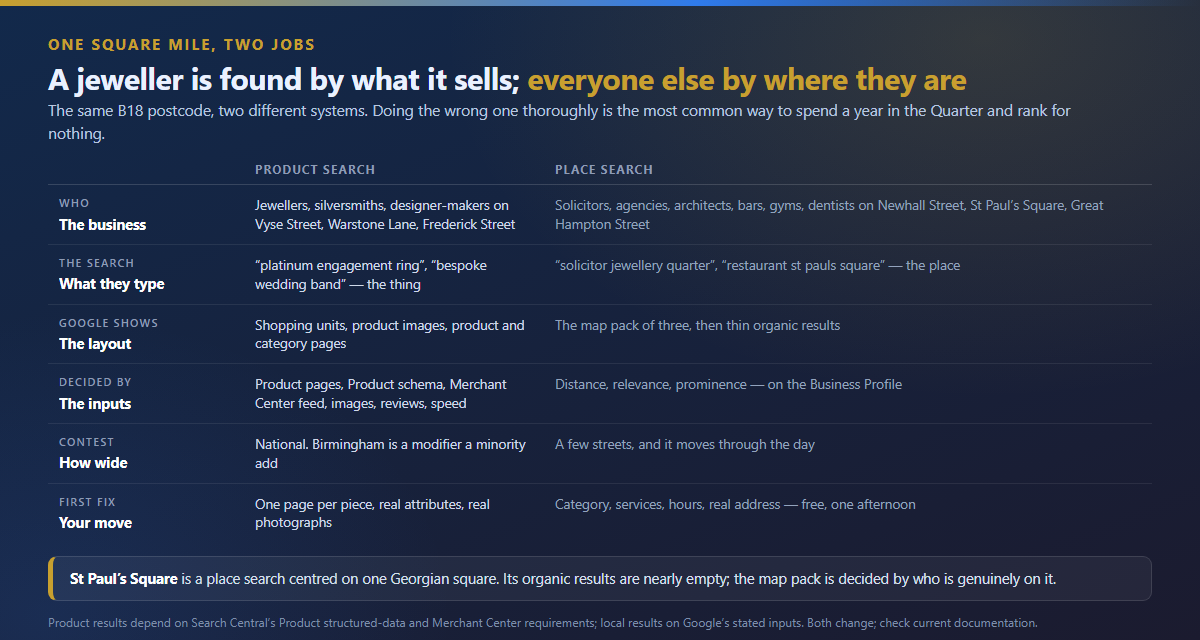
The Jewellery Quarter is about a square mile of Birmingham, and it contains two completely different search problems. A jeweller on Vyse Street is found by what it sells, in a contest that runs nationwide. A solicitor on Newhall Street or a bar on St Paul’s Square is found by where it is, in a contest drawn a few streets wide. Most advice treats the district as one place. It is one place with two jobs, and this page separates them.

One square mile, two kinds of search
The Jewellery Quarter is a conservation area of roughly a square mile north-west of Birmingham city centre, bounded loosely by Great Charles Street Queensway, Constitution Hill, Icknield Street and the Hockley side. It is Europe’s largest concentration of businesses in the jewellery trade, it produces around forty per cent of the jewellery made in the UK by the commonly cited figure, and it is home to the Birmingham Assay Office, which hallmarks something like twelve million items a year. It also contains solicitors, architects, design studios, marketing agencies, bars, restaurants, a Metro stop, two Victorian cemeteries and a Georgian square with a Grade I church in the middle of it.
That mix is the whole problem with the phrase seo company jewellery quarter. A jeweller on Vyse Street and a solicitor on Newhall Street share a postcode and almost nothing else about how they are found. The jeweller is found by what it sells, in a contest that runs against retailers in Hatton Garden, Manchester and online, and in which Birmingham is at most a modifier. The solicitor is found by where it is, in a contest drawn a few streets wide by whoever is searching from Newhall Street, Colmore Row or St Paul’s Square at that moment.
Nearly every page ranking for this search treats the Quarter as one place with one answer. It is one place with two jobs. This page separates them, says what Google is actually measuring in each, deals with St Paul’s Square on its own because searchers use it as an address, and sets out the order of work for each kind of business.
A caveat up front, because it matters more here than in most places. I am one specialist, I work remotely from Lahore, and I have no premises in the Jewellery Quarter, on St Paul’s Square, or anywhere in Birmingham. Nothing on this page claims a local address, and nothing in the work involves inventing one, because a fabricated B18 address on a Business Profile is the fastest route to a suspension there is.
For a jeweller, the search is the product
Somebody typing “platinum engagement ring” or “diamond eternity ring birmingham” or “bespoke wedding band” is not looking for a place. They are looking for a thing, and they will buy it from whoever shows them the right thing convincingly, whether that is a workshop on Warstone Lane, a showroom in the Big Peg, a retailer in Hatton Garden or a website with no shop at all. Google reads that intent and answers it with a different page layout: shopping results, product images, a map pack that is often demoted or absent, and organic results dominated by product and category pages.
For a Jewellery Quarter jeweller this is both the threat and the opportunity. The threat is that the Quarter’s reputation does not rank a website; national retailers with deeper catalogues and more reviews do. The opportunity is that a Vyse Street or Frederick Street workshop has something the national retailers cannot fake: the Assay Office round the corner, the hallmark, the making, the trade’s own history running back to Matthew Boulton, the School of Jewellery on Vittoria Street training the people who do the work. A product page that is genuinely about a piece made in the Quarter reads differently from a drop-shipped catalogue entry, and Google’s systems have been moving towards rewarding that difference for years.
What the product contest is actually scored on:
- Product pages, one per product, with the attributes a buyer searches by: metal, carat, stone, cut, ring size, hallmark, whether it is made to order. A category page with thirty rings on it does not rank for “1ct oval diamond ring”; the page for that ring does.
- Product structured data. Schema.org Product markup with price, availability, brand and review data, so the listing is eligible for the rich result formats Google shows for shopping queries. Google’s Search Central documentation is explicit about which properties it reads.
- Google Merchant Center. Free product listings in the Shopping tab and in the shopping units on the main results page do not require an advertising budget. They require a feed that matches the website, with the same prices, the same availability and the same images, kept in sync.
- Images. Jewellery is bought with the eyes. Original photography, named and described properly, appears in image search and in the visual results Google increasingly leads with for product queries. Stock images and supplier catalogue shots are shared by every other retailer and rank for none of them.
- Reviews of the product and the maker, gathered honestly and marked up, because a bespoke commission is a high-trust purchase and the searcher is comparing you with a national brand.
- Speed and mobile. A ring is often chosen on a phone on a Sunday evening. A catalogue that takes six seconds to paint loses the comparison before it starts.
Where does “Birmingham” or “Jewellery Quarter” fit? As a modifier that a minority of buyers add because they want to visit, see the piece, and have it sized. Those searches deserve a page too, and it should say the things a visitor needs: the street, the nearest Metro stop at Jewellery Quarter station, parking, appointment hours, the Museum of the Jewellery Quarter two streets away if they want to make a day of it. But it is a supporting page. The main contest for a jeweller is the product one, and it is national.
For everyone else, the search is the postcode
The Quarter is no longer only jewellers. The regeneration that followed the conservation-area designation turned warehouses on St Paul’s Square and Newhall Street into offices and flats, and the district now carries a working population of solicitors, accountants, architects, design and marketing studios, recruitment firms, gyms, dentists, cafés, bars and restaurants, with the Colmore Row business district a few minutes’ walk down Newhall Street and Snow Hill station on the edge. Their customers do not search for a product. They search for a service, near where they are.
That is a place search, and it is scored by the local system: the map pack of three businesses above the organic results, computed from the searcher’s position and from three inputs Google names, distance, relevance and popularity. It is the same system that decides a dentist in Harborne or a plumber in Solihull, and it behaves the same way here, with one difference that makes the Quarter unusual.
The searchers move. A suburb’s map-pack searchers are mostly residents at home. The Quarter’s are office workers at their desks between nine and six, residents in the converted warehouses in the evening, and visitors on Vyse Street and Warstone Lane at the weekend. The centre of the map moves through the day, and a business that sits between Newhall Street and Great Hampton Street is nearest to a different crowd at lunchtime from the one it is nearest to on a Saturday. Opening hours that are true, and a profile that says what the business does for each of those crowds, is what earns the slot.
For a place search the work is on the Business Profile first and the website second:
- Primary category chosen precisely, because it decides eligibility. A marketing agency that has picked “Consultant” is invisible for the searches it wants.
- A real B18 or B3 address that customers can visit, shown; or a service area, hidden, if they cannot. Not a virtual office on Newhall Street that nobody works from.
- Services listed one by one, in the words a customer uses.
- Hours that match the door, including the evening ones a bar or restaurant genuinely keeps.
- Reviews that keep arriving, replied to, and never bought.
- A page on the website about the Quarter that a St Paul’s Square searcher would recognise as being about their square, not a city-wide page with the district name inserted.
The search that brought you to this page, seo company jewellery quarter, is itself a place search. The organic results for it are thin and mostly templated, and the map pack for it is whoever is nearest with the right category. That is why a genuine local presence with an honest profile can appear here quickly, and why a fabricated one gets reported.
A square inside the Quarter that searchers use as an address
St Paul’s Square sits at the southern end of the Quarter, a few hundred metres from Snow Hill. It is Birmingham’s last surviving Georgian square, laid out from the 1770s on the Newhall estate, with St Paul’s Church, completed in 1779 and Grade I listed, at its centre. The Georgian houses round it became workshops in the nineteenth century and offices, restaurants and flats in the twentieth, and today the square is where a good share of the Quarter’s professional services and evening trade sits.
People search for it by name. “Restaurants St Paul’s Square”, “solicitors St Paul’s Square”, “seo company st pauls square”. Google resolves the square to a point on the map and treats the search as a place search centred there, which means the map pack is decided by who is genuinely on or beside the square with the right category and hours. The organic results for those searches are, at the time of writing, thin to the point of being empty: a mapping site, a social-media answer page, a business-centre listing. There is almost nothing to beat.
Two consequences. First, a business that is actually on the square, on Ludgate Hill, Cox Street or Water Street, can own these searches with a Business Profile that is accurate and a page that names the square, the church, the nearest Metro stop and what the business does there. It does not need a campaign; it needs to say true things clearly. Second, a business that is not on the square gains nothing by pretending. A St Paul’s Square address on a profile that trades from elsewhere is a guideline violation, and the square is small enough that competitors notice.
That is why this page covers St Paul’s Square as a section rather than a separate page. The searches are real, they are distinct enough to name, and they are decided by the same local system as the rest of the Quarter’s place searches, with the map centred on one Georgian square instead of on a street.
The one profile field that decides which searches you can appear for
For the place-search businesses in the Quarter, one Business Profile field matters more than the rest put together: the primary category. It decides which searches the profile is eligible for at all, and the Quarter’s mix means it is often set wrong, because a business here is frequently two things at once.
The trade itself. Jeweller, Jewellery store, Jewellery designer, Jewellery repair service, Jewellery engraver, Jewellery appraiser, Goldsmith, Silversmith, Diamond dealer, Diamond buyer, Gold dealer, Gemologist, Watch store, Watch repair service, Pawnbroker, Bullion dealer. A workshop that sells to the public is a Jewellery store first and a Jewellery designer second; one that only makes to order for the trade is the reverse. Schema.org has JewelryStore for the shop and ProfessionalService or LocalBusiness for the workshop.
The professional streets. Solicitor, Law firm, Barrister, Conveyancer, Notary public, Accountant, Chartered accountant, Tax adviser, Financial adviser, Wealth management, Insurance broker, Architect, Architectural designer, Interior designer, Structural engineer, Surveyor, Estate agent, Letting agent, Property developer, Marketing agency, Advertising agency, Design agency, Web designer, Software company, Recruitment agency, Photographer, Photography studio, Video production, Coworking space, Serviced office. Schema.org: Attorney, LegalService, AccountingService, FinancialService, InsuranceAgency, RealEstateAgent, ProfessionalService, and Organization for a firm that is not a place people visit.
The square and the evenings. Restaurant, Bar, Cocktail bar, Wine bar, Pub, Gastropub, Café, Coffee shop, Brunch restaurant, Bakery, Italian restaurant, Indian restaurant, Tapas restaurant, Event venue, Wedding venue, Function room, Hotel, Boutique hotel, Serviced apartments. Schema.org: Restaurant, BarOrPub, CafeOrCoffeeShop, Bakery, EventVenue, Hotel, LodgingBusiness.
The residents. The Quarter now houses thousands of people in converted factories and new blocks, and they search like any neighbourhood: Gym, Personal trainer, Yoga studio, Hair salon, Barber shop, Beauty salon, Nail salon, Dentist, Physiotherapist, Pharmacy, Convenience store, Dry cleaner, Launderette, Locksmith, Cleaning service, Veterinarian, Dog groomer, Nursery, Tutor. Schema.org: HealthClub, HairSalon, BeautySalon, Dentist, Physiotherapy, Pharmacy, ConvenienceStore, Locksmith, VeterinaryCare, ChildCare.
Visitors and heritage. Museum, Art gallery, Heritage building, Tourist attraction, Gift shop, Craft store, Art studio, Antique store, Vintage clothing store, Record shop, Book shop, Tattoo shop, Piercing shop. Schema.org: Museum, ArtGallery, TouristAttraction, Store and its subtypes.
Two rules apply here as everywhere. Choose the single most specific primary category that is true, and reflect the same choice in the website’s Schema.org type, in Bing Places and in Apple Business (formerly Apple Business Connect), so that all of them read the business the same way. Then use secondary categories only for what you genuinely offer at scale. A jeweller who also does two repairs a month should not be a Jewellery repair service; a bar that hosts one wedding a year should not be a Wedding venue.
The streets and institutions a genuine page knows
A page that could only be about the Jewellery Quarter knows it street by street, and every place here is checkable on a map, in the conservation-area appraisal or in the public record. This is the material an honest Business Profile description, a visit page and a local page are built from, and it is what a templated district page never contains.
The trade streets. Vyse Street, Warstone Lane and Frederick Street carry the retail jewellers and the showrooms; the Big Peg on Warstone Lane and the Argent Centre on Frederick Street house workshops and studios; Vittoria Street has the School of Jewellery, part of Birmingham City University, where much of the trade trains. The Chamberlain Clock at the junction of Vyse Street, Warstone Lane and Frederick Street is the landmark every visitor is given directions from; it was put up in 1903 to mark Joseph Chamberlain’s visit to South Africa. The Assay Office on Newhall Street is where the hallmarks come from. The Museum of the Jewellery Quarter on Vyse Street, the Pen Museum and the Coffin Works, the former Newman Brothers factory on Fleet Street, are the heritage sites that bring the weekend visitors.
The business streets. Newhall Street runs from the Quarter down towards Colmore Row and the Birmingham Museum and Art Gallery, and its offices are where much of the district’s professional work now sits. Great Hampton Street, Constitution Hill and Livery Street form the Hockley edge; Great Charles Street Queensway and the Middle Ring Road mark the city-centre side; Icknield Street and Camden Street the west. Northwood Street, Caroline Street, Ludgate Hill, Cox Street, Water Street and Mary Street feed St Paul’s Square. Snow Hill station sits on the southern edge; Jewellery Quarter station on Vyse Street serves both the railway and the West Midlands Metro, with the tram running along the Quarter to the city.
The history a page can honestly use. The Newhall estate, laid out from St Paul’s Church in the late eighteenth century on land the Colmore family had held; Matthew Boulton, whose Soho Manufactory was on the Hockley side; the Birmingham Mint, which struck coins on Icknield Street for over a century; Key Hill Cemetery and Warstone Lane Cemetery, the two Victorian burial grounds with their catacombs; the Conservation Area designation that stopped the demolition and started the regeneration, and the Character Appraisal and Management Plan that Birmingham City Council maintains for it. The 40 per cent figure for UK jewellery output and the twelve million hallmarks a year are the two numbers everybody quotes about the Quarter, and both are attributable.
What to do with this. A jeweller’s visit page should say Vyse Street, the Chamberlain Clock, Jewellery Quarter station and the Museum, because that is how a customer finds the door. A solicitor on Newhall Street should say Newhall Street, Colmore Row and Snow Hill, because that is where the clients walk from. A bar on St Paul’s Square should say the square and the church. Nobody should list all of it; the test is whether a person who works in the Quarter would recognise the page as being about their bit of it.
What each system is called, and what it is checked against
Product search and place search are measured with different tools and against different documents. These are the actual names, so that a report can be checked against its source.
For product search. Google Merchant Center holds the product feed and decides eligibility for free listings and Shopping ads; its policies on prices, availability and returns are the commonest reason a jeweller’s products are disapproved. Google Search Central documents the Product structured data Google reads: name, image, description, sku, brand, offers with price, priceCurrency and availability, aggregateRating and review. The Shopping tab, the shopping units on the main results page and Google Images are the surfaces the product contest is fought on. Schema.org’s JewelryStore type is the right LocalBusiness subtype for a shop with a door. PageSpeed Insights and the Chrome User Experience Report measure whether a thousand-page catalogue is fast enough on a phone; Core Web Vitals, Largest Contentful Paint and Interaction to Next Paint are the metrics it is judged on. Google Search Console’s Merchant listings and Product snippets reports say which pages qualified for the rich results and which did not.
For place search. Google Business Profile and its guidelines for representing your business; the Local Pack and the Local Finder; Google Maps directly; Bing Places for Business and Bing Webmaster Tools for the office worker on a laptop; Apple Business for the Maps app on an iPhone. Schema.org’s LocalBusiness and its subtypes: Attorney, AccountingService, ProfessionalService, Restaurant, BarOrPub, Cafe, Dentist, HealthClub, and the boring properties that matter, address, telephone, openingHoursSpecification, areaServed, sameAs. Google Search Console for queries and pages; Google Analytics 4 for what happened after the click.
The public record a buyer checks. The Assay Office and the Hallmarking Act 1973, which is why a hallmark on a piece over the exemption weights is a legal requirement rather than a marketing choice, and the British Hallmarking Council that oversees it. The National Association of Jewellers for trade membership. The Gemological Institute of America and similar laboratories for stone reports, which a buyer of a diamond ring now expects to see named on the product page. Companies House for who the business is. The Solicitors Regulation Authority, ICAEW, ACCA and the Architects Registration Board for the professional firms on Newhall Street. The Food Standards Agency rating for a kitchen on the square.
The consumer law that applies online. The Consumer Rights Act 2015 and the Consumer Contracts Regulations 2013 govern what a jeweller selling at a distance must say about returns and cancellation, and Merchant Center checks for it. The Digital Markets, Competition and Consumers Act 2024 makes fake reviews, and buying them, an offence the Competition and Markets Authority can act on directly. Keep the original message and the permission behind every testimonial, and never touch a review seller.
None of this is a tactic. It is the checklist a serious report for a Jewellery Quarter business is written against, and any agency, including this one, can be held to it.
The attributes Google reads on a jeweller’s page
For a jeweller, the search engine and the customer want the same thing: the specifics. A product page that says “beautiful bespoke ring” competes with nothing because it claims nothing. A page that states the metal, the stone, the certificate and the price competes with everything, and wins where the details match what was typed.
Metals. Platinum, palladium, 18ct yellow gold, 18ct white gold, 18ct rose gold, 9ct gold, sterling silver, titanium, tungsten. Each is a search term in its own right, and each carries a hallmark from the Assay Office under the Hallmarking Act 1973 that a buyer can check. The metal belongs in the product name, in the Product schema’s material property and in the Merchant Center feed, spelt the same way in all three.
Stones. Diamond, lab-grown diamond, moissanite, sapphire, ruby, emerald, tanzanite, aquamarine, morganite, opal, pearl, and the four Cs that a diamond buyer has already read about before they arrive: cut, colour, clarity and carat weight. The grading laboratory matters: GIA, IGI, HRD, GCAL and the Assay Office’s own AnchorCert. A product page that names the laboratory and shows the report number is trusted; one that says “certified” is not.
Pieces. Engagement ring, solitaire, halo, trilogy, wedding band, eternity ring, signet ring, cocktail ring, stacking ring, pendant, locket, tennis bracelet, bangle, cuff, stud earrings, drop earrings, hoops, cufflinks, tie pin, brooch, charm. These are the category pages, and each needs its own real text, not a filtered view of the same list.
Provenance. Fairtrade Gold, Fairmined, recycled gold, the Responsible Jewellery Council, the Kimberley Process for rough diamonds, conflict-free, Canadian-origin, Botswana-origin. Buyers search for these, and so do the journalists who write about the Quarter. Claim only what the supply chain actually documents.
Services. Bespoke design, CAD design, remodelling, resizing, rhodium plating, stone replacement, engraving, valuation for insurance, repair, restringing, watch battery, watch servicing. Each is a page and a Business Profile service, and for a workshop in the Big Peg or the Argent Centre these searches are often the ones that pay the rent.
The data behind it. Product structured data with name, image, description, sku, brand, material, offers, price, priceCurrency, availability, itemCondition, aggregateRating and review; the Merchant Center feed with id, title, description, link, image_link, price, availability, brand, gtin or mpn where they exist, condition, the product type and Google’s own product category, and the shipping and returns policies the account requires. Search Console’s Merchant listings report and Product snippets report say whether each page qualified. The Rich Results Test says why not.
Where else the same pieces are sold. Etsy, Not On The High Street, eBay, Amazon Handmade, Instagram Shopping, Pinterest, TikTok Shop and the wedding directories Hitched, Bridebook and Rock My Wedding all appear in the results a jeweller is competing in. Shopify, WooCommerce and Magento are the platforms most Quarter sites run on, and each has a different way of emitting the structured data above; half the disapprovals I see are a theme writing one price and a feed sending another.
None of this is marketing. It is describing the piece completely, in the words the buyer and the machine both use. A Quarter jeweller who does it for every product has done most of the product-search work already.
Who you are actually competing with on a Jewellery Quarter search
Look at the actual results for a Quarter search and most of the ten are platforms, not neighbours. Knowing which ones appear for your kind of business tells you where to be listed, where reviews count and where an afternoon is wasted.
For jewellery, the results for “engagement rings jewellery quarter” are the Shopping units, Google Images, then the large Quarter retailers, Etsy, Not On The High Street, the Hitched and Bridebook supplier lists, Trustpilot and Feefo review pages, TripAdvisor’s shopping category and the Museum of the Jewellery Quarter’s visitor pages. Review platforms matter here: Trustpilot, Feefo, Reviews.io and Google reviews all show in the results and in the product rich results, and the Competition and Markets Authority has been explicit about what may and may not be done to collect them.
For food, drink and events, TripAdvisor, OpenTable, DesignMyNight, Deliveroo, Uber Eats, Just Eat, the Birmingham Mail, Independent Birmingham and the venue directories for weddings and corporate hire dominate. St Paul’s Square bars and the Quarter’s restaurants appear inside those platforms and in the map pack, and a venue’s own site wins mainly for its own name and for “private hire” and “wedding venue” searches with the Quarter attached.
For professional and creative firms, the Law Society’s Find a Solicitor, ReviewSolicitors, the ICAEW and ACCA directories, the RIBA and Architects Registration Board registers, Clutch and DesignRush for agencies, LinkedIn and Companies House appear, and the results are thin. A solicitor, accountant, architect or agency on Newhall Street or Frederick Street with a genuine Quarter page can rank, because almost nobody has written one.
For property, Rightmove, Zoopla and OnTheMarket own everything, and the Quarter’s many new-build and conversion developments mean the estate and letting agents on Great Hampton Street and Warstone Lane compete for “estate agents jewellery quarter” and nothing else.
For visitors, the Jewellery Quarter Business Improvement District’s own site, the Jewellery Quarter Development Trust, Visit Birmingham, Birmingham Museums Trust, the JQ Festival pages and the heritage trail listings appear, and a business that is listed on them, with a working link back, has one of the few genuinely local links available in the district.
The institutions around it. Birmingham City Council and its conservation team, the Greater Birmingham Chambers of Commerce, the Colmore Business District immediately to the south, Birmingham City University’s School of Jewellery, Aston University and the University of Birmingham, the West Midlands Combined Authority and Transport for West Midlands. Snow Hill, New Street and Moor Street stations, the Metro along the Quarter, the HS2 Curzon Street site to the east and Birmingham Airport at the end of the line are why the Quarter’s visitor searches come from further away than Harborne’s ever will.
The practical point is the same as anywhere: count how many of the ten results are platforms, be on the two or three that matter for your trade with real reviews, win the map pack for the place searches, and spend the website effort only where the website can actually win. For a jeweller that is the product pages. For everyone else it is one honest Quarter page and a Business Profile that is right.
What an SEO company should do for a Jewellery Quarter business
Everything here is done by one person working remotely, with a written report each week. The first job is the one most agencies skip: saying which of the two contests you are in, because the two lists below are different work.
If you are a jeweller, a silversmith, a designer-maker or anyone whose search is a product:
- A product catalogue built so that each piece has its own page, its own attributes, its own photographs and its own structured data.
- A Google Merchant Center feed that matches the site exactly, submitted for free listings first and for Shopping ads only if the numbers justify it.
- Category pages that answer the broader searches, ring styles, metals, occasions, without competing with the product pages beneath them.
- A visit page for the minority who want to come to the Quarter: the street, Jewellery Quarter station on the West Midlands Metro, parking, appointments, the Museum of the Jewellery Quarter and the Chamberlain Clock for orientation.
- Technical work on speed, image delivery and crawlability, because a catalogue of a thousand pages fails in ways a ten-page site never does.
- Reviews of the maker and the pieces, collected honestly and marked up.
If you are a solicitor, an agency, a restaurant, a gym, a dentist or anyone whose search is a place:
- The Business Profile made accurate and specific: category, services, hours, address or service area, photographs that are yours.
- A page about the Quarter, and a section about St Paul’s Square if you are on it, that could not have been written about anywhere else.
- Name, address and phone identical across the website, the profile, Bing Places, Apple Business and the directories that carry weight. No bulk citation submissions.
- A review process that runs continuously, with replies written for the next reader.
- Links from organisations in the Quarter and the city that you genuinely work with, sponsor or belong to. Slow and real.
- Measurement in Search Console and Google Analytics 4, reported against enquiries rather than rankings, because the map pack is different for every searcher and a single rank check is meaningless.
What I will not do for either: promise a position, promise the map pack across Birmingham, put a B18 address on anything, buy links, buy reviews, or produce a set of district pages from one template. Under the Digital Markets, Competition and Consumers Act 2024 fake reviews are a legal exposure as well as a search one, and under Google’s spam policies scaled location pages are a risk to the whole site.
What to do first, for each kind of business
Jewellers
- Check what Search Console says people already find you for. If it is your own name and nothing else, the product pages are not doing their job.
- Fix the product pages: one per piece, real attributes, real photographs, Product schema.
- Set up Merchant Center and submit the free feed. Reconcile it with the site until there are no disapprovals.
- Then category pages, then the visit page, then reviews, then links. In that order, because each depends on the one before.
Service businesses
- Fix the Business Profile. Category, services, hours, address or area, photographs. Free, an afternoon, effect within days because it changes eligibility.
- Check what Google already thinks you are, in Search Console and by searching from the square, from Newhall Street and from Great Hampton Street.
- Build or rebuild the Quarter page, with a St Paul’s Square section if that is where you are.
- Make the listings consistent and remove wrong ones.
- Start the review process and keep it running.
- Only then links, and only real ones.
For both: measure for a quarter before changing direction. Product results move over months as the catalogue is crawled and compared; place results move in weeks for eligibility and over a year for prominence. Anyone giving a date for a specific ranking is guessing.
The Quarter in the wider Birmingham picture
The Quarter’s edges blur into Hockley to the north, Ladywood to the west and the city centre down Newhall Street and Snow Hill. A place-search business near those edges is nearest to a different crowd from one in the middle of Vyse Street, and its profile should describe where it actually is rather than where it would like to be. A business that serves the whole city rather than one district is in a different contest again, and the West Midlands page covers how a regional campaign is built without turning into a list of place names.
The contrast with a residential suburb is instructive. In Harborne the map pack is drawn from people at home on the High Street and the organic results are a Birmingham-wide competition, and the Harborne page works through that. Here the map pack is drawn from people at work, in a district where half the businesses are not in a place search at all. The method is the same, decide which contest you are in, do the free eligibility work first, build a page that could only be about here, measure honestly, but the answers come out differently, and the general local SEO picture explains the system underneath both.
The honest summary for the Jewellery Quarter: jewellers are in a national product contest that the district’s name helps with only at the margins, and they win it with catalogue work and feeds. Everyone else is in a place contest that is thin, winnable in weeks for eligibility, and decided over a year by reviews and reputation. St Paul’s Square is its own small version of the second. Doing the wrong one thoroughly is the most common way to spend a year here and rank for nothing.
What a client said, and what you can check
“Great communication and very helpful throughout the process. Took the time to explain everything clearly and set up the campaign professionally. Focused on quality results rather than just numbers. Highly recommended.”
This is one of three client reviews published so far; the other two, from a UK SEO client and a US Google Ads client, are on the home page. Every figure comes from the client’s own ad account, and a review goes on this site only when it is real.
What you can check before you pay
- Prices published in full on the pricing page, not hidden behind a sales call
- Month to month, with one month’s notice and no lock-in contract
- Every account, profile and file stays in your name; I work through partner access
- A written report every week, in plain English
- One specialist does the work, from the audit to the report
Jewellery Quarter SEO questions, answered plainly
I am a jeweller. Should my SEO be about the Jewellery Quarter or about my products?
Your products. The overwhelming majority of people who will buy from you search for a thing, a ring, a band, a stone, a style, and they will buy it from whoever shows it best, wherever they are. The Quarter’s name is a modifier a minority add because they want to visit. Build the catalogue for the product contest and give the visitors one good page. Do not build the whole site round a district name.
Does being in the Jewellery Quarter help a jeweller rank at all?
Not directly. Google does not rank a website higher for being in a famous district. It helps indirectly, because a workshop with the Assay Office round the corner, a hallmark on every piece and a maker who trained at the School of Jewellery has real things to say on a product page that a drop-shipped catalogue cannot, and Google’s systems increasingly reward that. The advantage is in what you can honestly write, not in the postcode.
What is Google Merchant Center and do I need to pay for it?
It is Google’s product feed system. You submit a structured list of your products, prices and availability, and Google can show them in the Shopping tab and in shopping units on the main results without you paying for clicks. Free listings are exactly that. Shopping ads are the paid layer on top, and whether they make sense depends on margins and the numbers, not on a default assumption that you must advertise.
I run a service business in the Quarter. Why do I not appear on the map for “seo company jewellery quarter”?
Usually one of three things. The primary category on your Business Profile does not match the search. The address is hidden when it should be shown, or shown when it should be hidden. Or you are simply not the nearest good match to where that particular searcher is standing, which changes through the day here because the searchers are office workers, residents and visitors in turn. Fix the first two; accept the third.
Can I use a St Paul’s Square address to rank for the square?
Only if you genuinely trade from it, with staff there during the hours you list. A virtual office, a registered address you never visit or a friend’s premises is against Google’s guidelines, it is the most common reason profiles are suspended, and the square is small enough that competitors notice and report it. If you serve the square from elsewhere in the Quarter, say so honestly; the organic results for square searches are thin enough that a truthful page can still appear.
Do I need separate pages for the Jewellery Quarter and St Paul’s Square?
Usually not. The square is inside the Quarter and the searches are decided by the same local system, so one Quarter page with a section on the square covers both without producing two near-identical pages, which is the pattern Google’s spam policies describe. A separate page only makes sense if the square is genuinely your main trading location and you have enough true, specific things to say about it.
How many reviews does a Quarter business need?
There is no threshold. What matters is that reviews keep arriving, that they are real, and that you reply to them. A bar with a strong average and nothing new since last winter reads as closed. A jeweller whose reviews describe specific commissions in specific words is far more convincing than one with a hundred one-line five-stars posted in the same fortnight, and under the 2024 consumer law the second kind is now a legal problem as well.
How long does SEO take for a Jewellery Quarter business?
Profile fixes for a place search can change what you appear in within days. A rebuilt catalogue for a product search takes months to be crawled, compared and settled, because Google is weighing thousands of product pages against national retailers. Reviews and links build over a year for both. Anyone promising a position by a date is guessing; the honest measure is enquiries and sales, reported weekly.
Is the Jewellery Quarter a hard place to rank in?
For product searches, yes, because the contest is national and the competitors are large. For place searches, no; the organic results are thin and mostly templated, and the map pack is decided by eligibility and proximity, both of which an honest business can fix quickly. The mistake is treating the two as one and doing the wrong one carefully.
You are not in Birmingham. Does that matter for a Jewellery Quarter business?
For the work, no: catalogue structure, feeds, profiles, pages, Search Console and reports do not depend on where I sit. What it does mean is that I will never claim a Jewellery Quarter or St Paul’s Square address, and never suggest you claim one you do not have. Every place, street and institution named on this page is checkable, and the results are measured in what you receive, not in where the work is done.
Tell me whether you sell a product or a place
Send the website and say what you sell. You get a written answer: whether you are in the product contest or the place contest, what Search Console says people already find you for, whether the catalogue or the Business Profile is the thing holding you back, and what I would fix first. It costs nothing and there is nothing to sign. If the honest answer is that the site is fine and the constraint is elsewhere, that is what the answer will say.