
Local SEO in Manchester: why every neighbourhood sees a different map pack
Manchester is the most densely populated local authority area in the North West, and Google’s map pack shows it. The three businesses above the results are chosen partly by where the searcher is standing, so a plumber visible in Chorlton can vanish in Ancoats, and a Salford firm can beat a Wythenshawe one for a search made on Deansgate. This page explains how the pack is really chosen, how to measure it with a geo-grid instead of a single rank, and how to set categories, service areas and reviews for the streets your customers actually use.

One city in the search box, a different map pack on every corner
Most of what gets written about local SEO in Manchester treats Manchester as one place with one set of results. It is not. Google builds the local pack, the three businesses with a map that sit above the ordinary results, from the spot where the searcher is standing, and in a city this crowded that spot changes the answer within a few streets. A plumber who appears for someone on Beech Road in Chorlton can be missing for someone in an Ancoats apartment on the other side of the city centre, and neither result is the “real” one. As far as Google is concerned they are two different searches.
The census explains why. The City of Manchester had around 551,900 residents in 2021, up from just over 503,100 in 2011, and the Office for National Statistics found it the most densely populated local authority area in the North West. Pack that many people, and the businesses that serve them, into a small area and the patch any single Business Profile can realistically win shrinks. On a market-town high street one electrician may be the only electrician for miles. In south Manchester there may be several within a short walk of the searcher, and Google still shows three.
This page covers how Google chooses the pack, why Chorlton and Ancoats get different answers, why the council boundary means nothing to customers, what a geo-grid check shows, how to set categories, service areas and reviews, and how to judge the local SEO companies that will offer to do it for you.
The disclosure first, because the results page for this search is full of agencies opening with a city-centre address. I am one specialist working remotely from Lahore, in Pakistan. I have no office in Manchester, no desk in Spinningfields and no staff anywhere in the city, and nothing on this page will claim otherwise. The work is done through your Business Profile, your website and the data Google gives you about both, and none of it requires me to be standing on Deansgate.
What Google shows for this search, and who is really typing it
I looked at the results for “local seo manchester” on google.co.uk on 28 September 2026. The shape was simple: a map pack of agencies, then organic results made up of agency service pages and directory or listing sites that rank agencies against one another. Google’s People also search for block pointed to the searches a business owner makes next: “local seo manchester reviews”, “seo agency”, “digital marketing agency manchester”, “uk seo companies” and “marketing agencies in manchester”.
That tells you who is searching. Not a customer looking for a plumber, but a Manchester business owner looking for help with being found, very often after noticing a competitor turning up on the map. Some are building a shortlist of local SEO agencies in Manchester. Some want to read the reviews on agency profiles before they pick up the phone. Some shorten the city to Mcr.
The agencies in the map pack were chosen partly by distance from the searcher, exactly as a plumber’s or a dentist’s would be. Search from an office on Deansgate and the agencies nearest Deansgate have the advantage; search from Didsbury and the pack is drawn from a different starting point. The businesses selling map-pack work are subject to the same rule they sell, which is the clearest demonstration you will get that nobody owns the Manchester pack. Each business holds a patch of it, for some searchers, some of the time.
The directory pages deserve a word too. A page listing a batch of Manchester agencies is useful for building a shortlist and little more. The order is set by whoever compiled it, sometimes by who paid for a listing, and it tells you nothing about how any of those agencies would handle a Gorton garage or a Didsbury dentist. Read them for names, then judge the names yourself using the questions further down this page.
Relevance, distance and popularity in a city this dense
Google’s Business Profile help pages state the rule plainly: local results are mainly based on relevance, distance and popularity. Relevance is how well a profile matches what someone is searching for. Distance is how far each business is from the customer who is searching, and if the customer does not share where they are, Google uses what it knows about their location. Popularity, which the page explains under the heading prominence, is how well known a business is, which draws on things like how many websites link to it and how many reviews it has. The same page says, just as plainly, that there is no way to request or pay for a better local ranking.
Relevance and prominence you can work on. Distance you cannot, because it belongs to the searcher. What you control is whether Google knows accurately where you are and where you work, which is what the address, the pin and the service areas are for. In a rural area distance barely separates businesses, because there are so few of them. In Manchester many relevant businesses sit close together, so small differences in where a searcher happens to be standing decide which three names appear.
Two kinds of search behave differently here. A search with no place in it, “plumber” or “emergency locksmith” typed on a phone, is judged from wherever the phone is. A search that names a place, “plumber chorlton” or “dentist didsbury”, adds that neighbourhood to what Google is trying to match, so a business that plainly serves Chorlton has a better chance than one that merely sits near it. Most Manchester businesses need to be found both ways, which is why one ranking position tells you so little.
Prominence is where a lot of Manchester businesses under-invest. It is built from what exists about you outside your own profile: reviews, mentions and links from other sites, and how consistently your name, address and phone number appear. A well-reviewed business a little further away can outrank a closer one with a thin profile, and that is the only reason a Levenshulme business ever appears for someone standing in Rusholme. Distance sets the playing field. Prominence decides how far across it you can reach.
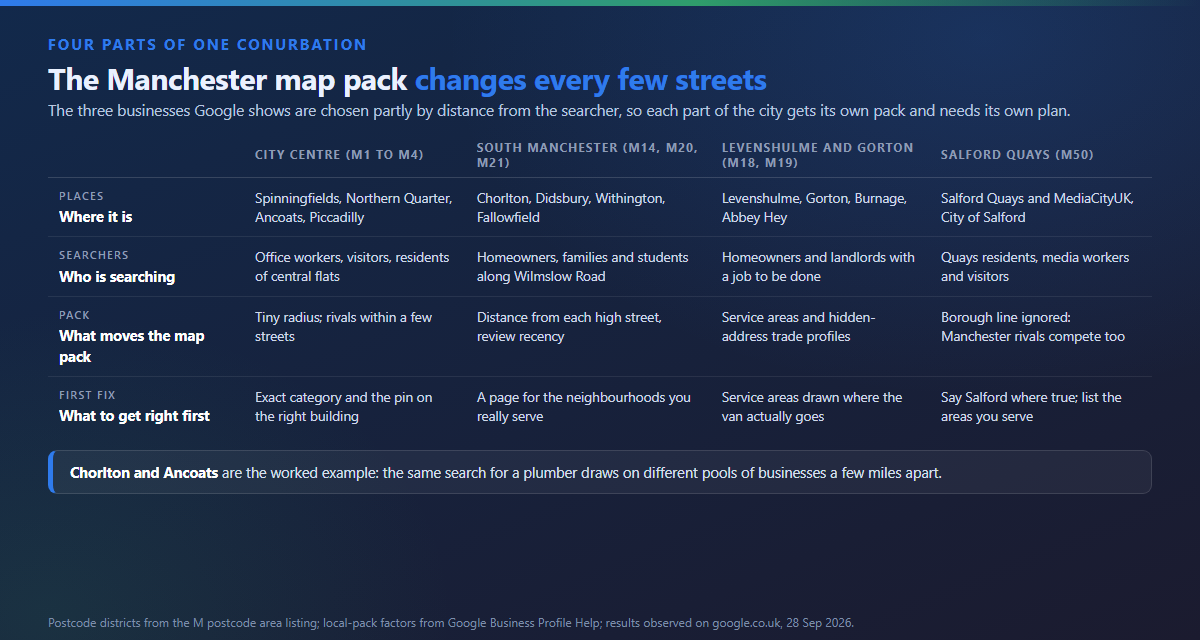
Why the plumber pack in Chorlton is not the pack in Ancoats
Take one search and two places. Chorlton-cum-Hardy sits about three miles south-west of the city centre, in the M21 postcode district, with the River Mersey along its southern edge, Beech Road and Chorlton Water Park within it, and Metrolink stops on the line that opened in July 2011. Ancoats sits immediately north-east of the city centre, in M4. It has been called the world’s first industrial suburb, it grew around cotton mills and the Rochdale Canal, and since the 1990s it has been renewed as a residential neighbourhood; its southern part, rebranded New Islington, now has a marina and its own tram stop.
Type “plumber” into a phone in each place. In Chorlton the searcher is typically a homeowner with a leak under the sink or a boiler that has given up, and Google draws the candidates from businesses in and around south Manchester. In Ancoats the searcher may be a tenant in a flat, a building manager or someone running a bar, and the candidates come from the city centre and the districts to the north and east. The two packs draw on different pools of businesses for different jobs.
So a plumbing business has to decide which contest it is really in. A plumber based in Stretford, just over the borough line in Trafford, can reasonably compete for Chorlton, Firswood and Whalley Range. It will struggle to appear for a searcher in an Ancoats apartment, because there are plumbers much closer who are just as relevant. Spending money trying to win Ancoats from Stretford is spending it against the map itself.
The same effect runs along a single road. Wilmslow Road runs north from Didsbury, about five miles south of the centre on the north bank of the Mersey, through Withington and Fallowfield, where the University of Manchester’s Fallowfield Campus and Owens Park halls bring a large student population, into Rusholme, where the stretch known locally as the Curry Mile is lined with restaurants and takeaways, and on towards the city centre as Oxford Road. Search “takeaway” or “dentist” at the Didsbury end and again at the Rusholme end and you are asking Google two different questions, with two different sets of neighbours competing for the answer.
None of this is a flaw. It is the system doing what it says it does. A Manchester business that understands it stops asking “where do I rank?” and starts asking “where do I rank from?”
Manchester is one of ten boroughs, and your customers ignore the lines
Greater Manchester was created on 1 April 1974 and has ten metropolitan boroughs: Manchester, Salford, Trafford, Stockport, Tameside, Oldham, Rochdale, Bury, Bolton and Wigan. Since 2011 they have worked together through the Greater Manchester Combined Authority. The City of Manchester is only one of the ten, and many places people think of as “Manchester” are not in it.
MediaCityUK, where BBC staff began moving in May 2011, has its main site on Salford Quays in the City of Salford, while the Coronation Street sets are across the Manchester Ship Canal at Trafford Wharf, in Trafford. Salford, a city since 1926, begins on the far bank of the River Irwell, directly opposite Manchester city centre. The Trafford Centre, Trafford Park and the Old Trafford football and cricket grounds are all in Trafford. On the other hand, the Etihad Campus in east Manchester, home to the Etihad Stadium and the Co-op Live arena that opened in May 2024, is inside the city, and so is Manchester Airport, at Ringway immediately south of Wythenshawe, about seven miles south-west of the centre; Wythenshawe itself was transferred from Cheshire to the City of Manchester in 1931.
The postcodes blur the lines further. The M postcode area has three post towns, Manchester, Salford and Sale. M3 covers parts of the city centre and also Blackfriars, Greengate and Trinity on the Salford side. M15 and M16 reach into Old Trafford, and the football ground’s own postcode is M16. An M postcode does not mean the City of Manchester.
None of this changes how distance is measured. Google does not draw the pack by borough. A business in Greengate is nearer to a searcher on Deansgate than a business in Wythenshawe is, whatever the council map says. People cross these lines all day, and the Metrolink, the most extensive light rail system in the UK, runs from the city centre to eight termini, among them Altrincham, Bury, Rochdale, Eccles, East Didsbury, Manchester Airport and the Trafford Centre.
What the lines do affect is honesty. A Salford business should say Salford where Salford is true, and can say it serves Manchester if it genuinely does. Google allows up to 20 service areas and asks that the overall area stays within about two hours’ drive of where the business is based, but a Manchester trade business rarely needs anything like that reach. Naming the neighbourhoods you actually visit is more useful than listing “Greater Manchester” and hoping. The service area describes where you go; it does not, on its own, make you appear everywhere you list.
A city-centre agency listing is not a Levenshulme trade business
A lot of local SEO advice quietly assumes one kind of business: a firm with an office people visit, somewhere central. That describes a marketing agency in the Northern Quarter, an accountant near St Peter’s Square or a law firm in Spinningfields, the business district between Deansgate and the River Irwell. It does not describe an electrician based in Levenshulme, and one plan does not fit both.
The city-centre office is a place customers come to. Its profile shows the address, its photographs should show the door, and the pin must sit on the right building, because the next competitor may be across the street. Its searchers are office workers, visitors and residents of central flats, and the realistic radius is tiny. A “digital marketing agency manchester” search made in Piccadilly and the same search made in Spinningfields can return different packs, simply because the two points sit near different clusters of agencies. Winning there is about precision: the exact category, the exact pin, reviews that keep arriving, and a page describing this office rather than the whole North West.
Google’s rules bite harder in the centre too. A virtual office, a rented mailing address the business does not operate from, is not eligible for a Business Profile. A co-working desk qualifies only with clear signage, customers received there and the business’s own staff there during business hours.
Levenshulme is a different world. It sits on the A6 roughly halfway between the city centre and Stockport, in M19, bordered by Longsight, Gorton, Burnage, Fallowfield, Heaton Chapel and Reddish, with its antiques village and its community market. An electrician based there goes to the customer rather than the other way round, which makes it a service-area business. Google’s guidelines say such a business should hide its address and show the areas it serves instead, and its searcher is a homeowner or landlord with a job to be done, often on a phone, often in a hurry.
So the plan is different: service areas drawn where the van actually goes, a phone that is answered, services listed one by one in customers’ words, reviews that describe real jobs, and a website page about Levenshulme, Burnage, Longsight and Gorton rather than the city centre it rarely visits. Both are “Manchester businesses”. As far as the map pack is concerned they have almost nothing in common.
What a geo-grid check shows that a single rank hides
If the pack changes every few streets, a single ranking number cannot describe it. Yet that is what most monthly reports contain: “position 2 for “plumber manchester””, measured from one point, often a coordinate somewhere in the city centre. It might be true from that point. It says nothing about Chorlton, Moston or Wythenshawe.
A geo-grid check is the fix. You lay a grid of points over the map around the business, say seven by seven points half a mile apart, and at each point you run the same search as though the searcher were standing there, recording where the business appears in the local results, if at all. The output is a map of coloured dots: strong near the business, fading with distance, dropping out where a competitor takes over. For the first time you see the patch you actually hold.
In Manchester that picture is usually revealing. A Didsbury dentist may be strong in M20 and fade within a mile or two, where the next cluster of dentists takes over. A city-centre bar may hold a few streets around its door and nothing beyond. A Harpurhey trade business on Rochdale Road may do better to the north than towards the centre, because the competition is thinner. None of that shows in a single number.
A few rules make the check worth having. Draw the grid over the area you actually serve, not the whole conurbation. Space it tightly in the centre and wider in the suburbs. Use the exact phrases customers type, with and without the neighbourhood name, and repeat the same phrases each time. Keep the first grid as a baseline, or you will never know what the work did.
It has limits, and anyone selling Google Maps work in Manchester should say what they are. A grid simulates location; it does not reproduce a real person’s search history or wording. It shows the map pack, not the organic results, and it does not show calls or bookings. That is why it belongs alongside the Business Profile’s performance data, which shows the search terms that surfaced the profile, with the searches figure updated at the start of each month, and alongside Search Console for the website.
Categories, names and service areas, set for how Manchester moves
Before any of the slower work, the Business Profile has to describe the business accurately, because that decides which searches it can appear for at all. Google’s guidance is to use as few categories as possible and to choose ones that are as specific as possible while still representing the main business; pick a specific category and Google includes the broader ones behind the scenes.
Manchester makes that easy to get wrong, because so many businesses here are two things at once. A restaurant on the Curry Mile is better served by the category for its actual cuisine than by a generic one. A Northern Quarter bar that also serves food should be clear about which it mainly is. A Fallowfield letting agent working mostly with student houses is still a letting agent. A manufacturer on an industrial estate in Wythenshawe or Roundthorn, in M22 or M23, probably needs the organic results more than the map pack, and should never be filed under a retail category. Choose the most specific category that is true, and mirror it in the Schema.org type on the website.
The name comes next, and in a competitive city the temptation to add keywords is strong. Google’s guidelines say the name should reflect the business’s real-world name, as used on the shopfront, website and stationery, and list location and service information among the things that should not be added. “Smith Plumbing” is a name. “Smith Plumbing Manchester Emergency Boiler Repairs” is a suspension waiting to happen.
Then the address and the service areas. If customers come to you, show the address and check the pin sits on the right building, which matters more in a tight grid of city-centre streets than anywhere else. If you go to customers, hide the address and name the neighbourhoods you genuinely cover: Chorlton, Didsbury, Withington, Levenshulme, Gorton, Moston, Harpurhey, Wythenshawe, or wherever the van goes.
After that, hours that are true, services listed individually, photographs that are yours, and a description written for a Mancunian customer rather than a keyword tool. Each field is small. Together they are most of what relevance means.
Reviews in Manchester, read by the next customer first
Google says plainly that more reviews and positive ratings can help a business’s local ranking. Customers read them before they call, and business owners read them before they hire an agency. Where three businesses of the same kind may be a few minutes apart, the reviews often decide the call.
What matters is less the total than the pattern. A profile with a strong average and nothing new for a year looks dormant next to a competitor whose reviews arrive every week. Reviews that describe real jobs, a boiler fixed in Moston, a filling done on a Saturday morning in Didsbury, tell the next reader far more than a row of stars with no words. You should not script them, but asking every customer at the same point, with a direct link, produces reviews that naturally mention the places and jobs you do.
The rules are strict and getting stricter. Google’s fake-engagement policy prohibits offering payment, discounts or free goods and services in exchange for reviews, and prohibits discouraging negative reviews or selectively asking only happy customers. In the UK the Digital Markets, Competition and Consumers Act 2024 goes further: since its consumer rules came into force on 6 April 2025, submitting or commissioning fake reviews, and concealing that a review was incentivised, are banned, and the Competition and Markets Authority can act against them directly.
Reply to every review, good and bad, and write for the next reader rather than the reviewer. A calm, specific reply to a bad review often does more for the next customer’s confidence than the good reviews around it. And when you are the one reading, on an agency’s profile for example, look at the dates, whether reviews describe actual work, and whether a large batch arrived all at once.
What Google has actually published about reviews and local rankings, and the rules that ban incentives, gating and fake reviews, are set out in the guide to reviews and SEO.
How to judge local SEO companies before you sign anything
Search for marketing agencies in Manchester and you get a mix: full-service digital marketing agencies, SEO specialists, web designers who also offer SEO, freelancers and remote specialists like me. The label tells you little. How each one answers a few plain questions tells you a lot.
Where will you measure from? If the answer is a single ranking position, ask for a geo-grid over the area you serve, before and after.
What will you change on my profile first, and why? A good answer names fields: the primary category, the services, the service areas, the pin. A vague answer about “optimisation” is a warning.
Will you build a page for every neighbourhood? Pages per area are legitimate when each describes something real. Near-identical pages with the district name swapped are what Google’s spam policies call doorway abuse, which includes pages targeted at specific regions or cities that funnel users to one page.
Who owns the profile and the accounts? You should. An agency can be added as a manager, but the business should stay the owner.
Who does the work? You should know who is touching your profile and website, and get a written account each month.
Then the red flags: a promised position in the map pack, when Google says there is no way to pay for a better local ranking; any offer to supply reviews; a virtual office or borrowed address; “Manchester” stuffed into your business name; submissions to hundreds of directories. A careful shortlist of Manchester local SEO agencies removes these first and compares the rest.
Price is the question everyone asks and agency pages answer least. How local SEO is usually priced, what drives the cost and what a fair monthly scope looks like is set out in a separate guide to what local SEO costs. The short version: pay for work you can see and measure, not for a report.
A fair word on distance. A Manchester agency can visit you, and some owners value that. A remote specialist works from the same data, profile and documentation. What matters is whether the person doing the work plans for the streets you actually serve.
What the work looks like for a Manchester business
Everything below is done by one person, remotely, and reported in writing: what was done, what moved, what comes next. The full scope is on my local SEO service page; this is how it applies here.
Define the patch. Which postcode districts and neighbourhoods your customers come from, and which searches they make, with and without a place name. For a Chorlton business that might be M21, M16 and the edge of Trafford; for a city-centre business, a few streets.
Baseline the grid. A geo-grid for two or three searches that matter, over that patch, before anything changes.
Fix the profile. Category, name, address or service areas, hours, services, photographs, description. Often the change that shows fastest, because it alters eligibility rather than slowly building authority.
Build the page. A page for the area you really serve, written so it could not be relabelled for the next district along, marked up with the right Schema.org type and linked from the navigation.
Make the details consistent on the website, the Business Profile, Bing Places, Apple Business (formerly Apple Business Connect) and the few directories that matter in your trade, correcting wrong listings rather than piling on new ones.
Run reviews as a process, and earn a few real local links: your trade body, the club you actually sponsor, local press when there is news.
Measure for a quarter. Repeat the grid monthly, read the profile’s search terms and calls, and read Search Console. Map results can move within weeks; organic results take months.
Not every Manchester business stops at the city edge. If your customers run south past the airport into Cheshire, the pattern changes: fewer competitors, a wider radius, and a profile that can hold far more ground than it could in M20. The Knutsford page works through a Cheshire East market town about 14 miles south-west of Manchester, where that looser map is the norm.
What I will not do: promise a position, buy reviews or links, invent an address, or build a page for every Manchester district from one template. The city’s results already have plenty of that. What they lack is businesses whose profile, page and reviews match the few streets where their customers actually stand.
What a client said, and what you can check
“Great communication and very helpful throughout the process. Took the time to explain everything clearly and set up the campaign professionally. Focused on quality results rather than just numbers. Highly recommended.”
This is one of three client reviews published so far; the other two, from a UK SEO client and a US Google Ads client, are on the home page. Every figure comes from the client’s own ad account, and a review goes on this site only when it is real.
What you can check before you pay
- Prices published in full on the pricing page, not hidden behind a sales call
- Month to month, with one month’s notice and no lock-in contract
- Every account, profile and file stays in your name; I work through partner access
- A written report every week, in plain English
- One specialist does the work, from the audit to the report
Manchester local SEO questions, answered plainly
Why do I appear on the map at work but not when I search from home?
Because the map pack is built around the person searching. At your premises you are as close to your own business as any searcher can be. From home, perhaps in another part of the city, closer competitors are just as relevant and win on distance. A geo-grid check shows the whole patch at once, which is far more useful than checking from two places.
Is local SEO in Manchester harder than in a smaller town?
Tighter rather than harder. In a small town one well-set profile can cover the whole place. In Manchester, the most densely populated local authority area in the North West, similar businesses sit close together, so each profile holds a smaller patch. The work is the same; the targets are more local and details such as the exact pin and category matter more.
My business is in Salford or Trafford. Should I say Manchester?
Say where you are, and say who you serve. A Salford business should not pretend to be in the City of Manchester, but it can list the Manchester neighbourhoods it genuinely serves as service areas and describe them on its website. Google measures distance on the map, not by borough.
Do I need a Manchester address to appear in the Manchester map pack?
You need a real presence: premises where customers are served, or a genuine service area around where you are based. A virtual office is not eligible for a Business Profile, and a co-working desk only qualifies with signage, customers received there and your own staff present during business hours. Borrowed addresses are the quickest route to a suspended profile.
How many service areas should a Manchester trade business list?
Google allows up to 20, but the useful number is however many places you genuinely go. Name real neighbourhoods rather than a whole region. Service areas describe your coverage; they do not on their own make you appear everywhere you list, so accuracy beats length.
What is a geo-grid check, and do I need one?
It runs the same search from a grid of points around your business and records where you appear at each, producing a map of your visible patch. In a dense city it is the honest way to see local visibility, because a single ranking position describes one spot. Use it alongside your profile’s performance data and Search Console.
How many reviews does a Manchester business need?
There is no magic number, and anyone quoting one has made it up. What helps is a steady flow of genuine reviews and a reply to each. A recent, specific review persuades the next customer more than an old one. Never buy or incentivise them; in the UK that is now a legal matter as well as a breach of Google’s policies.
Should I build a page for every Manchester neighbourhood?
Only for neighbourhoods you genuinely serve, and only if each page says something true and specific about serving that place. Near-identical pages with the district name swapped are what Google’s spam policies describe as doorway abuse. A few honest pages do far more than dozens of templates.
How long before changes show in the map pack?
Profile corrections, such as a better category or accurate service areas, can show within days or weeks because they change which searches you are eligible for. A new area page takes weeks to be crawled and months to settle. Reviews and links build over a year. Anyone giving a date for a specific position is guessing.
How do I compare local SEO agencies in Manchester?
Ask each the same questions: where they will measure from, what they will change on your profile first, who owns the accounts, who does the work and what you will see each month. Rule out anyone promising positions, offering reviews or suggesting an address you do not operate from, then compare the clarity of the plans that remain.
You work from Lahore. Does that matter for a Manchester business?
For the work, no. Everything is done through your Business Profile, your website, Search Console and written reports, and none of it depends on standing in Manchester. It does mean I will never claim a Manchester office or put a Manchester address on anything, and never suggest you use one you do not operate from.
Tell me which streets your customers search from
Send the business name, the website and the parts of Manchester your customers actually come from. You get a written answer: where you show in the map pack across those streets, whether the Business Profile or the website is the weak point, what Search Console already says, and what I would fix first. It costs nothing and there is nothing to sign.