
Web design and SEO package, scoped together in one written quote
A web design and SEO package should do one thing that a separate build and a separate SEO contract cannot: settle the search decisions before the pages are designed. The page plan, URLs, internal links, speed, structured data and tracking are decided once, in writing, inside accounts you own. This page covers what the phrase means, what a package should list, the red flags, the UK rules a new site must meet, and what my own builds and SEO Foundation cost at their listed prices.

Two trades on one website, and what the phrase really means
Type “web design and seo” into google.co.uk and the suggestions show what people are unsure about: its meaning, how to do it, a step-by-step method, templates, and which companies offer it. For “web design and seo package” the questions turn to money: examples, cost, companies, marketing services and the development agency route. This page answers both, from public sources and my own published prices.
Web design is the planning, design and build of a site: its pages, layout, navigation, copy, forms and the HTML, CSS and JavaScript underneath. Search engine optimisation, or SEO, helps those pages get crawled, understood and chosen by search engines. In the UK that mostly means Google: StatCounter put its UK search market share at about 91 per cent in September 2026, with Microsoft Bing at about 6 per cent.
The two meet at almost every decision. The page structure a designer sketches is the site architecture Googlebot crawls. The navigation is the internal linking. The hero image decides Largest Contentful Paint. The URL a service page gets on the first day is the URL that collects links for years.
So a web design and SEO package, in plain terms, is a build and an SEO foundation scoped together before the first page is designed, in one written quote. Here that means two things I already sell at listed prices, a build and the SEO Foundation, on one scope and one delivery plan, with a monthly retainer afterwards only if the site needs ongoing work. There is no bundle discount. The value is in the order of work.
One disclosure: I work alone and remotely from Lahore, in Pakistan, and I have no office or staff in the UK. Everything is built inside accounts you own.
Why the build and the SEO belong in the same plan
Google’s own page on hiring an SEO names the moment to do it: when you are considering a site redesign, the earlier the better, or planning to launch a new site. Several SEO decisions are really build decisions, cheap on a wireframe and expensive after launch.
Site architecture. Which pages exist and how they group. A plumber offering boiler repair, bathroom fitting and emergency callouts needs a page for each, because each is a different search. A one-page site with the services as tabs gives Google a single page to rank for everything, and a page buried four clicks deep is harder for visitors and crawlers to reach than one in the main navigation.
URL structure. Google recommends readable words rather than long ID numbers, hyphens rather than underscores, and one consistent case, because URLs are case-sensitive. A path like /services/boiler-repair/ explains itself to a person and a crawler; /index.php?page_id=482 explains nothing.
Internal linking. Google’s SEO Starter Guide says the vast majority of new pages Google finds every day are found through links, and that good anchor text tells users and search engines what a linked page contains before they visit it.
Redirects on a redesign. Google’s site-move guidance says to map every old URL to its new one, use permanent server-side redirects such as 301 Moved Permanently or 308 Permanent Redirect, and keep them for as long as possible, generally at least a year. A redesign that launches without that map throws away whatever the old pages had earned.
Titles and headings. The title element, the single H1 and the H2s beneath it are design as much as SEO. Google says a good title is unique to the page, clear and concise, and that Google Search does not use the keywords meta tag, so a package that bills for meta keywords is billing for nothing.
Core Web Vitals and mobile-first indexing are design decisions
Since 5 July 2024, Google has moved the last sites still crawled by its desktop crawler over to Googlebot Smartphone, and a site whose content cannot be reached on a mobile device can no longer be indexed. Under mobile-first indexing, Google uses the mobile version of a site’s content for indexing and ranking, so text, links or structured data that exist only in the desktop layout effectively do not exist.
Core Web Vitals are Google’s three measures of real page experience. Largest Contentful Paint (LCP) measures loading, and good is within 2.5 seconds. Interaction to Next Paint (INP) measures responsiveness to taps, clicks and key presses, and good is 200 milliseconds or less; INP replaced First Input Delay as a Core Web Vital on 12 March 2024. Cumulative Layout Shift (CLS) measures visual stability, and good is 0.1 or less. Each is judged at the 75th percentile of page loads, split between mobile and desktop. Google says good scores align with what its core ranking systems seek to reward. Most of what decides them is set at design time.
The hero image. Serve it as WebP or AVIF at its displayed size, and never lazy-load it: research published on web.dev found that lazy-loading images above the fold made LCP measurably worse. Put meaningful images in HTML img elements with useful alt text, because Google does not index CSS background images.
Reserved space. Width and height attributes on every image and video, or a CSS aspect-ratio, stop the page jumping as media arrives, and cookie banners, chat widgets and embedded maps need room reserved too.
Scripts and page builders. Every tracking tag, slider and animation library competes with the visitor’s first tap, which is what INP measures, and heavy page builders load CSS and JavaScript the page never uses. I target a load under two seconds on landing pages, so those choices are made before building.
HTTPS. Google announced HTTPS as a lightweight ranking signal in 2014, and since Chrome 68 in July 2018 every plain HTTP page has been labelled “Not secure”. Let’s Encrypt, a free and automated certificate authority run by the not-for-profit Internet Security Research Group, removed the cost excuse long ago.
Measuring it. PageSpeed Insights shows field data from the Chrome UX Report (CrUX), covering real visitors over the previous 28 days, and lab data from Lighthouse, a simulated test on fixed settings. A new site may have no field data yet, so Lighthouse is the early check, and the Core Web Vitals report in Search Console, which also draws on CrUX, takes over as visits build.
Schema, sitemaps, robots.txt and canonical tags, the parts nobody sees
Structured data. Schema.org is a shared vocabulary founded by Google, Microsoft, Yahoo and Yandex, and Google recommends writing it as JSON-LD. For a service business the useful types are LocalBusiness, using the most specific subtype such as Plumber, Dentist or AccountingService, with PostalAddress, GeoCoordinates and OpeningHoursSpecification inside it; Service for each service, with serviceType, provider and areaServed; BreadcrumbList for the page trail; and Organization and WebSite for the brand. Google treats name and address as required for LocalBusiness, says not to mark up content that readers cannot see, and says correct markup makes a page eligible for rich results without ensuring them.
FAQPage, and what changed in 2026. Google limited FAQ rich results to well-known, authoritative government and health websites in August 2023, then stopped showing them altogether on 7 May 2026. FAQPage remains a valid schema.org type, and Google’s John Mueller said sites need not change anything. But a package still selling “FAQ rich snippets” is selling something Google no longer displays. The Rich Results Test checks only the features Google still supports; the Schema Markup Validator at validator.schema.org checks any schema.org markup.
XML sitemap. One sitemap file can hold 50,000 URLs or 50MB uncompressed. Google ignores the priority and changefreq values some sitemap generators still write, and uses lastmod only when it is consistently and verifiably accurate. Submit the sitemap in the Sitemaps report in Search Console and list it in robots.txt.
Robots.txt. The file must sit at the root of the host, and it controls crawling, not indexing: Google says it is not a mechanism for keeping a page out of Google. To keep a page out, use a noindex rule and leave the page crawlable so Google can read it. The launch mistake I check for first is a staging site’s blanket block or noindex carried over to the live domain.
Canonical tags. One page can exist at several addresses: with or without www, over HTTP or HTTPS, with a trailing slash or a tracking parameter. Google treats redirects and rel=canonical link elements as strong signals of the preferred version and sitemap inclusion as a weak one, and still makes the final choice, so all three should agree.
Bing. The same sitemap belongs in Bing Webmaster Tools, and IndexNow can notify Microsoft Bing, Naver, Seznam.cz, Yandex and Yep of new or changed URLs as they go live.
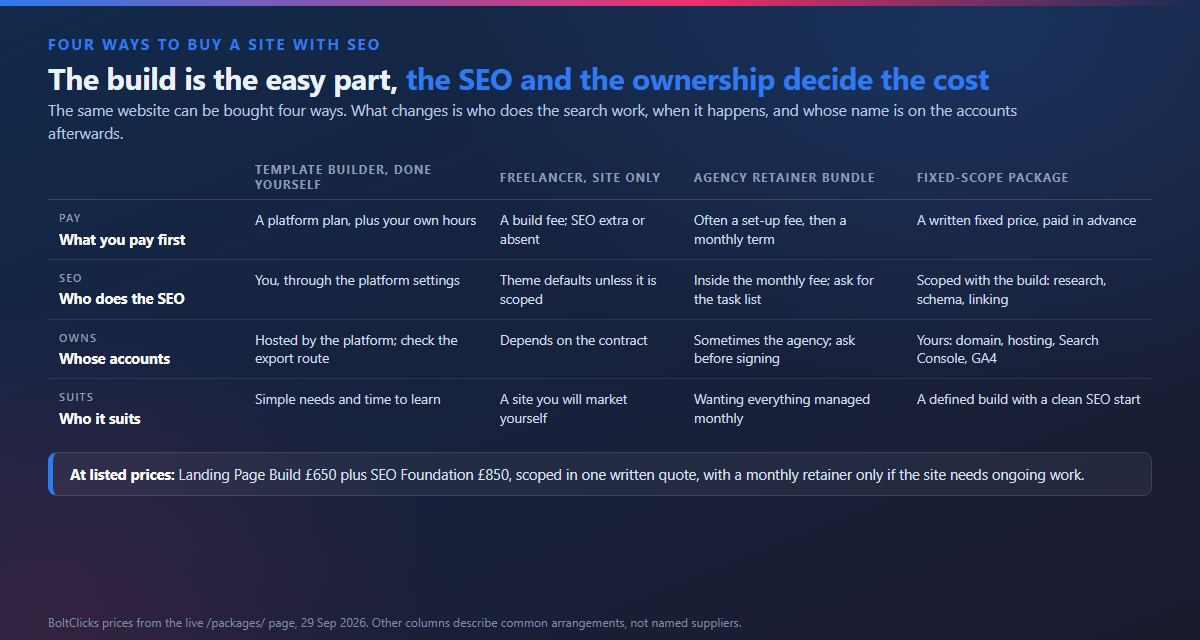
Templates, freelancers, agencies or a fixed scope: choosing the route and the builder
There are four common routes to a site with SEO, and the choice depends less on budget than on who does the search work, and who owns the result, after launch.
A template builder, done yourself. The cheapest route in cash and the dearest in time. Before committing, check that you can edit each page’s title, meta description, URL and headings, add JSON-LD, set up redirects and export your content if you leave. The SEO is then yours to do.
A freelancer, site only. Often good design at a fair fee, with SEO limited to whatever the theme does by default. If the answer to “is SEO included?” is that the site will be SEO-friendly, treat it as a no until the tasks are written down.
An agency or specialist firm. Roughly: web design and SEO companies build sites and optimise them; a development agency is strongest on code, integrations, e-commerce and custom applications; a marketing services firm runs paid search, paid social and email, and may subcontract the build. Many sell a retainer bundle, a set-up fee plus a monthly term covering hosting, updates and “SEO”. Read what happens at the end of the term and whose name is on the domain.
A fixed-scope package. A written list of what gets built and which SEO tasks get done, a fixed price, a delivery date and a handover into accounts you own.
Templates or a custom build? A template is quicker and cheaper to start and often carries code for features you never use; a custom build loads only what the page needs. Neither is automatically better for SEO, and a template page can rank if it is useful, fast and crawlable. For landing pages and small sites I usually hand-build in HTML and CSS, which loads fast, costs nothing in licences and leaves little to attack. WordPress makes more sense for frequent blogging, an online catalogue or several people editing content.
What a web design and SEO package should list in writing
The written scope should let you tick off every item on launch day. “SEO-optimised” and “fully responsive” are adjectives, not deliverables.
A page plan and URL map. Every page, its URL, the search it is written for and its place in the navigation; on a redesign, every old URL with its redirect target.
Keyword research mapped to intent. One main query per page, so two pages never compete for the same search.
On-page work. A unique title, one H1, ordered headings, a meta description, alt text and descriptive internal links on every page.
Technical set-up. HTTPS everywhere, one preferred version of each URL, an XML sitemap, robots.txt, a 404 Not Found page that helps people onwards, and JSON-LD that matches the visible page.
A performance target. A number, such as the Core Web Vitals thresholds, tested on a phone. “Fast” is not a target.
Accessibility. WCAG 2.2 criteria named, not implied: 1.1.1 Non-text Content for alt text, 1.4.3 Contrast (Minimum) at 4.5:1 for normal text, 2.1.1 Keyboard, 2.4.7 Focus Visible and 3.3.2 Labels or Instructions on every form.
Compliance and measurement. A privacy notice, cookie consent that holds back non-essential tags, the legally required business details, and Search Console and Google Analytics 4 in your name, with conversion tracking on the enquiries that matter.
Handover. Every login, and a note of what was done and why.
Against that list, my Landing Page Build covers one mobile-first page with copywriting included, an under-two-second load target, conversion tracking from day one, a privacy policy and cookie consent, hosted on your own account with the files yours. Every build gets title tags, heading structure, schema markup, clean URLs and an XML sitemap as standard. The SEO Foundation adds a full technical audit with a prioritised fix list, keyword research mapped to buying intent, on-page optimisation across ten priority pages, schema markup and internal linking rebuilt, Search Console and GA4 set up in your name, and a six-month content plan with briefs.
Red flags in a package, and the question each one needs
Most weak packages are vague rather than dishonest. Query these lines before paying.
Bulk directory submissions. Google’s spam policies list low-quality directory or bookmark site links as link spam. A few real listings, such as Google Business Profile, Bing Places for Business, Apple Business (formerly Apple Business Connect) and your trade body, are housekeeping; “500 directory submissions” is not a service.
No Search Console access. If the supplier holds the property and sends you screenshots, you cannot see what Google sees, and you lose up to 16 months of performance history when you leave. Ask for a Domain property verified through a DNS record, with you as owner, since only owners can add or remove users.
Hosting or platform lock-in. A proprietary platform, or a domain registered in the supplier’s name, turns a contract into a hostage situation. Ask whose name is on the registration, whose card pays for hosting, and whether you get the files and the database when you leave.
Per-page SEO add-ons. A build quoted without titles, headings, a sitemap or schema, with SEO sold per page on top, has had the basics stripped out to make the headline figure look lower. Paid SEO should buy research, structure and content, not the correct use of an H1.
Promises about positions. Google’s page on hiring an SEO warns against anyone who claims to secure a top ranking, claims a special relationship with Google or advertises a “priority submit”. For the local map, Google says there is no way to request or pay for a better ranking.
Out-of-date promises. FAQ rich snippets, meta keywords or a Universal Analytics set-up in a proposal show it was written from old notes; standard Universal Analytics properties stopped processing data on 1 July 2023.
Town pages by the dozen. Google’s spam policies describe doorway abuse, pages created to rank for specific, similar searches, and scaled content abuse, many pages generated mainly to manipulate rankings. Fifty near-identical location pages fit both.
What web design and SEO packages cost, with worked examples at listed prices
A figure for “web design and seo packages cost” means little without the scope behind it, so read any package in four layers. Is the fee one-off or monthly? Multiply a monthly fee by the minimum term before comparing. What is fixed and what can move: pages, revision rounds, copy, photographs? What sits outside the fee: hosting, domain renewals, plugin or theme licences, email, stock images, ad budget? And does the SEO line name deliverables, or just say “SEO”?
My prices are published, so here is how they combine. Each keeps its listed price, is paid in advance against a written scope, and carries no bundle discount.
Example 1: a new landing page on an existing site. The Landing Page Build is £650 for one page, delivered in five working days, with copywriting included. Adding the SEO Foundation at £850 covers the rest of the site over two to three weeks, with a technical audit and prioritised fix list and on-page optimisation across ten priority pages. Because the Foundation works across ten priority pages, it suits a new page joining a site that already has several; a standalone one-page site needs only the build, which already carries the on-page basics.
Example 2: a small business site of four to six pages. This takes two to three weeks. It has no listed price; it is quoted as a fixed price, agreed up front in the written quote that follows the scope call. Paired with the SEO Foundation at £850, the keyword research shapes the pages instead of being bolted on later.
Example 3: a business serving one area. Add Local Launch at £650 per location: Google Business Profile fully optimised, a citation audit with name, address and phone number made consistent, core directory listings, a review request process, two location pages for your website and a rank tracking sheet you keep.
Example 4: the site and the advertising together. Full Launch starts from £3,200, scoped per business, over four to six weeks: a website or landing pages, Business Manager and tracking set up correctly, Meta Ads and Google Ads campaigns built, local SEO for one market and full handover documentation.
All of these are listed on my fixed-price packages page, and what goes into each build is set out on the website builds page. The price covers the work only: hosting, domains and ad spend are paid by you, directly, in your own accounts, and for a small site hosting typically runs to a few pounds a month and a .co.uk domain to around £10 a year. If the job turns out bigger than the package, you are told before anything starts, and either the scope is trimmed to fit or the larger job is quoted separately.
The UK rules a new website must meet on launch day
This is a summary for most UK business websites, not legal advice; each regulator publishes the detail.
UK GDPR. A contact form collects personal data, so under UK GDPR and the Data Protection Act 2018 the site must give privacy information at the point of collection, as Article 13 requires: why you process the data, how long you keep it and who receives it. Unless an exemption applies, organisations that process personal data must also pay the data protection fee to the Information Commissioner’s Office (ICO): £52, £78 or £3,763 depending on size. The ICO can fine up to £17.5 million or 4 per cent of annual worldwide turnover.
PECR and cookies. Regulation 6 of the Privacy and Electronic Communications Regulations 2003 requires consent before non-essential information is stored on, or read from, a visitor’s device. The Data (Use and Access) Act 2025 added exceptions, including statistics collected only to improve your own site, provided visitors get clear information and a simple, free way to object. The ICO says that exception does not cover online advertising, and that an analytics provider must act only as your processor, so a site running ad pixels still needs a consent banner. After reviewing the top 1,000 UK websites, including whether rejecting advertising cookies was as easy as accepting them, the ICO reported in December 2025 that 979 met its checks. Since 5 February 2026, PECR fines share the UK GDPR ceiling.
Google’s consent rules. Google’s EU user consent policy covers visitors in the European Economic Area, the UK and Switzerland. Consent Mode passes each visitor’s choice to Google’s tags, and its second version added the ad_user_data and ad_personalization signals.
Business details. Under the Company, Limited Liability Partnership and Business (Names and Trading Disclosures) Regulations 2015, a limited company’s website shows its registered name, registered number, registered office address and where it is registered (England and Wales, Scotland or Northern Ireland); GOV.UK adds that it should be clear the business is a limited company, usually through “Limited” or “Ltd” in the full name. Regulation 6 of the Electronic Commerce (EC Directive) Regulations 2002 adds a geographic address, an email address and any VAT number, and says prices shown must state whether they include tax and delivery.
Accessibility. WCAG 2.2 became a W3C Recommendation on 5 October 2023. It added nine success criteria, among them 2.4.11 Focus Not Obscured (Minimum), 2.5.8 Target Size (Minimum), at least 24 by 24 CSS pixels, 3.3.7 Redundant Entry and 3.3.8 Accessible Authentication (Minimum), and it removed 4.1.1 Parsing. For private businesses the legal duty comes from the Equality Act 2010. Guidance from the Equality and Human Rights Commission says the reasonable adjustments duty covers websites, is anticipatory, and applies whether the site is one page or a sophisticated one maintained by a professional web design company. The Public Sector Bodies (Websites and Mobile Applications) (No. 2) Accessibility Regulations 2018, under which GOV.UK guidance expects WCAG 2.2 AA and an accessibility statement, bind only the public sector. Selling services online to consumers in the EU can also bring in the European Accessibility Act, applying since 28 June 2025, with EN 301 549 as the usual technical reference, though microenterprises providing services, with fewer than ten staff and no more than €2 million turnover or balance sheet, are exempt.
Claims and reviews. Since 1 March 2011 the Advertising Standards Authority has applied the CAP Code to marketing claims on a business’s own website. Since April 2025, fake reviews, concealed incentivised reviews and hiding negative reviews have been banned practices under the Digital Markets, Competition and Consumers Act 2024, which the Competition and Markets Authority enforces with fines of up to 10 per cent of global turnover.
Domain, hosting, CMS and analytics in your name from day one
The quickest test of any package is to ask whose name will be on each account. Everything below should be yours, with the supplier given its own access, never your password.
The domain. The registrant is the legal holder of a domain name. For .uk names, Nominet requires registrant details that are accurate and clearly identify the registrant, so the registrant should be your business, not your web designer. Nominet’s public WHOIS hides a registrant’s name and address unless they opt in, so ask the registrar to confirm the registrant in writing. For a .com, the account at the ICANN-accredited registrar should carry your email address and your card.
DNS and hosting. DNS records point the website at its host and the email at its mail provider, so whoever controls DNS controls both. Hosting should be an account in your name, paid by you, with the supplier added as a user.
The site itself. The files, the database, the top-level admin account in the content management system, and any theme or plugin licences, bought in your business’s name.
Google Search Console. A Domain property, which covers every subdomain and both HTTP and HTTPS and can only be verified through DNS, with you as owner and the supplier as a full user.
Google Analytics 4. You as Administrator; the other roles are Editor, Marketer, Analyst and Viewer, and a supplier rarely needs more than Editor. For a standard property, set data retention to 14 months rather than 2.
Google Business Profile. You as primary owner, with any supplier added as a manager, a role that can edit the profile but cannot add or remove users.
That is how every package here runs: paid in advance, partner or user access, never your passwords, and everything built inside your accounts with a written walkthrough. With no proprietary platform or licence, leaving costs nothing.
How to do web design and SEO together, step by step
This is the order I work in on a combined build, and it doubles as a checklist for any supplier.
- Scope call. Twenty minutes on what the site must do. If a package does not fit, I say which one does, or that none of them do.
- Written quote. What is included, what is not, and the delivery date. The price does not move after this.
- Payment and access. Paid in advance, then access to your domain, hosting, Search Console and GA4, with any missing account created in your name.
- Research and the page plan. Keyword research mapped to buying intent, one main query per page, every URL fixed and, on a redesign, a redirect map for every old URL.
- Content. Copy written to the page plan, by you or, if you would rather not, by me, with your photographs. The main thing that delays projects is waiting on content, so have photos, service descriptions and prices ready before the start.
- Design and build, mobile first. One clear action per page, accessible markup, compressed images and the speed target checked on a real phone.
- On-page and technical SEO. Titles, headings, internal links, JSON-LD, canonical tags, the XML sitemap and robots.txt.
- Compliance. The privacy notice, cookie consent that genuinely gates analytics and advertising tags, and the business details in the footer.
- Pre-launch checks. No leftover noindex or blanket block, redirects and forms tested one by one, markup through the Rich Results Test, key pages through PageSpeed Insights, and a keyboard-only pass.
- Launch and handover. The sitemap submitted in Search Console, the main pages checked with the URL Inspection tool, a written walkthrough, and the six-month content plan where the SEO Foundation is in scope.
On timing, a single landing page is delivered in five working days once content is in, a four-to-six-page site takes two to three weeks, and so does the SEO Foundation. When the two are scoped together, the research comes first so it can shape the pages.
Indexing, content and the retainer question, once the site is live
Google’s SEO Starter Guide says some changes take effect in a few hours and others take several months, and suggests waiting a few weeks before judging whether work has helped.
Indexing. Google says not to expect every URL on a site to be indexed, and the Page indexing report in Search Console shows why pages are left out. “Discovered – currently not indexed” means Google found the URL but has not crawled it yet; “Crawled – currently not indexed” means it was crawled and not indexed for now, with no need to resubmit. The URL Inspection tool can request indexing within a daily limit, and Google says a request does not ensure the page is indexed. Improving a page, or linking to it more clearly, usually does more than resubmitting it.
Reading the data. The Performance report shows queries, impressions, clicks, click-through rate and average position, with 16 months of history.
The content plan. The SEO Foundation ends with a six-month content plan and briefs, which you can write from yourself, pass to a copywriter, or hand to a retainer.
When a retainer makes sense. In a competitive market, when you want new content every month without writing it, when the site needs regular technical fixes, or when links have to be earned through outreach. My monthly SEO retainers are £299, £449 and £649 a month, month to month, paid in advance, with one month’s notice either way and no lock-in; the monthly SEO pricing page lists what each level includes.
When it does not. When the business serves one area with a handful of services, the site changes rarely, and you are happy to work through the plan yourself. Small tweaks in the first month after a build are included anyway, and if a retainer is not the right fit yet, I will say so rather than sell you one.
The names on a web design and SEO quote, and what to ask about each
Quotes for a website with SEO tend to list product names rather than outcomes. A name on its own tells you very little, so here is what the common ones are and the one question worth asking about each. None of them is a reason to pay more on its own; what matters is who sets it up, whose account it sits in, and what it is used for after launch.
| Name on the quote | What it is | The question to ask |
|---|---|---|
| WordPress | Open-source content management system you can install on any web host that runs PHP and MySQL or MariaDB | Whose hosting account is it in, and do I get the admin login? |
| Wix, Squarespace, Shopify, Webflow | Hosted platforms that bundle hosting and the editor into a monthly plan | What happens to the site and the content if I stop paying for the plan? |
| Elementor, Divi, the WordPress block editor (Gutenberg) | Page builders and editors that decide how pages are laid out in WordPress | Will I be able to edit text and photos myself, and how much extra code does the builder load on each page? |
| SiteGround, Hostinger, Kinsta, WP Engine | Examples of hosting companies; managed hosts take backups for you, and some also apply plugin and theme updates, sometimes as a paid add-on | How often are backups taken, where are they kept, and whose card pays the renewal? |
| Nominet, 123 Reg, GoDaddy, Namecheap | Nominet runs the .uk registry; the others are registrars that sell and renew domain names | Is the domain registered to my business, and will I have the registrar login? |
| Google Workspace, Microsoft 365 | Business email on your own domain, which depends on the same DNS settings as the website | Will moving the site or the DNS touch my email records, and who checks it on launch day? |
| Hotjar (now part of Contentsquare) | Heatmaps, recordings and on-page surveys; Hotjar is now part of Contentsquare, where new sign-ups get a free plan with paid tiers above it | Is it needed at launch, or only once there is enough traffic to learn from? |
| Meta Pixel and the Conversions API | Meta’s tracking for Facebook and Instagram ads, from the browser and from the server | Is it set up in my own Meta business portfolio, and does it respect the consent choice? |
| Google Merchant Center | Where a shop’s product feed goes so products can appear in Google’s free listings and Shopping ads | Is it relevant to what I sell, or is it on the quote by default? |
| Yoast SEO, Rank Math, SEOPress | WordPress plugins that write title tags, meta descriptions, sitemaps and some schema | Who writes the titles and descriptions? A plugin can fill the fields from a template or, in paid versions, suggest AI wording; someone still has to choose the words. |
| Google Tag Manager | A container that loads tracking tags without editing the site code each time | Which tags will it load, and do they wait for cookie consent? |
| Google Analytics 4 and Microsoft Clarity | Visit and conversion reporting; Clarity adds free session recordings and heatmaps | Which enquiry actions are set up as key events, and are the recordings covered by the consent banner? |
| Google Search Console and Bing Webmaster Tools | The search engines’ own reports on indexing, queries and errors for your domain | Will they be verified in my name, with you added as a user? |
| Screaming Frog SEO Spider | A desktop crawler that follows a site’s links and lists each URL it finds with its status code, title and canonical; the free version crawls up to 500 URLs | Can I see the crawl before launch, with broken links and duplicate titles at zero? |
| Semrush and Ahrefs | Research suites for keywords, competitors and backlinks; both have limited free accounts, and the full tools are paid | Which keywords did the research pick, and why those? |
| WAVE and axe DevTools | Automated accessibility checkers from WebAIM and Deque, each with a free browser extension and paid versions that add more | What was checked by hand? Automated tools catch only part of what WCAG 2.2 asks for. |
| Cloudflare, LiteSpeed Cache | A content delivery network and DNS service; a WordPress caching plugin whose page cache needs a LiteSpeed web server or the QUIC.cloud CDN | What does the caching change for logged-in editing and for forms? |
| Let’s Encrypt, HTTP/2, HTTP/3 | Free TLS certificates for HTTPS; newer protocols that let a browser load many files at once over a single connection | Does the certificate renew automatically, and who is told if it fails? |
| Google Business Profile, Bing Places, Apple Business | The free business listings behind map results on Google, Bing and Apple Maps | Will the listings be claimed in my name, and which categories will be set? |
| Unsplash, Pexels, Pixabay, Canva | Free and subscription image sources, each with its own licence terms | Where did every photo come from, and is any licence tied to your account rather than my business? |
| Getty Images, Shutterstock, Adobe Stock | Paid stock libraries where each image is licensed for a set use | Which licence was bought, and can I have the receipts in case a photo is ever queried? |
| Yell, Checkatrade, Trustpilot | Directories and review platforms that can appear on a “citations” line | Which listings exactly, are any paid, and who owns the logins? |
Two legal names also belong on a UK quote even though nobody sells them as features. If you trade as a limited company, the trading disclosure rules made under the Companies Act 2006 (the Company, Limited Liability Partnership and Business (Names and Trading Disclosures) Regulations 2015) put your registered name, company number, registered office address and the part of the UK where the company is registered on the website, and the details can be checked against Companies House. If you sell to consumers online, the Consumer Contracts (Information, Cancellation and Additional Charges) Regulations 2013 decide what must be shown before someone places an order and how cancellation works, and local Trading Standards services enforce them. A package that ignores both has left work for you to find later, usually after launch.
What a client said, and what you can check
“Great communication and very helpful throughout the process. Took the time to explain everything clearly and set up the campaign professionally. Focused on quality results rather than just numbers. Highly recommended.”
This is one of three client reviews published so far; the other two, from a UK SEO client and a US Google Ads client, are on the home page. Every figure comes from the client’s own ad account, and a review goes on this site only when it is real.
What you can check before you pay
- Prices published in full on the pricing page, not hidden behind a sales call
- Month to month, with one month’s notice and no lock-in contract
- Every account, profile and file stays in your name; I work through partner access
- A written report every week, in plain English
- One specialist does the work, from the audit to the report
Web design and SEO questions, answered plainly
What does web design and SEO mean, in one sentence?
Web design builds the site people use; SEO makes sure search engines can find, understand and choose its pages. Done together, the page plan, URLs, internal links, speed and structured data are decided once, instead of being rebuilt after launch.
Should the SEO start before the design?
Yes. Google’s own advice is to involve an SEO when you are considering a redesign, the earlier the better, or planning a new site. Keyword research decides which pages exist and what they are called, which is a design input, not a finishing touch.
How much does a web design and SEO package cost with you?
The listed prices added together. A Landing Page Build is £650 and the SEO Foundation is £850. A four-to-six-page site is quoted as a fixed price after scoping. Local Launch is £650 per location, and Full Launch starts from £3,200. Hosting, domains and ad spend are paid by you directly.
Can a template website rank on Google?
It can, if the template lets you control titles, headings, URLs and structured data, loads quickly on a phone and does not hide content behind scripts. The usual weakness of a template is unused code slowing the page, not the fact of being a template.
Will I own the website and every account?
You should, whoever builds it. With me, the domain, hosting, files, Search Console and GA4 are in your name from the start, and I work through partner or user access, never your passwords. Leaving costs you nothing.
How long before a new site shows up in Google?
Google says some changes take effect within hours and others take several months, and that not every URL will be indexed. Submitting the sitemap and inspecting the key pages in Search Console helps Google find them; rankings are judged over months, not days.
Do I need a monthly SEO retainer after launch?
Not always. If you serve one area with a few services and can follow the six-month content plan yourself, the foundation may be enough for a while. A retainer makes sense in competitive markets, or when you want content, fixes and outreach handled every month.
What should I ask web design and SEO companies before signing?
Who owns the domain, hosting and Search Console; which SEO tasks are itemised; what the performance target is; whether old URLs will be redirected one by one; and what leaving costs. Google’s own list adds whether they will share every change they make to your site and explain why.
Tell me what the site has to do
Send the business name, the current website if there is one, and what a good month of enquiries would look like. You get a written answer: whether a single landing page or a small site fits, which parts of the SEO foundation matter for you, what it costs at the published prices, and what I would leave out. It costs nothing and there is nothing to sign.