
Facebook Ads Agency Carlisle: Borders and Cumbria Targeting
Carlisle sits eight miles from Scotland and an hour from anywhere bigger, so a standard radius on a Meta Ads map spends half its budget on the Solway Firth and Pennine moor. This page is about buying the corridors instead: the M6 to Gretna, the A69 to Brampton. The work is done remotely by one specialist, Moeez Abbas, on UK hours, with a written report every week.

Why a circle drawn around Carlisle spends most of its budget on water and moorland
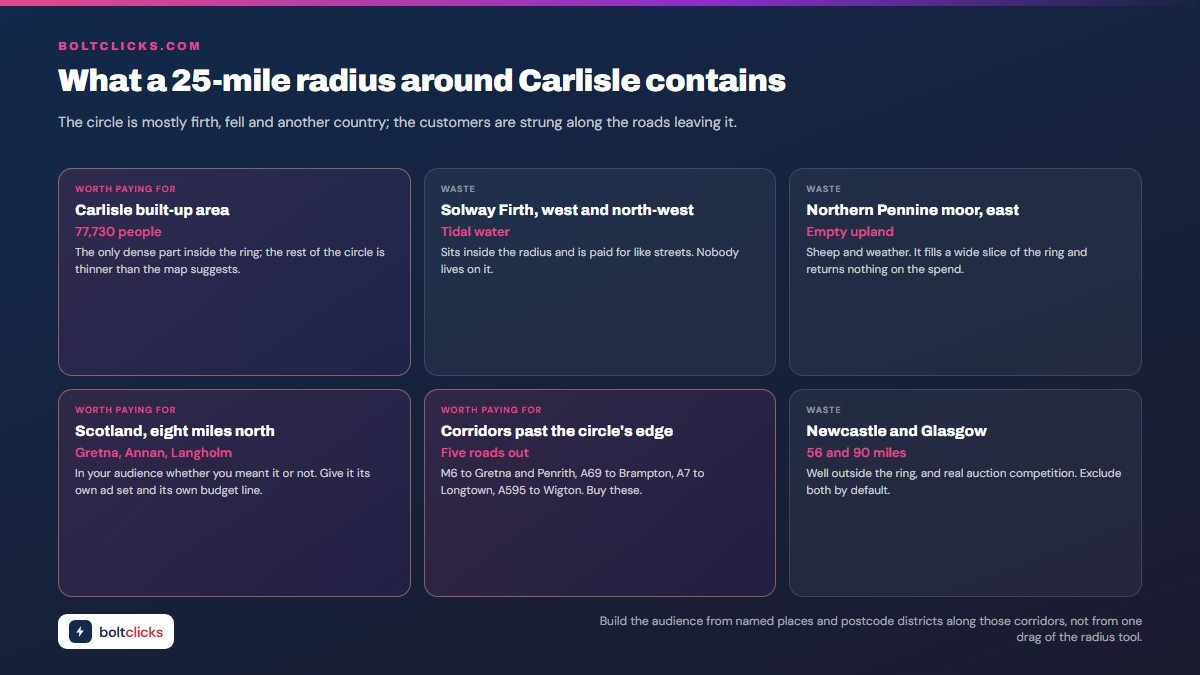
Open Ads Manager, drop a pin on Carlisle and drag the radius out to 25 miles, and Meta will tell you the audience is big enough to run. It will not tell you what is inside the ring. West and north-west, a wide slice of it is the Solway Firth, which is water. East, it is empty Northern Pennine moorland, which is sheep and weather. And eight miles north of the city centre the Anglo-Scottish border cuts clean through the circle, so Gretna, Annan and Langholm are sitting in your audience whether you meant to buy them or not.
This is not the usual small-town complaint about thin audiences. Carlisle’s built-up area was 77,730 people at the 2021 census, and the city is the administrative centre of Cumberland, the unitary authority of 280,495 people created on 1 April 2023 when Cumbria County Council and the six districts, Carlisle City Council among them, were abolished. There is no larger place within an hour’s drive in any direction: Newcastle upon Tyne is 56 miles east, Glasgow 90 miles north-west, Lancaster 71 miles south. Carlisle keeps its own trade because nothing close enough exists to take it away. The circle does not fail because the catchment is small. It fails because the catchment is the wrong shape.
The shape that matters here is linear, not circular. Your customers are strung along five roads leaving the city, and every one of them carries on well past the point where the circle stops. Push the radius out to catch them and you buy more firth, more fell and more of another country. Keep it tight and you cut off Penrith, Brampton and Wigton, where a good share of the money lives.
The Scottish border is eight miles north — how that splits your ad account in two
For a business in most English cathedral cities, a boundary on the map is an administrative detail. In Carlisle it is a national one. Gretna is a short run up the M6, Longtown is nearer than parts of your own authority, and a great many Carlisle trades, clinics, gyms, installers and mobile services have an honest working catchment that straddles two countries. Drawing one circle over the top of that does not make the Scottish half disappear. It only means you can never see what the Scottish half costs you.
So the account gets split from the start. England in one ad set with its own budget, Scotland in another with its own, never blended into a single radius. Same offer, same creative to begin with, two budget lines, so that by the end of the second week you can read cost per enquiry on each side of the border independently instead of averaging a strong half with a weak half and calling the result a campaign. Which side wins differs sharply by trade, and there is no honest way to guess it in advance.
The split earns its keep for a second reason. Anything you sell that is licensed, delivered, warranted or regulated can work differently in Dumfries and Galloway, and a call-out charge that is fine to Dalston may be uneconomic to Annan. Better settled before the ad goes live than after an enquiry you cannot serve.
The England ad set
- Carlisle itself, Stanwix and the suburbs north of the Eden
- Harraby and the southern edge of the city
- Brampton and east along the A69
- Dalston, Wigton and the Solway coastal villages
- Penrith, down the M6
The Scotland ad set
- Gretna and Annan first, because they are closest and cheapest to reach
- Canonbie, Langholm and Dumfries only where you genuinely travel that far
- Its own budget line from day one, never folded into the English one
- Checked for licensing, delivery and regulation before a pound is spent
Buying the corridors instead: M6 to Gretna and Penrith, A69 to Brampton, A595 to Wigton
Radius targeting is the default because it takes one drag of a mouse. Building an audience out of named places and postcode districts takes an afternoon, and in Carlisle that afternoon is the whole job: you stop paying to reach the Solway at high tide and start paying to reach the drive-time routes your customers actually use. It is the same corridor-first approach I bring to any Meta Ads campaign, redrawn here for a tidal estuary, an upland range and a national border.
Five roads carry the trade, and which deserves the largest share depends on what you sell and how far you will travel to deliver it.
| Corridor | Where it actually reaches | Who it matters to |
|---|---|---|
| M6 north, Junction 44 | Kingmoor Park, then Gretna and Annan | Trade suppliers, logistics, cross-border service areas |
| M6 south | Penrith and the Eden valley | Services people will drive down the motorway for |
| A69 east | Brampton, towards Haltwhistle | Rural trades and the Hadrian’s Wall corridor |
| A7 north | Longtown and the border villages | Mobile trades whose vans already cross the line |
| A595 west | Wigton and the Solway coast | Agricultural supply and farm-facing services |
Two exclusions belong in the campaign before launch, not in the first month’s report. Newcastle and Glasgow come out by default: you will pay city auction prices to reach people who were never going to drive 56 or 90 miles to you. Whitehaven and Workington come out too, unless you genuinely work in west Cumbria, because the A595 is slower than the map suggests.
One inclusion is worth naming. Kingmoor Park, two and a half miles north at Junction 44, holds 96 businesses and around 3,100 jobs across more than two million square feet, with Enterprise Zone status and DPD, UPS, Edinburgh Woollen Mill and Story Homes among the occupiers. If you sell to other businesses here, that estate is a target in its own right.
Reaching the Borderway and Cumberland Show trade: farms you will never catch on a high street
Feed merchants, machinery and quad dealers, fencing contractors, agricultural groundworks firms, large-animal vets and agri-insurance brokers share the same awkward problem here. Their customers are scattered in ones and twos across a 280,495-person authority and over the border into Dumfriesshire. There is no high street that catches them, no footfall to convert, and search volume for what these firms sell is thin because the buying happens by relationship and on mart days at Borderway. Facebook is genuinely where that audience spends its evenings. For a lot of Carlisle’s rural suppliers it is not one channel among several, it is the only one that reaches a buyer who is otherwise physically unreachable.
The calendar matters as much as the targeting. The Cumberland Show at The Showfield, Warwick on Eden falls in early June each year, and the sale season either side of it drives the rural half of the year. A flat twelfth of the budget each month misses both peaks and pays full price in the dead weeks between. Front-load into late spring and the autumn sales.
- Build from postcode districts, not a radius, so a farm nine miles down a lane outside Wigton is in the audience and the Solway is not.
- Expect frequency to climb fast, because the audience is small and the same people see the ad again and again inside a fortnight.
- Plan the creative refresh from day one, rather than waiting for results to sag and reacting three weeks late.
- Spend hard in show and sale weeks, then pull the budget back rather than leaving it running.
- Keep the Scottish farms on their own budget line, because haulage and call-out economics change the moment you cross the border.
Hadrian’s Wall Path finishes at Bowness, it does not start there — advertising to a visitor already on their way
The 84-mile Hadrian’s Wall Path National Trail runs from Wallsend and ends at Bowness-on-Solway, so most walkers reach the Carlisle area at the end of the walk rather than the beginning, footsore, with a bed and a baggage transfer booked weeks earlier from somewhere else entirely. Stanwix, now a Carlisle suburb, was Petriana, the largest fort on the Wall. None of that helps a guesthouse advertising to people already standing in Carlisle. The buyer was never here. They were at home at the other end of the country in February, deciding where to finish.
The railway trade works the same way. The Settle–Carlisle line, 73 miles of Victorian engineering with 14 tunnels and 22 viaducts, carried around 1.2 million journeys by 2012 and is one of the most popular routes in the country for charter and steam specials, which cluster in the warmer months. A guesthouse, a pub with rooms, a taxi firm or a baggage-transfer service aimed at either market should be buying interest and travel behaviour. A radius here is not merely inefficient, it is pointed at the wrong people entirely.
What to target
- Interest and travel behaviour rather than geography around Carlisle
- The regions where long-distance walkers and heritage rail passengers live
- Creative that answers the end-of-walk question: bed, bath, bag moved, lift back
- Walkers and rail visitors in separate campaigns, because they book differently
When to spend
- Roughly April into September for walking and heritage rail, bought weeks ahead of arrival
- Racing gives Carlisle a winter most cathedral cities do not get: the Carlisle Bell and Cumberland Plate in June, then National Hunt at Blackwell with the Colin Parker Memorial Chase in November
- January can go dark, and that saved budget does more work in April
Storm season on the Eden and the Caldew: the campaign you switch on in forty-eight hours
In January 2005, 180mm of rain put 2,700 Carlisle homes under water and three people died. In December 2015, Storm Desmond flooded the city again after nearly 36 hours of continuous rain. Everybody here remembers both, and that memory sits behind insurance, property and trade decisions in a way it does not in a dry inland town.
For restoration firms, damp-proofers, drying specialists, roofers, joiners, electricians and anyone doing insurance work, demand is weather-triggered rather than steady, and it arrives with about two days’ warning. Meta is the only channel that goes from nothing to full spend inside a single day. Search advertising moves quickly too, but it waits for somebody to type; organic rankings take months and cannot be conjured on Thursday because the rivers rose on Tuesday. The work is all done before the weather.
Step one: build it dry
Audiences, ad sets, budgets and creative are written, put through Meta’s review and left paused. Nothing gets drafted in a panic, because the forty-eight hours you have are for answering the phone and loading the van, not for writing copy and waiting on approval.
Step two: hold a reserve
Keep roughly 20 to 25 per cent of the annual ad budget back rather than spreading every pound evenly across twelve months. That reserve is the difference between reaching people in the week they are looking and arriving after they rang somebody else.
Step three: switch on, then switch off
When the Eden and the Caldew rise, the reserve goes live within the day, geography tightened to the streets actually affected. When the water drops and the diary is full, it comes straight back off. Spending into demand you cannot service is an expensive way to annoy your neighbours.
What a budget actually buys when your whole addressable audience is under 200,000 people
Start with the arithmetic. The city is about 77,700 people and Cumberland about 280,500, and once you remove the firth, the moor, the excluded cities and the parts of the authority nobody would drive in from, the realistic addressable audience for most Carlisle service businesses sits under 200,000. That single number sets everything else.
The good news is that you are not bidding against Newcastle or Glasgow advertisers for those people, so the cost of reaching a thousand of them is far kinder than it would be beside a metro area. The bad news is the same coin turned over: frequency climbs quickly, the same faces see the same ad, and creative fatigue rather than auction price becomes the thing that ends the campaign. A Carlisle plan with no refresh cadence in it works for a month and then quietly stops. Next door to a large city you can get away with that. Here you cannot.
On money, everything is published rather than quoted on request. Retainers start at £650 a month, with £1,200 and £4,000-plus tiers above that, a one-off SEO Foundation at £850 where groundwork is needed first, and international clients billed at USD 800, 1,500 or 5,000; the full list of prices and what sits in each tier is on the site. Payment is in advance, month to month, with no minimum term and no percentage of your ad spend.
- The retainer and the ad budget are separate, and the ad budget goes straight from your card to Meta.
- Never a share of ad spend, so nothing here rewards talking you into a budget the audience cannot absorb.
- Paid in advance, month to month, and you can cancel at the end of any month.
- A free written account review first, which sometimes ends with me saying the money is better spent elsewhere.
Working with a remote Meta Ads specialist rather than an agency that charges you for an office
There is no office in Carlisle behind this page. No desk on English Street, no unit at Kingmoor Park, no local landline and no pretence of one. This is one person, Moeez Abbas, working remotely from Lahore on UK hours, said plainly rather than buried at the foot of a contact page. A city-centre address tells you where somebody pays rent. It does not tell you who will be inside your ad account on a wet Tuesday in November.
Two other northern cities are written up the same way: Facebook ads in Lancaster, whose largest block of customers lives three miles south of the city at Bailrigg, and Facebook ads in Durham, a short drive south of Tyneside and Wearside.
What it does change is the price and the chain of command. An office, a receptionist and an account manager between you and the person who touches the campaign all come out of your fee before a pound reaches Meta. Here the person reading the numbers writes the ad and answers your email, which also means there is nobody to hide behind when a month goes badly.
What you get
- One specialist on the account from the first audit to the last report
- UK working hours, so replies land in your day rather than overnight
- A written report every week, in plain English
- Results split by side of the border and by placement
What is not in the price
- Rent on premises you will never visit
- An account-manager layer relaying your questions to a media buyer
- Any percentage of your ad spend
- A contract that makes leaving harder than joining
What you get every week, what access I need, and what happens if you want to stop
Access first, because owners ask about it before price. I never need your Facebook password and would not accept it if offered. What I need is partner or delegated access to your Meta Business Manager (now called a business portfolio in Meta’s help centre), granted by you in a couple of clicks and revoked just as quickly. The ad account and the page stay in your name, and the audiences and creative built while we work together stay with you if we stop. If the account is already restricted, that is a separate job on its own timescale, and Meta Business Manager recovery has its own page rather than being folded into a retainer as though it were routine.
Before the first ad runs
A free written review of the account, or of the plan where there is no account yet. The corridors get named, the Scottish ad set gets its own budget, Newcastle and Glasgow get excluded, and we agree what counts as an enquiry so we are measuring the same thing in week three.
Every week
A written report: what was spent, what came back, cost per enquiry on each side of the border, how Facebook and Instagram compared, what I changed and what I intend to change next. Written for the owner, not for another marketer.
If you want to stop
You cancel at the end of any month. No notice period, no exit call, nothing withheld. Access is yours to withdraw whenever you choose, and the final report is written whether you stay or go.
The one campaign result I can show you, and the caveat that comes with it
Here is every client result I have, in full. An independent artist in the UK ran one Meta Ads campaign with me on £25 of ad spend. Across five days it produced more than 500 Spotify saves and 10 new followers, and the client left a verified five-star review.
The caveat matters more than the numbers do. It is one campaign, in one niche, on a budget smaller than a tank of diesel, optimised for an outcome with nothing in common with a fencing contractor outside Wigton, a drying specialist in Harraby or a guesthouse at Bowness-on-Solway. It shows a campaign was built, run and measured properly. It is not a forecast of what yours will do, and anybody drawing a prediction out of a £25 test is selling you something.
Padding this out would be easy: percentages with no client attached, a testimonial from a first name and an industry, a chart with its axis labels removed. All of it would have to be invented, and an invented number is worth nothing to a Carlisle owner deciding where the next £650 goes.
If you want more before committing, ask for the free written review. It costs nothing, it is specific to your account and your corridors, and it will tell you more about how I work than any case study could.
What a client said, and what you can check
“Great communication and very helpful throughout the process. Took the time to explain everything clearly and set up the campaign professionally. Focused on quality results rather than just numbers. Highly recommended.”
This is one of three client reviews published so far; the other two, from a UK SEO client and a US Google Ads client, are on the home page. Every figure comes from the client’s own ad account, and a review goes on this site only when it is real.
What you can check before you pay
- Prices published in full on the pricing page, not hidden behind a sales call
- Month to month, with one month’s notice and no lock-in contract
- Every account, profile and file stays in your name; I work through partner access
- A written report every week, in plain English
- One specialist does the work, from the audit to the report
Facebook Ads in Carlisle: the questions Cumberland business owners actually ask
Should I run ads into Dumfries and Galloway, or is that money wasted?
The border is only eight miles away, so a real chunk of your catchment is Scottish and ignoring it is usually the costlier mistake. Run it as a separate ad set with its own budget, so you can read cost per enquiry on each side independently. Check first whether anything you sell is licensed, delivered or regulated differently north of the line.
My customers are farms spread across thirty miles of Cumberland. Can Facebook really reach them?
Yes, and for a lot of rural suppliers it is the only channel that can, because there is no footfall to catch them on and search volume is thin. Build the audience from postcode districts and interests rather than a radius, taking in the lanes around Wigton, Dalston and Brampton and leaving out the Solway. Expect frequency to climb quickly, which means changing creative more often than a city advertiser would.
Is there even enough population around Carlisle for Meta Ads to work?
The city is about 77,700 people and Cumberland about 280,500. Small audiences mean less reach, but also far less auction competition than Newcastle or Glasgow, so reaching people costs less here. What limits results in Carlisle is creative fatigue, not cost per thousand, which is why a refresh cadence goes into the plan on day one.
Newcastle is 56 miles away and Glasgow 90. Should I exclude them?
For most service businesses, yes, by default. You will pay city auction prices to reach people who were never going to make that drive, and the spend disappears into impressions rather than enquiries. Decide it before launch and write it into the exclusions.
Facebook or Instagram for a Carlisle business?
It splits by trade here more sharply than in most towns. The agricultural, trades and older resident audience sits on Facebook. The arts-student audience around Brampton Road, where the University of Cumbria’s Institute of the Arts has over 1,000 full-time arts students, sits on Instagram and resets every September. Run both, but report them separately so you can see which is carrying the campaign.
What should I budget to start, and is the ad spend included?
No, the retainer and the ad budget are entirely separate. The ad budget goes straight to Meta from your own card and I never take a share of it. Retainers start at £650 a month, paid in advance, month to month, cancel any month. For weather-driven trades, plan to hold roughly 20 to 25 per cent of the year’s ad budget back as a reserve rather than spending it evenly.
Do you need my Facebook password?
No, never. Partner or delegated access to your Meta Business Manager only, which you grant yourself and can revoke at any time without asking me. The ad account, the page and the audiences stay in your name, and stay yours if we stop working together.
What if my Business Manager or ad account gets restricted?
Meta Business Manager recovery is a service I run, but it is its own process on its own timescale and nobody honest will give you a date for it. If your account is already restricted, that work happens first and separately, so you are not paying a management retainer on an account that cannot spend.
Are you actually based in Carlisle?
No, and no page here will pretend otherwise. This is one specialist, Moeez Abbas, working remotely from Lahore on UK hours, with a written report every week. There is no office in Carlisle to pay for, which is part of why the price is what it is.
A free account review, before anything is agreed
Send over the ad account, or just the website if there is no account yet, and you get a written review of what is set up, what is leaking and what I would change first. It costs nothing and there is nothing to sign. If the honest answer is that ads are not the right spend for a business your size in Carlisle, that is what the review will say.