
Facebook ads agency Lincoln: paid social built around how the city actually trades
I am Moeez Abbas, one person working remotely from Lahore in Pakistan on Facebook and Instagram advertising for UK and US businesses. There is no office in Lincoln and no team behind me. What this page is instead is the local reading that has to happen before a Meta campaign is built here: the uphill and downhill split, the LN postcode map, drive times on roads with no motorway, two academic calendars, and a December that no longer works the way it used to.

What a Lincoln business is actually buying when it buys Meta ads
I am Moeez Abbas. I work on my own, remotely from Lahore in Pakistan, for businesses in the United Kingdom and the United States, and a large share of that work is Facebook and Instagram advertising through Meta Ads Manager. There is no office in Lincoln and nobody who will walk up Steep Hill to shake your hand. What there is instead is somebody who read the city properly first, because Lincoln is a place where geography does more damage to a careless media plan than weak creative ever will.
Another cathedral city is written up the same way: Facebook ads in Ely, where a fifteen-minute train takes much of the city’s working-age spending power to Cambridge every morning.
Start with what many owners in the LN postcode area have already paid for once and disliked. Boosting a post is not advertising. Press Boost in the Facebook app or in Meta Business Suite and you are buying reach on content written for people who already follow you, optimised for engagement rather than enquiries, with one audience and no structure underneath it.
A campaign built in Ads Manager is a different object. You choose an objective matching the commercial outcome — leads, sales, messages through Messenger or WhatsApp, calls, store traffic — and a conversion event a real Lincoln customer triggers. You decide where money may be spent across Facebook, Instagram, Reels, Stories and the Audience Network, and which parts of the county it may touch. Then you feed delivery enough signal through the Meta Pixel and the Conversions API that it finds more of the same person without you guessing at interests.
So a month here is an audit, a geography plan, a small number of ad sets, four to ten creatives, pixel and Conversions API work in Events Manager, retargeting, and a weekly read of what changed. The audience is finite, so the job is to spend into the part that converts and keep the creative moving.
Two retail economies in one city, split by a hill
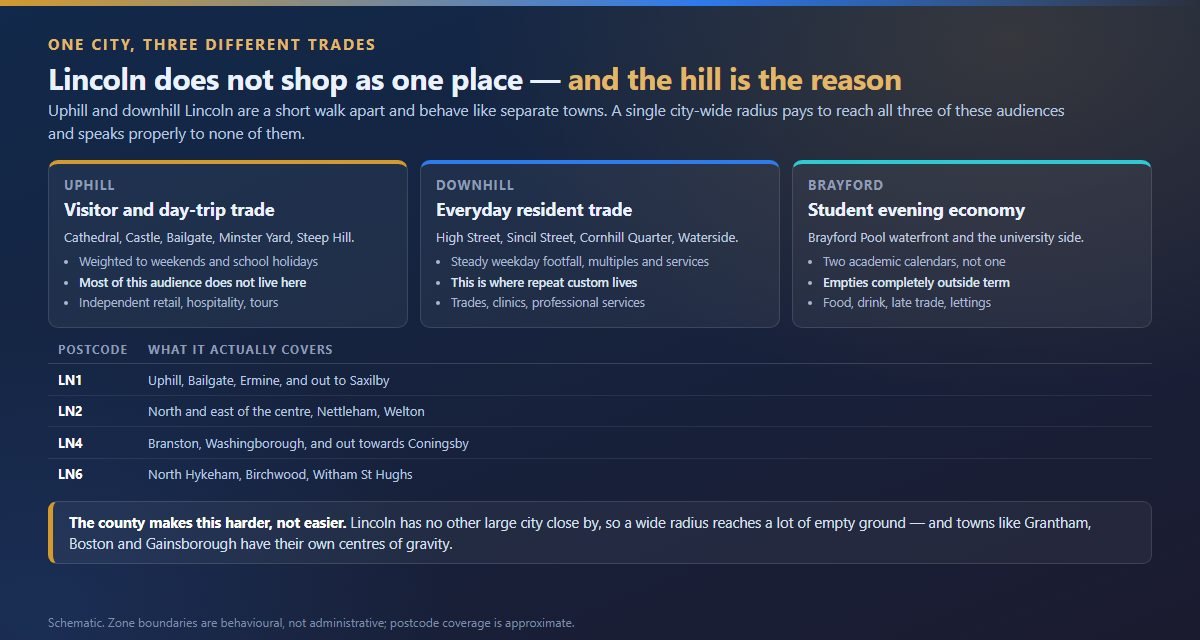
Almost every generic page tells you to target your city. Lincoln is not one trading area but two, stacked vertically and separated by a climb.
Uphill Lincoln is Bailgate, Castle Hill, Minster Yard, Exchequergate, Pottergate, the Medieval Wall Walk, the streets around Lincoln Cathedral and Lincoln Castle, and the run of Steep Hill and The Strait down toward Well Lane and the Glory Hole. Steep Hill is one of the steepest shopping streets in England — a gradient steep enough that the handrail up the middle is not decorative — and it was voted Britain’s Great Street by the Academy of Urbanism in 2012. That gradient is a filter on your customer: older shoppers, people with buggies, wheelchair users and anyone carrying bags largely do not walk up it. The businesses at the top — galleries, antique dealers, chocolatiers, jewellers, bookshops, tea rooms, boutique hotels, destination restaurants — trade on tourists and day visitors who came deliberately, often for Lincoln Castle, its Victorian prison and the Magna Carta vault, or for the Bishops’ Palace and Greestone Stairs.
Downhill Lincoln is the Lincoln High Street, Sincil Street, the Cornhill Quarter, the Stonebow and Guildhall end of the centre, and the Waterside Shopping Centre: everyday spend and multiple retail. Lincolnshire Co-op and Wykeland Group bought the Waterside centre in a fifty-fifty partnership, following the Lincolnshire Co-op-led regeneration of the Cornhill Quarter; the Co-op’s own announcement describes a 130,000 sq ft scheme, largely let at acquisition, with tenants including H&M, Next, New Look, Superdrug, O2, Office and Skechers, and a follow-on investment programme including a more welcoming frontage from High Street and along the River Witham. Lincoln BIG works the same streets, and St Marks and the Lincoln shopping park on Tritton Road pull the car-borne end of the same trade.
A third zone behaves like neither: Brayford Pool and the Brayford Waterfront, where bars, chain restaurants, hotels, a multiplex cinema and a student-facing hospitality cluster sit on the water. Brayford Pool is a natural widening of the River Witham that the Romans used as a port and linked to the River Trent by cutting the Foss Dyke; the Brayford Trust restored it as a marina, and it is routinely described as the country’s oldest inland harbour. The University of Lincoln built its Brayford Pool Campus on derelict railway land there, the first building opened by Queen Elizabeth II in 1996, which is why this evening economy is young, dense and term-driven. The Engine Shed, the Lincoln Performing Arts Centre, the Isaac Newton Building and the Lincoln Science and Innovation Park with its Boole Technology Centre sit within the same few hundred metres.
Practical consequence: an uphill gift shop, a downhill barber and a Brayford bar should almost never share an ad set, a creative or a radius. They sell to three populations who happen to share a postcode prefix.
Radius by distance overstates your catchment because Lincoln has no motorway
Lincoln sits in a large, thinly populated county with no other big city close by. The Office for National Statistics recorded 768,364 residents in Lincolnshire at the 2021 census, and 103,813 in the City of Lincoln district. The map looks generous; the clock does not. There is no motorway. West is the A46 to Newark-on-Trent and then the A1, or onward toward Leicester and the M1; north is the A15 past the former RAF Scampton toward the Humber; east is the A158 Wragby Road toward Wragby, Horncastle and the coast; south is the A15 and the A607 toward Sleaford and Grantham, with the A17 running east past Holbeach toward King’s Lynn.
National Highways describes the A46 around Newark as the only remaining single-carriageway section of that trunk route, and has taken the A46 Newark Bypass scheme through the Development Consent Order process to dual the stretch between the Farndon and Winthorpe roundabouts. Schemes in the Road Investment Strategy get reprioritised, so I treat the bottleneck as present until a road is actually open, rather than pricing a westward catchment on a promise.
The road change that did happen is the Lincoln Eastern Bypass. Lincolnshire County Council’s major projects record puts the opening in December 2020: roughly 7.5 km of single carriageway from a new roundabout on the A15 Sleaford Road in the south-east round to the A15 and A158 Wragby Road in the north-east, linking with the existing northern relief road, at a cost the council reports at around £122 million, funded by central government, the county council and third-party developers, with four roundabouts, eight bridges including a long crossing of the River Witham, and a footpath and cycleway. Service-area assumptions that predate 2020 are wrong in a direction that costs you jobs around Washingborough, Heighington, Branston and Canwick.
So I build geography from drive time. Meta’s own documentation in the Business Help Centre lets you drop a pin, choose a distance, target postcodes and cities and apply exclusions; it also lets you choose the audience type inside a location — people living in or recently in this location, which is the default, people living in this location, and options covering recent visitors and travellers. That control is the difference between reaching residents and reaching tourists: an uphill gift shop near Minster Yard often wants visitors, an electrician covering Birchwood wants residents and nothing else. I check radius limits live in Ads Manager rather than quoting a third-party summary, because Meta changes them. Pushed far enough, a wide radius is not a bigger catchment but a more expensive one, reaching Retford, the outskirts of Doncaster and Peterborough commuters who were never going to drive past closer options.
Two local details matter more than they should. Pelham Bridge, Canwick Road and Broadgate carry most of the through traffic on the downhill side, and the level crossings on Brayford Wharf East and High Street can hold a customer still long enough to change their mind about a journey. If your business sits behind one of those, say so in the creative and give the alternative route — that is a conversion-rate fix disguised as local knowledge.
LN1 to LN6 is a better targeting map than any radius around the city
Because the city is small and the villages distinct, postcode-district targeting usually beats a city-wide radius. The LN postcode area covers thirteen districts across seven post towns, and only LN1 to LN6 are Lincoln itself: LN7 and LN8 are Market Rasen, LN9 Horncastle, LN10 Woodhall Spa, LN11 Louth, LN12 Mablethorpe and LN13 Alford. Anyone using LN as shorthand for Lincolnshire has missed Boston in PE21, Spalding in PE11, Skegness in PE25, Grantham in NG31 and Gainsborough in DN21.
| District | Includes | What it usually means for a campaign |
|---|---|---|
| LN1 | City centre uphill, Ermine, Ermine Street, Saxilby, Stow, Sturton by Stow, Burton | Uphill visitor trade plus a dense estate north of the centre |
| LN2 | St Giles, the Monks Road side, Nettleham, Welton, Sudbrooke, Dunholme, Scothern | Commuter villages with higher household spend. Home improvement, garden work, higher-ticket services |
| LN3 | Cherry Willingham, Fiskerton, Bardney, Reepham, Langworth | Thin population. Worth including for trades, rarely worth its own ad set |
| LN4 | Branston, Washingborough, Heighington, Canwick, Dunston, Nocton, Metheringham, Billinghay, Coningsby, Tattershall | Village trade plus RAF Coningsby households, far quicker to reach since the eastern bypass |
| LN5 | Waddington, Bracebridge Heath, Bassingham, Carlton-le-Moorland, Harmston, Aubourn, Navenby | RAF Waddington and the southern villages. Salaried households, predictable pay cycles |
| LN6 | North Hykeham, South Hykeham, Birchwood, Skellingthorpe, Doddington, Witham St Hughs, Thorpe on the Hill, Swinderby, Boultham | The volume play: large estates and the strongest value in the county for home-services lead generation |
In practice I run one broad ad set covering LN1 to LN6 with a drive-time overlay, and split out LN2 or LN6 only when the offer or the average order value genuinely differs. Splitting sooner sounds sophisticated and behaves badly: each ad set needs its own conversions before Meta can learn. Exclusions matter as much as inclusions — if you install driveways around Lincoln, excluding the student blocks near Brayford and the West Parade, Monks Road and West End rental streets removes impressions that will never convert.
Half of Lincolnshire shops somewhere else and you should not pay to reach it
The most expensive misunderstanding in Lincolnshire paid social is treating the county as one audience. The towns around Lincoln face whichever centre is easier to reach, and in several cases that is not Lincoln.
- Sleaford, Market Rasen, Horncastle, Woodhall Spa, Caistor and the Wolds villages do look to Lincoln for comparison shopping, hospital appointments at Lincoln County Hospital and a night out. These are your real secondary catchment.
- Grantham and Newark-on-Trent mostly do not. South Kesteven District Council’s 2015 retail study found Peterborough exerting significant influence over shopping patterns in South Kesteven, particularly south of Bourne, with Grantham and the area north of it more influenced by Nottingham and only to a lesser extent Lincoln; it counted 96 comparison shops in Nottingham against 42 in Lincoln and 13 in Newark-on-Trent. That study is dated, so treat it as directional rather than current. Grantham Designer Outlet Village promotes a catchment spanning Nottingham, Leicester, Derby, Peterborough, Lincoln and Cambridge — the developer’s own promotional claim, not independent data, but a reminder that Grantham pulls discretionary spend rather than sending it north.
- Boston, Spalding and Holbeach form their own food-logistics economy facing south and east, with Peterborough and King’s Lynn closer than Lincoln in usable travel time.
- Skegness, Mablethorpe, Chapel St Leonards and Sutton-on-Sea are a seasonal resort economy anchored by Butlin’s Skegness, the first Butlin’s, opened in 1936. The rhythm is holiday weeks, not shopping weeks.
- Gainsborough looks partly to Lincoln and partly across the Trent to Retford and Doncaster.
- Scunthorpe, Grimsby and Cleethorpes sit in North Lincolnshire and North East Lincolnshire and run on their own centres entirely. Buying them from Lincoln is buying a different county.
So I would rather run a tight LN1 to LN6 build with a deliberate secondary layer on Sleaford, Market Rasen and Horncastle, and leave Boston, Spalding, Grantham and Skegness out unless the product is worth a special journey. The honest exception is postal fulfilment — a Lincolnshire food producer, a maker, a subscription — where a local-only audience becomes the mistake.
Two universities set the calendar more forcefully than Christmas does
For a great many Lincoln businesses, term dates are the dominant seasonality, ahead of the festive period. The University of Lincoln has a student body large enough to reshape the city — on the order of one student for every five residents of the district, on a campus physically inside the city centre — and Bishop Grosseteste University, on Longdales Road uphill, adds a smaller, teacher-training-heavy population on top. Set either against a district population of around 104,000 and the shape of the year is obvious. I take the current student numbers from the universities’ own published data or HESA rather than repeating a figure from a blog.
The published pattern at the University of Lincoln is the standard English one: a Welcome Week in the second half of September, teaching to a winter break that starts just before Christmas and runs into the first or second week of January, an assessment period in late January, a spring break around Easter and a second assessment period in May and early June. Bishop Grosseteste runs a semester calendar with its own dates, and its PGCE and teacher-training programmes run school-style, starting in the first days of September. That intake arrives weeks before the main undergraduate term, which means an early-September audience most advertisers miss because they are still waiting for Freshers.
Both institutions publish term and semester dates on their own sites, they revise them, and the exact days move year to year. I read those pages before setting a flight rather than reusing last year’s plan.
What I do with that, for a student-facing gym, barber, nail studio, takeaway, phone repair shop, bar or letting agent:
- Late August to mid-September. Build audiences and warm up. Lettings demand peaks before arrival, and the teacher-training intake is already here.
- Welcome Week. The highest-intent window of the year. Front-load budget, run offers that create a habit rather than a single visit, and accept a higher cost per acquisition because the customer lifetime is a full academic year.
- October to mid-December. Retention and repeat spend, where Reels and Stories carry more weight than static.
- The winter break. The void. Cut spend hard or pivot to resident and trade audiences in LN2, LN4, LN5 and LN6.
- Assessment weeks. Delivery food and late-night convenience rise while nightlife and grooming fall.
- June to late September. The long trough, when a Brayford bar should advertise to residents, tourists and function bookings rather than students who are back in Leeds or Leicester.
The same calendar drives the rental cycle on Monks Road, West Parade, Carholme Road and the streets behind the Brayford, and it drives recruitment for every bar, cafe and shop that staffs itself from the student body.
The Christmas Market is gone, and that rewrote the whole Q4 plan
This is the fact an outsider gets wrong and every Lincoln owner notices immediately. The Lincoln Christmas Market no longer runs. City of Lincoln Council’s executive scrapped it in February 2023, as reported at the time by ITV News Calendar and the Lincolnshire Echo, redirecting the event’s budget into smaller events spread through the year. The final market was held in December 2022, after a run that began in 1982. The reason given was scale and safety rather than cost alone: the council leader, Councillor Ric Metcalfe, said that if it kept growing at the rate it had, it would become unsafe, and the final four-day event drew a record crowd reported in the region of 320,000 visitors. That is a very large volume of trade that used to arrive in one compressed weekend and now does not.
What replaced it is a longer, thinner programme: the council spreads festive markets, events and experiences across late November and December under the banner Christmas in Lincoln, built around a lights switch-on on the High Street in the last week of November and a run of trails, markets and performances through the following fortnight. Separately, Lincoln Cathedral runs its own ticketed Christmas market in the cathedral and its grounds, in timed sessions with pre-booking. Dates and formats change every year, so check Visit Lincoln, the City of Lincoln Council events pages and the cathedral’s own site for the current year before committing a budget to a weekend.
That distinction gets muddled constantly. The cathedral event is a cathedral event, not a revival of the council’s market, and because it is ticketed and capacity-capped it produces a predictable, time-boxed uphill footfall window rather than open mass footfall, which tells an uphill independent exactly which hours to be open, staffed and running an offer. The advertising consequence is a phased Q4 rather than a blitz:
- Start gifting and hospitality campaigns in the second week of November, not the first week of December.
- Build the spend curve toward the lights switch-on and hold it, rather than spiking on a weekend that no longer exists.
- Run separate uphill and downhill creative: a visitor at a ticketed cathedral session in Minster Yard and a family parking at Waterside are not the same buyer.
- Expect December to pay out across five or six weeks rather than one burst, and plan cashflow accordingly.
Race days, show weeks, the coastal season and a football fixture list
Outside the student and festive calendars, Lincolnshire trades on rhythms that have nothing to do with the standard retail year, and a plan that ignores them looks randomly volatile.
Racing and shows. Market Rasen Racecourse is Lincolnshire’s National Hunt venue, and race days move hospitality, taxi, accommodation and grooming demand in LN7 and LN8 and along the A46 corridor. The agricultural calendar — the Lincolnshire Show at the Lincolnshire Showground north of the city, plus the village and country shows through summer — does the same for agri-food audiences: a grower or packer near Boston is far more receptive to a machinery or recruitment ad in the fortnight around a show than in February.
The coast. Skegness, Mablethorpe, Sutton-on-Sea and the wider resort strip run an intense season and a very quiet off-season. Bateman’s Brewery, George Bateman & Son Ltd, brews at Salem Bridge Brewery in Wainfleet near Skegness — founded in 1874, family-run across generations, still selling XB and XXXB under the line “Good Honest Ales”. It is a brand people here recognise and it is not in Lincoln, which is the sort of detail worth getting right before writing copy about the county. For a Lincoln business the coast is less a customer base than a competitor for summer weekends.
Matchdays. Lincoln City FC, the Imps, play at Sincil Bank, which has carried a sponsor’s name since a naming-rights deal in 2019 — locals still say Sincil Bank, so I write it that way and check the current official name before it appears in an ad. Home fixtures move footfall on the High Street, around Sincil Street and along Canwick Road, away Saturdays do the opposite, and televised kick-offs move the whole day. Before a quarter starts I pull the club’s published fixture list and its current division from the EFL site, because a city-centre restaurant should not run the same budget on a home Saturday, an away Saturday, a race day at Market Rasen and a wet Tuesday in February.
Turbines, ISTAR and vegetables: the audiences a generic plan never finds
Lincoln’s employment base is unusual, and knowing it changes who you advertise to.
Defence households
Lincolnshire is still called Bomber County, and the label is still operational. The Royal Air Force describes RAF Waddington, just south of the city in LN5, as the hub of UK Intelligence, Surveillance, Target Acquisition and Reconnaissance and the main operating base for its airborne intelligence aircraft; the Protector RG1 fleet is being introduced there, and the Red Arrows, the RAF Aerobatic Team, relocated to Waddington. RAF Coningsby in LN4 is one of two Quick Reaction Alert stations protecting UK airspace, the other being RAF Lossiemouth in Moray, and it holds frontline Eurofighter Typhoon squadrons, the Typhoon training role and the Battle of Britain Memorial Flight. RAF Cranwell, home of the RAF College, continues south of Sleaford, with the Cranwell Aviation Heritage Centre nearby and the International Bomber Command Centre on Canwick Hill at the edge of Lincoln.
RAF Scampton, by contrast, is closed: it ceased flying operations in 2022 and closed as a station in March 2023. The Home Office later abandoned its plan to use the site as asylum accommodation after costs escalated, and West Lindsey District Council has pursued a large private-sector regeneration of the site with a prospective purchaser. That is a proposal, not a completed project, and I would not price a catchment on it; if it lands, the LN1 corridor up the A15 changes shape. Calling Scampton an operating base, or the current home of the Red Arrows, is the classic outsider error.
Commercially, service households are salaried, paid on a predictable cycle, move in and out on posting rotations and cluster in LN4 and LN5 around Waddington, Bracebridge Heath, Coningsby and Tattershall. Lettings, storage, removals, driving schools, childcare, gyms, barbers and car servicing all have a real audience there, and timing against payday matters more than interest targeting.
Engineering and agri-food
Siemens Energy’s Lincoln operation at Teal Park is a gas turbine site: an overhaul facility for small and industrial gas turbines plus a Global Service Operations Centre handling spare parts, turbine engine units, tooling and safety equipment. Siemens’ own material describes 135,000 sq ft in total — an 85,000 sq ft workshop and 50,000 sq ft of offices — and the first building in Lincolnshire awarded a BREEAM “excellent” rating. That is a concentrated, well-paid audience on one site.
Across Greater Lincolnshire, though, the defining industry is food. Evidence submitted by the Greater Lincolnshire Food Board to a UK Parliament committee, drawing on the Greater Lincolnshire LEP agri-food sector plan, puts agri-food at about 18% of local gross value added against 3% nationally and about 13% of employment against 3.6% nationally, and credits the county with roughly 30% of English fresh vegetable production and the country’s greatest concentration of food logistics companies; on the same evidence, South Holland employs around 42% of its workforce in agriculture, food processing and distribution. Boston hosts plants operated by Albert Bartlett, Greenyard, Greencore and Bakkavor; Holbeach runs on food processing and bulb growing; and the UK Food Valley brand carries the cluster, with the University of Lincoln’s National Centre for Food Manufacturing at Holbeach attached to it. That is why Spalding and Holbeach face their own logistics economy rather than Lincoln, and why recruitment advertising is often the highest-value paid-social job in the county.
Public sector and everything else
The other large employers are public: Lincoln County Hospital, Lincolnshire County Council at County Offices on Newland, City of Lincoln Council at City Hall, Lincolnshire Police with its headquarters at Nettleham, Lincolnshire Fire and Rescue, and the two universities. Then the ordinary base: trades and home services working the commuter villages — North Hykeham, Nettleham, Welton, Branston, Washingborough, Witham St Hughs, Birchwood, Saxilby, Skellingthorpe, Cherry Willingham, Metheringham, Bassingham and Waddington — plus Lincolnshire Co-op as the benchmark local brand, an independent co-operative owned by hundreds of thousands of dividend-card members and running over two hundred outlets, from food stores and pharmacies to funeral homes and post offices. Its published annual results show turnover growing while trading surplus fell in the most recent year reported: near-universal household reach, and a margin squeeze that is the honest backdrop against which anybody here buys ads.
Simple structure, broad targeting, creative that looks like Lincoln
In a catchment this size the structure should be boringly simple, because complexity fragments an audience that cannot afford it.
- One campaign per commercial outcome — sales, leads or messages, not one per idea somebody had on a Tuesday.
- One or two prospecting ad sets. Geography by drive time and postcode district, age range wide unless the product genuinely excludes people, no interest stacking unless the product is itself a niche. Where Advantage+ audience or Advantage+ shopping suits the account I test it against a manual build.
- One retargeting ad set. Site visitors from the Meta Pixel, video viewers, Instagram and Facebook engagers, and lawfully uploaded customer-list matches. It refills slowly here, so frequency caps matter.
- Four to ten live creatives. Vertical video first, static second, carousel where there is a range, refreshed on fatigue signals rather than monthly ritual.
- One landing experience — a page on WordPress, a Shopify or WooCommerce product page, a WhatsApp thread or a Facebook lead form — tested on a phone on a poor signal.
Creative a Lincoln viewer believes
What works is unglamorous: the shop front, the van on a village road, the cobbles, the person who answers the phone, filmed on a phone in daylight with captions burnt in because most of it is watched on mute.
Worth filming
The walk up Steep Hill to your door. Parking guidance, since for uphill businesses the objection is parking and gradient rather than price. Before and after shots for trades. A staff member explaining one thing properly. A queue, a busy Friday, a full function room.
Worth cutting
Stock-photo handshakes. Long copy that buries the offer. Discounts with no deadline. Small text nobody can read on a phone. Interest stacks so narrow that delivery spends the first week of each month relearning the account.
Because the resident audience is small, the same person sees you repeatedly: familiarity builds faster here than in a large city, and so does fatigue.
What social media management really moves, and what it honestly cannot
Plenty of Lincoln businesses want the organic side handled too, so here is what month-to-month social media management is and is not.
It is a posting cadence you can sustain, content actually about your business, replies to comments and messages inside a working day, Instagram Stories and Reels made from footage somebody genuinely captured, a Google Business Profile kept current, review responses on Google and Trustpilot handled with a straight face, and a library of assets paid campaigns can draw on. Tools help — Meta Business Suite for scheduling, Canva or CapCut for editing — but tools are not the work.
What it moves is trust at the point of decision. Somebody in Welton sees your ad, taps through to your Instagram grid, finds a handful of posts from three years ago and a review you never answered, and does not enquire. That is the loss organic prevents. What it cannot do is produce reach at any reliable scale: organic reach for local Pages is not what it was, and anyone promising that posting alone fills your diary in a city this size is describing a hope rather than a mechanism.
What a Lincoln business can genuinely do for nothing
- Finish your Google Business Profile, with real photos, correct festive hours and the awkward truth about parking.
- Film ten seconds a day on your phone. A month of that is a creative library.
- Answer every message within the working day — in a small city, response speed is free advantage.
- Ask satisfied customers for a review in person, by name.
- Post opening hours for every event weekend — the switch-on, the cathedral market sessions, matchdays, show weekends — because people search exactly that.
- Join the local conversation where it already happens: the Lincolnshire Echo and The Lincolnite comment threads, BBC Radio Lincolnshire, village and neighbourhood groups.
I would rather you did it yourself than paid anybody to do it badly.
Why the number in Ads Manager and the number in your till never match
This is where campaigns most often break, and it is rarely the targeting.
The Meta Pixel is JavaScript on your site reporting events — page views, add to cart, purchase, lead, contact — from the browser, and browser tracking loses data to privacy settings, tracking prevention, ad blockers, in-app browsers and people who tap on a phone and buy on a laptop. The Conversions API is the server-side counterpart, sending the same events directly to Meta and deduplicating against the pixel by event ID. On WordPress, Shopify or WooCommerce that is configuration rather than development, checked in Events Manager against event match quality. Without it, delivery learns from a partial picture and you pay for the gap.
Then attribution. Meta reports conversions inside an attribution setting — commonly a seven-day click and one-day view window, with shorter options available — credited to the day of the click, not the day of the sale. Three consequences follow, and they explain most arguments between owners and advertisers:
- Reported results move after the fact. Yesterday’s numbers keep filling in for days, so judging a campaign on one day is meaningless.
- Meta and Google Analytics 4 will disagree, because they model attribution differently. Use consistent UTM parameters, keep Google Tag Manager tidy, pick one source as the decision-maker, and stop reconciling to the penny.
- Offline conversions are invisible unless you close the loop. If an enquiry becomes a quote and a job three weeks later, Meta never learns which lead was worth having. Feeding that back through your CRM or an offline event upload is often the highest-return work on the account.
There is also the gap Meta cannot see: the person who saw the ad in Sudbrooke, said nothing and walked in on Saturday. Ask every caller and walk-in where they heard about you.
Two things I insist on before spending: a conversion event that fires when money or an enquiry actually happens, and agreement on what a good result looks like — cost per lead, cost per booked job, or return on ad spend.
Reporting is a short weekly note and a monthly read: spend, results against the agreed measure, what changed and what is not working.
What a sensible budget looks like, and who owns the ad account
I will not invent a recommended daily spend, because the answer depends on your margin, your average order value and how many customers you can serve. The mechanics are these. The audience is small, so the constraint is frequency rather than reach: spend enough and you reach most of the addressable people in LN1 to LN6 within weeks, after which extra budget buys repetition and eventually irritation. Scaling here means widening geography carefully, adding a second offer or improving conversion rate, not simply raising the daily cap. Learning also needs volume, which argues for optimising on a qualified enquiry rather than a signed job.
National benchmarks also mislead here. City of Lincoln Council’s published city profile records median earnings for both full-time and part-time workers in Lincoln below the East Midlands and England averages, and the city has a large student population alongside them. Lower earnings and a young population mean lower average order values than a UK-wide benchmark assumes, so a campaign missing a national cost-per-acquisition target may be performing perfectly normally for Lincoln.
Small budgets can still do real things. The only result of mine I will quote: an independent UK artist spent £25 on Meta Ads and saw over 500 Spotify saves and ten new followers across five days, verified in a five-star Fiverr review. That is one small result, on a tiny budget, over a very short window, for a product that was a free listen rather than a purchase — not a benchmark and no guide to what a Lincoln roofing company should expect.
What I charge
Management is £650 a month for a single-market Facebook and Instagram programme, £1,200 a month where paid social runs alongside search and the reporting has to be joined up, and from £4,000 a month for multi-market or multi-location work with a heavier creative load. There is a one-off Ads Launch at £750 for a full audit and rebuild — structure, pixel and Conversions API, geography, audiences and a first creative set — handed over for your own staff to run. For US clients the monthly tiers are $800, $1,500 and $5,000. Ad spend is separate, on your own card, in your own ad account.
Ask about ownership before you ask about price
The most damaging thing that happens to small advertisers is not poor performance, it is losing the asset. If a supplier runs your ads inside their own Business Manager (now called a business portfolio in Meta’s help centre), on their own pixel, using a Page you do not control, the relationship ending costs you your conversion history, custom audiences and pixel data. So:
- You own the Business Manager, the ad account and the pixel or dataset. Your business creates them, you are the admin, and you grant partner access to whoever runs the ads. Never the reverse.
- You own the Facebook Page and Instagram account, with the supplier a partner rather than the only admin.
- Your card pays for ad spend. Otherwise you cannot see raw delivery data and you are exposed if their account is restricted.
- Stopping changes nothing structural. Access is removed, everything stays.
- Get scope, notice period, reporting and the agreed measure written down, along with who writes copy, who edits video and whether anybody is filming — because if nobody is, creative has to come from somewhere.
Compliance points a serious supplier raises unprompted: advertising must comply with the UK Code of Non-broadcast Advertising and Direct & Promotional Marketing, enforced by the Advertising Standards Authority and written by the Committee of Advertising Practice; tracking and cookies engage UK GDPR and PECR, overseen by the Information Commissioner’s Office; uploaded customer lists need a lawful basis; and Meta’s special ad category rules cover credit, employment, housing, social issues, elections and politics, which bites directly on recruitment and lettings advertising here.
How this works with me
I am one person and I work from Lahore, so everything happens over email, messaging and scheduled calls, often before your morning starts. I cannot film your shop or attend your event: where filming is essential, you or your staff shoot to a shot list I write, or you engage a local videographer and I direct and edit from the footage. In exchange, the person reading the account is the person building it. None of this is a promise of rankings, positions, timescales or results. What I commit to is a plan built on what is actually true about Lincoln: the hill, the postcodes, the roads, the terms, the station, the fixtures and the missing market.
What a client said, and what you can check
“Great communication and very helpful throughout the process. Took the time to explain everything clearly and set up the campaign professionally. Focused on quality results rather than just numbers. Highly recommended.”
This is one of three client reviews published so far; the other two, from a UK SEO client and a US Google Ads client, are on the home page. Every figure comes from the client’s own ad account, and a review goes on this site only when it is real.
What you can check before you pay
- Prices published in full on the pricing page, not hidden behind a sales call
- Month to month, with one month’s notice and no lock-in contract
- Every account, profile and file stays in your name; I work through partner access
- A written report every week, in plain English
- One specialist does the work, from the audit to the report
Questions worth asking before any Lincoln campaign starts
You are not in Lincoln, so how can you understand my customers?
What I can do is read the place properly: the uphill and downhill split, the postcode districts that hold your customers, the roads that decide who reaches you, the term dates and the events that move footfall. Where local judgement is needed — which villages send you work, which streets never do — you supply it and I build the plan around it.
Should I target all of Lincolnshire?
Almost certainly not, unless you deliver nationally. The Boston, Spalding and Holbeach belt faces its own food economy and Peterborough, Grantham leans toward Nottingham and the A1, Skegness is a resort economy and Gainsborough splits toward Retford and Doncaster.
Is the Lincoln Christmas Market coming back?
It was scrapped by City of Lincoln Council in February 2023 and has not returned. What exists now is a longer programme of festive events through late November and December, plus a separate ticketed market run by Lincoln Cathedral. If a Q4 plan still assumes one enormous four-day weekend, it was written for a city that no longer trades that way.
Do these ads work for trades and home services around Lincoln?
They can, and the villages are part of why. Demand for roofing, driveways, windows, landscaping, electrical and plumbing work concentrates in identifiable areas — North Hykeham, Birchwood, Witham St Hughs, Welton, Nettleham, Branston, Washingborough — which is what postcode-district targeting is good at. The usual failure is follow-up: paid-social leads are colder than search leads, so if nobody rings back within the hour the campaign looks broken when the response process is the problem.
What about the student audience — is it worth chasing?
If your product suits it, it is the most predictable audience in the city, because both institutions publish the calendar in advance. The window before and during Welcome Week is the highest-intent period of the year, and the winter break is a genuine void worth cutting spend into. Teacher-training intakes start earlier than the main term, giving an early-September audience most advertisers never bid on.
How does the lack of a motorway affect my ads?
Distance and drive time diverge sharply, so a radius drawn on a map flatters your catchment. Rail shapes the visitor side: Lincoln Central station is served mainly by LNER, East Midlands Railway and Northern, with a small number of direct LNER trains a day to and from London King’s Cross and services toward Newark, Nottingham, Leicester, Sheffield, Doncaster, Peterborough via Sleaford and Grimsby Town via Market Rasen. Direct London capacity is modest, which is why the visitor mix skews to regional day-trippers — weight tourist targeting toward those cities rather than the capital.
Do I need the Conversions API, or is the pixel enough?
If you sell online or capture leads on your site, you want both: the pixel reports from the browser and loses events, the Conversions API sends the same events server-side, and the two are deduplicated. If enquiries come by phone or footfall, the more valuable work is recording lead source at the point of sale.
Will you guarantee a number of leads?
No, and I would be sceptical of anyone who does. Meta runs an auction, your competitors bid in it, your margin sets what you can afford and your close rate decides whether a lead is worth anything. I will agree a target, report against it honestly, and say if the channel is the wrong fit.
Can I run paid social and keep posting myself?
Yes, and for many small businesses here that is the sensible split. I would rather take the ad account, the pixel, the geography and the creative direction than charge for organic work you can do faster yourself.
Does devolution or local government matter to my advertising?
Indirectly. Greater Lincolnshire now has a combined county authority with a directly elected mayor, Dame Andrea Jenkyns of Reform UK, elected in May 2025, holding powers over economic development, skills, transport and planning alongside an annual investment fund, while Lincolnshire County Council, North East Lincolnshire Council and North Lincolnshire Council remain in place. Transport and skills decisions change drive times and labour supply, and a supplier still describing the Greater Lincolnshire LEP as the active body is working from out-of-date information about where you trade.
Send the account, not a brief
Give me access to the ad account you already have, or the page you would advertise from if you have never run anything. You get a written answer: what the current radius is actually reaching across Lincolnshire, whether the pixel and Conversions API are recording anything usable, which campaigns are paying for engagement rather than enquiries, and what I would change first. It costs nothing and there is nothing to sign. If the honest answer is that the budget is too small to steer, that is what the answer will say.