
Facebook ads agency in St Albans: when your audience is home
St Albans has a direct line into central London and a large share of working residents who use it. Location targeting places people by where they are, so a campaign delivering evenly across the week spends part of its budget on a town its audience has temporarily left. Here is what changes as a result.

Your audience is in St Albans. They are not in it at 11am
St Albans has a direct line into central London and a large share of working residents who use it. That single fact changes how paid social behaves here, and almost nobody adjusts for it.
Location targeting on Meta places people by where they are, and a commuter is somewhere else for most of the working day. A campaign set to St Albans and delivering evenly across the week is spending a meaningful part of its budget reaching a town its target audience has temporarily left.
This is not a reason to avoid the town. It is a reason to run it differently from a place where people work where they live. What follows is what actually changes.
One note before the detail: I am Moeez Abbas, one specialist working remotely from Lahore, Pakistan, on UK hours. There is no St Albans office and no team behind this page; the ad account stays in your name, and you get a written report every week.
The schedule matters more than it does anywhere else
In most towns, ad scheduling is a minor optimisation. Here it is structural.
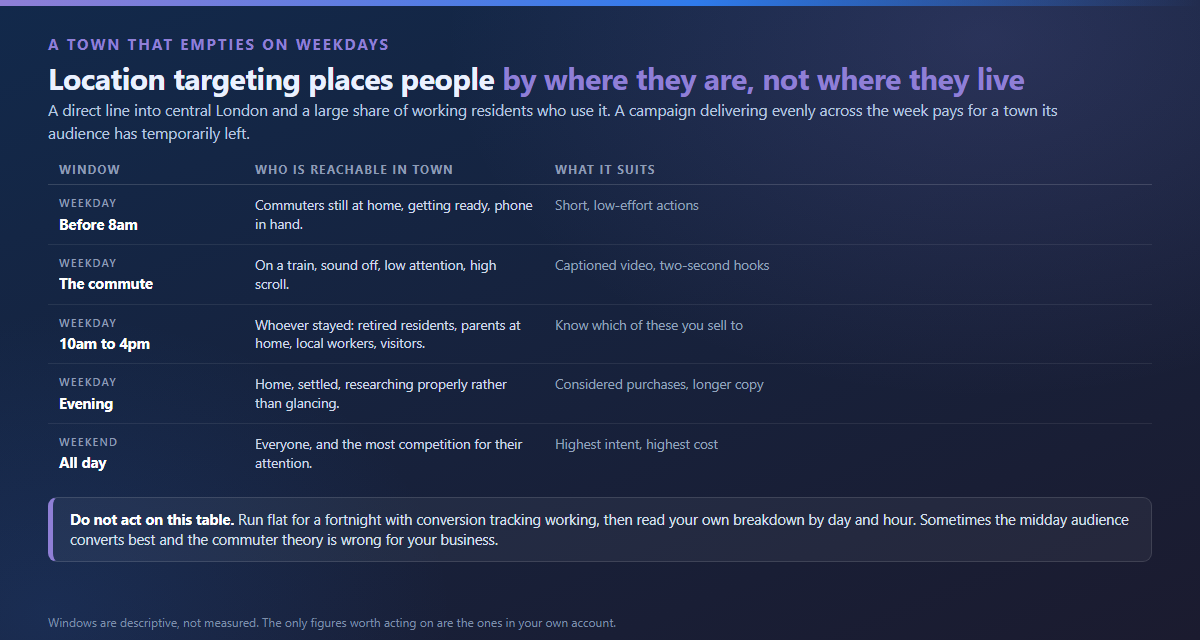
The people you want are reachable in identifiable windows: early morning before they leave, the commute itself, the evening once they are home, and weekends. During the middle of a weekday, a St Albans radius is reaching whoever stayed — retired residents, parents at home, people working locally, and visitors. Some of those are your customers and some are not, and the point is to know which you are paying for.
The practical move is not to switch the campaign off during the day. It is to look at when results actually arrive before assuming anything. Run it flat for a fortnight, then read the breakdown by day and hour, and let the account tell you rather than guessing from a theory about commuters — including this one.
What you will usually find is that the cost per enquiry is meaningfully different between windows. That difference is the whole opportunity, and it is invisible unless somebody looks.
Two settings that decide who you actually pay for
Inside the location options there is a choice between people who live in a place and people who were recently in it. For a commuter town this is not a detail.
“Recently in this location” will include people passing through, changing trains, visiting for the day, and working here from elsewhere. For a restaurant or a shop near the station that can be exactly right. For a builder, a dentist or a mobile service, it is money spent on people who will never be customers because they do not live here.
The second setting is the radius itself. St Albans sits in a dense corner of the country with several other towns close by, and a generous radius stops being a St Albans campaign quite quickly. Widening it feels like buying more audience; often it is buying a different one.
For most local service businesses the answer is people who live in the area, a radius drawn to where you would genuinely travel, and nothing wider. If you do want the visitor trade, that should be its own campaign with its own creative, because the message to a resident and the message to somebody passing through are not the same message.
You are bidding against London budgets
Proximity to London does something else that shows up directly in your costs.
Meta’s auction is not run per town. You compete for attention against every other advertiser trying to reach the same people, and the people here are also being targeted by advertisers aiming at the London commuter belt with considerably larger budgets. That pushes up what it costs to reach them.
So a St Albans business reading a higher cost per result than a comparable business in a quieter part of the country is not necessarily doing anything wrong. It is paying the going rate for an audience other people want badly.
What you cannot do is outspend that. What you can do is be more relevant than a national advertiser bothers to be — local specifics in the creative, an offer that only makes sense if you are nearby, and a landing page that speaks to someone who lives here. Relevance is the only lever that gets cheaper as you improve it.
What a tired commuter will actually stop for
If a good share of your impressions land on a phone on a train or on a sofa at nine in the evening, that shapes what works.
Assume the sound is off. Anything that depends on hearing a voice is wasted, so captions are not an accessibility afterthought, they are the message.
Assume the attention is low. The first two seconds decide it, and a logo animation spends them on nothing.
Assume the action needs to be small. Somebody half-asleep on a train will not fill in nine fields. A message, a saved post, a callback request — something that takes one thumb and no thinking.
And assume they cannot act now. An evening enquiry expects a reply tomorrow, not tonight. What matters is that the reply actually comes, and comes early, because a lead that sat until Thursday is usually a lead that went elsewhere on Tuesday.
None of it counts until the tracking does
Everything above is a way of spending the same money more usefully, and every bit of it depends on being able to see which spend produced which enquiry.
That means the pixel and the Conversions API both installed and verified before any budget goes out, domain verification done, and the conversion event defined around the enquiry rather than a page view. Without those, the day-and-hour breakdown that the whole timing argument rests on is measuring nothing.
It is also worth being honest about what this channel is for. Nobody in St Albans is scrolling Instagram looking for you. Paid social creates demand; it does not catch somebody who needs a plumber tonight. If your work is urgent, search is where that customer is, and social is the wrong place to put the budget.
Where it does earn its place — the considered purchase, the service people did not know existed — the monthly mechanics are the same wherever you trade. Only the targeting and the timing change, which is what this page has been about.
If the ad account or Business Manager (now called a business portfolio in Meta’s help centre) is disabled, none of this can start. That gets resolved first, as its own job.
What a client said, and what you can check
“Great communication and very helpful throughout the process. Took the time to explain everything clearly and set up the campaign professionally. Focused on quality results rather than just numbers. Highly recommended.”
This is one of three client reviews published so far; the other two, from a UK SEO client and a US Google Ads client, are on the home page. Every figure comes from the client’s own ad account, and a review goes on this site only when it is real.
What you can check before you pay
- Prices published in full on the pricing page, not hidden behind a sales call
- Month to month, with one month’s notice and no lock-in contract
- Every account, profile and file stays in your name; I work through partner access
- A written report every week, in plain English
- One specialist does the work, from the audit to the report
St Albans Facebook ads questions, answered plainly
Should I turn my ads off during working hours?
Not before you have the data. Run flat for a fortnight with proper conversion tracking, then read the breakdown by day and hour. Sometimes the daytime audience converts perfectly well and the commuter theory is wrong for your business. Switching off on a hunch is how people remove the window that was actually working.
Why is my cost per result higher than a friend’s in another county?
Partly because you are reaching an audience that London advertisers with far bigger budgets also want. The auction is not run per town. That is not proof your account is broken, and it is not something more budget solves. Relevance is the lever that works: local specifics a national advertiser will not bother with.
Should I target St Albans only, or the surrounding towns too?
Target where you would genuinely take the job. This is a dense corner of the country and a generous radius stops being a St Albans campaign very quickly, which changes who you are paying for without you noticing. If nearby towns are real trade for you, that is fine — but make it a deliberate choice, not a slider left on its default.
Is Facebook still worth it, or should I be on Instagram?
They are one ad system and you can run both from the same campaign, so the question is usually answered for you. Let the placements report tell you where results come from rather than deciding in advance. Restricting to one platform on a hunch is another way of making the audience smaller than it needs to be.
How much budget should a St Albans business start with?
Enough to produce conversion data inside four weeks, which depends on your trade and what a customer is worth. I will not give you a figure before seeing the account and the offer, and anyone who does is guessing. What I will say is that costs here tend to run higher than the national average for the auction reasons above, so a budget that would work elsewhere may not produce a fair test here.
Do evening enquiries convert worse?
Not inherently. They convert worse when nobody replies until two days later. The enquiry arriving at nine in the evening is fine; the gap between then and your response is what loses it. If you cannot reply the following morning, that is worth fixing before the targeting is.
Can you run ads for a business that serves London as well?
Yes, but as separate campaigns. The audience, the competition and the cost are different, and blending them into one campaign means the cheaper geography quietly absorbs the budget while you conclude the expensive one does not work. Splitting them is the only way to judge either fairly.
What do you need from me to start?
Partner access to your Meta Business Manager, never your password. Your offer and what one customer is worth over time. Any photographs or video you already have, though I can produce creative if you have none. And somebody who replies to enquiries quickly, because slow responses waste good leads faster than bad targeting does.
Let the account say when your audience is home
Send the ad account, or the page you would advertise from if nothing is running yet. You get a written answer: what the breakdown by day and hour actually shows, whether you are paying for people passing through rather than living here, whether the tracking can support that reading at all, and what I would change first. It costs nothing and there is nothing to sign.