
Facebook Ads Agency Wells: Radius Planning for a Small City
Wells has 12,105 people in its built-up area and no railway station, so a Facebook ads radius drawn on the city alone will stall before it spends. I am Moeez Abbas, one specialist working remotely from Lahore on UK hours, building Meta campaigns around the A39 and A371 catchment, the Mendip villages and the cathedral’s 300,000-plus visitors a year.

Can Facebook ads actually work in a city of twelve thousand people?
Wells is the smallest city in England by population apart from the City of London, which is smaller again in both area and people. The 2021 census recorded 11,145 people in the city parish and 12,105 across the built-up area where it spills into St Cuthbert Out, inside a parish of roughly 2.11 square miles. So the question every owner here asks first is a fair one: is there actually anybody to advertise to?
There is, but not inside the city sign. A campaign aimed only at people living in Wells draws from a pool small enough that delivery stalls and the same faces see the same advert four times in a week. The ones that work here are built on three other things: the drive-time catchment along the A39 and A371, the roughly 1,900 people who commute into Wells each working day, and the 300,000-plus visitors a year the cathedral has been reported to draw. Two of those three are invisible to a residence setting.
That is what this page is about. Not whether Facebook and Instagram advertising works in general, but how a campaign has to be assembled when the resident base is village-sized, the trade arrives by car, and the busiest night of the year falls in November.
Why a two-mile radius on Wells will spend your money and show you nothing
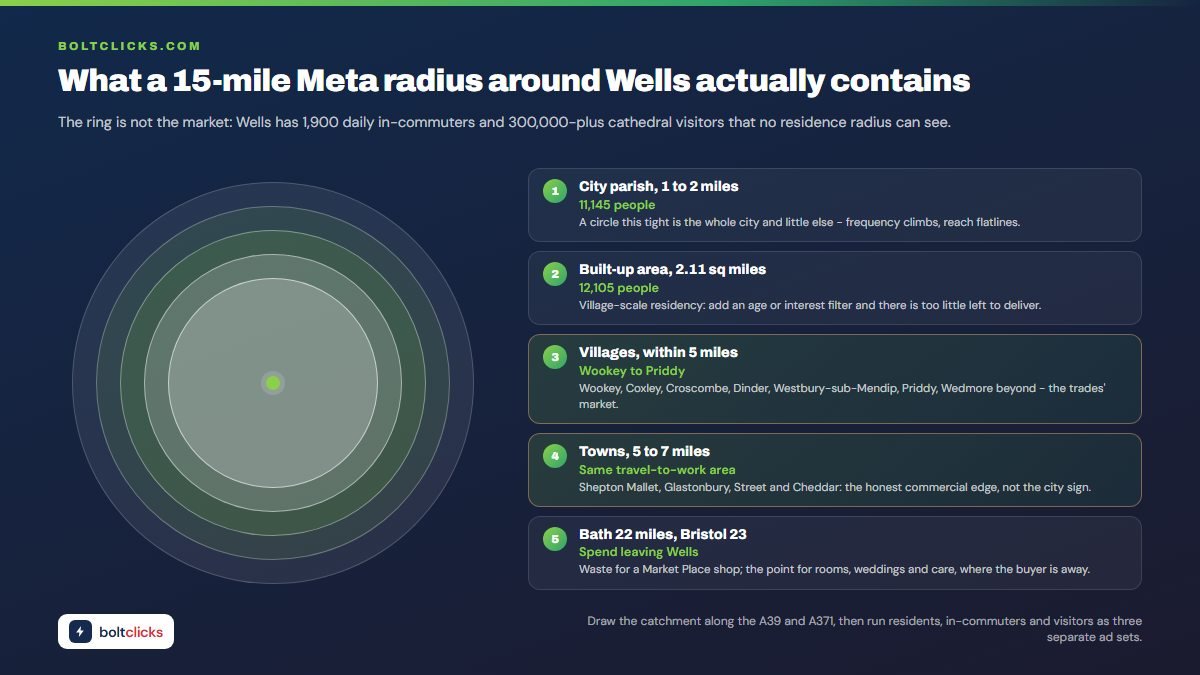
Meta lets you draw a circle as tight as one mile. In most towns that is a reasonable starting point. In Wells a one or two-mile circle sits almost entirely inside a parish of 11,145 people, which is the whole city and very little else. Before you have added a single filter you are already working with an audience a large agency would call a retargeting pool rather than a campaign.
Then the filtering starts. Take out everyone under 25 and over 70, add an interest or two, exclude existing customers, and the auction has almost no room left to optimise. What happens next is predictable: cost per result climbs week on week, frequency reaches five or six within days, and reach flatlines while spend does not.
The failure is quiet, which is the problem. Nothing breaks. The account keeps reporting impressions and a few clicks, so it looks like advertising is happening. It is the most common reason a Wells business tries Facebook ads for two months and decides the channel does not work for them.
- Frequency above four in the first fortnight, on a campaign that has barely spent anything, is a radius problem and not a creative problem.
- Cost per result rising steadily rather than jumping, with reach stuck, means the audience is exhausted rather than expensive.
No station, so your catchment is a drive time along the A39 and A371, not a circle
Wells has no railway station. The nearest national rail is Castle Cary, about 12 miles away, and Bristol Temple Meads is around an hour on the 376 bus. Nobody arrives here by train and almost nobody walks in from outside. Every customer you want comes down a road, and there are two that matter: the A39, running north-east to Bath and south-west towards Glastonbury and Bridgwater, and the A371, running east to Shepton Mallet and north-west to Cheddar and Weston-super-Mare.
That changes the shape of the targeting. A true circle around Wells wastes a large share of its area on the Mendip hills and open farmland while cutting off villages that are ten minutes down a road. The working answer is a 10 to 15-mile catchment stretched along those two roads, assembled from pins and radii on the places people actually live, rather than one ring dropped on the cathedral.
There is an official version of this boundary worth knowing. Wells sits inside the ONS Street and Wells travel-to-work area, which also takes in Glastonbury and Shepton Mallet. That is the honest commercial edge of the city, and a far better starting point for a radius than the city boundary.
Who a Wells radius should reach: Wookey, Coxley, Croscombe and Wedmore before Bath or Bristol
Go out of the city on the A371 and the A39 and the market appears quickly. Wookey, Coxley, Croscombe, Dinder, Westbury-sub-Mendip, Priddy and Wedmore are all inside a sensible drive, with Wookey Hole about two miles out. Then Shepton Mallet at roughly five miles east, Glastonbury at five to six miles south-west, Street at about seven and Cheddar to the north-west.
For a builder, an electrician, a roofer, an oil boiler or log burner fitter, or anyone doing garden and tree work, that ring is the actual business. These are scattered settlements with no single local paper covering all of them and no one high street they share. A leaflet drop across that geography is slow and expensive; a radius does it in an afternoon.
The villages also behave differently in the auction. There are fewer advertisers bidding for attention out there than in Bristol or Bath, which usually shows up in the cost per result — though that is something to read in your own account rather than promise in advance. The trade-off is that you have to be specific about what you do and where you go.
| Where | Roughly | Who should be paying to reach it |
|---|---|---|
| Wookey, Coxley, Croscombe, Dinder | Inside five miles on the A371 and A39 | Trades, home services, garden and tree work |
| Westbury-sub-Mendip, Priddy, Wedmore | Five miles and beyond, scattered | Roofers, builders, boiler and log burner fitters |
| Shepton Mallet and Glastonbury | Five to six miles east and south-west | Almost everyone — same travel-to-work area |
| Street and Cheddar | Seven miles down the A39; north-west on the A371 | Services yes, retail with care |
Clarks Village, Bath and Bristol: when targeting outside Wells is the point and when it is waste
Beyond the village ring the pull reverses. Bath at 22 miles and Bristol at 23 take spend out of Wells rather than bringing it in, and so does Clarks Village at Street — an outlet with more than 90 retailers, roughly seven miles down the A39, sitting inside the ring while the money flows the other way. That is the one place where the radius and the money flow disagree.
So there is no single radius recommendation that fits every Wells business, and anyone who hands you one has not thought about it. A shop on Market Place paying to reach Bath residents is paying for people who have their own city centre on the doorstep and an outlet village on the way. A hotel on Cathedral Green paying to reach exactly those people is doing the most sensible thing in the account.
Bath itself has its own write-up: marketing agency Bath, on what is free in a World Heritage city with a Clean Air Zone and what each tier costs.
Go wide on purpose
- Hotels, B&Bs and holiday lets — the guest is by definition not local
- Wedding suppliers working around the Bishop’s Palace and St Cuthbert’s
- Care, retirement living and at-home support, where the buyer is often an adult child in Bristol or Bath
Stay inside the catchment
- Shops, galleries and cafes on Sadler Street, High Street and Broad Street
- Trades and home services working the A39 and A371 villages
- Appointment-based services people will not drive forty minutes for
The 2,500 who leave the city for work each morning, and the 1,900 who arrive
Mendip’s Local Plan records roughly 2,500 Wells residents commuting out to Bristol and Bath, about 1,900 commuting in — around half of those from Bristol and Bath, half from elsewhere in Somerset — and close to 1,000 travelling in from other towns in the old Mendip district. The net outflow is about 524 people, and those numbers break two assumptions at once.
The first: your residents are not where you think they are. Around 2,500 of them are working somewhere other than Wells between roughly eight in the morning and six at night. That does not make them unreachable, but it changes when their attention is worth paying for. Evening and weekend delivery does more for a Wells audience than a nine-to-five schedule, and a lunchtime offer aimed at residents is aimed at a city many of them have left.
The second: about 1,900 people you would never have included are in Wells all day. They buy lunch, get their hair cut and pick things up on the way to the car park, and a residence-based radius excludes every one of them. Reaching them takes a separate ad set built on daytime presence rather than home address.
Cathedral visitors are footfall, not a customer list: how to reach them without wasting local budget
Wells Cathedral has been reported to draw over 300,000 visitors a year. The Bishop’s Palace alongside it runs 14 acres of gardens and a moat, and Wookey Hole Caves is about two miles out. For a city of 12,105 people that is an enormous volume of passing trade, and it tempts owners into treating it as an audience. It is not. It is footfall, and the two are targeted in completely different ways.
Visitors are reached through travel and visitor behaviour settings, never through people living in this location. That means a separate ad set and a separate offer, because what persuades a resident and what persuades somebody who is in Wells for four hours are not the same message. Mixing them into one campaign is how budget disappears here: resident money buys impressions from people who will have left Somerset by Thursday.
There is a limit worth being honest about. A day visitor decides where to eat on a phone in the street, and that is a moment paid social rarely wins — it is normally settled in Maps and search, which is where your Google Business Profile and local listings do the work instead. Meta earns its place before the trip and after it: the weekend break, the return visit, the thing worth booking ahead.
A practical rule for anything visitor-facing here. If the offer only makes sense to somebody standing on Sadler Street right now, it belongs in search and signage. If it makes sense to somebody planning a trip a fortnight away, it belongs in a Meta ad set of its own.
An older audience than the rest of the old Mendip district, and what it does to Facebook against Instagram
The Local Plan states plainly that Wells has a markedly older age structure than the rest of the district. There is a Churchill Living retirement development in the city and a cluster of care and nursing provision around it and the surrounding villages. This is not a detail to be polite about — it decides which platform carries the delivery.
In practice Facebook does most of the work for most Wells businesses, and Instagram earns its place in specific cases rather than by default. Weddings, hospitality and anything visitor-facing genuinely need it. A local trade, an accountant or a care service usually does not, and splitting a modest budget evenly halves the learning data on the platform that was working.
The age profile also changes who the advert is written for. Care, retirement living and at-home support are the clearest example: the person who needs the service lives in Wells or the villages, but the person who researches, compares and pays is very often the adult son or daughter in Bristol or Bath. That is two locations and two messages inside one account, and running it as a single local campaign is the reason so many care providers conclude Facebook does not work for them.
- Start Facebook-led, then let the placement report earn Instagram its share rather than assuming it.
- Write for the buyer, not the user, when those are two different people in two different cities.
- Keep the offer concrete — a date, a price bracket, a phone call, not a slogan.
The Wells year: Comedy Festival, Glastonbury week, the October festivals and Carnival night
Wells does not have a weather-shaped year, it has an event-shaped one, and the events are unusually well spread. The late May bank holiday brings the Wells Comedy Festival. Late June is Glastonbury Festival week at Worthy Farm, Pilton, a short drive east, when rooms, B&Bs, holiday lets and the food trade fill and price up while residents avoid the roads entirely. July and August belong to cathedral and Wookey Hole family tourism. October is a double — the Wells Food Festival, free to enter with over 150 regional producers, and the Wells Festival of Literature, running since 1992.
Then mid-November, which is the one most plans get wrong. The City Carnival is the biggest single evening of the year, part of the Somerset Guy Fawkes circuit, when the centre closes to traffic and huge illuminated carts come through Strawberry Way, Tucker Street, Chamberlain Street, Sadler Street, High Street, Broad Street and Priory Road. The crowd arrives from the surrounding Somerset towns rather than from outside the county, and it lands in the month most advertising calendars treat as dead.
So a flat monthly spend is the wrong shape here. The sensible structure is a steady always-on campaign plus a reserve held back deliberately, released in the fortnight before Glastonbury week and the fortnight before Carnival. Roughly January to March is the flat stretch, and it is the cheapest attention of the year precisely because every visitor-facing business has stopped bidding — which is exactly when trades, professional firms and care providers should be buying. The mistake to avoid is a hospitality business spending evenly from January and finding nothing left in June.
| When | What happens | What the budget should do |
|---|---|---|
| January to March | The flat stretch | Cheapest attention of the year — trades, professional firms and care providers buy here |
| Late June | Glastonbury Festival week at Worthy Farm, Pilton | Rooms and food release the reserve a fortnight early; local trades hold |
| July and August | Cathedral and Wookey Hole family tourism | Visitor ad sets carry it; resident offers go quiet |
| October | Food Festival and Festival of Literature | Two separate fortnight campaigns, not one long one |
| Mid-November | City Carnival, centre closed to traffic | The second reserve release, for food and hospitality |
| December | Wednesday and Saturday market trade | Steady, local, tight radius |
Wells businesses Meta Ads genuinely suits, and the ones I would talk out of it
It suits the businesses in Wells that have two distinct customer groups, or one time-limited thing to say. Independent shops, galleries and cafes on Sadler Street, High Street, Broad Street and Market Place split their trade between about 12,000 residents and 300,000-plus visitors, and Meta is one of the few channels where those run as two campaigns with two offers instead of one shop window doing both jobs badly. Places with rooms need somewhere a date-specific offer can launch at a fortnight’s notice and stop the moment they are full. Wedding suppliers have a fixed stream of couples planning around the Bishop’s Palace Undercroft, with ceremonies a short walk away at St Cuthbert’s, St Thomas’ or the Town Hall, and life-event targeting is one of the few things Meta does better than search.
Professional and B2B firms around Cathedral Park — the 17-acre park off the A371 with more than 200,000 sq ft of office, warehouse and trade-counter space, where occupiers include Old Mill, Mogers Drewett and TePe — usually do better than they expect, because their audience is at home in the evening rather than searching at eleven in the morning. So do the small firms in units like those at Wells Enterprise Centre, which opened in December 2020 with five light-industrial units of roughly 474 to 483 sq ft and twelve offices of roughly 108 to 164 sq ft. That is the real scale of a Wells business: one or two people, not a department.
Now the ones I would talk out of it. If your demand is an emergency — a burst pipe, a failed boiler in February — nobody is scrolling towards you, and Google Ads is the honest recommendation instead. If you sell to a handful of named trade accounts nationally, a radius of any size is the wrong instrument. And if you have nothing time-limited to say and no second audience, paid social will flatter you with reach and never produce an enquiry. I would rather tell you that in the free audit than take a retainer for it.
Working with one specialist remotely: what happens each week, and what it costs
There is no office in Wells, no desk on Broad Street and no local phone number, and I would rather say so here than let you find out afterwards. I am one specialist, Moeez Abbas, working remotely from Lahore on UK hours, and the person who builds the campaign is the person you speak to. For a city with no agency sector of its own that is hardly a compromise, and there is no office cost buried in the fee.
The arrangement is deliberately plain. Advance payment, month to month, cancel any month, and never a percentage of your ad spend — your media budget goes to Meta, not to me. Access is partner or delegated through Business Manager (now called a business portfolio in Meta’s help centre), so you keep ownership of your page, pixel and ad account, and I never hold your passwords. Retainers start at £650 a month, with £1,200 and £4,000-plus tiers for wider scopes, an £850 one-off SEO Foundation, and international work at USD 800, 1,500 or 5,000; the full breakdown of what each tier includes is published rather than saved for a phone call.
On results, I have one campaign I can point to and I will not pretend otherwise. An independent artist in the UK, £25 of Meta spend, 500-plus Spotify saves and 10 followers across five days, with a verified five-star review. That is one campaign in one niche, not a prediction for a Wells hotel, a trade or a wedding photographer. It is the only real number I have, so it is the only one on this page.
Before anything is spent
A free written audit or account review first: what the current radius is actually reaching, where the frequency is going, and whether I think Meta is the right channel for you at all.
Build
The catchment drawn along the A39 and A371 rather than as a circle, residents and visitors separated into their own ad sets, tracking checked before launch, and the seasonal reserve agreed in advance so June and November are funded before they arrive.
Every week, in writing
A written report every week: spend, enquiries, cost per enquiry, what changed and what I am changing next. At the scale of most businesses here — one or two people, not a department — enquiries arrive in single figures a month, so it tracks logged enquiries and a consistent ask of how people heard about you, building a pattern over weeks rather than passing a verdict the morning after launch.
What a client said, and what you can check
“Great communication and very helpful throughout the process. Took the time to explain everything clearly and set up the campaign professionally. Focused on quality results rather than just numbers. Highly recommended.”
This is one of three client reviews published so far; the other two, from a UK SEO client and a US Google Ads client, are on the home page. Every figure comes from the client’s own ad account, and a review goes on this site only when it is real.
What you can check before you pay
- Prices published in full on the pricing page, not hidden behind a sales call
- Month to month, with one month’s notice and no lock-in contract
- Every account, profile and file stays in your name; I work through partner access
- A written report every week, in plain English
- One specialist does the work, from the audit to the report
Wells Facebook ads: frequently asked questions
Is the audience in Wells even big enough for Facebook ads?
Honest answer: not on its own. The built-up area is 12,105 people, so the campaign has to run on a 10 to 15-mile catchment taking in the villages, Glastonbury, Shepton Mallet, Street and Cheddar. Drawn tighter than that, delivery stalls and frequency spikes within days.
Should I target just Wells, or the whole of Mendip?
It depends on whether you deliver or they travel. A trade or home service goes wide along the A39 and the A371. A shop on Market Place or Sadler Street stays tight and adds a separate visitor campaign on top, rather than widening the resident one.
Will I end up advertising to tourists instead of locals?
Only if the campaign is built badly. Residents and visitors need separate ad sets with different offers. The residence setting and the travel-behaviour setting are not interchangeable, and mixing them is the most common way budget disappears here.
Do I need to exclude Street and Glastonbury so I am not paying for Clarks Village shoppers?
Usually no. You exclude by intent and offer rather than by geography, because those same postcodes contain plenty of people who would happily drive into Wells for the right thing. Cutting the postcode cuts the good traffic with the bad.
Does it matter that there is no office in Wells?
No, and it saves you money. One specialist working remotely on UK hours, with a written report every week. There is no office cost built into what you pay, and there is no agency in Wells charging you for one either.
Is Instagram worth running for a Wells business?
Facebook usually carries the delivery, because Wells has a markedly older age structure than the rest of the old Mendip district. Instagram earns its place for weddings, hospitality and anything visitor-facing, and often not much else. Let the placement report decide.
Should I spend more during Glastonbury Festival week?
If you have rooms, food or anything visitor-facing, yes, and the money should be committed a fortnight beforehand rather than on the Monday. If you are a local trade or a professional firm, no — your customers are avoiding those roads that week.
Is Carnival night worth advertising around?
For hospitality and food the run-up is one of the strongest windows of the year, because the crowd comes in from across Somerset in a single evening. For most other businesses it is atmosphere rather than revenue.
How do I tell whether it is working when I only get a handful of enquiries a month?
Low volume needs different measurement: tracked enquiries, a consistent ask of how people heard about you, and a written report every week so you watch the pattern build rather than reading a dashboard the day after launch.
A free account review, before anything is agreed
Send over the ad account, or just the website if there is no account yet, and you get a written review of what is set up, what is leaking and what I would change first. It costs nothing and there is nothing to sign. If the honest answer is that ads are not the right spend for a business your size in Wells, that is what the review will say.