
Facebook Ads Agency Winchester: Meta for Hampshire Trade
Winchester is a city of under 50,000 people whose highest earners are on a 56-minute train to Waterloo by nine, and whose trading year turns on six weeks of Cathedral Christmas Market. Meta ads here are won on hours and radius, not budget. I run them remotely, one specialist, UK hours, with a written report every week.

The Winchester audience is wealthy, small, and in London by nine
Around 45,000 to 50,000 people live inside Winchester itself, sitting in a district of about 127,900. That is the first number that should change how you buy Facebook and Instagram ads here. The second is the one that makes this city unusual: The second is the one that makes this city unusual: Halifax’s affordability research has named Winchester the least affordable city in the UK to buy a home in, and local house prices still run at many times local earnings. The money is here. A large share of the people holding it are not.
The fastest trains to Waterloo run in 56 minutes, with more than 120 services a day and an annual season ticket running well past £6,000. A meaningful slice of the city’s highest earners is physically in central London from roughly 08:00 to 18:30, Monday to Friday. Leave an ad set on “Everyone in this location” with flat all-day delivery and you are putting a Winchester offer in front of people sitting in central London, while the audience genuinely inside your radius at eleven on a Tuesday is visitors, students and the institutional workforce.
That is an audience-construction problem, not a budget problem. Meta will separate people who live in a location from people who happen to be standing in it, and in Winchester that one setting is worth more than another few hundred pounds of spend. Everything else in the way I build Meta and Instagram ad campaigns follows from deciding, before a pound is committed, who counts as a Winchester person.
- Use “People living in this location”, never “Everyone in this location”, for any campaign selling to residents rather than visitors.
- Weight delivery towards 06:30–08:30, 17:30–19:30 and weekends, because that is when the commuting half of your audience is reachable.
- Treat Tuesday to Thursday as a structural trough for city-centre trade, not a performance problem to be solved with a higher bid.
- Switch to “People recently in this location” for visitor-facing offers, and accept that the audience refreshes constantly.
Why a 25-mile radius around Winchester funds a shopping trip to WestQuay
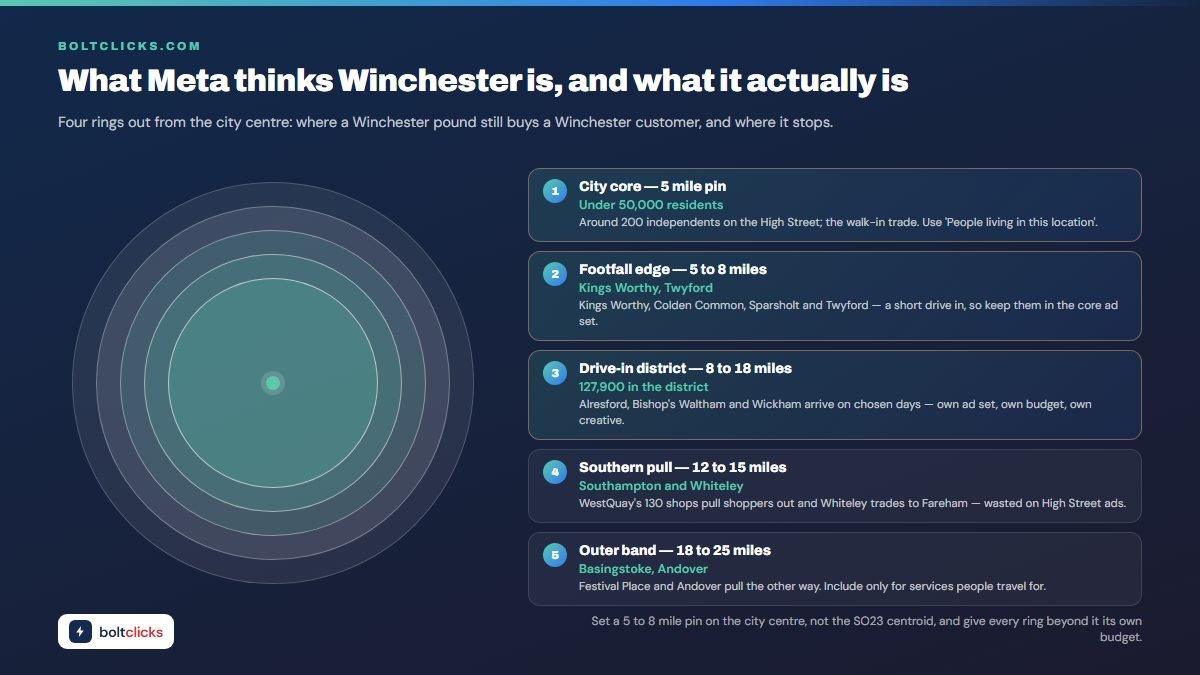
Drop a pin on Winchester in Ads Manager, pull the radius out to 25 miles because it feels safe, and the circle gets expensive fast. It swallows Southampton about 12 miles to the south, along with Eastleigh, Chandler’s Ford, Romsey, Basingstoke about 18 miles north, Andover, and the outer edge of Portsmouth.
Southampton is not neutral ground. WestQuay, with roughly 130 shops including John Lewis and M&S, is the regional retail centre Winchester shoppers already travel to, and Festival Place in Basingstoke is the other comparison-shopping magnet on the opposite side. For a High Street boutique, a café or a salon, buying reach in either city is paying to advertise to people heading in the opposite direction.
The structure that works instead has three parts. A tight five to eight mile pin on the city centre itself, not the SO23 postcode centroid, which pulls the circle off shape and hands you fields instead of customers. A separate ad set for the rural district, because those customers drive in deliberately, convert differently and respond to different creative. And Southampton or Basingstoke included only where people genuinely travel for the service, always with their own budget so the result can be judged on its own. How people arrive matters too: M3 Junction 9 north-east by Winnall and Junction 11 south near Bar End and St Cross shape drive-in trade far more than the map suggests.
The six weeks from mid-November that decide a Winchester trading year
Most towns of this size are budgeted around a summer curve. Winchester is not, and getting the shape wrong is the costliest planning error here. The dominant peak runs from mid-November to Christmas Eve: the Cathedral Christmas Market and the ice rink. In 2025 it averaged 3,743 visitors a day, up nearly 4% on 2024, with around £3.5 million spent at the market itself and the share of visitors staying over an hour climbing from 62% to 74%.
What matters most to everyone who is not a stallholder is where the rest of that money goes. Those visitors do not only spend at the chalets; they spend in the shops, cafés and restaurants they pass on the way in and out. The market does not only trade for itself; it pulls spending into the whole city centre for six weeks. A Winchester advertiser is competing less for the market’s customers than for the attention of people already coming.
September and early October: warm the pools
Video views, page engagement and website traffic audiences built now are the retargeting pools that carry December. Cold traffic in the market’s opening week is the most expensive of the year to buy.
Opening week to Christmas Eve: bid hardest
Spend disproportionately here, with creative that assumes the viewer is already planning a trip into the city.
January: retarget December, do not abandon it
A retention campaign aimed at people who engaged in December is worth more in Winchester than in most towns, because the visitor volume behind it is unusually large for a city this size.
Roughly 82% of the district’s businesses are micro — what a sensible monthly budget looks like here
There are around 8,165 businesses in Winchester district and roughly 82% of them are micro-businesses, with about 16% small and only 1.5% medium. There is almost no large private-sector employer in the mix. In practice the advertiser reading this is a one to nine person firm, often the owner doing the marketing after the shop shuts, and a fee built for a fifty-person marketing department is the wrong shape.
So the prices are published rather than quoted after a discovery call. Management starts at £650 a month, with £1,200 and £4,000-plus tiers as the work grows, and a one-off SEO Foundation at £850 where search needs fixing alongside the ads. Work outside the UK is priced at USD 800, 1,500 and 5,000 equivalents. Everything is paid in advance, month to month, cancellable at the end of any month, and never as a percentage of your ad spend — because a percentage fee quietly rewards me for spending more of your money, which is exactly the wrong incentive in a city where the win comes from spending less, in the right hours. The full breakdown sits on the pricing page. Your ad budget is separate and goes straight to Meta from your own card — and for a tight Winchester radius it is usually smaller than owners expect.
| Management | Fee | Typically suits |
|---|---|---|
| Entry | £650 a month | A single shop, café or clinic on a tight city radius |
| Growth | £1,200 a month | Trade and home-improvement firms running lead campaigns plus retargeting |
| Full | From £4,000 a month | Multi-service businesses with seasonal peaks and several audiences to keep apart |
| SEO Foundation | £850 one-off | Fixing the site the ads point at, before paying for traffic |
Winnall, the High Street and Southgate Street need three separate campaigns, not one
Winchester’s commercial life is not evenly spread, and the three clusters that matter want different campaigns. Trade and light industry sit north-east at Winnall, off Easton Lane, Winnall Manor Road and Winnall Valley Road, with St Martins Trade Park and Sun Valley Business Park alongside, a quarter of a mile from M3 Junction 9 and the A34. The occupiers — Jewson, Wickes, Toolstation, Mole Country Stores, Beaver Tool Hire and Halfords Autocentres — tell you what the customer looks like: arriving by vehicle, buying on job value rather than impulse, and reachable with before-and-after creative.
Retail is the opposite. Around 200 independent shops, services, restaurants and cafés trade along the pedestrianised High Street, Parchment Street, Jewry Street and The Square, with The Brooks Shopping Centre on Middle Brook Street holding Primark, TK Maxx and Sports Direct, a street market from Thursday to Saturday and one of the country’s largest farmers’ markets. These businesses cannot outbid national chains on shopping feeds. Meta is the one channel where visual stock competes on the image rather than the budget.
Then there is the professional quarter on Southgate Street, including Southgate Chambers, and St Peter Street: solicitors, chartered accountants, tax advisers and wealth firms with an unusually high-equity client base on their doorstep. Meta will not replace search for someone typing “probate solicitor” at eleven at night, which is why that work usually belongs with a search campaign running alongside. What Meta does well here is retargeting site visitors, filling seminars and getting guides downloaded by the over-fifty owner-occupiers who dominate this city.
Whiteley, Alresford and the 250 square miles the council calls Winchester
Winchester district covers roughly 250 square miles and about 127,900 people, but fewer than half live in the city. The rest are in New Alresford, Bishop’s Waltham, Wickham, Kings Worthy, Colden Common, Sparsholt, Twyford, Whiteley and dozens of villages. Select “Winchester” as an administrative area in a targeting tool, assume it describes a trading catchment, and you have bought an audience that does not behave like one.
Whiteley is the sharpest example: its northern and eastern half sits in Winchester district, yet the place as a whole is roughly 15 miles south beside Fareham, inside the Solent commercial orbit, with shopping and commuting habits that point away from the city entirely. For a High Street business, Whiteley reach is close to wasted. The rural district is different again. Alresford is watercress country, with the Watercress Line running from it, and its customers, like those in Bishop’s Waltham and Wickham, drive in on purpose, on chosen days. They need their own ad set, budget and creative that acknowledges a journey rather than a walk past the window.
Keep in the core ad set
- The city centre and its immediate five to eight miles
- Kings Worthy, Colden Common, Sparsholt, Twyford
- Anyone whose visit is a walk or a short drive
Split out, always
- New Alresford, Bishop’s Waltham and Wickham as deliberate drive-in trade
- Whiteley, which trades towards Fareham and the Solent
- Southampton and Basingstoke, and only for services people travel for
Term dates matter: 6,840 students at the university, 4,400 at Peter Symonds
The University of Winchester has about 6,840 students across the King Alfred campus on Sparkford Road and West Downs off Romsey Road. Peter Symonds College is one of the largest sixth-form colleges in England with over 4,400 students aged 16 to 19, and Winchester College has around 740 pupils. Between the university and Symonds alone, roughly 11,000 students move in and out of a city of under 50,000 on a fixed calendar you can look up a year ahead.
For some advertisers that is the whole opportunity: late-night food, phone repair, hairdressing, gyms and bars should build audiences in late August and spend hardest through the first three weeks of the intake. For others — a wealth adviser, a kitchen fitter, a private clinic — those weeks are a quiet tax, because a broad radius will happily deliver impressions to eighteen-year-olds with no interest in a £20,000 job. Age and interest layering is not optional in a city with this student share.
The institutional workforce sits behind the students. Hampshire County Council is headquartered in the city centre and the Royal Hampshire County Hospital sits off Romsey Road, part of a trust employing around 8,600 people across its sites. That is a stable weekday audience that stays put while the commuters are away, which makes lunchtime offers and after-work services more viable than the daytime population figures suggest.
Hat Fair, Boomtown and how to shape a year of Winchester ad spend
Flat monthly spend is the default because it is easy to invoice, not because it works. Winchester’s calendar has three lifts and two troughs, and matching money to them changes results more than any creative change.
Hat Fair, the free outdoor arts festival founded in 1974 and the longest continually running event of its kind in the UK, normally lands on the first weekend of July alongside the school holidays. Check the year first: it paused in 2026 and returns in 2027, and a campaign planned around a festival that is not running is an expensive mistake. Boomtown runs five days in mid-August at the Matterley Estate in the South Downs near the city, capacity just under 80,000. For most city-centre shops that week is a traffic problem rather than a trading one; for accommodation, taxis, camping supplies, convenience stores and late food it is the biggest week of the year.
The troughs matter as much. January and February are genuinely quiet, and the right response is to underspend on purpose, using cheap CPMs to test creative and rebuild audiences rather than pushing budget at a market that is not buying.
| Window | What is happening | What the budget should do |
|---|---|---|
| January–February | The deepest trough of the year | Underspend on purpose; test creative at low CPMs |
| Late June–July | School holidays, and Hat Fair in the years it runs | A secondary lift, weighted to visitors and families |
| Mid-August | Boomtown at the Matterley Estate | Heavy for accommodation, taxis and late food; reduce for city-centre retail |
| September | University and Peter Symonds intake | A step up for student trade; start warming December pools |
| Mid-November–24 December | Cathedral Christmas Market and ice rink | The hardest spend of the year, across the whole city centre |
How I build, report on and charge for a Meta campaign
Every account starts the same way, and the first step costs nothing: I look at what is already running, and write up what I find in plain English before any money changes hands.
1. A free written audit or account review
If you already advertise, I go through the structure, audiences, placements and creative, and send back a document setting out what is working, what is leaking and what I would change first. If you have never run ads, it is a written plan instead: audiences, radius, offers and a realistic monthly figure.
2. Access without passwords
You keep ownership of your Business Manager (now called a business portfolio in Meta’s help centre), your Page and your ad account. I am added as a partner or given delegated access, which you can remove yourself at any time. I never ask for and never hold your Facebook password.
3. Build, then split by geography
City core, rural district and travel-for-it markets are kept apart so results can be read separately rather than averaged into one number that hides which half works.
4. A written report every week
Not a monthly call. A weekly written report covering what was spent, what it returned, what changed and what changes next — forwardable to a partner or accountant without translation.
Payment is in advance, month to month. You can cancel at the end of any month, there is no minimum term, and the fee is never a percentage of your ad spend.
No Winchester office and no local number — what remote actually looks like
Said plainly: there is no office in Winchester, no desk on Jewry Street, no local phone number and no team. I am Moeez Abbas, one specialist working remotely from Lahore on UK hours with businesses in the UK and the US. Every other page competing for this search leads with a building as proof of local credibility. I would rather lead with the fact that you are not paying for one.
The same approach is written up for two cathedral cities in the neighbouring counties, each with its own problem: Facebook ads in Salisbury, where Southampton pulls shoppers twenty miles east, and Facebook ads in Chichester, where the hard part is telling a resident from a day-tripper.
What you get instead is the thing an office was supposed to prove. A written report every week rather than a quarterly visit. Replies during your working day. One person who knows your account, rather than an account manager relaying instructions to a media buyer you never speak to. And a fee carrying no rent on a Hampshire high street.
Knowing a place is not the same as sitting in it. Everything on this page — the Waterloo commute, the WestQuay pull, the six weeks in December, the Whiteley boundary, the split between Winnall and the High Street — is what local knowledge has to mean for an advertiser. None of it requires a postcode. It requires having done the reading before spending your money.
- No fake local address, no virtual office rented to look like a neighbour.
- UK working hours, so questions are answered the same day rather than the next one.
- A written report every week, in language you can forward without explaining it.
- You own everything, from the Business Manager to the Page to the pixel and the audiences built inside it.
The one result I can show you, and the caveat that comes with it
Here is the entire body of results I am willing to put on a page. One client: an independent artist in the UK. One Meta Ads campaign. A budget of £25. Across five days it produced more than 500 Spotify saves and 10 new followers, and the client left a verified five-star review.
Now the caveat, which matters as much as the number. That is one campaign, in one niche, with a tiny budget and an objective — saves and follows — that has nothing in common with filling a restaurant in December or selling a fitted kitchen to a household in Kings Worthy. It is not a forecast and not a benchmark, and it should not be read as an indication of what your account will do.
You will find pages on this search quoting percentage uplifts and client counts. I cannot honestly do that yet, so I am not going to. What I offer instead is a free written audit before you pay anything, published prices, a weekly report and the ability to leave at the end of any month. If that is a fair trade for having no case study wall, send over what you are running now.
Meta, search or the site: which one to fund first
Everything above covers one of four places your money can go, and for a fair number of Winchester businesses it is not the first. What settles the order is whether somebody already types what you sell into a search box, or whether they have to be shown it before they know they want it. Winchester splits unusually sharply on that question.
On the city council’s own tourism figures the district takes over 7.8 million day visitors and 220,000 overnight visitors a year, a visitor economy worth more than £292m and supporting over 5,760 jobs. Those people decide where to park, eat, book and buy by searching, usually on a phone and usually the same day. If that is your customer, the demand already exists and the job is to be findable rather than interesting, which puts search work first in the queue and makes Meta the thing you add once the basics are earning.
The other fork is a local peculiarity. The fast line into Waterloo means plenty of firms registered in the district do not sell to the district at all: technology companies, consultancies and online retailers that picked the place for the commute and the schools, then trade nationally from it. For them the town in the keyword is irrelevant and the local search argument collapses. Work out which of the two you are before you argue about channels.
| Your business | Fund first | Why |
|---|---|---|
| Cafes, pubs, hotels, attractions | Search and the map listing | A day visitor searches before deciding. Be in the result, not in a feed. |
| Solicitors, accountants, surveyors, clinics | Google Ads, then search | Few searches, high value per client. Paid search buys a small market outright. |
| Trades covering the villages | Map listing and reviews | Boiler, roof, drains. The search happens the moment the problem starts. |
| Shops and studios on a footfall street | The website, then Meta | Discovery is visual, but the phone check happens before anyone walks in. |
| A launch, or a service nobody searches for yet | Meta | The demand has to be made. There is nothing to rank for. |
| Suppliers and recruiters selling to the large employers | Google Ads | You cannot target a procurement lead by interest. You can meet their search. |
Where a Winchester pound buys more on Google
For a city this size the employer list is odd. IBM’s Hursley laboratory sits just outside the city, Arqiva is headquartered in the district, and Hampshire County Council, the University of Winchester and the county hospital all run from the city as well. That supports a layer of local business selling to organisations rather than households: fit-out, catering, IT support, compliance, training, recruitment. Interest targeting cannot find a facilities manager or a procurement lead, because there is no Facebook interest called “needs a new supplier by March”. A search campaign can, because that person types the thing they need. This is where Google Ads tends to out-earn a social budget in Winchester, and it is the half of the market the Meta work above leaves alone.
The honest limit is volume. Town-level service terms in a district this size are counted in tens of searches a month rather than thousands, and the phrase that most likely brought you to this page is one of them. Once you have taken the clicks that exist, more budget only buys a wider radius, and wider from Winchester means paying Southampton rates for people who were never coming up the A33 to you. A sensible Winchester paid search budget stays small, tightly matched and left to compound.
Google Ads earns its place
- Urgent trades: lock, leak, boiler, emergency dental.
- Services worth four figures a client, where a few pounds a click is cheap.
- Selling into the large employers and the public sector in the district.
- A launch that cannot wait for rankings to build.
- Seasonal cover where six weeks of visibility is the whole job.
Google Ads wastes money
- Broad match left on, which in a market this small means the whole county.
- Every ad pointing at the homepage instead of the page about that service.
- No call tracking, so the phone rings and nobody knows which pound did it.
- Terms you would rank for organically inside a few months anyway.
- Niches where the searches are simply not there to buy.
Fees matter more once two ad channels are running. A marketer paid a percentage of ad spend, who also decides the Meta and Google split, is paid to recommend more of both. This is a flat monthly fee instead, in advance, cancellable any month, from £650 through £1,200 to £4,000 and up, by scope. The work is run remotely from Lahore on UK hours, so there is no Winchester office sitting inside the price, and a written report lands every week.
The page every pound lands on, and what it must do in Winchester
Meta, Google and organic search all finish in the same place: a page on your own site. It is the cheapest to put right and the one left alone longest. Winchester sharpens the point, because the retail core is compact and largely pedestrianised. Your customer is comparing you with the business forty yards along the High Street, usually on foot, usually with a phone already in their hand. A site that needs six seconds and a pinch-zoom before it shows an opening time has already lost that comparison.
Out across the parishes the job changes but gets no vaguer. The site has to name the places you cover, answer the price question with a range instead of a form, and give one obvious way to make contact. Vague coverage is the easiest fault to fix and the most common: “Winchester and surrounding areas” gives Google nothing to match against a search typed in a named village, and gives the reader no reason to believe you will turn up when it rains.
- One page per service, not a single page listing nine. An ad needs somewhere specific to land and search needs something specific to rank.
- Hours and location in the text, not only inside a graphic, so the search answer and the phone answer agree.
- An enquiry route that works with one thumb, on a poor signal, with no account to create.
- Named coverage, the villages and streets you genuinely serve, written out in full.
- Prices, or an honest range. In a market this small, people who cannot afford you cost you time by enquiring.
- Proof that belongs to you, photographs of your own work and real reviews, not stock shots.
Sequence rather than either-or: the site is fixed once and then improves the Meta campaign above, the organic work and the paid search together, which is why it usually comes before either monthly budget.
What a client said, and what you can check
“Great communication and very helpful throughout the process. Took the time to explain everything clearly and set up the campaign professionally. Focused on quality results rather than just numbers. Highly recommended.”
This is one of three client reviews published so far; the other two, from a UK SEO client and a US Google Ads client, are on the home page. Every figure comes from the client’s own ad account, and a review goes on this site only when it is real.
What you can check before you pay
- Prices published in full on the pricing page, not hidden behind a sales call
- Month to month, with one month’s notice and no lock-in contract
- Every account, profile and file stays in your name; I work through partner access
- A written report every week, in plain English
- One specialist does the work, from the audit to the report
Winchester Facebook ads: frequently asked questions
Is there even enough of a Facebook audience in Winchester to run ads?
Yes, but not in the way most people assume. Under 50,000 people live in the city itself, so a workable audience is built from the wider district plus the 8 million-plus visits the area takes each year, worth around £292 million and supporting over 5,760 jobs. That is an audience-construction problem rather than a budget one, solved with ad set structure rather than more spend.
Should I target Southampton as well?
Usually no for a shop, café, salon or anything footfall-dependent, because Southampton and WestQuay pull Winchester shoppers out rather than sending them in. Yes if you sell weddings, clinical services, legal work or high-value trades, where people genuinely travel — but always as a separate ad set with its own budget, so you can see what that city actually returns instead of burying it in an average.
My highest-value customers commute to London. How do I actually reach them?
Target by home location rather than current location, using “People living in this location”, and weight delivery towards the commute windows, evenings and weekends. With the fastest Waterloo trains at 56 minutes and up to 121 services a day, those households are outside a tight Winchester radius for most of the working week, so a flat all-day schedule spends much of its budget while the audience sits in London.
When should I start advertising for the Cathedral Christmas Market?
Start building audiences in September and early October, bid hardest from the market’s opening week through to Christmas Eve, then run a January campaign retargeting the people who engaged in December. This matters to businesses nowhere near the cathedral close too, because market visitors do not confine their spending to the chalets — they eat, drink and shop in the city centre on the same trip.
Whiteley and Alresford are in Winchester district. Do I target them the same way?
No. Whiteley sits roughly 15 miles south near Fareham, inside the Solent orbit, and its shopping habits point away from Winchester entirely. Alresford is drive-in trade, where people choose a day and make the journey. Both need their own ad sets, because a council boundary covering around 250 square miles is an administrative line, not a trading catchment.
How much do I need to spend a month, all in?
Management starts at £650 a month, with £1,200 and £4,000-plus tiers, paid in advance and cancellable at the end of any month. Your ad spend is separate and goes directly to Meta from your own card — I never take a percentage of it. There is also a one-off SEO Foundation at £850 where the website needs work first.
Will Meta ads work for a professional services firm on Southgate Street?
Partly, and it is worth being clear which part. Meta is strong for retargeting website visitors, for awareness among an older, property-rich local audience, and for seminar sign-ups or guide downloads. Someone actively searching for a solicitor or an accountant is on Google, though, so for firms on Southgate Street and St Peter Street it belongs alongside search rather than instead of it.
Do you need my Facebook password or account login?
No. You keep ownership of your Business Manager, your Page and your ad account, and I am added as a partner or given delegated access. You can remove that access yourself at any time, without asking me. I do not ask for passwords and do not hold them.
You are not in Winchester. How does that work in practice?
One specialist working remotely on UK hours, with a written report every week instead of a monthly catch-up call. There is no office here, no local number and no receptionist, and the fee reflects that. What you are buying is the campaign work and the reporting, not a building on the High Street you would never have visited.
A free account review, before anything is agreed
Send over the ad account, or just the website if there is no account yet, and you get a written review of what is set up, what is leaking and what I would change first. It costs nothing and there is nothing to sign. If the honest answer is that ads are not the right spend for a business your size in Winchester, that is what the review will say.