
Facebook ads agency for Worcester businesses, run remotely by one person
I am Moeez Abbas, and I run Facebook and Instagram advertising on my own, remotely from Lahore in Pakistan, for businesses in the UK and the US. There is no Worcester office and no team behind me: just one person, your ad account, and a weekly conversation about what is working. This page is about how paid social actually behaves in this particular city, from the catchment the Severn cuts in half to the trading year the river interrupts. It also answers the free question honestly, because the tools genuinely are free and the management time never is.

What a Worcester business actually buys when it pays for Meta ads
The Boost button under a Facebook post and a campaign built in Meta Ads Manager are sold in the same place and take money the same way, but they are not the same product. Boosting pushes something you have already published at an audience Meta picks, usually optimised for engagement. That is a real thing to buy, and it is rarely what a Worcester business needs.
A proper campaign has three layers. The campaign sets the objective and the budget rules. The ad set decides who sees it, where they live, which placements run — Facebook Feed, Instagram Feed, Reels, Stories, Marketplace, Messenger and Audience Network — and which optimisation event Meta chases. The ad is the creative. Boosting collapses all three into one panel with most of the controls removed.
The optimisation event quietly governs everything else. Optimise for engagement and Meta finds people who engage: the retired gentleman in Barbourne who comments warmly on every photograph of Worcester Cathedral and books nothing. Optimise for a lead, a message or a purchase and the auction hunts a different person entirely.
In local terms: a salon on Friar Street does not need reach across WR1 to WR5, it needs a dozen new heads a month within a short walk of a chair it already pays rent on. A heating engineer in Warndon needs enquiries in the fortnight either side of the first hard frost, from homeowners in Warndon Villages, Ronkswood and Battenhall whose boiler has just failed. A caterer working the Vale of Evesham wedding season needs bookings nine months out.
Who is writing this. I am one person — Moeez Abbas — working remotely from Lahore in Pakistan, for businesses in the UK and the US. There is no Worcester office and no team behind me. What follows comes from research and from the ad platforms themselves, not from standing on The Cross on a wet Tuesday.
So you are buying four things, and the last is the one most local advertisers never get.
- An objective tied to a business outcome, not a vanity number.
- A radius reflecting where customers genuinely travel from.
- A tracked event installed and verified before a penny is spent.
- A named person who turns off the losers weekly.
Four Worcester economies, and only two of them buy paid social
Worcester’s trading base splits four ways, and each part buys marketing differently. A page treating the city as one market is useless to all four.
Manufacturing and engineering on the eastern edge
Worcester Bosch was founded in 1962 by the engineer Cecil Duckworth as the Worcester Engineering Co Ltd, at the Old Vinegar Works in St Martin’s Gate. It became Worcester Heat Systems, was sold to Robert Bosch GmbH in 1992, and has traded from Cotswold Way in Warndon since 1990, reporting more than 2,000 people across the Worcester headquarters and a second plant at Clay Cross in Derbyshire, plus over 300 service engineers. Yamazaki Mazak builds CNC machine tools at Badgeworth Drive, WR4 9NF, in a European headquarters the company says employs over 600 at its Worcester plant. Lea & Perrins, founded on Broad Street in 1837 by the chemists John Wheeley Lea and William Henry Perrins and now part of Kraft Heinz, has made Worcestershire sauce at the Midland Road factory since 1897. Off M5 Junction 6, Worcester Six Business Park — ninety acres developed by Stoford, consented for up to 1.5 million sq ft — has over 1.2 million sq ft delivered or committed, with occupiers including MiTek, Bidfood, Alliance Flooring Distribution, Kimal, Spire Healthcare, IONOS, Kohler Mira, ZwickRoell, Material Solutions, Super Smart Service, Stop Start Transport and Sierra CP Engineering.
None of those firms buys local Facebook ads. Their supply chains hold the local money: tooling, fabrication, calibration, contract packing, industrial cleaning and courier logistics, trading from Blackpole Trading Estate in WR3, Shrub Hill Industrial Estate, Tolladine Goods Yard, the Great Western Business Park on Tolladine Road, Checketts Lane, Perry Wood, Newtown Road and Everoak. Those firms sell to buyers with job titles rather than postcodes, which changes the platform as well as the budget.
The public sector and the anchor institutions
Worcestershire Royal Hospital stands on Charles Hastings Way, WR5 1DD, the county’s main acute site, run by Worcestershire Acute Hospitals NHS Trust alongside the Alexandra Hospital in Redditch and Kidderminster Hospital and Treatment Centre. Herefordshire and Worcestershire Health and Care NHS Trust sits beside it. The University of Worcester taught 8,755 students in 2024/25, across St John’s Campus, the City Campus on the former Royal Infirmary site, the Lakeside Campus and the Riverside site with the Worcester Arena; The Hive, a £60 million library run jointly by the university and Worcestershire County Council and opened on 2 July 2012, is the most visible building any of them owns. Worcestershire County Council’s County Hall stands on Spetchley Road; Worcester City Council meets at the Guildhall on High Street, WR1 2EY; and Sanctuary, one of the country’s largest social landlords, is headquartered at Sanctuary House, Chamber Court, Castle Street, WR1 3ZQ. Around them cluster care homes, domiciliary care agencies, student lettings, nurseries and recruiters, advertising on Meta mostly for staff.
An unusually independent city centre
Worcester BID has run since April 2010, represents over 650 businesses and is in its fourth term, BID4, covering 2025 to 2030, with the Safer City scheme, CityNet, footfall reporting and the BID Card among its programmes. The trading spine is High Street, The Shambles, Friar Street, New Street, Pump Street, Cathedral Square, Mealcheapen Street, Broad Street, Angel Street, The Cross, Sidbury and Lowesmoor, plus the covered centre reached from Broad Street, whose malls are Friary Walk and Chapel Walk. Independent cafés, bars, barbers, salons, tattoo studios, gyms, bridal shops and antiques dealers dominate: small budgets, high sensitivity to footfall and flood days.
Trades and property in the suburbs
St John’s in WR2, Barbourne in WR3, Warndon and Warndon Villages in WR4, Ronkswood, Battenhall and Diglis in WR5, plus Dines Green, Tolladine, Claines, Northwick, Red Hill, Henwick, Lower Wick, Cherry Orchard, Rainbow Hill, Blackpole, St Peter the Great and Perdiswell. Plumbers, heating engineers, electricians, roofers, builders, landscapers, estate and letting agents, mortgage brokers, accountants and driving instructors. A meaningful slice is flood-reactive: damp proofing, drying and restoration, flood-resilience installation, groundworks and loss adjusting.
Two of those four buy paid social with their own money: the city centre and the suburban trades. The rest of this page is written for them.
Why a circle drawn on a map is the first thing a Worcester campaign gets wrong
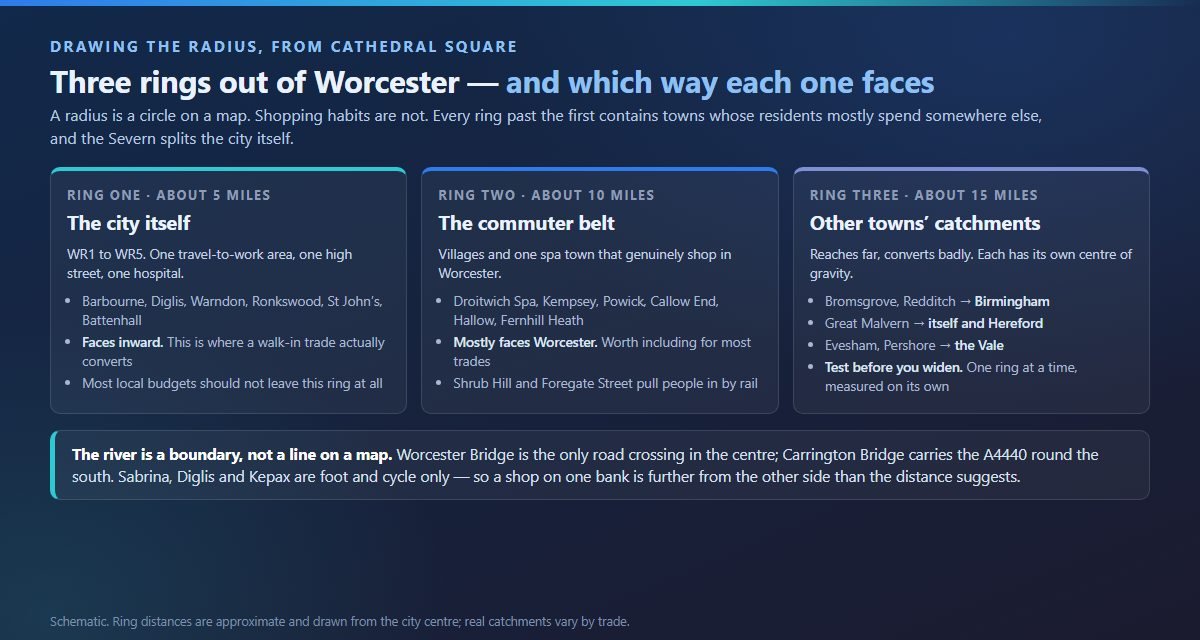
In Ads Manager you drop a pin, pick a radius, and the map draws a circle. The circle is geometry. Trade is not. Worcester sits on the River Severn a mile and a half north of its confluence with the River Teme, and the land either side does not behave like a disc.
Draw ten miles from Cathedral Square and you have swallowed Droitwich Spa, Kempsey, Powick, Callow End, Hallow, Fernhill Heath and Norton, and you are reaching towards Great Malvern and Pershore. Push to fifteen and you add Evesham, Upton-upon-Severn, Kidderminster and Bromsgrove, and clip Redditch. In practice you have bought impressions from people facing the wrong way: Bromsgrove and Redditch commuters look north to Birmingham, Great Malvern to itself, the Malvern Hills National Landscape and Hereford, Evesham and Pershore to the Vale of Evesham, Tenbury Wells to Ludlow.
West of the Malvern Hills the opposite problem applies: the Facebook ads agency in Hereford page covers a city whose ten-mile circle is mostly orchard, pasture and river.
The demographics matter as much as the map. Census 2021 put Worcester’s population at 103,900, up 5.2 per cent on 2011, below England’s 6.6 per cent and the West Midlands’ 6.2 per cent. The Office for National Statistics recorded the over-65 population rising 25.9 per cent over that decade, against 20.1 per cent across England and Wales, with under-15s down 1.6 per cent and the median age up from 37 to 39. The same census put Worcester among the fifth of English local authority areas with the highest population density. Read commercially: nobody here grows by riding population growth, only by taking share from the business three doors down.
Such growth as there is sits in the ring: ONS recorded Wychavon growing 13.3 per cent between 2011 and 2021 and Malvern Hills 6.4 per cent, against Redditch at 3.3 per cent and Wyre Forest at 3.7 per cent. If you sell something that travels — boiler servicing, tree surgery, a wedding photographer — the honest catchment is Worcester plus Droitwich, Pershore and Evesham.
Both errors cost. Three miles around The Cross, plus two interests and an age band, can drop the audience below the size Meta needs to learn, so delivery stutters. Twenty miles buys cheap impressions in Redditch from people who will never cross the M5 for a job they can get on their own high street.
One more control is worth knowing. Meta lets you target people living in a location or people recently in it. For most Worcester trades you want residents. For anyone selling to visitors — and the cathedral, the riverside and the December fayre push them through the same few streets — the second setting pays, aimed at a tight box around Cathedral Square, The Commandery on Sidbury and the quayside.
The river splits the city and the bridges decide your real catchment
Worcester has two M5 junctions on its eastern flank: Junction 6 to the north, anchoring Worcester Six and Sixways, and Junction 7 to the south, serving the A4440 and Worcestershire Parkway. The final phase of dualling the A4440 Worcester Southern Link Road, between Ketch Roundabout and Powick Roundabout, brought a new Carrington Bridge and a Powick Common viaduct, with £54.5 million announced by the Department for Transport in November 2017 and the rest from Worcestershire County Council, the former Worcestershire Local Enterprise Partnership and developer contributions.
Count the crossings and the catchment argument makes itself. Worcester Bridge carries the A44 over the Severn in the centre and is the only road crossing in the city centre; Carrington Bridge takes the A4440 across on the southern edge, and the next road bridges beyond those are Holt Fleet on the A4133 to the north and Upton-upon-Severn to the south. Everything else is for people on foot or on bikes: Sabrina Bridge by Pitchcroft, Diglis Bridge downstream by the basin, and now Kepax.
The railway shows where footfall concentrates. Office of Rail and Road estimates put Worcester Foregate Street at 1.914 million entries and exits in 2024/25, against 0.577 million at Worcester Shrub Hill and 0.456 million at Worcestershire Parkway. Foregate Street, opened on 17 May 1860, is the city centre station and roughly three times busier than Shrub Hill, which opened on 5 October 1850. Worcestershire Parkway opened on 23 February 2020 near Norton beside M5 Junction 7, and the county council reports it passing two million journeys within five years. Services run with West Midlands Railway, Great Western Railway and CrossCountry, on the Cotswold Line and the two Birmingham routes via Kidderminster and via Bromsgrove.
On the road, Crowngate bus station remains the interchange, with First Midland Red the main operator and Diamond Bus running in along the A449 from Kidderminster. The county council voted in 2014 to close the Perdiswell and Sixways park and ride sites; the Sixways service has since been reinstated, running to Worcestershire Royal. Parking is a live grievance among city-centre traders, which is a creative insight as much as a political one.
The newest change to catchment is a footbridge. The Kepax walking and cycling bridge opened on 5 December 2024, 145 metres across the Severn between Gheluvelt Park and the former landfill site off Hallow Road in St John’s. It is the city’s third bridge built purely for active travel, and it redrew the pedestrian catchment for WR2 businesses previously a long way round from Barbourne.
Hence a rule that matters more here than in most cities this size: the Severn is a behavioural boundary, not just a blue line. Somebody in Warndon Villages will not cross the centre at five o’clock for a haircut in St John’s. Split the banks into separate ad sets if budget allows, and name the bridge or the car park in the copy if it does not.
Worcester’s calendar is lumpy, so a flat monthly budget is a lazy plan
Most agencies bill the same every month and spend the same every month, because it is administratively easy. In a city with a trading year this uneven, that is money burnt some weeks and left on the table in others. Worcester’s year has a shape, and the budget should follow it.
January to March is river season on the west bank and a hard quarter for discretionary retail, but also the peak of gym, driving instruction and home improvement intent, so the money should move rather than stop. Spring brings cricket back to New Road, where Worcestershire County Cricket Club plays as one of the eighteen first-class counties. Late July belongs to the Three Choirs Festival, which rotates between the cathedrals of Worcester, Hereford and Gloucester, so the city hosts one year in three.
Summer is the visitor quarter. Worcester Cathedral, begun in 1084, holds King John’s tomb and Prince Arthur’s Chantry, and the cathedral describes its chapter house as the only circular one in the country. The Commandery on Sidbury, WR1 2HU, was the Royalist headquarters at the Battle of Worcester on 3 September 1651, the last battle of the English Civil War, fought between Oliver Cromwell’s New Model Army and the forces of Charles II. The Museum of Royal Worcester on Severn Street holds the world’s largest collection of Worcester porcelain and is all that is left of Royal Worcester on that site: the factory closed in 2009 and the brand went to Portmeirion Group, so writing about it as a working manufacturer is an instant credibility failure. The Firs at Lower Broadheath, birthplace of Sir Edward Elgar, is run by the National Trust. Worcestershire’s visitor economy generated £1.05 billion in 2024, supporting 21,185 jobs on the county council’s STEAM-based figures, though that is county-wide rather than the city alone.
Autumn brings the university intake and, since 2025, competitive rugby again. Worcester Warriors, founded in 1871 and backed for decades by Cecil Duckworth of Worcester Bosch, entered administration on 26 September 2022, were expelled from Premiership Rugby and disbanded in February 2023. The club’s return was confirmed on 3 April 2025, it beat Coventry 29–19 at home on 4 October 2025, and it took the Champ Rugby title in its first season back with a win at Bedford Blues. Sixways Stadium sits off Junction 6 and falls under Wychavon District Council for planning, not Worcester City Council. Local sponsorship here runs through rugby, cricket and the Worcester Wolves basketball side at the Worcester Arena rather than football, since Worcester City F.C. plays non-league. The evening economy is similarly small-scale: Worcester Theatres runs the Swan Theatre and Huntingdon Hall, a former chapel of 1773, each seating around 350, and their performance nights fill the restaurants nearby.
Then December. The Worcester Victorian Christmas Fayre, organised by the city council, draws over 125,000 visitors across four days and is credited on its own figures with an economic boost of more than £7.3 million a year. It also revokes pavement licences on High Street, Cathedral Square, Pump Street, New Street and Friar Street: if your creative shows outdoor seating you do not have that week, you are advertising a disappointment. Worcester BID reported city-centre footfall rising by an average of 21,180 a month across 2023, while the wider West Midlands fell.
What the Severn does to your advertising between November and March
No template written for a dozen other cathedral cities contains this variable. Worcester floods: loosely enough to be unpredictable, regularly enough to plan for.
The Environment Agency’s river level station at Worcester (Barbourne) on the Severn has a typical range of 0.55 m to 3.35 m and a highest recorded level of 5.79 m, set on 26 February 2020. What makes that gauge unusually useful to a business owner is that the Agency publishes named impact thresholds against it. Above the top of that normal range, low-lying land flooding becomes possible. At 4.50 m, surface water floods Hylton Road. At 4.70 m, property flooding becomes possible and water reaches the upstream end of the Pitchcroft. At 4.75 m it takes Pitchcroft Lane and Waterwork Road; at 5.00 m, King Stephen’s Mount, Newport Street, Park View Terrace and The Butts; at 5.25 m, Croft Road; at 5.40 m, Lyttleton Street, North Parade, Severn Terrace and Stephenson Road; at 5.45 m, the A449 North Quay, the A44 New Road, the Hylton Road gyratory and Tybridge Street. That is not a forecast. It is a list of the streets your customers cannot reach, indexed to a number anyone can check on the Agency’s own service.
The Agency also maintains named warning and alert areas: River Severn at Hylton Road; River Severn at Pitchcroft, North Worcester; River Severn in North and in South Worcester; Barbourne Brook at Barbourne; Blackpole and Perdiswell on the Barbourne Brook; River Teme at Powick, at Lower Wick and at Toronto Close; River Severn at Court Meadow, Kempsey and Callow End; Kempsey Village; and River Severn at Hawford Wood and Bevere. The Teme entries explain the mechanism people miss: the worst flooding comes when the Severn and the Teme run high together, which is why Powick, Lower Wick and the St John’s side go under while the east bank stays dry.
The record is recent and repeating. Storms Ciara and Dennis in February 2020 produced the city’s most serious modern flooding. Storm Henk arrived on 2 January 2024 onto saturated ground, lifting levels at Diglis, and Storm Bert flooded the centre of Tenbury Wells that November. New Road cricket ground flooded seven times over the winter of 2023–24, forcing the first two home County Championship games of 2024 to Kidderminster’s Chester Road North Ground. In July 2007 the Powick roundabout, the Worcester Bridge area and the Cattle Market were all affected, and the Mythe Water Treatment Works near Tewkesbury was inundated downstream.
The defences are real but partial. The Hylton Road scheme uses demountable barriers set into the highway, with pumping arranged by Severn Trent Water and the scheme managed jointly with Worcestershire County Council. Upstream at Tenbury Wells, a proposed scheme of flood walls, embankments and twenty flood gates was reviewed in 2024, found to need a further £8 to £13 million on top of the £17.2 million allocated, and not taken forward; Property Flood Resilience is being pursued instead.
- Write the rule before the water arrives: which level pauses which ad sets, and who checks.
- Pause by geography. A west-bank ad set can stop while WR4 and WR5 keep running.
- Swap creative rather than going dark. Route in, parking, open as usual.
- Keep the tone flat, and remember drying and restoration demand spikes after the water drops.
Targeting here is narrower than it looks once you subtract what Meta will not allow
Two things shrink a Worcester audience. The first is arithmetic: a city this size holds far fewer adults with an active Facebook or Instagram account inside your radius than the map implies. The second is policy: Meta has spent years removing targeting options, and the ones that went were the ones small advertisers relied on.
Detailed targeting no longer offers the sensitive interest categories it once did. Lookalike audiences need a seed list, and a salon with 300 past customers does not have enough of one. Custom Audiences built from a customer list are only lawful if you have the right basis for using that data — a UK GDPR and Information Commissioner’s Office question before it is a marketing one — and website Custom Audiences depend on a pixel that only fires for visitors who accepted cookies under PECR. Advantage+ audiences take a broad brief and spend it, which in a small market often works better than hand-built layers.
Some Worcester businesses sit squarely in restricted territory. Anything advertising housing, employment or credit — the lettings agencies around the campuses, the recruiters feeding the hospital and the care sector, the mortgage and insurance brokers in WR1 — falls into Meta’s Special Ad Categories, which restrict how narrowly you may target, differ by country and change without much warning. Check the current policy in Ads Manager before building the ad set.
The student market deserves its own caution. Spread across St John’s, the City Campus, Lakeside and Riverside, Worcester’s student body is small by university-city standards, and a venue planning at Birmingham or Nottingham scale will overspend against an audience that is not there. The larger opportunity runs the other way: the age group growing fastest here is the over-65s, easier to reach on Facebook than on TikTok or Pinterest, who buy mobility equipment, home adaptation, gardening, domiciliary care and estate planning. LinkedIn is the exception for anyone selling into Worcester Six, Blackpole or the Tolladine estates.
Placement choice matters too, because the inventory is not equal: Facebook Feed still carries the older audience, Marketplace delivers curiosity rather than intent, and Audience Network can absorb a small budget quietly. Read the placement breakdown before concluding a campaign failed.
- Prefer broad geography with sharp creative over narrow targeting with bland creative.
- Watch frequency weekly: small audiences accumulate repeat impressions fast.
Ads that look like Worcester beat ads that look like anywhere
The strongest advantage a local advertiser holds is recognisability, and most throw it away for a stock photograph of a generic high street. If somebody scrolling in Claines sees the Cathedral tower over the rooftops, the timber fronts of Friar Street, the arcade of The Shambles, Glover’s Needle, Worcester Woods Country Park, the slope of Fort Royal Park, the narrowboats at Diglis Marina where the Canal & River Trust’s Worcester and Birmingham Canal meets the river, or the Malverns on the western skyline, they stop for a beat longer. That beat is the whole game.
The mechanics are dull and non-negotiable: vertical 9:16 for Reels and Stories, 4:5 for feed placements, captions instead of sound, and a first three seconds that earn the rest. One square image everywhere is a compromise nobody asked for.
Then what the creative shows. For trades, the before and after of a real Worcester job with the street type visible. For hospitality, the plate and the room, filmed on a phone by whoever is already there. For personal services, the actual person — in a city with this many independent traders, people choose a person as much as a service. For suppliers around Worcester Six or Blackpole, a named capability aimed at a job title.
A word on claims. Advertising on Meta is still advertising: the CAP Code applies, the Advertising Standards Authority acts on complaints from the public, and trading standards for the county is a Worcestershire County Council responsibility. If an ad says free, the thing must be free without a condition hidden below the fold. Testimonials must be genuine and evidenced, and comparative claims against a named local rival are a fight I will not write.
The honest constraint of working with someone remote: I cannot stand on Mealcheapen Street and film your shopfront. Footage has to come from you, from a member of staff with a decent phone, or from a local photographer you commission. I write the shot list and turn what comes back into a month of ads.
Volume matters more than polish in a small market. One beautiful video running three months will fatigue against an audience this size: a filming session each quarter, a dozen clips, three or four live at a time. Keep the raw files, because the clip that carries a campaign is rarely the one anybody planned.
What a social media agency does month to month and what it genuinely cannot move
People search for a social media marketing agency in Worcester and a Facebook ads agency in Worcester as though they were one purchase. They overlap, but they are different jobs with different economics.
The organic month, done properly, is a planning session mapping content to what the business is trying to sell next; gathering assets, which means chasing the owner for photographs; writing captions that sound like the business rather than a marketing department; scheduling through Meta Business Suite; replying to comments, messages and reviews, the part most agencies quietly skip; keeping the Google Business Profile current; and a report saying what changes next month.
What that work genuinely moves: repeat custom, because your existing customers are the people who actually see your posts; recruitment, where care, hospitality and trades chase the same staff; and the “are they still open, are they any good” check almost every customer runs before booking.
What it cannot move: cold reach at scale. Unpaid distribution from a business Page to people who do not follow you is a fraction of what it once was, and no posting schedule substitutes for media spend when you need new people this month. Organic will not fill a diary in a fortnight, fix a two-day reply time, or deliver footfall on a day when the A44 New Road is under water.
Worcester’s earned-media map is small and worth knowing while you are at it: the Worcester News daily, Berrow’s Worcester Journal, the Worcester Observer, the Malvern Gazette and BBC Hereford & Worcester, with the print titles under Newsquest, plus the community Facebook groups for St John’s, Warndon and Barbourne, which reach further locally than any of them. It is a small media patch, and one good story travels a long way across it.
Cadence, honestly: three good posts a week outperform seven filler ones, and if you need enquiries rather than reassurance, take the paid budget.
The map pack itself is a separate job again, covered on the local SEO Worcester page.
What is genuinely free in Worcester and what only looks free
Plenty of people type “free social media marketing agency Worcester” into Google, and it deserves a straight answer rather than a bait page. No agency works for free. What is free is nearly all of the tooling, and a surprising amount of the setup.
Actually free
- A Facebook Page and an Instagram professional account, at no fee on any tier.
- Meta Business Suite and its planner, and Meta Business Manager (now called a business portfolio in Meta’s help centre), where your ad account, Pages and datasets should live.
- The Meta Pixel and its dataset, plus the Conversions API through the partner integrations most website platforms already offer.
- A Google Business Profile — still the highest-return free asset for “near me” searches across WR1 to WR5 — and Bing Places for Business beside it.
- Google Analytics 4 and Google Search Console.
- The Meta Ad Library, which is public and shows what every advertiser in the city is running today.
- Free tiers of Canva and CapCut, enough for a respectable vertical video.
- The WhatsApp Business app, for businesses whose customers message rather than call.
If you trade inside the BID boundary you already pay a levy, and what it buys is effectively pre-paid. The Herefordshire and Worcestershire Chamber of Commerce, with around 1,400 member businesses, is paid membership rather than a free channel. Worcestershire Growth Hub is the route for business support now that government funding for Local Enterprise Partnerships was withdrawn in April 2024.
Not free, whatever anyone implies
The media spend, which goes to Meta on your own card and should never route through an agency’s. Photography and video, unless somebody in the business does it. And management time — planning, writing, cutting, replying, testing, switching off — which is the entire product, and runs to hours a week rather than minutes.
“Free” in a search result usually means a free audit that is a sales call, a trial month recovered in the contract, or templates. Looking at an account and saying what I would change costs nothing, and if your money belongs on Google rather than Meta, that is what I will say.
Pixel, Conversions API and the gap between reported and real
Measurement is where most local accounts quietly fall apart, usually because nobody checked the tracking before the spending started.
The Meta Pixel is code on your website reporting what visitors do: a page view, a form submission, a click to call, a booking, a purchase. The Conversions API does the same job from your server rather than the visitor’s browser, which matters because browser-side tracking is blocked constantly. Running both, with a shared event ID so Meta can deduplicate, is the baseline now. Verify it in Events Manager: a pixel installed on the home page and nowhere else is a common fault. If you take bookings through a third-party salon or restaurant platform, ask whether a conversion can be attributed back at all.
Then consent. Under UK GDPR and PECR, and following Information Commissioner’s Office guidance on cookies, a pixel firing before a visitor agrees is a compliance problem, and a banner implemented properly reduces the data Meta receives. Expect Ads Manager numbers to be incomplete.
Then the gap. Apple’s App Tracking Transparency, introduced in 2021, cut the signal from iPhone users, and Meta fills part of that hole with modelled conversions. Meta’s default attribution setting credits a conversion when somebody clicked within seven days or viewed within one, and credits it to the day of the click rather than the day of the sale. Google Analytics 4 tends to credit the last non-direct source, usually a search for your business name by somebody who first saw you on Instagram. A small local account will never reconcile the two to the penny.
| Look at this | Not this | Why |
|---|---|---|
| Cost per qualified enquiry | Cost per lead | A form fill from Redditch is not a lead if you serve WR2 |
| Enquiries answered within an hour | Impressions | Response speed moves conversion more than targeting does |
| Booked jobs, weekly | Daily cost per result | Small budgets make noisy daily numbers and panic decisions |
| Revenue per enquiry by source | Reported return alone | Job value differs wildly between suburbs and services |
| “How did you hear about us?” | Nothing at all | One free form field outperforms most attribution tooling |
Add UTM parameters to every link, and do the test that settles arguments: switch the campaign off for a fortnight and watch the phone.
Budget reality without pretending to know your numbers
There is no rate card for attention. You are in an auction, and your CPM depends on who else wants the same people at the same moment: it rises in December when national retail budgets arrive, and eases in the flat weeks of late January.
The most useful mechanical fact is about learning. Meta’s own documentation describes an ad set as being in a learning phase until it gathers roughly fifty optimisation events within a seven-day window. Against a small local business the implication is sharp: if you optimise for a conversion that happens four times a month, the ad set never stabilises and the account looks broken when it is merely starved. The fix is not more money. It is to optimise for an event that happens often enough — a message, a lead form, a call click — and to treat the rarer, valuable event as what you measure rather than what you optimise for.
Two rules follow. Concentration beats spread, so one ad set with enough budget to learn outperforms five on a trickle; and budget changes reset learning, so nudging the number every few days pays for the same lesson twice.
What I charge, since a page like this should say so plainly. Monthly management runs at £650, £1,200 or from £4,000 depending on the number of campaigns, the volume of creative and how much of the organic side is included. A one-off setup — account structure, pixel and Conversions API, audiences, tracking and a first set of campaigns handed over for you to run — is the £750 Ads Launch package. Media spend is separate and goes directly to Meta.
On what a small budget can do, here is the one result I can evidence, caveated properly. An independent UK musician spent £25 on Meta Ads and saw over 500 Spotify saves and ten new followers across five days, verified in a five-star Fiverr review. That is one small result, a tiny budget, a very short window, in a category with almost no friction between seeing an ad and acting on it. It is not a benchmark and not a prediction, and nobody should extrapolate from it to a bathroom fitter in Warndon.
Too thin
Delivery stops and starts, cost per result doubles between weeks, the ad set never leaves learning. Raise the budget, widen the geography, or move the optimisation event up the funnel.
Being wasted
Frequency climbing until your own staff say they keep seeing the ad, spend split across six near-identical ad sets, a report full of reach.
Questions worth asking and who owns the account when it ends
The most expensive mistake in local paid social is not choosing the wrong agency. It is choosing any agency without settling ownership first, then finding the ad account, the pixel data and the audiences sitting inside somebody else’s Business Manager.
The correct structure is simple. Your business has its own Meta Business Manager, owning the ad account, the Facebook Page, the Instagram account and the dataset behind the pixel, and whoever runs your advertising holds partner access, removable on a Friday afternoon without anything breaking. If an agency builds the ad account inside its own Business Manager because it is easier for billing, the learning accumulated by that pixel stays with them.
- Whose Business Manager will the ad account sit in, and do I have admin rights from day one?
- Who owns the pixel or dataset, and does the event history come with me if I leave?
- Who holds the original photography and video at full resolution, not just exported ads?
- Whose payment method is the media spend charged to, and can I see the billing directly?
- What is the notice period, and is there a minimum term dressed up as a campaign cycle?
- What is the fee buying: how many new creatives, campaigns and hours of replying?
- Will the report lead with spend against enquiries rather than reach?
- Who is actually doing the work, where are they, and will I speak to that person?
- What happens in a bad month, and who has authority to pause?
On the eighth question my answer is at the top of this page: one person, working from Lahore, in your inbox rather than your doorway. Some businesses want someone who can walk into the Guildhall with a licensing query. That is a good reason to hire locally, and I will say so if you ask.
One last point, because it affects copy that will still be live in two years. Worcestershire’s two-tier local government is being abolished on 1 April 2028: the seven existing county, city, district and borough councils will be replaced by North Worcestershire Council, covering Bromsgrove, Redditch and Wyre Forest, and South Worcestershire Council, covering Worcester City, Malvern Hills and Wychavon, with elections to the shadow authorities expected in May 2027. Alongside that, the South Worcestershire Development Plan Review sets an outstanding housing requirement of 18,852 homes to 2041 across those three southern areas, and the Shrub Hill Quarter regeneration, backed by £1.1 million from the Brownfield Land Release Fund, is set to bring over 500 homes and up to 5,000 jobs to the Canalside and Lowesmoor area. If your ads name a council, a plan or a grant scheme, diarise a date to check them.
What a client said, and what you can check
“Great communication and very helpful throughout the process. Took the time to explain everything clearly and set up the campaign professionally. Focused on quality results rather than just numbers. Highly recommended.”
This is one of three client reviews published so far; the other two, from a UK SEO client and a US Google Ads client, are on the home page. Every figure comes from the client’s own ad account, and a review goes on this site only when it is real.
What you can check before you pay
- Prices published in full on the pricing page, not hidden behind a sales call
- Month to month, with one month’s notice and no lock-in contract
- Every account, profile and file stays in your name; I work through partner access
- A written report every week, in plain English
- One specialist does the work, from the audit to the report
Straight answers to what Worcester owners actually ask
Is a Facebook ads agency worth it for a small Worcester business?
It depends whether people buy what you sell on impulse or after research. A café on Mealcheapen Street or a gym in Blackpole can move trade within days. A supplier selling into the estates around M5 Junction 6 usually gets more from search.
What is the difference between boosting a post and running proper Meta ads?
Boosting pushes an existing post at an audience Meta picks, usually optimising for engagement. A campaign in Ads Manager lets you choose the outcome, audience, placements, optimisation event and schedule. Boosting costs the same per impression and tells you less.
Can I get free social media marketing in Worcester?
You can get free tools, and almost all of them: a Facebook Page, an Instagram professional account, Meta Business Suite, the pixel, a Google Business Profile and the Ad Library. What is never free is the media spend and the management time.
What radius should I target around Worcester?
Start with where your last fifty customers came from, not with a number. For a city-centre venue that is often a tight box around the trading streets. For a trade business it is the WR postcodes you genuinely service.
Do you have an office in Worcester?
No. I work remotely from Lahore for UK and US businesses, on my own, and there is no local presence to visit. That means direct access to the person doing the work, and it means I cannot film your shopfront or meet you at the Guildhall.
Should I pause my ads when the Severn floods?
Not wholesale and not on instinct. Pause the ad sets whose audience sits on the affected side of the river, keep the rest running, and switch that creative to access and parking information. Agree the trigger level in advance against the Barbourne gauge.
How long before I know whether it is working?
Long enough for the ad set to leave the learning phase and a few weeks beyond, which for most local advertisers means four to eight weeks. A business generating two conversions a week needs longer than one generating twenty.
Who owns the ad account and the pixel if the arrangement ends?
You should, and it is worth insisting before anything is built. The ad account, the Page, the Instagram account and the dataset belong in your own Business Manager, with the agency holding partner access. Set up the other way, you lose the pixel history.
Do I need Instagram as well as Facebook?
Usually yes, because the placements are bought in the same auction and excluding Instagram narrows delivery for no saving. Which carries the weight depends on who you sell to: older customers here are easier to reach on Facebook.
What do you charge, and what is included?
Monthly management runs at one of three tiers, set out in the budget section above, depending on the number of campaigns, the volume of new creative and whether organic posting is included. There is also a one-off build and handover for businesses that want to run it themselves. Media spend always goes straight to Meta on your own card.
Send the account, not a brief
Give me access to the ad account you already have, or the page you would advertise from if you have never run anything. You get a written answer: what the current radius is actually reaching, whether the pixel and Conversions API are recording anything usable, which campaigns are paying for engagement rather than enquiries, and what I would change first. It costs nothing and there is nothing to sign. If the honest answer is that the budget is too small to steer, that is what the answer will say.