
SEO Agency Lancashire: Get Found Where Your Buyers Actually Search
SEO for businesses across Lancashire, from one specialist: keyword research by town and service, service pages that rank, Google Business Profile and map pack work for Preston, Blackburn, Burnley, Blackpool, Chorley, Lancaster, Lytham and the Rossendale valley, technical fixes, site speed, content and the links that build authority. Fixed monthly fees, weekly written reports, no long contracts.

What an SEO agency in Lancashire should actually do for a local business
Lancashire is not one market. A joiner in Rawtenstall, a manufacturer on a Blackburn industrial estate, a dental practice in Lytham and a law firm in Preston are all chasing different searches, in towns that behave differently in the results. The map pack decides the phone calls in Burnley and Accrington; the organic results decide the enquiries for county-wide and trade searches; and the searches that pay best, the ones where somebody is ready to buy, are usually a service plus a town rather than the word “SEO” on its own. An SEO service that ignores that difference produces traffic reports and no enquiries.
This is search engine optimisation delivered for Lancashire businesses by one specialist rather than an account team: research into what your customers type in your towns, service pages written to rank for those searches, a Google Business Profile completed and maintained so you appear in the local map results, technical and speed work so the site can be crawled and loads fast on a phone, content that answers the questions buyers ask before they ring anyone, and links and mentions from sources that carry weight. The work is done remotely, on UK hours, with partner access to your own accounts, and every week you get a written report showing what was done and what moved.
This page sets out what is included, which Lancashire businesses it suits, the searches worth targeting across the county and town by town, how the work is sequenced, what it costs in pounds, how a specialist compares with a bigger agency or a lead platform, and the questions local business owners ask before they commit. The free audit at the end is the normal starting point: a written summary of where you appear today, where your competitors appear, and what would change it.
The Lancashire businesses that get the most from search
Trades and home services
- Builders, joiners, electricians, plumbers, roofers, landscapers and installers across the county
- Map pack and “service plus town” searches decide the calls; reviews and location pages do the selling
Manufacturers and engineering
- Lancashire’s industrial base: fabrication, precision engineering, packaging, textiles, food production
- Needs technical product and capability pages that rank for what buyers specify, not brochure pages
Professional services
- Accountants, solicitors, surveyors, consultants and financial advisers in Preston, Blackburn and the market towns
- Needs service pages, expertise signals and content that answers client questions before the first call
Clinics and practices
- Dental, cosmetic, physiotherapy, veterinary and private healthcare
- Booking-led: local rankings, reviews, treatment pages and a site that converts on mobile
Retail, hospitality and leisure
- Independent shops, restaurants, hotels and venues in Blackpool, Lytham, Clitheroe and the Ribble Valley
- Local search, photos, opening hours, events and the reviews that fill tables and rooms
Online stores and multi-site firms
- Businesses selling beyond the county, or with branches in several Lancashire towns
- Needs category and location structure that lets each branch and each product group rank on its own
Everything in the Lancashire SEO service
SEO audit
A crawl of the site plus Search Console, speed data, competitor and local visibility review. It shows where you rank today for the searches that matter in your towns, what is holding the site back technically, and what the competitors ranking above you are doing that you are not.
- Technical, content, local and link findings in one written report
- Ranked by impact and effort
- A fix list you own, whoever does the work
Keyword research by service and town
What your customers actually type: service plus town, “near me”, problem-led and question searches, with volumes and competition checked for the UK. Mapped so that one page answers each search rather than three pages competing.
- County, town and service searches separated
- Buying intent prioritised over volume
- A keyword map every page is written from
Service and location pages
The pages that earn enquiries, written properly: what you do, how you do it, what it costs, who it suits, the areas you cover and the questions buyers ask. Location pages that say something real about each town rather than the same page with the name changed.
- One page per service, one per area worth targeting
- Written for the searcher first, the search engine second
- Internal links that connect them
Local SEO and the map pack
The Google Business Profile completed and maintained: categories, services, service areas, photos, posts, a chat or booking link, and a review process that actually runs. Citations made consistent across the directories that matter, and local signals built into the site.
- Profile set-up and monthly upkeep
- Citations and consistent business details
- Reviews requested at the right moment and answered
Technical SEO and site speed
Crawling, indexing, canonicals, sitemaps, redirects, headings, schema markup and Core Web Vitals measured with real-visitor data on mobile. Images, caching, scripts and hosting sorted so the site is quick for someone standing in a car park with one bar of signal.
- Search Console errors cleared
- Speed fixed at template level
- Structured data validated after every change
Content that answers real questions
Guides and posts built from what people in your market search for: costs, how long jobs take, what is involved, what to look for, seasonal demand. Written to earn the visit and the link, not to hit a word count.
- Editorial plan tied to the money pages
- Briefs for your team or content written for you
- Existing pages improved, merged or pruned
Links, press and local authority
Coverage in local press and trade publications, suppliers and partners, trade bodies, chambers, sponsorships and community organisations, plus digital PR built from your own data. Every link judged on relevance; nothing bought, nothing from directories that exist only to sell links.
- Quarterly link and mention plan
- Existing unlinked mentions turned into links
- Competitor link sources reviewed
AI search visibility
Buyers now ask AI assistants for a recommendation before they search properly. The service checks whether your business is named for the buying questions in your market and makes the changes that get you included: clear entity information, answer-ready pages, structured data, consistent details.
- Monthly checks of the questions that matter
- Pages structured so answers can quote them
- Business details identical everywhere
Conversion and tracking
Rankings are only worth having if the phone rings. Forms that qualify, click-to-call on mobile, clear next steps, and conversion tracking so every enquiry is tied back to the page and the search that produced it.
- Form, call and message tracking
- Enquiry quality reviewed monthly
- Reporting that shows leads, not just sessions
Reporting and direct access
A written report every week: what was done, what moved, what did not and what is next, using the numbers in your own Search Console and analytics. Questions answered by the person doing the work, and a quarterly review of the plan.
- Weekly written reports
- Quarterly strategy reviews
- No account manager in between
Lancashire town by town: what each local market searches for
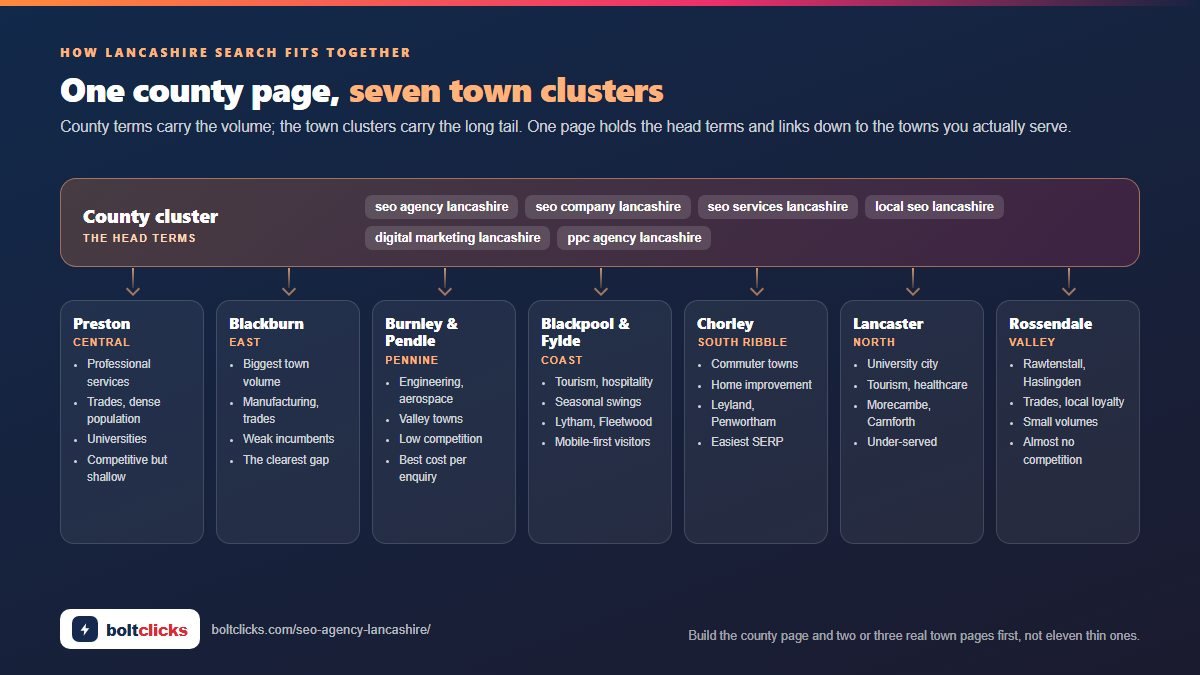
County-wide searches bring the biggest single numbers, but most enquiries come from a service plus a town. The table sets out the Lancashire markets worth targeting, what tends to drive demand in each, and the page that should answer it. Nothing here needs an office in the town: the work is remote, and the ranking comes from the profile, the page and the links, not from a postcode on a contact page.
| Area | What drives search demand | Typical searches | What wins it |
|---|---|---|---|
| Preston | The county’s business centre: professional services, universities, trades serving a dense population | seo preston, seo agency preston, service plus preston, near me | Service pages plus a complete Business Profile; Preston SERPs are competitive but shallow |
| Blackburn and Darwen | Manufacturing, trades, ethnic-minority-led SMEs, strong local retail | seo blackburn, digital marketing blackburn, trade plus blackburn | The biggest town search volume in the county and the weakest incumbents: the clearest gap |
| Burnley, Pendle and Rossendale | Engineering, aerospace supply chain, trades, valley towns with tight local loyalty | seo burnley, seo rossendale, seo rawtenstall, trade plus town | Local pages plus reviews; small volumes but very little competition |
| Blackpool and the Fylde | Tourism, hospitality, leisure, trades serving a seasonal population | seo blackpool, seo lytham, seo fylde, web design blackpool | Seasonal content, photos, reviews and pages built for mobile visitors |
| Chorley and South Ribble | Commuter towns, home improvement, professional services | seo chorley, seo leyland, service plus chorley | Map pack plus service pages; one of the easiest SERPs in the county |
| Lancaster and Morecambe | University city, tourism, healthcare, independent retail | seo lancaster, seo morecambe, marketing agency lancaster | Content and local links; the north of the county is under-served |
| Ribble Valley and Clitheroe | Hospitality, weddings, food and drink, high-value trades | seo clitheroe, marketing ribble valley | Photography, reviews and editorial coverage |
| Accrington and Hyndburn | Trades, manufacturing, local services | seo accrington, trade plus accrington | Profile and citations; almost no agency competition |
| Skelmersdale, Ormskirk and West Lancashire | Logistics, agriculture, student market, trades | seo ormskirk, seo skelmersdale | Local pages and directory consistency |
| County-wide | Businesses serving all of Lancashire, and buyers who search by county rather than town | seo lancashire, seo agency lancashire, seo company lancashire, seo services lancashire | One strong county page with real depth, linked from every town section |
The practical rule: pick the two or three towns where your work actually comes from and build those properly, then widen. A county page plus three real town pages beats eleven thin ones every time.
How the work runs, from audit to enquiries
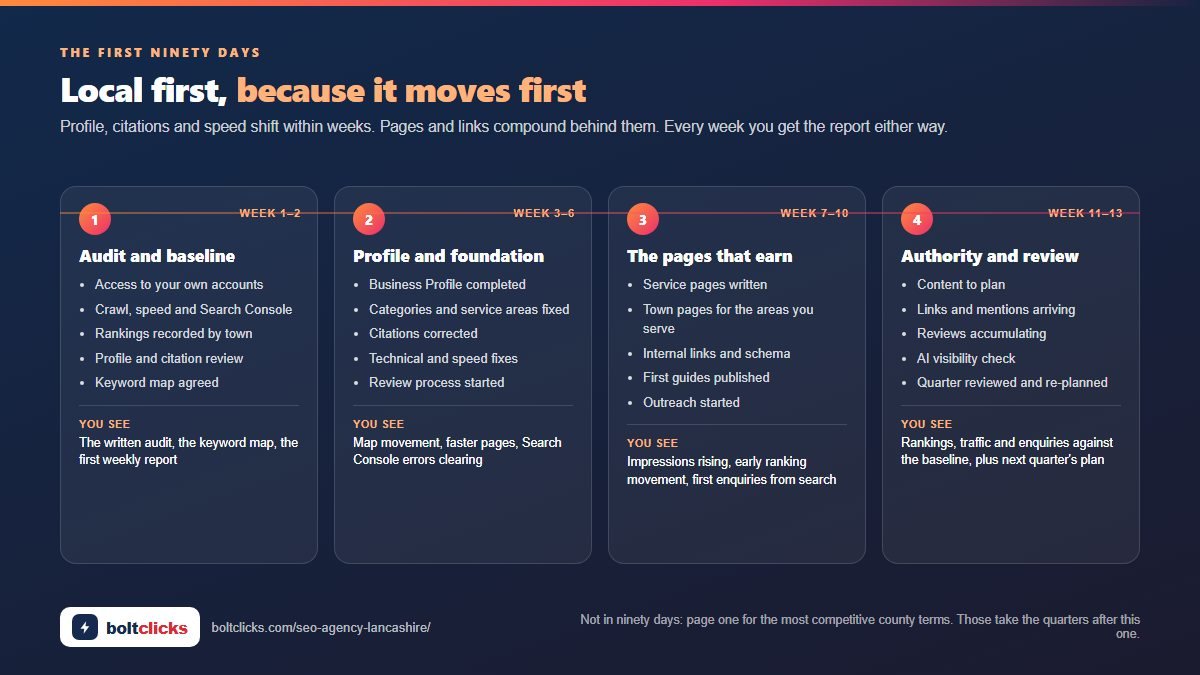
- Free audit summarySend the website and the three searches you most want to win. You get a short written summary of where you appear, where competitors appear, and whether SEO is worth funding for your business.
- Full audit and keyword mapCrawl, Search Console, speed data, local visibility, competitor review. Then every search worth winning, grouped by service and town, mapped to the page that should answer it.
- Technical foundationIndexing, canonicals, sitemaps, redirects, headings, schema and speed fixed first, because content built on a broken foundation is wasted effort.
- The pages that earn moneyService pages rewritten or written, location pages built for the towns you actually serve, internal links connecting them, structured data on each.
- Local presenceBusiness Profile completed and posted to, citations corrected, review process set up with your team, map pack rankings tracked by area.
- Content and authorityGuides published to a plan; local press, trade publications, suppliers, partners and community organisations approached for links and mentions.
- Measure, report, re-planWeekly written reports on rankings, traffic and enquiries; monthly AI visibility and competitor checks; the roadmap re-set each quarter.
The map pack: where most Lancashire enquiries actually start
For any business a customer might drive to, or that drives to the customer, the three-business map block at the top of the results takes the largest share of calls. Google’s help page on local ranking says appearing there depends mainly on relevance, distance and popularity: how well your profile and website match the search, how far you are from the searcher, and how well known your business is online, which Google explains under the heading prominence. Distance cannot be changed, which is why no honest specialist promises a map position. Relevance and popularity can be changed, and that is where the work goes.
In practice that means the Google Business Profile finished properly rather than half-claimed: the right primary category, secondary categories, every service listed with a description, the service area set to the towns you actually cover, hours and attributes complete, photographs of real work added every month, posts about finished jobs, and questions answered before a competitor answers them for you. Then the review process, which is the single biggest lever most Lancashire businesses are not pulling: asking at the moment the customer is happiest, making it one tap, and replying to every review. Then citations, so your name, address and phone are identical everywhere, and the on-site signals that tie the site to the area. The local SEO service covers the profile, citation and review work in full.
- Profile completed and maintained monthly, not claimed and forgotten
- Service area set to the towns you cover, or the address hidden if you work from home
- Review process your team can actually run, with responses to all reviews
- Citations consistent across the directories that matter here
- Map pack rankings tracked by town, not a single national average
- Calls and direction requests reported alongside website enquiries
The technical work that decides whether anything else can rank
Most local business websites in Lancashire were built once, three to eight years ago, by a designer who did a good job on the look and was never asked about search. The result is a site that reads well and cannot compete: pages that take five seconds to load on a phone, a template that prints two H1 headings, service pages that exist only as sections of the homepage, image files straight from a camera, no structured data, and a Search Console account nobody has ever opened. None of that is visible from the front, and all of it caps what content and links can achieve.
The technical stage fixes that before a word of new content is written. Crawling and indexing first: what Google can reach, what it is wasting time on, what it has quietly dropped. Then the structure: one H1 per page, headings that follow the content, clean URLs, canonical tags, a sitemap listing only pages worth indexing, redirects for anything that moved. Then speed, measured with field data from real visitors on mobile rather than a lab score: images resized and served in modern formats, caching configured for the hosting, scripts and fonts trimmed, the theme’s unused features switched off. Then structured data for the organisation, the services, the location and the questions, validated after every change. The technical SEO service sets out that layer in detail.
| Problem found on most local sites | Effect | Fix |
|---|---|---|
| Services described only on the homepage | Nothing to rank for “service plus town”; one page trying to be eight | A page per service, each with its own research, structure and internal links |
| Location pages that are copies | Thin, duplicated pages that Google ignores or filters | Real content per town: the work done there, the areas covered, local proof |
| Slow on mobile | Visitors leave before the page renders; Core Web Vitals fail | Images, caching, scripts, fonts, hosting worked through in order |
| Two H1s or none | Confused page topic; theme prints the site name as a heading | Template corrected so every page has exactly one H1 |
| No structured data | No rich results, weaker entity signals for AI answers | Organisation, local business, service and FAQ schema, validated |
| Old pages and dead links | Crawl waste, 404s from press coverage and directories | Redirect map; broken links fixed; useful old pages improved instead of deleted |
| Search Console never set up | No data, no error alerts, no proof of what works | Verified, errors cleared, sitemap submitted, reporting built on it |
| Contact details different everywhere | Weak local signals; customers ring an old number | Name, address and phone made identical on site, profile and citations |
Content that brings the customer before they are ready to buy
People research for weeks before they contact a business. A homeowner in Chorley planning an extension searches what it costs, whether they need planning permission and how long it takes. A factory buyer in Blackburn searches specifications and lead times. A patient in Lytham searches what a treatment involves and what it costs. The business that answered those questions is the one they remember when they are ready. That is what content is for, and it is why generic blog posts about “the importance of SEO” do nothing for anybody.
The plan is built from real searches: cost and price questions, how-long and what-is-involved questions, comparison questions, seasonal demand, and the local specifics that only somebody in your market knows. Each piece is written to answer the question properly, linked to the service page it supports, and given a named author so readers and search engines can see who is speaking. Existing content is audited first: what ranks gets improved, what duplicates gets merged, what has no purpose gets removed and redirected. Volume for its own sake is not the goal; pages that earn a visit, a link and an enquiry are.
What gets written
- Cost and pricing guides with real bands from real jobs
- Process explainers: what happens, in what order, how long
- Comparison pieces: the choices your customers weigh up
- Local guides tied to towns, regulations or seasons
- Questions your team answers on the phone every week
What does not
- Generic posts about why SEO or marketing matters
- Thin pages written to a keyword with nothing to say
- News about your own company nobody searches for
- Anything that could have been written without talking to you
- Content spun from competitors’ pages
Links and mentions a Lancashire business can genuinely earn
Search engines rank businesses other trusted sites talk about, and a local business has more of those opportunities than it realises. Local newspapers and business titles cover expansions, hires, awards, community work and anything with a story. Trade publications cover projects and products. Chambers of commerce, trade bodies, business networks and town business improvement districts all list members. Suppliers and manufacturers credit the firms that install or stock their products. Local charities, schools and sports clubs list sponsors. Every one of those is a real link from a site with a real audience, and most businesses have earned several already without ever asking for the link.
The plan starts with what exists: every mention of your name found, and where a link is missing, requested. Then a quarterly programme of the realistic targets for your sector and area, pitched properly rather than mass-emailed. Digital PR angles are built from your own data, such as what a job costs this year compared with last, or what demand looks like across the county. Nothing is bought, no directory that exists only to sell links is used, and anything that would embarrass you if a customer saw it is refused.
Sources that work here
- Lancashire business and local news titles
- Trade and sector publications
- Chambers, trade bodies and business networks
- Suppliers, manufacturers and accredited-installer lists
- Sponsorships, charities, schools and clubs
- Award schemes and shortlists worth entering
- Guest articles on relevant industry sites
What is refused
- Paid links and sponsored posts sold by the hundred
- Directory networks with no real users
- Reciprocal link schemes between unrelated businesses
- Private blog networks, however they are described
- Anything that would not survive being looked at
What SEO costs, in plain pounds
Fixed fees, agreed in writing before anything starts, month to month. Nothing is resold: hosting, premium plugins, ad budgets and award entry fees are paid by you, directly, at cost to you and nothing to me.
SEO packages start at £299 a month on the pricing page (Basic £299, Standard £449, Professional £649, each a counted scope of keywords and blog posts); the monthly retainers in the table below start at £650.
| Plan | What it covers | Price |
|---|---|---|
| Free SEO audit | Written summary of where you rank, what is holding the site back, and the competitor gap in your towns | Free |
| SEO Foundation (one-off) | Full audit with the foundation fixed: technical, speed, structure, schema, Business Profile set-up, citations, review process | £850 |
| Starter | Ongoing SEO: keyword map, service and location pages, local SEO, content, links, monitoring, weekly written reports | £650 / month |
| Growth | SEO with paid search run alongside for the services and towns you want enquiries from this month | £1,200 / month |
| Full Stack | Everything across SEO, paid search and paid social, with content and digital PR; multi-branch businesses | from £4,000 / month |
| Projects | Migrations, redesign protection, speed rescue, one-off audits, recovery after a traffic drop | Quoted |
Terms: month to month, invoiced in advance, cancel with a month’s notice. Partner access to your own Search Console, analytics, Business Profile and website; passwords are never requested and every account stays in your name. Full price list on the pricing page.
One specialist, a bigger agency, a lead platform or doing it yourself
| Option | Strengths | Weaknesses | Typical cost |
|---|---|---|---|
| One specialist (this service) | The person doing the work is the person you speak to; fixed fees; weekly written reports; strategy, technical, local and content in one engagement | Capacity is finite; a national brand programme needs a team around the specialist | £299 to £4,000+ a month; one-off projects from £650 |
| Larger regional agency | Capacity, several disciplines under one roof, established processes | Account manager between you and the work; junior staff on delivery; packages rather than a plan; longer contracts | £1,000 to £10,000+ a month |
| National agency with a location page | Scale and tooling | No knowledge of your towns; the same template applied to every county; you are a small account | £1,500+ a month |
| Lead platforms and quote services | Enquiries quickly, no setup | Leads shared with competitors, price-led, low fit; the platform owns the ranking and the customer relationship; cost rises as you depend on it | Per lead or subscription |
| Web designer who “does SEO” | Knows your site and can change it | Usually a plugin and a meta description; no keyword map, no local work, no links, no reporting | Hourly or bundled |
| Doing it in-house | Nobody knows the business better; no fee | Time taken from fee-earning work; the technical layer needs a specialist; consistency drops the moment you get busy | Your time |
How results are measured, and what to expect when
| Measure | Source | Why it matters |
|---|---|---|
| Map pack rankings by town | Local rank tracking per area | Where most local calls start |
| Organic rankings for the keyword map | Rank tracking by search and device | Leading indicator per service and town |
| Impressions and clicks by page | Search Console | Shows which pages are being shown and which are being clicked |
| Enquiries and calls | Analytics with conversion tracking; profile call data | The commercial result, attributed to page and search |
| Enquiry quality | Monthly review with you | Whether the leads fit the work you want |
| Core Web Vitals | Real-visitor data, mobile first | Speed as customers experience it |
| Links, mentions and reviews | Backlink data, coverage tracking, review counts | Authority and trust growth |
| AI answer visibility | Monthly checks of buying questions | Whether you are named where buyers now ask |
Technical and speed fixes show within weeks. Business Profile and citation work often moves map rankings inside one to two months. New service and location pages in competitive towns take three to six months to settle; quieter towns move faster. Content and links compound over six to twelve months. Enquiries follow rankings with a lag, because buyers research before they ring. Anyone promising page one in thirty days is selling something else.
Remote, on UK hours, with no office claimed
The work is done remotely, on UK hours, with partner or editor access to your own accounts that you grant and can revoke at any time. There is no Lancashire office and none is claimed; what you get instead is the specialist doing the work rather than a sales team and a junior. For most of what SEO involves, research, technical fixes, writing, profile management, outreach and reporting, that makes no practical difference: everything happens in your accounts, and everything is written down. Where being in the county genuinely matters, photographs of your work, a walk round a site, a face at a networking event, that is your part, and the plan is built so those are quick jobs for you rather than blockers.
- Partner access only, never your passwords
- Weekly written report with the numbers from your own accounts
- Direct contact with the person doing the work, on WhatsApp or email
- Everything documented, so any future agency can see what was done and why
- Honest advice, including when the website, the offer or paid search is the better answer
Where SEO sits alongside your website, paid ads and social media
Search engine optimisation is one part of a digital marketing strategy, and it works better when the rest of it is pulling the same way. The website design and development decides whether the traffic converts: a responsive design that works on every screen size, fast load speed, clear calls to action, landing pages built for the campaign rather than the brochure. Paid advertising buys the top of the results while organic rankings build, and its search-term data shows which keywords actually produce enquiries rather than clicks. Social media management builds brand awareness and feeds content to an audience that already knows you. Email keeps past customers warm. None of them replaces the others, and a small business does not need all of them at once.
What matters is the order. Get the site fast, crawlable and structured, then win the searches with buying intent, then widen. For most Lancashire businesses that means SEO and Google Ads together at the start, with the ads producing enquiries in the first month and the SEO compounding behind them, and social media used for proof rather than prospecting. If the website itself is the blocker, a slow theme, no service pages, an ecommerce website with product pages nobody can find, the websites service covers the build and the SEO plan is written around it so the new site launches ranking rather than starting from zero.
What each channel does best
- SEO: compounding visibility for the searches with buying intent; an asset you own
- Google Ads: enquiries this month, plus data on which keywords convert
- Website design and development: turning visits into leads and sales
- Social media marketing: brand awareness, proof of work, staying in mind
- Email: repeat work and referrals from customers you already have
How they feed each other
- Ad search terms sharpen the SEO keyword map
- SEO landing pages improve ad quality scores and cost per click
- Reviews and case studies lift both organic click-through and ad conversion
- Content written for search is reused on social media and in email
- One set of tracking shows which channel produced each enquiry
What changes by sector
| Sector | What the search looks like | Where the work goes |
|---|---|---|
| Trades and construction | Service plus town, emergency and “near me” searches, photo-led research | Map pack, service and area pages, reviews, job photographs, speed on mobile |
| Manufacturing and engineering | Product, capability and specification searches, often national or international | Technical product pages, capability content, trade publication links, long sales-cycle tracking |
| Professional services | Service plus town, plus a long research phase full of questions | Service pages, guides that answer client questions, author credentials, trust signals |
| Healthcare and clinics | Treatment and symptom searches, heavy review reliance, booking intent | Treatment pages, local rankings, review programme, booking paths that work on a phone |
| Retail and ecommerce | Product and category searches, comparison and price research | Category-first structure, product pages, product schema, site speed, guides that feed the funnel |
| Hospitality and leisure | Place, occasion and season-led searches with photos and reviews deciding | Profile photos and posts, seasonal content, events, review responses |
| Education and training | Course, qualification and “near me” searches with clear intake seasons | Course pages, seasonal publishing calendar, local and national mix |
| B2B services | Problem-led and comparison searches from buyers with a process | Solution pages, comparison content, case studies, lead tracking across a long cycle |
When demand across the county rises and falls
Search demand in Lancashire is not flat across the year, and the pattern differs by trade rather than by town. Blackpool and Morecambe carry a visitor season that lifts accommodation, attractions and hospitality queries from Easter onwards, while Preston, Burnley and the Ribble Valley run on domestic and commercial cycles that have little to do with tourism. Heating work climbs when the first cold nights arrive; roofing and fencing spike after gales come off the Irish Sea; garden, driveway and extension searches build through spring. Google Search Console data from a full year shows the real curve for one business rather than a general assumption, which is why the first twelve months are partly about recording the shape of demand and the rest is about arriving early.
| Period | What rises | What the work does |
|---|---|---|
| January | Heating breakdowns, frozen and burst pipes, damp and mould, self-assessment deadline queries, and the run of people researching suppliers before they commit to anything. | Emergency and same-day pages have to be indexed already. Holiday opening hours and profile posts are set in December, not on the second of January. |
| February to April | Extensions, driveways, fencing, landscaping, bathrooms and kitchens, wedding enquiries in the Ribble Valley, and coastal holiday-let bookings ahead of Easter. | Service and town pages for this group are written and published in November and December, so they have three or four months of age before the searches arrive. |
| May to August | Visitor demand along the Fylde coast and in the Forest of Bowland, plus roofing, rendering, external painting and commercial fit-out booked around dry spells. | Photographs, categories and review requests carry most of the weight here. Distance still decides much of what a visitor sees on a map, and that cannot be changed. |
| September to October | Boiler servicing, chimney and stove work, gutter clearing, school-year services, and accountancy, recruitment and software enquiries as budgets restart. | Servicing pages are refreshed and autumn content is live before the first cold week. Google Ads and Microsoft Ads budget shifts towards the shortest decision windows. |
| November to December | Emergency heating, Christmas hospitality and event bookings, gift and retail demand, and quotes being gathered quietly for January and February starts. | Holiday hours go on the Google Business Profile and the site. Next year’s January and spring pages are drafted now, while the diary is quieter. |
| Weather events | Storm damage: roofing, fencing, tree work, flooding and drainage, emergency glazing and electrical call-outs, concentrated into the two or three days after a named storm. | Nothing can be built in two days. The page has to exist all year with a clear phone number, and a profile post goes up the same morning. |
Planning note: the work that wins a peak is done in the quiet months before it. A page published the week demand starts has no history behind it, and paid traffic ends up covering the gap at the most expensive point in the year. Budget and content are set one season ahead. That improves the odds; it is not a ranking guarantee, and no honest version of this work offers one.
Keeping what you have earned through a rebuild
Most traffic losses at relaunch are not caused by design. They are caused by addresses changing without anyone mapping the old ones to the new, by service pages being merged into a single summary page, and by text being cut because the new layout looked tidier with less of it. A site that ranked for a hundred Lancashire phrases can lose half of them in a fortnight, and nobody notices until the enquiry line goes quiet six weeks later. Rebuilds also tend to arrive with new template code, new image handling and a new content management setup, so page titles, headings and internal structure all shift at once. The safe version of a rebuild is dull: record what exists, decide deliberately what happens to each URL, then check the result before and after it goes live.
- BenchmarkBefore anything is touched, export every ranking phrase, every landing page that receives traffic, and the enquiry numbers behind them. Without that record there is no way to tell afterwards whether a drop is real or simply seasonal.
- URL and redirect mapEvery existing address gets a row: keep, redirect, or retire. Redirects point to the closest equivalent page rather than the home page, and use permanent server-side rules, not temporary ones or meta refreshes.
- Template reviewCheck what the new templates do to titles, headings, breadcrumbs and body text before content is poured in. One heading level set wrongly in a template repeats itself across every service page and every town page.
- Staging auditCrawl the staging build while it is still private and password protected. Look for missing text, duplicated titles, blocked resources, broken internal links, and a robots file that would ship with the whole site disallowed.
- Launch checklistOn the day, remove the staging block, confirm indexing is allowed, crawl the live site, spot-check redirects by hand, resubmit the sitemap in Search Console, and verify that analytics and call tracking still fire.
- Twelve weeks of monitoringRankings wobble for a few weeks after any move. Impressions, clicks and crawl errors are watched weekly for three months, redirect chains and 404s are fixed as they surface, and the written report continues throughout.
The first three things actually worth doing
If you have never done any SEO
Start with the things that produce enquiries fastest and cost least. That usually means a claimed and completed Google Business Profile, a website that loads properly on a phone, and one page for each service you genuinely want more of. Everything else, including any writing plan, works better once those three are in place. None of this requires a rebuild or a new brand.
- Claim the Google Business Profile, set the categories and service area, and give opening hours that match what actually happens.
- Put a phone number, a coverage area or address, and a way to make contact on every page, not only the contact page.
- Give each main service its own page with real detail, instead of one list page that names eleven services in passing.
- Open the site on a five-year-old phone on mobile data and time how long it takes before you can tap anything.
- Set up Search Console and leave it running, so you own a year of your own data before the moment you need it.
If you have had SEO before and it went nowhere
Work out what was actually delivered before commissioning anything new. Ask for the reports, look at what changed on the site, and check whether anyone measured enquiries or only rankings. Often the pages exist but were never finished, the profile was never touched, and nothing was tracked, so the work cannot be judged either way. A short audit is cheaper than repeating the same twelve months.
- Get your own logins back: domain registrar, hosting, content management system, Search Console, analytics and Google Business Profile.
- Read the last six months of reports and note how many of them mention enquiries, calls or jobs rather than positions.
- Check for leftover damage: paid links, duplicated town pages, and thin pages published in bulk with the place name swapped.
- Compare the pages that were written against the words people in your area actually type, which are usually blunter.
- Decide what is worth keeping, because some of it will be, before paying anyone to redo work that only needs finishing.
- Access you control, even if a previous supplier set it up. Partner or delegated access is enough for the work; passwords never need to change hands.
- The three searches that matter, written down in the words a customer would use. Not the industry term, and not the phrase that sounds most impressive.
- The services with the best margin, so effort goes to the jobs worth winning rather than the ones that happen to be easiest to rank.
- The towns you will travel to, and the ones you will not. Blackburn, Chorley or Lancaster only belong on the site if you would genuinely take the job.
- Recent job photographs, straight off a phone, with rough dates and locations. They feed the profile, the service pages and the case detail that comes later.
Signs your Lancashire business is invisible in search
Most owners notice the symptoms long before they know the cause: the phone rings less than it used to, the work that does come in arrives through word of mouth alone, and the website “looks fine”. The list below is what an audit usually finds behind that. Three or more and the site is a brochure for people who already know you, working for nobody else.
Visibility symptoms
- Searching your service plus your town brings up directories, lead platforms and competitors, never you
- You appear only when someone types your business name
- The Business Profile is unclaimed, half-filled, or shows an old address and four reviews from years ago
- Competitors with worse websites sit in the map pack while you do not appear at all
- Search Console shows impressions but almost no clicks, or nobody has ever opened it
- Traffic is flat while the market is not
Site and content symptoms
- Every service crammed onto the homepage, or a services page with one paragraph each
- No page for any of the towns you actually work in
- Homepage takes four seconds or more on a phone
- No prices, no process, no answers to the questions customers ask every week
- Contact form asks for a name and a message and nothing that qualifies the job
- Nobody can say which pages produce enquiries, because nothing is tracked
The checklist run on every engagement
| Area | What is checked and fixed |
|---|---|
| Audit and baseline | Rankings by service and town; map pack positions per area; traffic and enquiries by page; Search Console errors; speed field data; Business Profile completeness; citation accuracy; competitor visibility; backlink profile |
| Keyword map | Service plus town searches, “near me”, problem-led, question and comparison searches, seasonal terms; grouped by intent; one page assigned per search; volumes and competition checked before anything is written |
| Service pages | One page per service: what it includes, how it works, what it costs or what drives the price, who it suits, proof, questions answered, clear next step, schema, internal links |
| Location pages | Only for towns you genuinely serve; real local content, jobs done there, areas covered, travel and coverage detail, local reviews, map, internal links; never a template with the name swapped |
| Google Business Profile | Categories, services with descriptions, service area or address, hours, attributes, description, photos monthly, posts, chat and booking links, review requests and replies, spam listings reported |
| Citations | Name, address, phone and website identical across the directories that matter; duplicates removed; old numbers and addresses corrected; social profiles aligned |
| Technical | Crawl, index, canonicals, sitemap, robots, redirects, broken links, heading structure, one H1 per page, image alt text, mobile usability, HTTPS, structured data validated |
| Speed | Core Web Vitals from real visitors on mobile; images, caching, scripts, fonts, database, hosting and theme settings worked through in order; measured before and after |
| Content | Audit of what exists; improve, merge, remove and redirect; editorial plan from real searches; briefs with intent, structure, questions and links; named authors |
| Authority | Existing mentions found and links requested; quarterly outreach to local press, trade titles, suppliers, bodies and sponsorship partners; digital PR from your own data; nothing bought |
| Conversion and tracking | Analytics and conversion tracking on forms, calls and messages; click-to-call on mobile; enquiry quality reviewed monthly; reporting tied to leads |
| AI search | Monthly checks of the buying questions in your market; entity clarity; answer-ready sections; consistent details across the web |
What you do, and what I do
The engagement is built so it costs you an hour or two a month, not a day a week. I own the strategy, the technical work, the writing, the profile, the outreach and the reporting. You own the things only you can do: the photographs of your work, the detail of a job that makes a page worth reading, the decision about which services you want more of, and asking a happy customer for a review. Where you have a web developer or designer, they get written specifications with the change, the reason and the test, and nothing is touched on the site without a record of what changed and why. Where you would rather learn to do parts of it yourself, you get the briefs and the training instead of the delivery, and pay less for it.
- An hour or two a month from you: photos, job detail, approvals, review requests
- Specifications, not vague requests, for any developer
- Nothing published unseen, nothing changed unrecorded
- A weekly written report and direct answers, without jargon
- Training and briefs if you want to bring it in-house over time
The terms you will see in the reports
| Term | Meaning |
|---|---|
| Map pack | The block of three local businesses shown with a map for local searches |
| Google Business Profile | The free listing that controls how you appear in the map results and beside the search results |
| Citation | A mention of your business name, address and phone on a directory or another site |
| Keyword map | The list of searches worth winning, each assigned to exactly one page |
| Search intent | What the searcher wants: to buy, to compare, to research or to find a place |
| Impressions | How often your page appeared in results, whether or not it was clicked |
| Click-through rate | The share of impressions that became clicks; driven by the title and description |
| Core Web Vitals | Google’s measures of loading, responsiveness and visual stability, from real visitors |
| Structured data | Schema markup describing your business, services and pages to search engines and AI systems |
| Canonical tag | The declared preferred address of a page when several versions exist |
| Backlink | A link from another website to yours; the main signal of authority |
| Anchor text | The words a link is written on |
| Local pack ranking | Your position in the map results for a given search and location |
| Crawl and index | Search engines reading your pages, then deciding to store them for results |
| Conversion tracking | Recording form submissions, calls and messages so enquiries can be attributed |
| Partner access | Delegated access to your own accounts, so no passwords are shared |
What a client said, and what you can check
“Great communication and very helpful throughout the process. Took the time to explain everything clearly and set up the campaign professionally. Focused on quality results rather than just numbers. Highly recommended.”
This is one of three client reviews published so far; the other two, from a UK SEO client and a US Google Ads client, are on the home page. Every figure comes from the client’s own ad account, and a review goes on this site only when it is real.
What you can check before you pay
- Prices published in full on the pricing page, not hidden behind a sales call
- Month to month, with one month’s notice and no lock-in contract
- Every account, profile and file stays in your name; I work through partner access
- A written report every week, in plain English
- One specialist does the work, from the audit to the report
SEO in Lancashire: frequently asked questions
How much does an SEO agency in Lancashire cost?
Here, SEO packages start at £299 a month on the pricing page, each a counted scope of keywords and blog posts; monthly retainers start at £650 a month for ongoing SEO, £1,200 with paid search alongside, and from £4,000 for the full-stack plan; the one-off SEO Foundation project that fixes the technical base, the profile and the citations is £850. Across the market, local agencies in the county typically charge £500 to £2,000 a month for a small business and more for multi-branch work. A free written audit comes first either way.
Do you have an office in Lancashire?
No, and none is claimed. The work is delivered remotely on UK hours with partner access to your own accounts. Everything in SEO happens in those accounts, and every week you get a written report. The parts that genuinely need somebody in the county, photographs of your work and a face at a networking event, stay with you and take minutes, not days.
Which Lancashire towns do you work with?
All of them: Preston, Blackburn, Burnley, Blackpool, Lancaster, Chorley, Accrington, Nelson, Colne, Clitheroe, Leyland, Ormskirk, Skelmersdale, Morecambe, Lytham St Annes, Fleetwood, Darwen, Rawtenstall, Bacup, Haslingden and the villages around them. What matters is not where I am but which towns your customers search from, and that comes out of the keyword map.
How long before I see results?
Technical and speed fixes show in weeks. Business Profile and citation work often moves map pack positions in one to two months. New service and location pages take three to six months in competitive towns and less in quiet ones. Content and links compound over six to twelve months. Enquiries follow rankings with a lag because buyers research first.
Can you get me into the map pack?
I can make you eligible and competitive: the profile completed properly, categories and services right, reviews coming in, citations consistent, and the site sending the right local signals. What nobody can control is how far you are from the searcher, which is a ranking factor in local results. Any agency guaranteeing a map position is guaranteeing something outside its control.
Is SEO worth it for a small business in a small town?
Usually yes, and often more than in a city, because the competition is thinner. A trade in Accrington or a clinic in Clitheroe can reach the top of its local results with a complete profile, a proper service page and a handful of reviews. The free audit answers this for your business specifically before any money is spent.
Do I need a new website first?
Not usually. Most sites can be fixed rather than replaced: speed, structure, headings, schema and new pages added to the existing build. If a theme cannot be made fast or the structure cannot carry service and location pages, I will say so plainly rather than working around it for a year.
What is the difference between SEO and local SEO?
Standard SEO wins the ordinary results for searches without a place attached. Local SEO wins the map pack and the local results for searches with a town or “near me” in them, and it depends on the Business Profile, reviews and citations as much as on the website. Most Lancashire businesses need both, and the map usually matters more.
Will you need my passwords?
No. Partner or delegated access to Search Console, analytics, the Business Profile and the website is all that is used, and every account stays in your name. If we stop working together you remove the access and keep everything.
Do you work with businesses outside Lancashire?
Yes, across the UK and the US. The method is the same; only the research changes. Businesses that sell beyond their county get a structure built for that rather than a local page with a county name in it.
What if I have been burned by an SEO agency before?
Common, and usually the same story: a package, a monthly report full of numbers that meant nothing, and no way to tell what was actually done. Here you get the audit before you pay anything, a plan in writing, a weekly report of work done and results moved, month-to-month terms, and direct contact with the person doing the work.
Do you offer paid search as well?
Yes, and for many businesses it is the sensible first step while SEO builds: Google Ads for the services and towns you want enquiries from this month, with the search-term data feeding back into the keyword map. It is a flat management fee, never a share of your ad spend.
Is there a contract?
Month to month, invoiced in advance, cancel with a month’s notice. Fees are agreed in writing before work starts and do not change without agreement.
What happens in the first week?
Access is set up, the audit runs, and you get the written findings plus the keyword map and the plan. Nothing is changed on the site until you have seen what is proposed and why.
Seven things worth knowing before you hire anyone
1. Ask what the audit found before you ask the price
A proposal without a diagnosis is a price with no reasoning behind it. Any agency worth paying will tell you what is wrong with your site before it tells you what it charges.
2. The map pack is usually worth more than the blue links
For a business customers drive to, the three-business block takes the calls. A complete profile with recent reviews moves faster than almost anything on the website, and it is free to do.
3. Service plus town beats the big head term
“SEO” as a search is dominated by directories. The searches that bring work are specific: a service, a town, a problem. There are hundreds of them and they are winnable.
4. Location pages must say something true about the place
Eleven pages with a swapped town name is the oldest trick in local SEO and it stopped working years ago. Three real pages beat eleven fake ones.
5. Speed is a local ranking factor and a conversion factor
Your customer is on a phone, often on a weak signal. A four-second page loses them before the search engine matters.
6. Reviews are the lever most businesses never pull
Asking every happy customer, at the right moment, and replying to all of them costs nothing and moves both rankings and enquiry rates.
7. If SEO is the wrong answer, you should be told
Some markets have no search demand, some offers need fixing before any traffic helps, and sometimes paid search is the better first spend. An honest answer on the first call is worth more than a twelve-month contract.
Start with a free SEO audit
Send your website and the three searches you most want to win. You will get a written summary of where you appear today, where your competitors appear, what is holding the site back, and a straight answer on whether SEO is worth funding for your business, before any conversation about a plan. No jargon, no lock-in, no passwords.