
SEO for Architects: Rank for the Projects, Places and Building Types You Want to Win
SEO for architects and architecture firms, delivered by one specialist: keyword research by project type and location, project and service pages that rank, local SEO and Google Business Profile work, technical and speed fixes for image-heavy portfolio sites, guides that answer client questions before the first call, and the links, reviews and AI search visibility that make a practice the obvious choice. Fixed monthly fees, weekly written reports, no long contracts.

What SEO for architects means, and why a portfolio site is not a marketing site
Most architecture practices win work through referrals, repeat clients and reputation, and most practice websites are built for the same audience: a portfolio of finished projects, a studio page, a contact form. That site does one job well, showing the quality of the work to someone who already knows the practice. It does almost nothing for the homeowner searching for an architect for a rear extension in their town, the developer looking for a practice with planning experience on constrained urban sites, or the business comparing architects for a commercial fit-out. Those people search, read, shortlist and enquire without a referral, and the practices that appear for the searches they use are the ones that get the call.
SEO for architects is the work of appearing for those searches: research into what prospective clients actually type, by project type, building type and place; service pages for the work the practice wants more of; project pages written so that each completed project ranks for the type of project and the area it is in rather than sitting as an unlabelled image gallery; local SEO so the practice appears in the map results for its area; technical and speed work for sites that carry hundreds of large images; guides that answer the questions clients ask at each stage, from whether they need an architect at all to what planning permission involves; and the links, press, awards and reviews that give search engines and AI assistants a reason to recommend the practice.
This page sets out what the service includes, which practices it suits, the searches architects should target, how project and service pages are built to rank, how local SEO works for a practice, what changes on image-heavy sites, how content earns enquiries, what it costs in pounds and dollars, how a specialist compares with directories, lead platforms and general agencies, and the questions practice owners ask before they commit. The free audit at the bottom of the page is the normal starting point: a written summary of where the practice appears today, where competitors appear, and what would change that.
The practices that get the most from architect SEO
Residential architects
- Extensions, loft conversions, renovations, new-build homes and self-build projects, where homeowners search by project type and town
- Needs service pages per project type, project pages per completed job, local SEO and guides on planning, costs and process
Commercial and mixed practices
- Offices, retail, hospitality, education, healthcare and industrial buildings, where clients search by building type and sector
- Needs sector pages, case studies with outcomes, and content that speaks to developers, facilities managers and business owners
Specialist practices
- Conservation and listed buildings, sustainable and low-energy design, interior architecture, healthcare, education or heritage work
- Needs pages that own the specialist searches nationally, not just locally, with the depth of content the specialism deserves
Sole practitioners and small studios
- One to five people, a portfolio site, no marketing budget to waste and no time to learn SEO
- Needs a focused plan: the three or four searches that matter, a fast site, a complete Business Profile and a steady stream of enquiries from the local area
Multi-office practices
- Two or more studios in different cities, each competing for its own local searches
- Needs location pages that do not duplicate, a Business Profile per office, and a site structure that lets each office rank in its city
Architectural designers and technologists
- Design and planning services offered without the protected title, competing for the same homeowner searches
- Needs clear service descriptions, honest positioning, and content that answers the architect-versus-designer question searchers ask
The full list of SEO services for architecture practices
Architect SEO audit
Where the practice appears today for the searches that matter, where competitors appear, what the site does well and badly technically, how the portfolio is structured, whether the Business Profile is complete, and what the content covers. Findings ranked by impact with a fix list.
- Rankings, traffic, indexation and speed baseline
- Competitor comparison for your project types and area
- A written plan before any fee is agreed
Keyword research by project type and place
What prospective clients type when they look for an architect: project types, building types, places, problems and questions. Grouped by intent and mapped to the page that should answer each one, with search volumes and competition for the UK or the US.
- Service, project, location and guide searches
- Question searches for each stage of a project
- A keyword map every page is written from
Service pages for the work you want
A page for each service the practice wants more of, extensions, new builds, renovations, planning applications, commercial fit-outs, feasibility studies, written to rank and to reassure: process, timescales, fees, what is included, examples and answers to the questions clients ask.
- One page per service, no duplication
- Written for the searcher and the search engine
- Linked to the projects that prove it
Project and portfolio page SEO
Each completed project becomes a page that ranks for its project type and location: descriptive titles, the brief, the constraints, the solution, the cost band, the timeline, image alt text, structured data and links to the related service. The portfolio stops being a gallery and starts being the practice’s strongest ranking asset.
- Project page template that ranks
- Existing projects rewritten in priority order
- Image filenames and alt text that describe the work
Local SEO and Google Business Profile
The map results decide the phone calls for local searches. The Business Profile is completed and optimised: categories, services, service areas, photos of projects, posts, an enquiry or booking link, and a review programme. Citations across the directories that matter are made consistent, and location signals are built into the site.
- Business Profile set-up and monthly upkeep
- Citations and directory listings
- Review requests built into project completion
Technical SEO and site speed
Portfolio sites carry hundreds of large images, galleries, sliders and page builders, and they are slow. Images compressed and served in modern formats, lazy loading, caching, script clean-up, clean URLs, canonicals, sitemaps, structured data and fixed heading structure, measured with real-visitor Core Web Vitals data on mobile.
- Image and gallery optimisation without losing quality
- Crawl, index and structure fixes
- Speed targets met on mobile
Content that answers client questions
Guides written for each stage of a project: do I need an architect, what does an architect cost, how planning permission works, permitted development, building regulations, party walls, timelines, how to brief an architect, how to choose one. Each guide targets a search, answers it properly and links to the service and project pages.
- Editorial calendar by project stage
- Briefs for the practice or content written for you
- Guides that earn links as well as enquiries
Links, press and awards
Authority is earned from sites that already have it: local press features on completed projects, design and property publications, award entries and listings, supplier and consultant partners, professional directories, guest articles and digital PR built from the practice’s own project data.
- Link and mention plan per quarter
- Award and directory listings that carry weight
- Digital PR angles from projects and data
Reviews, trust and expertise signals
Named architects with qualifications and registration, project credits, client reviews on the Business Profile and the site, insurance and accreditation details, and author information on guides: the signals search engines and AI systems use to decide whether to recommend a practice.
- Team and author pages that carry credentials
- Review programme and response handling
- Consistent practice details across the web
AI search visibility
Clients now ask AI assistants for architects who do a type of project in a place. The service checks whether the practice is named, what the answers cite, and makes the changes that improve it: clear entity information, answer-ready pages, structured data and consistent details.
- Monthly checks of the buying questions
- Pages structured for AI answers
- Entity clarity across the site
Conversion and enquiry quality
Rankings are only useful if the enquiries fit. Enquiry forms that ask about project type, location, budget and timescale, fee guidance that qualifies without scaring, a process page that sets expectations, and tracking so every enquiry is attributed to the page and search that produced it.
- Enquiry forms that qualify
- Fee and process pages that reassure
- Conversion tracking on forms and calls
Reporting and support
A written report every week: what was done, what moved, what did not and what is next, with rankings, traffic and enquiries from your own Search Console and analytics. Questions answered as they arise and a quarterly review of the plan.
- Weekly written reports
- Quarterly strategy reviews
- Direct access to the specialist
How SEO for an architecture practice is delivered, from audit to enquiries
- Free audit summarySend the website and the three project types you most want to win. You get a short written summary of where the practice appears, where competitors appear, and whether SEO is worth funding.
- Full architect SEO auditTechnical crawl, speed data, Search Console, portfolio structure, Business Profile, content and competitor review. Findings ranked by impact and effort with a fix list.
- Keyword mapEvery search worth winning, grouped by project type, building type, place and question, and mapped to the page that should answer it.
- Technical foundation and speedCrawl, index, structure and image fixes first, because a slow portfolio site with duplicate galleries caps everything that follows.
- Service and project pagesThe pages that earn enquiries written and structured first: services in priority order, then the projects that prove each service, then location pages where there are multiple offices.
- Local presence, content and authorityBusiness Profile and citations completed; guides published to the calendar; press, awards, directories and partners approached for links and mentions.
- Measure, report, re-planWeekly written reports on rankings, traffic and enquiries by page; monthly AI visibility and competitor checks; the plan re-set each quarter.
The searches architects should target, and the page that wins each one
Architecture is searched in a particular way. Almost nobody searches for “architecture firm” on its own; people search for an architect plus a project type, a building type, a place or a problem. The volumes for any single phrase are modest, but there are hundreds of them, and the practices that rank for the right set fill their pipeline. The table shows the main search groups and the page type that should answer each. Volumes and competition are checked for the UK or the US before anything is written.
The full list by project type, place and licensure, with the page each group should land on, is on the SEO keywords for architects page.
| Search group | Examples of what people type | Intent | Page that should rank |
|---|---|---|---|
| Architect plus place | architects in [town], architect near me, residential architects [city], local architects for extensions | Hiring, local | Homepage or location page, plus the Business Profile in the map results |
| Project type | house extension architect, loft conversion architect, architect for renovation, new build house architect, self build architect, barn conversion architect | Hiring, project-led | A service page per project type, linked to the matching projects |
| Building type and sector | commercial architects, office fit-out architects, restaurant architects, school architects, healthcare architects, retail design architects | Hiring, commercial | Sector pages with case studies and outcomes |
| Specialism | conservation architect, listed building architect, passive house architect, sustainable architect, interior architect, landscape architect | Hiring, national or regional | A specialism page with the depth to rank beyond the local area |
| Planning and regulation | architect for planning permission, planning application drawings, permitted development architect, building regulations drawings, planning appeal help | Hiring, problem-led | Planning and regulatory service pages plus guides |
| Cost and fees | how much does an architect cost, architect fees for extension, architect cost per square metre, architect fee percentage | Research, early stage | A fees guide that qualifies and reassures, linking to services |
| Do I need | do I need an architect for an extension, architect or builder first, architect vs architectural technologist, do I need planning permission for a loft conversion | Research, early stage | Guides that answer honestly and introduce the practice |
| Process and timeline | how long does an architect take, architect design process stages, what does an architect do, how to brief an architect | Research, mid stage | Process page and guides |
| Inspiration and examples | rear extension ideas, side return extension designs, loft conversion examples, modern house extension | Research, visual | Project pages and image-rich guides with proper alt text |
| Reviews and comparison | best architects in [city], architect reviews [town], top residential architects | Shortlisting | Business Profile reviews, awards, press and a strong homepage |
The practical rule: the practice cannot rank for everything, and should not try. The keyword map picks the project types with the best margin and the places within reach, then builds the pages for those first. Everything else is added once those rank.
Project and portfolio pages that rank, not just galleries
The portfolio is where architect websites waste the most ranking potential. A typical project page has a name, a location if you are lucky, a dozen large photographs and a sentence or two. Search engines see an image gallery with no subject. The same project, written up properly, ranks for its project type in its area, for the design problem it solved and for the visual searches people use for inspiration, and it converts better, because prospective clients want to know what the brief was, what the constraints were, what it cost and how long it took.
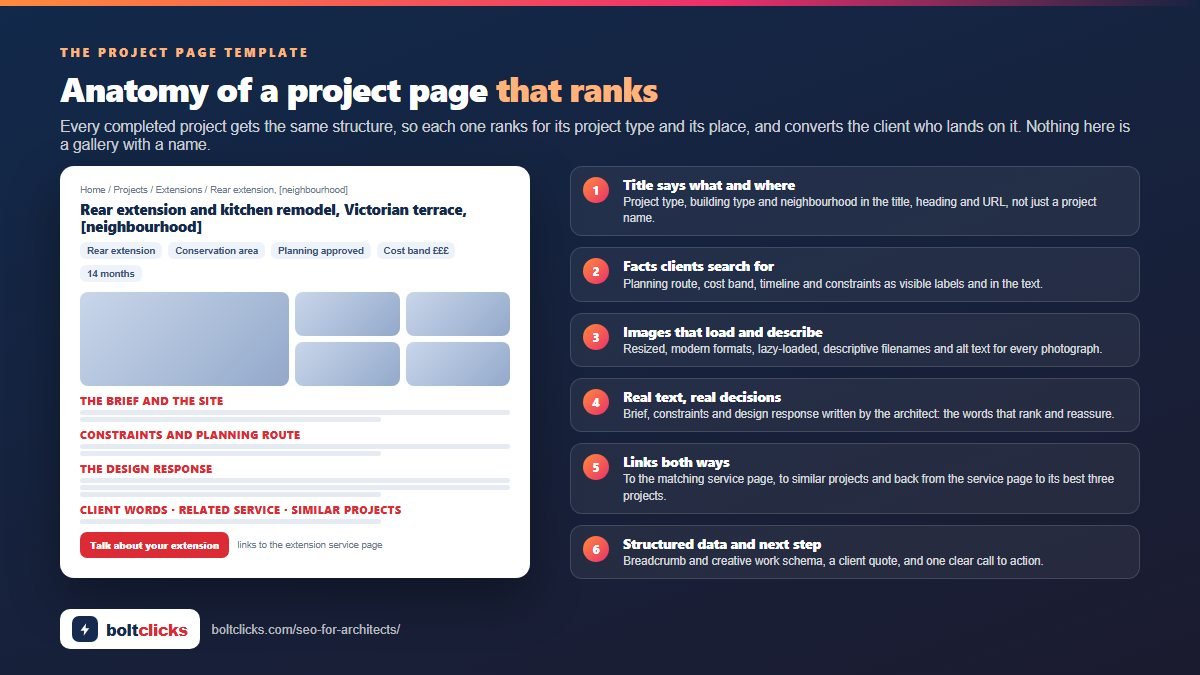
What each project page carries
- A title that says what it is and where: project type, building type, town or neighbourhood
- The brief in the client’s terms and the site’s constraints: plot, orientation, conservation area, planning history, budget
- The design response and the decisions that mattered
- Planning route, timeline and a cost band where the client allows
- Images with descriptive filenames and alt text, compressed for speed
- Structured data, breadcrumbs, and links to the matching service page and related projects
- A client quote and a clear next step
Portfolio structure that helps rankings
- Projects grouped by type and by place, with category pages that rank for the group searches
- Filters that do not create thousands of duplicate URLs
- Image galleries that load quickly and do not bury the text
- Older projects kept and improved rather than deleted, because they carry links and history
- Consistent naming so that “rear extension in [area]” appears on the page, not just in the photographs
- Every service page linking to its best three projects and every project linking back
Local SEO for architects: the map results, the Business Profile and the service area
For most residential and small commercial work the client wants an architect nearby, and the map results at the top of the page take a large share of the clicks and calls. Appearing there depends on the Google Business Profile, the practice’s consistency across the web, reviews, and the signals on the website that tie the practice to a place. Architects are often invisible here for simple reasons: the profile was claimed years ago and never completed, the category is wrong, there are no photos of projects, three reviews from 2019, and the address on the website differs from the one on the directories.
The service completes and maintains the profile: the right primary and secondary categories, the services listed with descriptions, the service area set to the places the practice actually works, project photos added monthly, posts about completed projects and planning wins, a booking or chat link, and a review programme that asks at the right moment, usually at practical completion, with a response to every review. Citations on the directories that matter are made consistent. On the site, the contact page, footer and structured data carry the same name, address and phone, service pages mention the places served naturally, and project pages carry the neighbourhoods they were built in. Practices with more than one studio get a location page per office, each with its own profile, projects, team and reviews, written so that the pages differ in substance rather than in the town name alone. The local SEO service covers the profile, citation and review work in detail.
- Business Profile completed and updated monthly with project photos and posts
- Service area and categories set to the work and the places you want
- Review programme tied to project milestones, with responses
- Citations and directories consistent, including professional and design directories
- Location pages for multi-office practices that are genuinely different
- Map pack rankings tracked for the searches that matter, by area
Technical SEO for image-heavy portfolio sites: fast pages without losing the work
Architecture websites are among the slowest on the web, for an understandable reason: the images are the product, and nobody wants to compress a photograph of a finished building until it looks cheap. The result is project pages of twenty megabytes, homepages with full-screen sliders that load six images before the visitor sees one, galleries that fire hundreds of requests, and Core Web Vitals scores that hold the whole site back. Speed is a ranking factor, a conversion factor and, on mobile, the difference between a client scrolling the portfolio and giving up.
The fix does not mean ugly images. Photographs are resized to the largest size any template actually displays, served in modern formats at quality settings chosen by eye, lazy-loaded below the fold with the hero image prioritised, and delivered through a content delivery network where the audience is spread out. Sliders are replaced or limited, galleries load on demand, scripts and fonts are trimmed, caching is configured for the hosting, and the theme or builder settings that generate five copies of every image are corrected. The rest of the technical audit covers what any site needs: crawlable structure, one canonical URL per project, sitemaps that list the right pages, clean headings, structured data, redirects for retired projects and a Search Console free of errors.
| Problem on architect sites | Effect | What is done |
|---|---|---|
| Full-resolution photographs | Pages of ten to thirty megabytes; poor Core Web Vitals; mobile visitors leave | Resized to display size, modern formats, quality judged visually, lazy loading, priority for the hero |
| Full-screen sliders and video backgrounds | Largest content loads last; layout shifts; nothing to read | Static hero with one optimised image, or a slider that loads one slide first; text in the HTML |
| Gallery plugins and lightboxes | Hundreds of requests per page; scripts on every page | Galleries load on demand; plugins limited to the pages that use them |
| Project filters that create URLs | Thousands of near-duplicate pages crawled and indexed | Filter URLs excluded; category pages for the groups worth ranking |
| Image-only project pages | No text to rank; images without alt text | Project template with structured text, descriptive filenames and alt text |
| Retired projects deleted | Broken links from press features and directories; lost history | Kept and improved, or redirected to the closest project or category |
| Theme and builder bloat | Slow templates, duplicate headings, poor structure | Builder settings tuned, unused features removed, heaviest templates rebuilt where necessary |
| Multiple site versions and old domains | Split signals; practice renames and mergers leave old sites live | One canonical site with redirects from every old domain and URL |
Content strategy for architects: answer the questions clients ask before they call
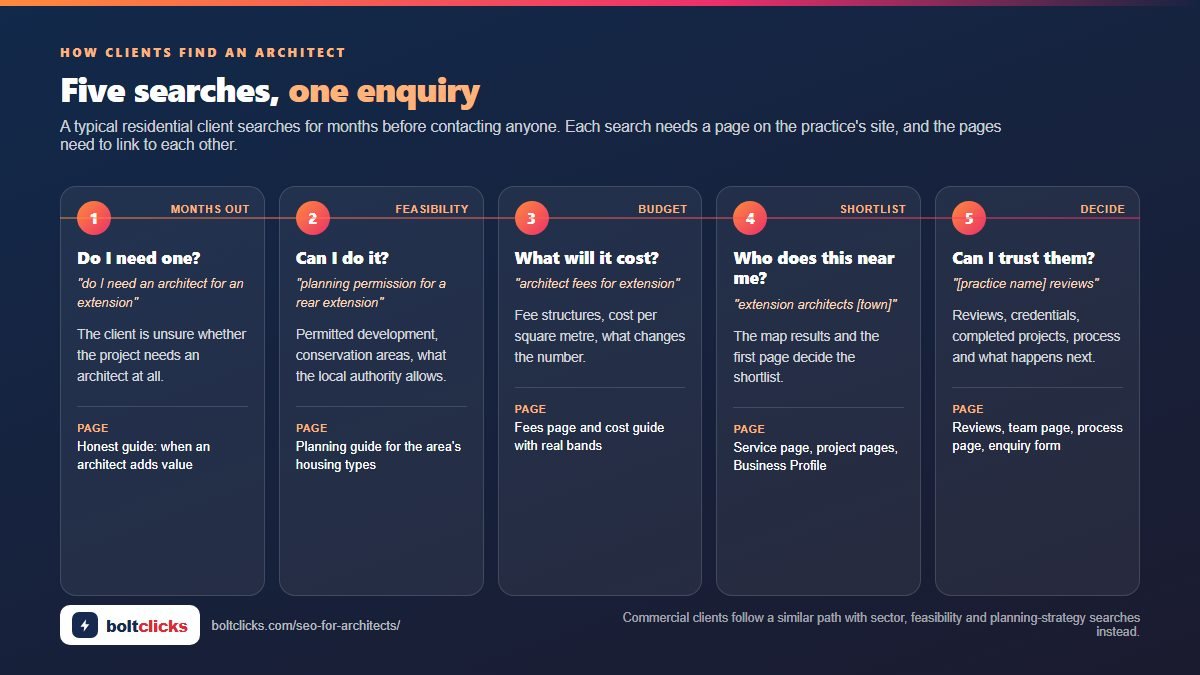
A client planning an extension searches for months before contacting an architect: whether they need one, whether they need planning permission, what it will cost, how long it takes, what the process involves, what has been done on houses like theirs. Each of those searches is an opportunity for the practice to be the one that answered, and the practices that publish honest, specific guides are the ones that get the enquiry when the client is ready. The content plan is built from those questions, organised by project stage, and every guide links to the service and project pages that turn a reader into an enquiry.
The guides are written from the practice’s own experience, which is what makes them rank and what makes them trusted: the actual planning history of the area, the real cost bands from recent projects, the constraints of the local housing stock, the decisions made on named projects. Generic articles about “the benefits of hiring an architect” rank for nothing and persuade nobody. Content is briefed for the practice to write, written from interviews with the architects, or drafted and reviewed by them, and always carries a named author with their credentials.
| Project stage | What clients search | Content that wins it |
|---|---|---|
| Thinking about it | do I need an architect, architect vs builder, architect vs designer, is an extension worth it | Honest guides that set out when an architect adds value and when they do not |
| Feasibility | can I extend my house, permitted development rules, planning permission for a loft conversion, conservation area restrictions | Planning and permitted development guides for the area’s housing types |
| Budgeting | architect fees, extension cost per square metre, new build cost, what affects cost | A fees page and cost guides with real bands from recent projects |
| Choosing | how to choose an architect, questions to ask an architect, architect reviews, best architects in [city] | A process page, team pages with credentials, reviews and awards |
| Briefing and process | how to brief an architect, design stages explained, how long does planning take, building regulations drawings | Stage-by-stage guides and a clear process page |
| Inspiration | rear extension ideas, side return designs, open plan kitchen extension, loft conversion examples | Project pages and image-led guides with proper text and alt text |
| Commercial and developer | feasibility study architect, planning strategy for development sites, office fit-out process, change of use architect | Sector pages, case studies with outcomes, and guides on planning strategy |
Links, press, awards and directories: the authority an architecture practice can earn
Search engines rank practices that other trusted sites talk about. Architecture has more of those opportunities than most professions: completed projects are newsworthy locally, design and property publications feature work constantly, awards schemes publish shortlists and winners, professional bodies and design directories list practices, suppliers and consultants credit their collaborators, and local press covers planning decisions and notable buildings. Most practices have earned dozens of mentions and never asked for a link, or have profiles on directories with the wrong website address. The contractors on those projects sit on the same untapped credits, and SEO for construction companies covers their side of the search, where architects are among the buyers.
The plan starts with what already exists: every mention found and, where a link is missing, requested. Then it builds a quarterly programme: project features pitched to local and specialist press, award entries for the projects that deserve them, directory and professional listings completed, partner and supplier credits arranged, guest articles on design and property sites, and digital PR built from the practice’s own data, such as what planning approval rates look like in the area or what extensions cost this year. Every link is judged on relevance; nothing is bought, and directories that exist only to sell links are refused.
Sources of links and mentions for architects
- Local press features on completed projects and planning wins
- Design, architecture and property publications
- Award schemes, shortlists and winners’ listings
- Professional body and design directories, completed properly
- Suppliers, engineers, contractors and consultants crediting projects
- Guest articles on planning, design and renovation topics
- Community and local business organisations
- Speaking, teaching and event listings
What is refused
- Paid links and sponsored posts sold by the hundred
- Directory networks with no real users
- Reciprocal link schemes between unrelated businesses
- Guest posts on sites that publish anything for a fee
- Anything that would not make sense if the search engine could see it, because it can
Reviews, expertise signals and AI answers: why the practice gets recommended
Expertise and trust signals
Search engines rate pages by whether they show experience, expertise, authority and trust. For a practice that means named architects with qualifications and registration, project credits, team pages, author details on guides, professional indemnity and accreditation details, client reviews and a history of completed work with dates and places. Most of it exists already and is missing from the website. The service puts it where search engines and clients can see it.
Reviews and reputation
Reviews decide shortlists and influence map rankings. A review programme asks clients at the moments they are happiest, usually planning approval and practical completion, makes it easy, and responds to every review. Reviews are shown on the site with structured data where the platform’s rules allow, and negative reviews are answered professionally rather than ignored.
AI search visibility
Clients now ask AI assistants for an architect who does extensions in their area or a practice with conservation experience. The answers name a few practices and cite the pages they drew from. The service checks those questions monthly, records who is named and why, and makes the changes that get the practice included: unambiguous entity information on the homepage and service pages, answer-ready sections that state what the practice does and where, structured data and consistent details across profiles and directories.
Conversion and enquiry quality
The goal is enquiries that fit the practice. Enquiry forms ask about project type, location, budget and timescale; fee guidance sets expectations without scaring; the process page explains what happens after the first call; and conversion tracking on forms, calls and messages ties every enquiry to the page and the search that produced it, so the report shows enquiries, not just rankings.
SEO for architects: pricing in pounds and dollars
Fixed fees, agreed in writing before work starts, month to month. Award entry fees, directory subscriptions you choose to take and any ad budgets are separate and paid by the practice directly; nothing is resold.
SEO packages start at £299 a month on the pricing page (Basic £299, Standard £449, Professional £649, each a counted scope of keywords and blog posts); the monthly retainers in the table below start at £650.
| Plan | What it covers | UK | US |
|---|---|---|---|
| Free architect SEO audit | Written summary of where the practice appears, where competitors appear, and the biggest technical, portfolio and content problems | Free | Free |
| SEO Foundation (one-off) | Full audit with the technical foundation fixed: speed and images, structure, canonicals, sitemaps, schema, Business Profile set-up, project page template | £850 | Quoted in USD |
| Starter: SEO for architects | Ongoing SEO: keyword map, service and project pages, local SEO, content, links, monitoring, weekly reports | £650 / month | $800 / month |
| Growth: SEO plus paid search | Architect SEO with paid search run alongside for the project types and places you want now, sharing keyword data and landing pages | £1,200 / month | $1,500 / month |
| Full Stack | Everything across SEO, paid search and paid social, with content, digital PR and award and press programmes; multi-office practices | from £4,000 / month | from $5,000 / month |
| Projects | Portfolio rewrites, website migrations and redesign protection, practice mergers and renames, speed rescue, one-off audits | Quoted | Quoted |
Terms: month to month, invoiced in advance, cancel with a month’s notice. Partner access to Search Console, analytics, the Business Profile and the website; passwords are never requested and everything stays in accounts the practice owns. The full price list is on the pricing page.
Specialist SEO, general agency, lead platforms, directories or doing it yourself
| Option | Strengths | Weaknesses | Typical cost |
|---|---|---|---|
| SEO specialist who knows the sector (this service) | Keyword map by project type and place, project pages that rank, local SEO, image-heavy speed work and content from the practice’s own experience; fixed fees; weekly written reports | Capacity is finite; large multi-office programmes need a team around the specialist | £299 to £4,000+ a month; $379 to $5,000+; one-off projects from £650 |
| General SEO agency | Capacity and process | Rarely understands how architecture is searched or bought; generic content; portfolio treated as a gallery; account managers between you and the work | £1,000 to £10,000+ a month |
| Lead platforms and quote services | Enquiries quickly | Shared with several practices, price-led, low fit; the platform owns the ranking and the client relationship; costs rise as you depend on it | Per lead or subscription |
| Directories and portals | Some visibility and a link; worth having for the strong ones | They rank instead of you; upgrades sold as marketing; little control over how the practice is presented | Free to several hundred pounds a year |
| Web designer or brand agency | A beautiful site that reflects the practice | Usually not an SEO specialist: heavy images, no keyword map, projects as galleries, no local SEO or content plan | Project fees |
| Doing it in-house | Knows the projects and the clients; no fee | Time taken from fee-earning work; technical and speed work needs a specialist; consistency drops when the practice gets busy | Partner and staff time |
How results are measured, and what to expect when
| Measure | Source | Why it matters |
|---|---|---|
| Rankings for the keyword map | Rank tracking by search, location and device, including the map pack | Leading indicator per service, project type and area |
| Impressions and clicks by page | Search Console | Visibility for each service, project and guide page |
| Organic sessions and enquiries | Analytics with conversion tracking on forms, calls and messages | The commercial result, attributed to page and search |
| Enquiry quality | Enquiry form fields and a monthly review with the practice | Whether the enquiries fit the project types and budgets you want |
| Business Profile actions | Profile insights: calls, direction requests, website clicks | Local demand captured |
| Core Web Vitals | Real-visitor data by page group, mobile first | Speed as clients experience the portfolio |
| Links, mentions and reviews | Backlink data, coverage tracking, review counts and ratings | Authority and trust growth |
| AI answer visibility | Monthly checks of buying questions | Whether the practice is named where clients now ask |
Technical and speed fixes show within weeks. Business Profile improvements often move map rankings within one to two months. New service and project pages in competitive cities take three to six months to settle; specialist pages with less competition move faster. Guides build traffic over six to twelve months and keep earning after that. Enquiry volume follows rankings with a lag, because architecture clients research for a long time before they contact anyone.
SEO by practice type
Residential practices
- Service pages per project type: extensions, lofts, renovations, new builds
- Local SEO and the map pack for the towns served
- Planning, cost and process guides for the local housing stock
Commercial and mixed practices
- Sector pages: offices, retail, hospitality, education, healthcare, industrial
- Case studies with outcomes: programme, budget, approvals, performance
- Content for developers, facilities managers and business owners
Conservation and heritage
- Specialism pages that rank nationally for listed building and conservation searches
- Guides on listed building consent, conservation areas and heritage statements
- Project pages that show the constraints and the approach
Sustainable and low-energy design
- Pages for passive house, retrofit, low-carbon and energy-efficient design searches
- Guides on standards, costs and performance with real project data
- Links from sustainability and construction publications
Interior architecture and design
- Service pages by space and sector; image-led project pages that still carry text
- Inspiration searches captured with proper structure and alt text
- Reviews and press features from completed interiors
Multi-office and growing practices
- Location pages per studio that differ in substance
- A Business Profile per office with its own projects and reviews
- Structure that lets each office rank in its own city without competing with the others
Remote SEO for practices in the UK, the US and anywhere
The work is done remotely, on UK and US hours, with partner access to Search Console, analytics, the Business Profile and the website that the practice grants and can revoke. There is no office in London or New York and none is claimed. Every week the practice receives a written report, and every question gets a direct answer from the specialist doing the work. Where the website itself is the problem, a portfolio built on a heavy template that cannot be made fast, or a site that needs rebuilding around the new structure, the websites service covers it, planned together with the SEO so the new site launches with its rankings intact and its project pages built to rank from day one.
- Partner access only, never your passwords
- Interviews with the architects so the content carries real experience
- Weekly written report with rankings, traffic and enquiries by page
- Every change documented so the practice and any future developer can see what was done and why
- Honest advice, including when the website, the positioning or the fee structure is the real problem
How architect searches differ between the UK and the US, and what changes in the plan
The service works for practices in both countries, and the keyword research is done separately for each, because clients search differently. In the UK the language of planning dominates: planning permission, permitted development, conservation areas, listed building consent, party wall agreements, building regulations and the local authority’s attitude to extensions. Residential searches centre on extensions, loft conversions, renovations and self-build; commercial searches on fit-outs, change of use and development feasibility. In the US the vocabulary is permits, zoning, setbacks, code compliance, homeowners’ associations and historic districts; residential searches centre on custom homes, remodels, additions and accessory dwelling units; commercial searches on tenant improvements, mixed-use development and adaptive reuse. Spelling, units, fee structures, review platforms and the directories that matter all differ, and so do the competitors on the first page.
| Area | United Kingdom | United States |
|---|---|---|
| Residential project searches | house extension architect, loft conversion architect, renovation architect, self build architect, barn conversion | residential architect near me, custom home architect, home addition architect, remodel architect, ADU architect |
| Regulatory searches | planning permission, permitted development, listed building consent, conservation area, building regulations drawings, party wall | building permit drawings, zoning variance, setback requirements, code compliance, historic district approval, HOA approval |
| Commercial searches | commercial architects, office fit-out, change of use, feasibility study, planning strategy | commercial architecture firm, tenant improvement architect, mixed-use development, adaptive reuse, site feasibility |
| Cost searches | architect fees for extension, cost per square metre, architect fee percentage | architect cost per square foot, architect fees for custom home, design fee percentage |
| Local structure | Towns, boroughs and counties; map results by town | Cities, counties, metro areas and neighbourhoods; map results by city and suburb |
| Trust signals | Registration with the statutory register, chartered practice status, professional indemnity, awards | State licensure, professional association membership, liability insurance, awards |
| Directories and reviews | Professional and design directories, home improvement platforms, review sites, local press | Professional and design directories, home design platforms, review sites, local press and business journals |
When clients search for architects, and what to have ready before they do
Demand for architects is seasonal and the search data shows it. Residential searches rise sharply in January, when households plan the year, climb through spring as extension and renovation projects are conceived, dip in late summer and rise again in early autumn as people aim to have designs and planning in place for a spring start on site. Commercial and developer searches follow budgeting and lease cycles rather than the weather. Because SEO takes months to build, the pages that need to rank for the January and spring peaks have to be written and indexed in the autumn, and the guides that answer the early-stage questions have to be earning visits before the searches peak.
The plan is built around that calendar. Technical and speed work, the project page template and the priority service pages go first, so they are settled by the time demand rises. Planning and cost guides are published ahead of the seasons in which those questions peak. Review requests are timed to project milestones so that ratings grow steadily through the year. Business Profile posts follow completed projects and planning approvals as they happen. Paid search, where the practice uses it, is turned up in the peak months for the project types the practice wants and turned down when organic rankings carry the demand. The weekly reports track enquiries against the same calendar, so a quiet August is read as August rather than as a problem.
Ready before the January peak
- Service pages for the project types you want most
- The ten best projects rewritten to the template
- Fees and process pages live
- Business Profile complete with recent reviews
- Planning and cost guides indexed and earning visits
Through the year
- Guides published ahead of each season’s questions
- Project pages added as projects complete
- Press and award activity around completions and shortlists
- Reviews requested at planning approval and practical completion
- Quarterly review of the keyword map against what actually converted
Where SEO fits in a practice’s marketing: referrals, social media, awards, press and paid ads
SEO is one part of a marketing strategy for an architecture practice, and it works best when it is planned with the rest: word of mouth and referrals from past clients, contractors and consultants; social media where the practice shows work in progress and finished projects; awards and press that build brand awareness and reputation; talks, teaching and thought leadership; email to past clients and contacts; and paid advertising when the practice needs enquiries for a particular project type or place right now. Each of those feeds the others. A press feature earns a link and a mention; a social media post about a completed project drives visits to the project page; a paid search campaign shows within weeks which searches convert, which sharpens the keyword map; a strong search presence makes every referral easier, because the client who was told your name searches for it and finds a practice that looks as good as the recommendation.
What SEO adds that the others cannot is the client who has no referral and has never heard of the practice: the homeowner, developer or business owner who searches, reads, compares and enquires. It also compounds. A referral or a paid ad produces one enquiry; a service page that ranks, a project page that appears for its neighbourhood and a planning guide that answers a common question keep producing enquiries for years, at no cost per click, and the practice owns the asset rather than renting it.
| Channel | What it does for the practice | How it works with SEO |
|---|---|---|
| Referrals and word of mouth | The biggest and best-qualified projects; slow and unpredictable | Referred clients search the practice name; the site, reviews and Business Profile confirm the recommendation |
| Social media | Brand awareness, work in progress, relationships with contractors and press; rarely direct enquiries | Posts drive visits to project pages; profiles link to the site; project photos reused on the Business Profile |
| Awards and press | Reputation, credibility and trust; shortlists and features | Links and mentions from publications and award sites; press coverage cited by AI assistants |
| Paid search and paid social | Enquiries quickly for chosen project types and places; stops when the budget stops | Search-term data and conversion data sharpen the keyword map; landing pages shared; SEO lowers the blended cost per enquiry over time |
| Email and past clients | Repeat work, referrals, reviews | Guides and project stories reused as email content; review requests timed to milestones |
| Directories and lead platforms | Some visibility, shared and price-led leads | Strong directories completed for links and citations; platforms not relied on |
| Talks, teaching and community | Thought leadership, local reputation, partnerships | Event listings, community organisations and partner sites provide links and mentions |
| SEO | Clients with no referral; enquiries that compound; an asset the practice owns | The foundation the other channels land on |
How to choose an SEO provider for an architecture practice, and how the work fits around yours
Choosing the right SEO provider is easier when you know what to ask. Every marketing agency says it delivers measurable results, has years of experience and understands your business; the useful questions produce specific answers about your practice. Ask which searches you would target first and why, what they would change on the portfolio, how they would handle the images, what the Business Profile needs, who writes the content and where the architectural knowledge comes from, who does the work day to day, and how you will know it worked. Then compare the answers with the lists below.
Good signs
- A written audit of your actual website and visibility before a price, even a short one
- A keyword map that talks about project types, places and client questions, not “architects” alone
- A plan for the portfolio: template, priorities, images, links
- Content that will come from your architects’ experience, with named authors, not from a content mill
- Field data for speed, Search Console and analytics for results, enquiries attributed to pages
- Direct access to the person doing the work, weekly written reports, fixed fees, month to month
- Willingness to say the website, the positioning or the fee structure is the real problem
Claims to be wary of
- Guaranteed rankings or guaranteed page-one results; nobody controls the search engine
- “Proven strategies” and “a team of experts” with no named person, no audit and an account manager between you and the work
- SEO packages priced before anyone has looked at your website or your market
- Link building sold by the hundred, or backlinks from sites you have never heard of
- Generic articles about the benefits of hiring an architect, written by someone who has never spoken to one
- Reports full of vanity metrics, keyword rankings with no traffic, and traffic with no enquiries
Once the work starts, it fits around the practice rather than on top of it. The specialist owns the strategy, the technical work, the local presence, the outreach and the reporting. The architects give an hour or two a month: an interview for each guide, a look at the project page drafts, a decision on which projects to feature and which project types to push. The web designer or developer, where there is one, receives written specifications for any template or theme change and tests them on staging. Practice managers get the weekly report and a monthly review of enquiry quality. Nothing is published without the practice seeing it, and nothing is changed on the site without a record of what was changed and why, so any future designer or developer can see the reasoning. Practices that want to build the capability in-house get training and briefs instead of delivery, and pay less for it.
- An hour or two a month from the architects: interviews, approvals, decisions
- Specifications, not vague requests, for any developer or designer
- Clear communication: a weekly written report and direct answers, no jargon unless you want it
- Nothing published unseen, nothing changed unrecorded
- Training and briefs for practices that want to do more themselves
Signs your practice’s website is losing enquiries to search
Practice owners usually notice the symptoms long before the cause: the site looks beautiful, the portfolio is full, and the enquiries still come from referrals alone. The list below is what an architect SEO audit usually finds behind that. If three or more apply, the site is a brochure for people who already know the practice, and it is not working for anyone else.
Visibility symptoms
- Searching your project type plus your town brings up directories, lead platforms and other practices, not you
- The practice appears only for its own name
- The Business Profile is unclaimed, incomplete or shows an old address and three reviews
- Competitors with weaker portfolios appear in the map results and you do not
- Project pages are indexed as image galleries with the project name as the only text
- Organic traffic in analytics is flat and mostly branded
Site and content symptoms
- Homepage load time over four seconds on mobile; full-screen slider; Core Web Vitals poor
- Services described in one paragraph on a single page, or not at all
- No guides, no fees page, no process page; nothing that answers a client’s early questions
- Team page with photographs and no credentials, registration or project credits
- Enquiry form that asks for a name and a message and nothing that qualifies the project
- Nobody can say which pages produce enquiries because nothing is tracked
The architect SEO checklist used on every practice
| Area | Checklist items |
|---|---|
| Audit and baseline | Rankings by project type and place; traffic and enquiries by page; Search Console errors; speed data; Business Profile status; competitor visibility; directory and citation accuracy |
| Keyword map | Project types, building types, specialisms, places, planning and regulation searches, cost and fee searches, early-stage questions, inspiration searches; each mapped to one page |
| Service pages | One page per service the practice wants; process, timescales, fees, inclusions, examples, questions answered; linked to matching projects; structured data |
| Project pages | Template applied to every project: descriptive title, brief, constraints, response, planning route, timeline, cost band, optimised images with alt text, related service, client quote, next step |
| Local SEO | Business Profile categories, services, service area, photos, posts, questions, reviews and responses; citations consistent; location pages for multiple offices; map pack tracking |
| Technical and speed | Images resized and converted; sliders and galleries tamed; caching, scripts and fonts; crawl and index rules for filters; canonicals, sitemaps, redirects for retired projects; headings and structured data; Core Web Vitals field data on mobile |
| Content | Guides by project stage; fees page; process page; named authors with credentials; internal links from every guide to services and projects; content audit of what exists |
| Authority | Existing mentions found and links requested; press pitches for completed projects; award entries; professional and design directories completed; supplier and consultant credits; guest articles; digital PR from project data |
| Trust signals | Team pages with qualifications and registration; project credits; insurance and accreditation details; reviews with structured data where allowed; consistent practice details |
| Conversion and tracking | Enquiry forms that qualify; click-to-call and messaging; conversion tracking on forms, calls and messages; monthly enquiry quality review |
| AI search | Monthly checks of the buying questions; entity clarity on key pages; answer-ready sections; structured data; consistent details across profiles |
What happens in the first ninety days of SEO for an architecture practice
| Period | Work | What you see |
|---|---|---|
| Week 1 to 2 | Access set up, audit, keyword map, competitor review, baseline of rankings, traffic, enquiries and speed; Business Profile claimed and corrected; plan agreed | The audit report, the keyword map, the first weekly report |
| Week 3 to 6 | Technical and speed work through the portfolio; project page template built and applied to the first ten projects; first service pages written; tracking fixed; citations corrected | Faster pages in field data, Search Console errors falling, profile completeness up, first reviews requested |
| Week 7 to 10 | Remaining priority service pages; more projects rewritten; first two guides published; press and directory outreach started; location pages where needed | Impressions rising for mapped searches; early ranking movement on service and project pages; map pack movement in the local area |
| Week 11 to 13 | Content to plan; links and mentions arriving; review programme running; AI visibility check; quarter review against the baseline and the next quarter’s plan | Rankings, traffic and enquiries compared with the baseline; the plan for the next quarter |
What you should not expect in ninety days: page-one rankings for the most competitive city-wide searches, or a fully rewritten portfolio of eighty projects. SEO compounds; the first quarter builds the foundation and the later quarters add the pages, links and reviews that move the competitive searches.
Architect SEO terms, defined
| Term | Meaning |
|---|---|
| Keyword map | The list of searches worth winning, each assigned to one page on the site |
| Search intent | What the searcher wants: to hire, to research, to compare or to see examples |
| Map pack | The block of three local businesses with a map shown for local searches |
| Google Business Profile | The free listing that controls how the practice appears in the map results and on the right of search results |
| Citation | A mention of the practice’s name, address and phone on a directory or another site |
| Service page | A page about one service, such as house extensions or planning applications, written to rank for that search |
| Project page | A page about one completed project, structured so it ranks for its type and place |
| Location page | A page for one office or area served, for practices with more than one |
| Core Web Vitals | Google’s measures of loading, interactivity and visual stability, taken from real visitors |
| Alt text | The description of an image in the page code, used by search engines and screen readers |
| Structured data | Schema markup describing the practice, its services, reviews and pages to search engines and AI systems |
| Canonical URL | The one preferred address for a page when several versions exist |
| Digital PR | Earning coverage and links from publications with newsworthy projects, data and stories |
| E-E-A-T | Experience, expertise, authoritativeness and trust: the qualities search quality guidelines look for |
| Conversion tracking | Recording form submissions, calls and messages in analytics so enquiries can be attributed |
| Partner access | Delegated access to the practice’s own accounts, so the specialist works without holding passwords |
What a client said, and what you can check
“Great communication and very helpful throughout the process. Took the time to explain everything clearly and set up the campaign professionally. Focused on quality results rather than just numbers. Highly recommended.”
This is one of three client reviews published so far; the other two, from a UK SEO client and a US Google Ads client, are on the home page. Every figure comes from the client’s own ad account, and a review goes on this site only when it is real.
What you can check before you pay
- Prices published in full on the pricing page, not hidden behind a sales call
- Month to month, with one month’s notice and no lock-in contract
- Every account, profile and file stays in your name; I work through partner access
- A written report every week, in plain English
- One specialist does the work, from the audit to the report
SEO for architects: frequently asked questions
What is SEO for architects?
Search engine optimisation applied to an architecture practice: research into how clients search for an architect by project type, building type and place; service and project pages written to rank for those searches; local SEO and the Google Business Profile; technical and speed work for image-heavy portfolio sites; guides that answer client questions; and the links, reviews and AI search visibility that get the practice recommended. The goal is enquiries for the projects the practice wants.
Do architects really get clients from search?
Yes, and increasingly so. Referrals still bring the biggest projects, but homeowners planning extensions, developers looking for planning expertise and businesses comparing practices for fit-outs all search, read, shortlist and enquire without a referral. Practices that appear for those searches get the call; practices that appear only for their own name do not.
How much does SEO for architects cost?
Here, SEO packages start at £299 a month ($379) on the pricing page, each a counted scope of keywords and blog posts; monthly retainers start at £650 a month in the UK and $800 a month in the US for ongoing SEO as a single channel, £1,200 or $1,500 with paid search alongside, and from £4,000 or $5,000 for the full-stack plan. The one-off SEO Foundation project is £850. A free audit summary comes first.
How long does SEO take for an architecture practice?
Technical and speed fixes show within weeks and Business Profile improvements often move map rankings within one to two months. Service and project pages in competitive cities take three to six months to settle; specialist searches move faster. Guides build over six to twelve months. Enquiries follow rankings with a lag, because clients research for a long time before contacting anyone.
Which searches should an architect target?
Project type plus place is usually the best starting point: extensions, lofts, renovations and new builds in the towns the practice serves, plus the map results for “architects near me”. Then building types and sectors for commercial work, specialisms that can rank nationally, planning and regulation searches, and the early-stage questions about cost, permission and process. The keyword map picks the set worth winning first.
Can our portfolio rank without ruining the images?
Yes. Images are resized to the largest size any template displays, converted to modern formats at quality settings judged by eye, lazy-loaded with the hero prioritised and delivered through a content delivery network where useful. The photographs look the same; the pages load in a fraction of the time.
Do we need to write the content ourselves?
Not necessarily. Guides can be briefed for the practice to write, drafted from interviews with the architects, or written for you and reviewed by them. What matters is that the content carries the practice’s real experience and a named author with credentials, because that is what ranks and what clients trust.
We have several offices. How does that work?
Each office gets a location page that differs in substance, its own projects, team and reviews, and its own Business Profile. The site structure lets each office rank in its own city without the pages competing with each other.
Do directories and lead platforms replace SEO?
No. The strong directories are worth a complete profile and a link, but they rank instead of you and present the practice their way. Lead platforms sell shared, price-led enquiries and own the client relationship. SEO builds visibility the practice owns.
Will you need our passwords?
No. Partner or delegated access to Search Console, analytics, the Business Profile and the website is all that is used, and everything stays in accounts the practice owns.
Do you work with architectural designers and technologists?
Yes. The searches overlap with those for architects, and the work is the same: clear service descriptions, honest positioning, project pages that rank, local SEO and guides that answer the architect-versus-designer question searchers ask.
Can you help if our site is being redesigned?
Yes, and it is the best time to start. Keyword research shapes the structure, the project page template is built into the design, images are handled properly from the start, and a redirect map protects the rankings the old site had. The websites service and the SEO are planned together.
Where are you based?
The work is delivered remotely for practices in the UK, the US and elsewhere, on UK and US hours. There is no office in either country and none is claimed.
Is there a contract?
Month to month, invoiced in advance, cancel with a month’s notice. Fees are agreed in writing before work starts and do not change without agreement.
Seven things to know before buying SEO for an architecture practice
1. The portfolio is the asset, and it is probably invisible
Every completed project can rank for its type and place. Most do not, because they are galleries with a name. Rewriting them to the template is the highest-return work on most practice sites.
2. Project type plus place beats “architects” every time
The big generic searches are dominated by directories and the largest practices. The searches that bring enquiries are specific, and there are hundreds of them. Win the right set, not the biggest one.
3. Local visibility is decided by the profile, not the website alone
A complete, active Business Profile with recent reviews moves map rankings faster than almost anything on the site. It is free, and most practices neglect it.
4. Speed matters more on a portfolio site than on any other
Photographs are the product, and they are also why the site is slow. Handle them properly and the rankings, the mobile experience and the enquiry rate all improve together.
5. Guides bring the client before the competition knows they exist
The homeowner asking whether they need planning permission is six months from hiring. The practice that answered is the one they remember. Write from real experience, with a named architect.
6. Enquiry quality is a design decision
Forms that ask about project type, location, budget and timescale, a fees page that sets expectations and a process page that explains what happens next produce fewer, better enquiries. That is the point.
7. Sometimes the website is the problem, and you should be told
A template that cannot be made fast or a structure that cannot carry service and project pages is cheaper to rebuild than to work around. An honest recommendation on the first call, and a plan that treats the rebuild and the SEO as one project, is worth more than a year of patches.
Start with a free SEO audit for your practice
Send your website and the three project types you most want to win. You will get a written summary of where the practice appears today, where competitors appear, the biggest technical, portfolio and content problems, and a straight answer on whether SEO is worth funding, before any conversation about a plan. No jargon, no lock-in, no passwords.