
SEO in Liverpool: one search, both banks of the Mersey
Liverpool is one word in the search box and two very different places on the map: a city of about 486,100 people and a city region of six boroughs split by the Mersey. Google draws the map pack from where each searcher stands, so a business in the Baltic Triangle and a business in Birkenhead face different contests. This is what the search for SEO in Liverpool actually shows, how each district and town searches, how to read reviews, and what to fix first on either bank.

One search term, two banks of the river
Type “seo liverpool” into Google and the question has two places hidden in it. The first is the City of Liverpool: about 486,100 people at the 2021 Census, one council, and postcodes running from L1 around Liverpool ONE out to L25 in Woolton and L27 in Netherley. The second is the Liverpool City Region: six boroughs and around 1.6 million people, with Liverpool, Knowsley, Sefton, St Helens and Wirral in Merseyside, and Halton, the borough of Widnes and Runcorn, in Cheshire. To a visitor it is all Liverpool. To Google it is not.
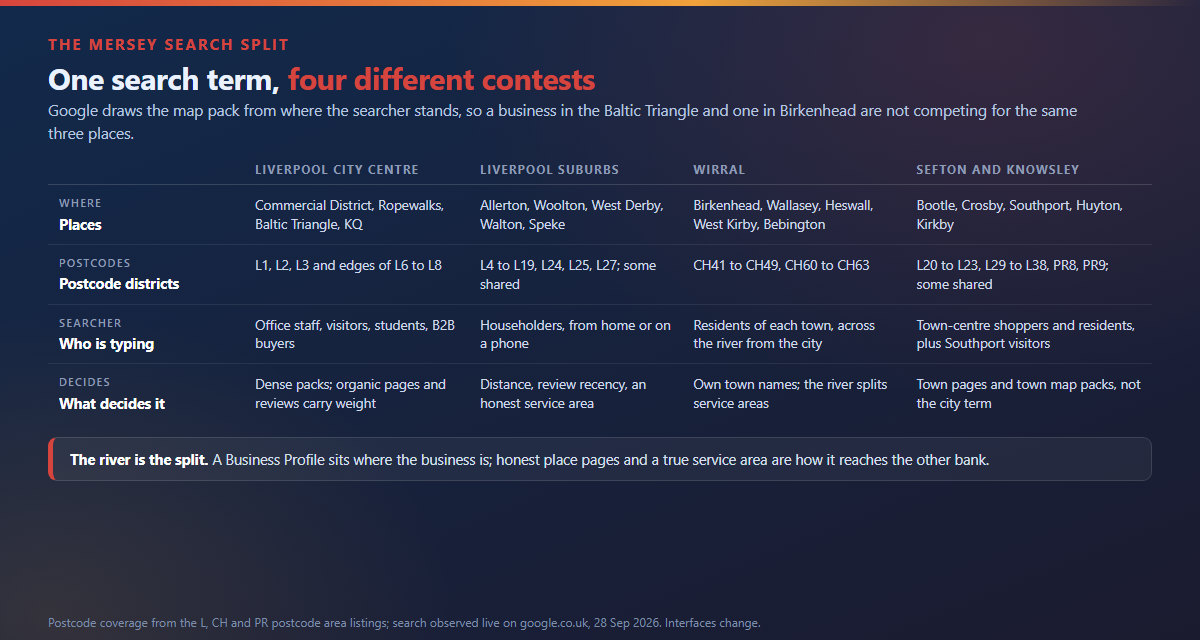
The River Mersey runs through the middle. Birkenhead and Wallasey are on the Wirral side, reached from the city centre by tolled road tunnels, and Wallasey also by ferry from the Pier Head. Southport is about seventeen miles north up the Sefton coast. Widnes and Runcorn face each other further upstream. Each town has its own centre and its own map pack, because Google builds local results around the person searching: how relevant each business is to the words typed, how far it is from that person, and how well known it is. A café owner in the Baltic Triangle and one in Birkenhead can type the same words and see different map packs, and so can their customers. That is what I mean by the Mersey search split.
This page covers what the split means in practice and what to fix first on either bank.
One disclosure first, because most pages ranking for this search are built around a local office. I work alone and remotely from Lahore, in Pakistan. I have no office and no staff in Liverpool, Birkenhead or anywhere else on Merseyside. Everything here is about how the searches behave and where the places are, and all of it can be checked.
What Google shows for the search, and who is really typing it
I checked “seo liverpool” on google.co.uk on 28 September 2026. The page had four layers. At the top, under filter chips for “Online appointments”, “Open now” and rating, sat an AI Overview, generated text with links to the sites it drew on. Then the map pack. Then agency pages written for this exact phrase, most of them built around claims about the agency itself, with a directory that lists agencies mixed in. Further down, the “People also search for” block offered reviews, web design, web agency, marketing agency and digital marketing agency, each with Liverpool attached.
The chips show what Google expects a searcher to care about. “Online appointments” narrows the pack to listings that take bookings online. “Open now” depends entirely on the hours in each Business Profile being right. The rating chip drops lower-rated listings with one tap. Chips like these appear on many local searches, so the same details decide whether a Liverpool dentist or a Southport guest house stays on screen once a filter is tapped.
Who types the search? Most likely business owners and marketing managers across the city region who want help, which is why the suggestions point at reviews and at different kinds of agency. Some are agencies checking the competition, and a few are students. Almost none of them are your customers. A plumber in Walton wins work from people typing “plumber walton” or “emergency plumber liverpool”, or from people who never search at all because a neighbour passed on a number.
So this page has two jobs: to show what good help looks like here, and to show how your own customers search, by place and by trade, where the place is often not Liverpool at all.
Six boroughs and four postcode areas under one city name
The Liverpool City Region Combined Authority came into being on 1 April 2014 and has had an elected mayor since 2017. Five of its six councils, Liverpool, Knowsley, Sefton, St Helens and Wirral, are the metropolitan boroughs of Merseyside, created in 1974. The sixth, Halton, is a unitary authority in Cheshire that has been a member since the combined authority was set up. For search, the towns matter more than the councils.
Wirral is across the river: Birkenhead, with Hamilton Square, the Pyramids shopping centre and Birkenhead Park, opened in 1847 as the first publicly funded park in Britain; Wallasey, where the council is based; and New Brighton, Heswall, West Kirby, Hoylake, Bebington and Port Sunlight, where Unilever still does research. Sefton runs up the coast: Bootle, which shares the council’s headquarters role with Southport; Seaforth, Waterloo, Crosby, Maghull and Formby; and Southport itself, with Lord Street and the second longest seaside pleasure pier in the British Isles. Knowsley lies east of the city: Huyton, where the council sits, Kirkby, Prescot, and Halewood, where Jaguar Land Rover builds the Range Rover Evoque. St Helens is the glass town, where Pilkington still makes flat glass. Halton is Widnes on the north bank and Runcorn on the south, joined by the Silver Jubilee Bridge of 1961 and the Mersey Gateway Bridge, opened in October 2017, with the Sci-Tech Daresbury science campus nearby.
The postcodes catch out anyone who assumes an L postcode means the city. Liverpool itself sits mostly in L1 to L19, plus L24 for Speke, L25 for Woolton and Hunts Cross and L27 for Netherley. But L20 to L23 are Bootle, Litherland, Seaforth, Waterloo and Crosby in Sefton, and L32 to L36 are Kirkby, Prescot, Whiston and Huyton in Knowsley. Several districts straddle the city boundary: L9 and L10 reach into Sefton at Aintree, L14 and L16 into Knowsley, and L24 into Halton at Hale. Beyond the L area, Wirral is CH41 to CH63, Southport is PR8 and PR9, and St Helens, Widnes and Runcorn are WA postcodes. A business serving the whole city region deals with four postcode areas.
The crossings shape search too. Two tolled road tunnels run under the river: Queensway to Birkenhead, opened in 1934, and Kingsway to Wallasey, opened in 1971. The Mersey Ferries sail from the Pier Head to Seacombe in Wallasey; the Woodside terminal in Birkenhead has been closed for rebuilding since October 2022. A trade business in the city may not want jobs that cost a toll each way, and its service area should say so.
The map pack ignores all of these boundaries. It weighs the words, the distance and the reputation, which is why the rest of this page treats the region as places, not one keyword.
Seven city-centre districts, seven different searchers
Liverpool’s centre is small enough to walk across, yet its districts search in completely different ways.
The Commercial District. Castle Street, Dale Street, Water Street and Old Hall Street were among the seven streets of the medieval borough, and they still carry the offices: law firms, insurers, accountants, banks, and the Liverpool Chamber of Commerce in the Cotton Exchange building on Old Hall Street. Customers here research, compare and read. The organic result carries more of the enquiry than the map pack does, and credentials such as SRA regulation or ICAEW membership belong on the page, not in a PDF.
The waterfront, the Royal Albert Dock and the Pier Head. The Albert Dock opened in 1846, and its five warehouses are the largest group of Grade I listed buildings in the UK, now home to The Beatles Story and the Merseyside Maritime Museum. The Pier Head has the Royal Liver Building, the Cunard Building and the Port of Liverpool Building, the Museum of Liverpool, opened in 2011, and the ferry terminal. This stretch was part of a UNESCO World Heritage Site from 2004 until 2021, and the arena at Kings Dock hosted the Eurovision Song Contest in 2023 on behalf of Ukraine. The searcher is a visitor with a phone, close by and wanting something now, so the map pack, the “Open now” chip and the reviews decide it.
Liverpool ONE. Opened in 2008, the year Liverpool was European Capital of Culture, across 42 acres, it is the largest open-air shopping centre in the UK. National chains own its brand searches. An independent nearby wins on the specific: the product, the service and the street it is on.
Ropewalks. Named after the long straight streets where rope was made for sailing ships: Bold Street, Seel Street, Wood Street, Duke Street and Slater Street, with Concert Square, FACT and Chinatown on Nelson Street. Independent restaurants, bars and shops, and a night-time economy searched late, on phones and very specifically. Wrong Saturday-night hours cost more here than almost anywhere else in the city.
The Baltic Triangle. Bounded by Liver Street, Park Lane, St James Street, Hill Street, Sefton Street and Wapping, it was once timber yards and warehouses for the Scandinavian trade. Since Baltic Creative was set up in 2009 to turn old warehouses into studios and offices, it has filled with digital and creative businesses, events spaces, food halls and the Cains Brewery Village. Many firms here have an office but no counter, so whether to show an address at all depends on whether customers really walk in.
The Knowledge Quarter. An innovation district of about 450 acres holding the University of Liverpool, Liverpool John Moores University, LIPA, the Royal Liverpool University Hospital, whose new building opened in October 2022, the Liverpool School of Tropical Medicine, founded in 1898, Liverpool Science Park and Paddington Village. Searches follow the academic year and the hospital shift.
The Georgian Quarter. Rodney Street, Canning Street, Falkner Square and Hope Street, which runs from the Metropolitan Cathedral past the Anglican Cathedral, with the Everyman and the Philharmonic Hall on the way. Rodney Street is sometimes called the Harley Street of the North for its private clinics. Practices here live on reviews, plainly stated credentials and a precisely chosen primary category.
Name your district wherever it helps a customer find you, and never claim one you are not in.
Out from the centre, where the map pack is decided on the doorstep
Most Liverpool households live outside the centre, in districts that were separate villages and townships until the city absorbed them. Search here is residential: a boiler repair, a dentist, a hairdresser, a takeaway. Distance weighs heavily, and the three names in the map pack can change from one district to the next.
South Liverpool. Aigburth (L17 and L19) has Lark Lane and sits between Sefton Park and the Otterspool Promenade. Mossley Hill (L18) has Sudley House and the Penny Lane of the song. Allerton (L18) has the Allerton Road shops, Calderstones Park and, on its border with Garston, Liverpool South Parkway station. Woolton (L25) still feels like a village, and St Peter’s Church there is where John Lennon is generally believed to have met Paul McCartney on 6 July 1957. Childwall (L16) has All Saints’, described as the oldest church in Liverpool, Childwall Fiveways, Liverpool Hope University’s Hope Park campus and Lime Pictures, which makes Hollyoaks. Garston (L19) has its own port. Speke (L24) has Liverpool John Lennon Airport, the National Trust’s Speke Hall, the New Mersey Shopping Park and pharmaceutical manufacturing.
East Liverpool. Wavertree (L15) runs along Smithdown Road, with the octagonal Wavertree Lock-up. West Derby (L12) is an old village with a courthouse built in 1586 and Alder Hey Children’s Hospital on its southern side. Next door, Croxteth Hall, former seat of the Earls of Sefton, stands in a council-owned country park of about 500 acres. Norris Green (L11), laid out from the 1920s between the East Lancashire Road and Queens Drive, shops along Broadway.
North Liverpool. Walton (L4 and L9) has County Road and Rice Lane. Anfield (L4) has the stadium, which seats 61,276 since the Anfield Road stand was expanded in 2024. Everton (L3, L5 and L6) has Everton Park and the Everton Lock-Up, while the football club moved in 2025 from Goodison Park to the Hill Dickinson Stadium at Bramley-Moore Dock in Vauxhall. Kensington (L6 and L7) is Victorian terraces around Newsham Park.
Three things follow. Most trades and home services are service-area businesses, and the service area should be drawn where the van actually goes. A shop on Allerton Road or County Road competes mostly with shops nearby, so its details, photographs and reviews matter more than city-wide content. And match days around Anfield, Walton and now Vauxhall change who is on the streets and what they search for.
What the city region sells, and how each sector searches
The local economy is broader than its postcard, and search demand follows it sector by sector.
The visitor economy. The Cavern Club on Mathew Street, first opened in 1957; two big football stadiums; the Grand National at Aintree each April, in Sefton rather than the city; the Open Championship, which Royal Liverpool at Hoylake on the Wirral hosted for the thirteenth time in 2023; and Royal Birkdale at Southport, host eleven times since 1954, most recently in July 2026. Visitors search twice: from home before they travel, which is a national search against booking and review sites, and on the day from a phone, which is a map-pack search. A hotel or restaurant needs a website for the first and a Business Profile for the second.
The universities. The University of Liverpool began as a college in 1881 and received its royal charter in 1903; Liverpool John Moores became a university in 1992 and Liverpool Hope in 2005. Student demand clusters in the Knowledge Quarter, Kensington, Wavertree and along Smithdown Road, where letting agents, takeaways and gyms see searches follow the academic calendar.
The port and logistics. The Port of Liverpool takes in the docks from Brunswick to Seaforth and those at Birkenhead, and the deep-water Liverpool2 container terminal, opened in November 2016, is at Seaforth in Sefton, not in the city at all. Forwarders, hauliers, customs agents and warehouses sell to procurement people who research by service and route, so the page and its specifics carry the enquiry, not the map pack.
Health and life sciences. The Knowledge Quarter hospitals and institutes, Alder Hey, pharmaceutical manufacturing in Speke, and Sci-Tech Daresbury in Halton, home to the Hartree Centre. Patients looking for a clinic or physiotherapist near them are a local search; research and industry buyers looking for specialist suppliers are national or international.
Digital and creative. The Baltic Triangle’s studios and television production such as Lime Pictures. These firms often sell outside the region, so their problem is ranking a portfolio and service pages for what clients elsewhere type, not the map pack.
Manufacturing. Jaguar Land Rover at Halewood, Pilkington in St Helens, Unilever at Port Sunlight, shipbuilding in Birkenhead. Their supply chains are business-to-business, and specifications, certifications and capacity stated on the page win those searches.
Local sectors search by place, business-to-business sectors search by capability, and the visitor sector does both. Know which one you are before paying anyone for anything.
How to read reviews, an agency’s and your own
The first suggestion in the “People also search for” block, for the main search and for “local seo liverpool” alike, was the same phrase with “reviews” on the end. That makes sense, but reviews of marketing suppliers are harder to read than restaurant reviews, and the star average says little on its own.
What to look for. Spread over time: a burst in one month and silence for a year shows a push to collect reviews, not good service. Specifics: a review that names the work, a profile corrected, a site moved without losing its pages, is worth ten that say “great team”. Who wrote it: if the reviewer’s other reviews are all for agencies and software tools, discount it. Replies to the bad ones: how a supplier answers a one-star review shows how it handles problems. Where it lives: reviews on an agency’s own site were chosen by the agency. I have set out how to read SEO company reviews in more detail on a separate page.
Your own reviews matter even more, and in Liverpool they often decide the click. Google says local results rest mainly on relevance, distance and popularity, and that more reviews and positive ratings can help a business’s local ranking; the rating chip then lets a searcher drop lower-rated profiles with one tap. What works is dull: ask every satisfied customer when the job is finished, with a direct link; reply to every review in a way that helps the next reader; and never buy, fake or filter them. Since April 2025, fake reviews and paid-for reviews that are not clearly marked have been banned practices under the Digital Markets, Competition and Consumers Act 2024, which the Competition and Markets Authority can enforce directly, and hiding negative reviews is covered too.
Readers notice dates. A Georgian Quarter clinic with a strong average and nothing new since last spring looks dormant beside one with a steady trickle, and a steady trickle is far harder for anyone to fake.
Web design, web agency or marketing agency: which one the problem needs
The rest of that block reads like a list of supplier types: “web design liverpool”, “web agency liverpool”, “marketing agency liverpool”, “digital marketing agency liverpool”. Searchers are plainly unsure which kind of help they need, which is fair: the lines are blurred and plenty of suppliers sell all four.
Roughly: a “web design” studio designs and builds the website. A “web agency” does the same with development, hosting and maintenance around it. A “marketing agency” plans how a business reaches customers across channels, online and off. A “digital marketing agency” runs the online channels: paid search, paid social, email, content and usually SEO. SEO itself is narrower: making sure the right pages exist, that Google can crawl and understand them, that the Business Profile is right, and that the business earns the mentions and reviews that make it prominent. Google’s own Business Profile categories keep these apart. Website designer, Marketing agency, Internet marketing service and Advertising agency are separate entries, and a supplier’s choice among them tells you what it thinks it mainly is.
If the site is slow on a phone, broken or impossible to update, you need web design first, with SEO in the room, because a redesign that changes every URL without redirects can wipe out the visibility the old site had. If the site works but nobody finds it, you need SEO, and a new design will not fix that. If you need customers this month rather than this year, paid search may be the right first spend.
A few questions separate suppliers, whatever label they use. Will the old URLs be kept, or redirected one by one? Who owns the domain, the hosting and the Business Profile when the contract ends? What does the monthly fee buy in hours or tasks, and does the report measure rankings from one spot or the calls and enquiries you actually received? For the money side, I have written separately about what local SEO costs and what the fee should pay for.
Storefront, service area or both, then the category and the citations
Every Business Profile starts with one question: do customers come to you, do you go to them, or both? Google’s guidelines are clear. A service-area business should hide its address. A hybrid business, one that receives customers at its premises and also travels to them, can show its address and set a service area, but only if the premises are staffed and able to receive customers during the stated hours. A virtual office, a rented address you do not operate from, is not eligible at all, and neither is a PO box.
In Liverpool terms, a café on Bold Street, a barber on Allerton Road and a dental practice on Rodney Street are storefronts. A plumber based in Norris Green, a mobile mechanic in Speke and a cleaning company in Bootle are service-area businesses. A Baltic Triangle studio that sees clients by appointment should think carefully; if nobody can walk in during stated hours, showing the address is a risk. A Birkenhead garage with a workshop that also offers roadside help is the textbook hybrid.
Then the primary category, the field that decides which searches a profile can appear for. Google says to use as few categories as possible and to choose the most specific one that describes what the business is. For the city region that means choices such as Restaurant, Hotel or Tour operator on the waterfront; Dentist, Cosmetic dentist or Physiotherapist on Rodney Street; Plumber, Electrician or Locksmith in the suburbs; Freight forwarding service, Logistics service or Customs broker around the docks; and Website designer or Video production service in the Baltic Triangle. Mirror the choice in the website’s Schema.org type, in Bing Places and in Apple Business (formerly Apple Business Connect).
Citations, the places where your name, address and phone number appear, are housekeeping, but inconsistent ones still confuse. Aim for consistency, not volume: the website and the profiles above, Companies House, your trade bodies and the few local sources that carry weight. In the city region those include the chambers of commerce (Liverpool Chamber, which also covers Sefton and St Helens, plus separate chambers for Wirral, Knowsley and Halton) and papers such as the Liverpool Echo, the Wirral Globe, the Southport Visiter and the St Helens Star when there is genuine news. Bulk directory submissions do nothing useful. This groundwork is what I mean by local SEO for the map pack, and it comes before any content plan.
A page for each place you really serve, and none for the rest
Here the split becomes a plan. A city business that genuinely works in Birkenhead, Southport or St Helens starts at a disadvantage in the map pack there, because distance counts against a profile that sits miles from the searcher, and its website probably talks only about Liverpool. A Wirral business wanting Liverpool work has the same problem in reverse. The honest fix is a page for each place the business actually serves, written so that it could only be about that place.
What makes such a page real: neighbourhoods named correctly, so Oxton and Prenton rather than “the Birkenhead area”; detail a local would recognise, such as a tunnel toll each way for Wirral jobs, Widnes and Runcorn being one borough on two banks, or Southport being a resort with a visitor season; what the business does there and what it does not; photographs from real jobs there; areaServed markup; and a link from the navigation.
What makes one fake: the same paragraphs with the town name swapped. Google’s spam policies describe doorway abuse as including multiple pages targeted at specific regions or cities that funnel users to one page, and scaled content abuse as pages generated mainly to manipulate rankings. Forty templated Merseyside town pages is that pattern exactly.
To decide which places get a page, look at where customers really came from last year, at Search Console queries that already include a place name, and at the profile’s own insights. If three towns account for most of the work outside your home district, build three pages, one at a time. For many businesses the honest answer is two: the home district and the other bank.
And the Business Profile stays where the business actually is. A second profile at a friend’s address in Birkenhead, or a virtual office in the Commercial District, breaks the guidelines and puts the profile at risk of suspension. Pages can travel; the profile cannot.
Manchester is the denser version of the same problem, with the map pack changing every few streets, and has its own page: local SEO Manchester.
What a Liverpool business should fix first
- Write down the real searches. Three queries your customers actually make, with the place in them. If the place is Birkenhead, Southport or Huyton, that is your target, not Liverpool.
- Settle storefront, service area or hybrid, and set the Business Profile to match, with the service area drawn where you really go.
- Fix the profile itself. Primary category, services in customers’ own words, hours that stay true on bank holidays and match days, the real business name with nothing stuffed into it, and your own photographs.
- Read Search Console. Many city-region businesses find their place searches landing on a homepage that was never written for them.
- Build or rebuild the page for your home district until it could not be relabelled for the next district along.
- Make the details consistent everywhere the business appears, and remove wrong listings rather than adding more.
- Start the review habit and keep it going.
- Only then add pages for other places you genuinely serve, one at a time, starting with the other bank if that is where the work is.
- Earn local mentions from the chamber, the trade body, the local paper and the clubs you genuinely support.
- Measure for a quarter before changing course. Profile fixes can show within days and pages take months, and because the map pack differs for every searcher, one rank check from one spot proves very little.
That list is what “local seo liverpool” work actually consists of when I do it: one person working through it in order, with a written report every week on what was done, what moved and what comes next. I will not promise positions, buy links or reviews, set up profiles at addresses you do not trade from, or build a page for every Merseyside town from one template. If the honest answer is that your profile is the problem and your website is fine, that is the answer you will get.
What a client said, and what you can check
“Great communication and very helpful throughout the process. Took the time to explain everything clearly and set up the campaign professionally. Focused on quality results rather than just numbers. Highly recommended.”
This is one of three client reviews published so far; the other two, from a UK SEO client and a US Google Ads client, are on the home page. Every figure comes from the client’s own ad account, and a review goes on this site only when it is real.
What you can check before you pay
- Prices published in full on the pricing page, not hidden behind a sales call
- Month to month, with one month’s notice and no lock-in contract
- Every account, profile and file stays in your name; I work through partner access
- A written report every week, in plain English
- One specialist does the work, from the audit to the report
Questions from both banks, answered plainly
Should my page target “SEO Liverpool” or the place I actually work?
The place you work, plus the trade you are in. The SEO search is typed mostly by business owners looking for help. Your customers type the service and the place they are standing in, and Google draws the map pack from that spot. For a café in Ropewalks that means searches around Bold Street; for a roofer in Crosby it means Crosby, Waterloo and Formby.
I am in Birkenhead. Will a page about Liverpool bring me Liverpool customers?
In the organic results, a genuine page about the Liverpool districts you really serve can help. In the map pack, distance counts against you, because your profile sits on the Wirral side and the searcher is in the city. Do not solve that with a second address in Liverpool. Solve it with honest pages, a service area that covers the parts of Liverpool you reach, and reviews from customers there.
Does an L postcode make me a Liverpool business in Google’s eyes?
No. The map pack measures how far your business is from the person searching, and the postcode prefix is just part of your address. The L area also reaches well beyond the city: Bootle and Crosby are in Sefton, Kirkby and Huyton are in Knowsley, and districts such as L9, L14, L16 and L25 straddle the city boundary. Name the actual places in your copy.
How do I check an agency’s reviews before I hire anyone?
Read the dates, not the stars: steady reviews over years mean more than a burst in one month. Look for reviews that name the work done. Tap reviewers’ names to see what else they review. Read the replies to the worst reviews. Treat reviews on the agency’s own website as chosen by the agency, and ask to speak to two current clients.
Do I need web design or SEO first?
If the site is broken, slow on a phone or impossible to update, web design first, with SEO involved so that every old URL is redirected to its new match. If the site works but nobody finds it, SEO first. If a redesign is planned within six months, do the SEO planning before the designer starts, not after.
What is the difference between a marketing agency and a digital marketing agency for local search?
A marketing agency plans how you reach customers across every channel, including print, events and PR. A digital marketing agency runs the online channels: paid ads, social, email and often SEO. Ask who will actually work on your Business Profile and pages, for how many hours a month, and what the report will measure.
I go to customers and have no premises. Can I still appear in the map pack?
Yes, as a service-area business. Hide your home address, set a service area that matches where you genuinely work, choose the most specific primary category, list your services one by one and collect reviews from customers in the places you serve. Do not rent a virtual office in the city centre to get a visible pin; virtual offices are not eligible, and it puts the profile at risk.
How many reviews does a Liverpool business need?
There is no number, and anyone quoting one made it up. What counts is that reviews keep arriving, that they mention what you did, and that you reply. Never buy them, swap them or reward them without disclosure; since April 2025 that is a legal problem under the Digital Markets, Competition and Consumers Act 2024, not only a Google one.
Should I build a page for every Merseyside town?
Only for the places you genuinely serve and can write about truthfully. Google’s spam policies describe pages targeted at many cities that funnel users to one destination as doorway abuse. Two or three honest pages, built one at a time, do more than forty with the names swapped.
You work from Lahore. Does that matter for a Liverpool business?
For the work itself, no. It happens in your Business Profile, your website, Search Console and written reports, and none of it needs someone standing on the Pier Head. It does mean I will never claim to be a Liverpool business, never put a Liverpool address on anything, and never suggest you use an address you do not trade from. You can judge the work by the enquiries you receive.
Tell me where in Liverpool your customers really are
Send the business name, the website and the districts your customers actually come from. You get a written answer: which searches they make, whether the Business Profile or the website is holding you back, what Search Console already says about you, and what I would fix first. It costs nothing and there is nothing to sign.