
SEO Newquay: the winter build behind a summer season
SEO for a town that earns most of its year between April and September – planned around the winter build window rather than the summer panic. One person, working remotely from Lahore to UK hours: no Newquay office, no local phone number, and none of that overhead in the fee. Published prices from £299 a month, a written report every week, and a free written audit before you pay anything.

What SEO in Newquay actually has to solve
Newquay parish had 23,626 residents at the 2021 census, and in August the town runs on a multiple of that. The Experience Newquay project – £365,426 from the Shared Prosperity Fund, matched with £100,000 from Cornwall Council, spent on selling the town as a winter destination – was built on the finding that April to September accounts for 67% of the town’s visitors. Almost every SEO decision in Newquay follows from that one number.
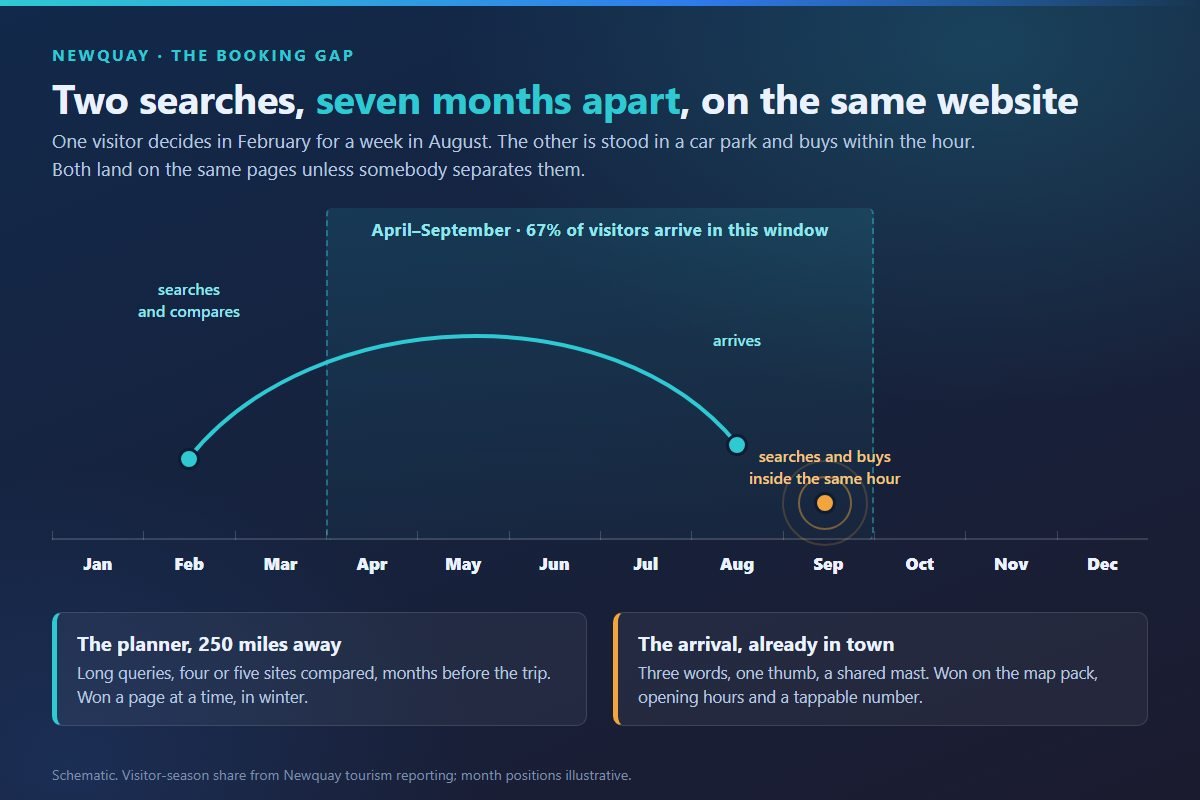
It means the search that pays your July invoice does not happen in July. It happens in February, on a sofa in the Midlands, from somebody who has never been to Cornwall and is comparing a cottage above Porth with a caravan near Crantock. By the time the car is on the A30 the decision has already been made. An inland market town can be sold to people who are standing in it. Newquay mostly cannot, and a page written for an inland high street will quietly fail in Newquay.
So the work splits in two. One half is aimed at people hundreds of miles away, months before they arrive, searching in full sentences with five tabs open. The other half is aimed at people already in the town, on a phone, with wet hands and one bar of signal, who will walk into whatever shows up on the map with the right opening hours beside it. Those are different pages, different words and different measurement.
- Demand is violently seasonal, so rankings have to be in place before the season rather than chased during it.
- Most buyers are not in Cornwall when they search, which changes what local search work is even for.
- Lead times are long for beds and short for activities, so one site often has to run both rhythms at once.
- Reviews arrive in a four-month burst, then stop dead, and both Google and your readers notice the silence.
- Winter is the build window, because it is the only stretch of the year when nobody in the town is too busy to answer an email.
An honest note before anything else. There is no office in Newquay, no desk on Bank Street and no local phone number. I work remotely from Lahore, to UK hours, and I would rather say so on the first screen than have you find out later. You are not paying for a Cornish lease or a car park – you are paying for the work, and a written report lands every week either way.
For paid social in mid-Cornwall, the Facebook ads agency in Truro page covers a city with more jobs than residents, where most of the people spending money on Boscawen Street live in Camborne, Falmouth or St Austell.
The Newquay search year, month by month
Every town has a search calendar. Newquay’s is steeper than almost anywhere inland, and it runs ahead of the trading calendar instead of alongside it. If you only ever look at your own till, you will reach for marketing in June, which is three months after the decisions were made. The shape below is what I plan around, and the first thing I do on any Newquay account is test it against your own Search Console data rather than assume it fits.
| Window | What is being searched, and by whom |
|---|---|
| October to December | Residents book trades, dentists, vets, accountants and garage work. Wedding and large-group enquiries for next summer begin. Beds get browsed but rarely booked. Thin competition, cheap attention. |
| January to February | The heaviest planning window of the year. Self-catering, parks and hotels are compared and booked from outside Cornwall. If your page is not ranking by New Year, you are selling into a market that has already decided. |
| March to April | Easter pulls the first real wave. Surf schools, activity centres and seasonal cafés reopen. Summer recruitment searches peak, and your own jobs page can carry that load instead of an agency fee. |
| May to July | Short-notice and same-day intent. Open now, near me, in the rain, dog friendly, table for four. The map decides most of it and opening hours matter more than copy. |
| Early August | Boardmasters week at Watergate Bay and Fistral. Enormous search volume, badly distorted trade, and a real need to tell your regulars you are open as normal. |
| September | The kindest month of the trading year and the most under-marketed. Adult couples, dog owners, surfers chasing the autumn swell. Almost nobody writes for it. |
Two completely different searchers, one website
The most useful thing I can do on a Newquay website is stop it trying to speak to both people in the same sentence. A family in Solihull choosing a week near Crantock next August and a group standing outside a pub on Fore Street tonight are not the same customer, do not use the same words, and should not land on the same page. When one page tries to serve both, it ranks weakly for each and converts neither.
The planning searcher types long: self catering near Fistral with parking and a dog, things to do in Newquay if it rains, how far is the beach from the airport. They read, compare, leave, and come back a fortnight later. The arrival searcher types three words and wants a phone number, a pin and today’s hours. Your analytics shows these two as one blurry average until somebody deliberately separates them, which is most of what the first month of work is for.
Searching from 250 miles away
- Searches in January and February for an August stay
- Reads whole pages and compares four or five sites
- Cares about parking, dogs, distance to sand, surf level, wet-weather options
- Will never see your shopfront before paying you
- Converts on trust: real photographs, clear prices, honest access notes
Searching from a beach car park
- Searches in the same hour they buy
- Three words, one thumb, a mast shared with thousands of visitors
- Cares about open now, how far, is there a table, can I hire today
- Often decides inside the map without opening a website at all
- Converts on hours, reviews, recent photos and a tappable number
Google Business Profile in a town that half closes in winter
Seasonality wrecks Google Business Profiles in a way it never does in a commuter town. A café that shuts from November to February, a surf school that only runs while the lifeguards are on the flags, a kiosk that opens for Easter – each one leaves a profile behind that carries on telling people it is open. Every dead call and disappointed walk-up turns into a one-star review that then sits on the listing right through the following summer, when it does the most damage.
The repairs are unglamorous and they work. Seasonal hours set in advance instead of corrected afterwards. Special hours for Boardmasters week, Easter and the bank holidays. A reopening date published as information rather than reaching for the temporary-closure flag, which can quietly cost visibility. Photographs dated to the season you are actually in, not a gallery still showing last year’s menu board. That is the ordinary discipline of local SEO, and in a resort town it is worth more than most link building.
Review velocity is the other Newquay-specific problem. A business that collects reviews steadily from June to September and nothing at all between November and April looks, to an algorithm and to a human reader, like a business that has stopped trading. The fix is to capture reviews in the season you are in – at the end of the lesson, at the till, in the check-out email – then release the asking steadily, and keep replying through the winter so the profile still has a pulse in February when the bookers arrive.
The businesses Newquay actually runs on
Newquay is not only holiday lets, and treating it as one sector is exactly how a generic agency page goes wrong. The town carries a surf economy around Fistral, Towan, Tolcarne and Watergate Bay, a wedding and events trade on the cliff beaches, resident-facing trades and professionals across TR7, an independent retail strip on Bank Street and Fore Street inside the Newquay BID area, and a year-round aerospace cluster at the airport at St Mawgan, where the Aerohub enterprise zone and Spaceport Cornwall sit. Those businesses share almost nothing except a postcode.
The BID itself is a useful signal of how the town behaves. Its levy money goes on events, cleaner and safer streets, business support and marketing, and it secured £9,500 from Cornwall Council’s Town Delivery Fund for thirteen member businesses to smarten their shopfronts, alongside a storytelling trail of seven illustrated pavement markers and QR codes through the Trenance valley. The town spends real effort pulling footfall into particular streets at particular times of year, and a website that ignores that calendar is working against its own high street.
| Who | How their search behaves |
|---|---|
| Surf schools and activity centres | Same-week and often same-day. Weather rules everything, so a rainy-day page and live availability beat a brochure site. |
| Self-catering, cottages and holiday parks | Booked three to nine months ahead, mostly from outside Cornwall, and fighting the booking portals for their own property name. |
| Cafés, restaurants and bars | Decided in the map, on the day. Hours, photographs and recent reviews carry more weight than any amount of copy. |
| Weddings, venues and suppliers | Searched twelve to eighteen months ahead from anywhere in Britain. Long pages, real galleries, and no local intent involved. |
| Trades, care, dental, vets, accountants | Resident demand, steadiest from October to March, competition thinner than the town’s size suggests, decided by the map pack and reviews. |
| Retail and independents in town | Footfall-led in season, online-led out of it. The winter half of the year is when the website has to earn its keep. |
| Aerospace and B2B near the airport | National and international buyers, no map pack worth chasing, and search terms nobody else in the town is competing for. |
Boardmasters week, and the rest of the events calendar
For a few days in early August the festival at Watergate Bay and Fistral drops tens of thousands of extra people into the area and the search graph goes vertical. It does not lift everyone. Newquay BID’s own feedback on the festival week found trade splitting both ways – some businesses reporting a rise of more than a fifth, others a fall of more than a fifth, with supermarkets and larger outlets gaining while independent restaurants and night-time venues lost – and the BID’s review of an earlier festival week found that most festival-goers bypassed town-centre businesses, moving directly between their accommodation and the festival sites..
That is a marketing problem with a search answer, and a discount scheme on its own does not fix it: the BID trialled wristband offers across town centre businesses and take-up stayed low. If your trade comes from residents and returning visitors, the people worth reaching in the last week of July are those regulars, not festival-goers, and what reaches them is a plain, current, indexable page saying you are open, where to park and what is different that week. If festival trade genuinely suits you, the opposite applies: those queries are predictable enough to prepare a year ahead – camping, transfers, late food, early breakfasts, luggage, board hire, and everyone who booked a bed near the site back in April.
The same logic covers the rest of the fixtures. Surf competitions at Fistral, the summer events programme on the cliff beaches, Easter and half-term weeks, and the summer-only direct trains from London that come up the Par branch between May and September and then vanish again. None of these justify a news post nobody reads. They justify one durable page per recurring event, refreshed each year, which accumulates authority instead of being rebuilt from scratch every spring.
Phones, patchy signal and booking engines
A large share of Newquay’s in-season traffic arrives on a phone, outdoors, on a network sharing a mast with several thousand other visitors. That is a harsher test than any desktop audit will give you. A hero video, six web fonts, a chat widget and a booking iframe that loads last will lose you the sale in the car park at Fistral, and no amount of keyword work makes up for it. The technical side of this job is mostly subtraction: fewer scripts, smaller images, real text instead of words baked into pictures, and a tappable phone number above the fold.
Booking engines are the other recurring fault. Availability calendars and third-party widgets often render after the page has been crawled, so the pages that should be capturing a search like cottage near Porth with a hot tub available in October end up thin, duplicated across every property, or invisible. The repair is nearly always the same: give every unit, room or course its own indexable page with its own words and photographs, and let the widget handle the transaction rather than the storytelling.
For anyone letting property in Newquay, one piece of Cornish policy shapes the whole market. Cornwall Council has charged a 100% council tax premium on second homes since April 2025, and a property only sits outside that by qualifying for business rates instead – available to let commercially for 140 nights and actually let for 70 in the past twelve months. That pushes owners hard towards filling shoulder-season weeks rather than leaving them empty, which is exactly the demand October, March and September pages can reach, and exactly the demand the portals charge the most commission to supply.
What October to March is actually for
The most common mistake in a seasonal town is starting in May. Search work has a lag built into it: pages have to be written, crawled, tested and improved, and a page published in June competes against pages indexed in November. In Newquay the practical deadline for next summer is Christmas and the comfortable start is October. Anyone promising a transformed April from a standing start in March is selling you a season you have already lost.
October to November – fix the foundation
Audit, tracking that actually records enquiries rather than pageviews, site speed, the property or course pages that were never written properly, and a Business Profile put in order before the quiet months rather than during them.
December to January – publish into the booking window
The planning pages go live and collect their first month of data while the rest of the country is booking next summer. This is the highest-value fortnight of the Newquay year and it is usually spent doing nothing at all.
February to March – build for arrival intent
Map pack work, seasonal hours loaded in advance, Easter pages, a recruitment page for summer staff, and the wet-weather content that earns its keep on every rainy day from May onwards.
April onwards – hold the line and measure
In season the job stops being building and becomes protecting: hours correct, reviews arriving steadily, nothing broken, and a weekly note telling you what moved while you were too busy to look.
What this costs, written down
Prices are published rather than produced after a discovery call, because a business earning its year in four months needs to know whether the winter spend is survivable before giving up an hour on the phone. SEO packages start at £299 a month on the pricing page (Basic £299, Standard £449, Professional £649, each a counted scope of keywords and blog posts); monthly retainers start at £650, with £1,200 and £4,000-plus tiers above that, and there is a one-off SEO Foundation at £850 for a business that wants the groundwork done once and then wants to be left alone. International clients are priced in dollars: $379, $579 and $829 for the packages, $800, $1,500 and $5,000 for the retainers. None of it moves depending on who is asking.
Payment is in advance, month to month, cancel in any month. Nothing is ever charged as a percentage of ad spend, because that pays me for spending your money rather than for making it work. You keep ownership of everything – domain, website, analytics, Business Profile – and I work through partner or delegated access instead of holding your passwords. In a town like this the month-to-month part matters: you are not tied to a twelve-month contract that felt affordable in a good August and does not in a wet February.
| Option | Who it suits in a town like this |
|---|---|
| SEO Foundation, £850 one-off | A single let, a small trade or a seasonal café that needs the technical work and the Business Profile done once and done properly. |
| Starter retainer, £650 a month | One business, one town, a handful of target searches, and steady monthly progress through the winter build. |
| £1,200 a month | Several properties, courses or locations, or a site competing across Newquay and the wider Cornish market at once. |
| From £4,000 a month | Larger operators, serious content programmes, or a business selling nationally from a Newquay base. |
What I can honestly show you
Here is the one result with published figures. One client, an independent artist in the UK, one Meta Ads campaign, £25 of spend across five days, which produced over 500 Spotify saves and ten new followers, plus a verified five-star review. That is one campaign in one niche. It is not an SEO result, and it is not a prediction of what will happen to a surf school, a holiday park or a dental practice in Newquay. Anyone showing you a graph from somebody else’s business and implying it is yours is doing something I would rather not do.
So there are no client logos, no case studies from businesses that do not exist, no borrowed screenshots and no promises about rankings, which nobody controls. What you can check before spending anything is everything else: a free written audit of your site and your Business Profile, prices published on the site instead of quoted after a call, a written report every week in plain English, and a month-to-month arrangement you can end in the month you decide it is not working. For a business that earns its year between Easter and September, that last part is worth more than a dashboard full of somebody else’s numbers – it means a wet February after a poor August is not also an argument about a contract.
How the first ninety days actually run
The first thing that happens is a free written audit, not a sales call. I go through the site, the Business Profile, what you currently rank for, and who is quietly winning the planning searches in your sector while you are busy trading. If the honest answer is that your problem is your booking system, your photographs or your prices rather than your search visibility, I will write that down and you can act on it yourself. That happens more often than this industry admits, and a seasonal business cannot afford to spend its one quiet winter fixing the wrong thing.
Weeks one to three
Audit, tracking, a tidy technical base, and a short written plan naming the specific searches worth owning in your corner of Newquay – including the ones that are not worth chasing, and why.
Weeks four to eight
The pages get written and published: planning pages aimed at the February bookers, arrival pages aimed at the people already standing on the beach, and the Business Profile work that carries in-season map traffic.
Weeks nine to twelve
Measurement against real data rather than hope, a first round of improvements to the pages that only half worked, and an honest decision about whether the next quarter is worth spending.
Every week you get the same written report: what was done, what moved, what did not, and what happens next. Same format each time so the trend is obvious, and sent in the weeks when the news is bad as well as the good ones. That is the whole accountability model, and it is why a Cornish address is not what makes somebody answerable to you.
What the pages already ranking for this leave out
I read the pages currently ranking for this phrase before writing this one. Between them they explain what SEO is, list keyword research, on-page work and link building, and finish with a long general FAQ. Several are directory listicles rather than agencies. What almost none of them mention is that Newquay trades hard for four months, that its buyers are usually somewhere else when they search, or that a page published in June has already missed the year – the things any Newquay trader would raise in the first two minutes.
That gap is the argument for this page. A generic explainer with the town name dropped into it is worth very little to somebody who has watched the tills go quiet in November. The parts of this job that are genuinely different in Newquay are the ones that decide whether the money comes back: the winter build window, seasonal hours loaded before the closure rather than after it, review velocity collapsing every autumn, the second-home premium and the 140-night test pushing owners towards shoulder-season demand, and a festival week in August that lifts some traders and empties others.
None of that makes the ordinary craft optional. Crawlable pages, sensible titles, internal links, fast loading, real content, a kept Business Profile and links from places that genuinely cover Cornwall still do the heavy lifting. It only means the calendar that craft is applied to is different from an inland town’s, and being wrong about the calendar costs a Newquay business a whole trading year rather than a slow quarter.
Start with the audit, not with an invoice
If you trade in Newquay – a let above Porth, a unit on the Aerohub estate by the airport, a practice looking after TR7 residents all winter, or a shop on Bank Street that lives on four months of footfall – the first step is the same and it costs nothing. I will write you an audit of where you stand: what you rank for now, what your Business Profile is doing, and which searches in your sector are genuinely reachable.
If it makes sense after that, the work starts month to month at a published price with a report every week. If it does not, you keep the audit and we leave it there. The only point I would push on is timing. In a town where two thirds of the visitors arrive between April and September, October to December is the cheap, quiet, sensible time to begin, and June is the expensive one.
The buyers in Newquay who never booked a holiday
Everything above sorts people by when they search. There is a second sort that decides whether a February invoice gets paid, and it goes by who signs it. A good deal of the steady money in the town belongs to buyers who never came on holiday at all. Cornwall Airport Newquay, owned by Cornwall Council and operated by Cornwall Airport Ltd, sits on the edge of St Mawgan beside RAF St Mawgan, and Cornwall Air Ambulance keeps its base at Trevithick Downs nearby. Newquay Community Hospital on St Thomas Road is run by Cornwall Partnership NHS Foundation Trust. Cornwall College Newquay teaches degree-level courses from Wildflower Lane at Trenance, next door to Newquay Zoo. Newquay Town Council works out of Marcus Hill, where it also runs the library and visitor information service. Not one of those closes for the winter.
The trade is the other year-round buyer, and unlike the visitor economy it has a fixed address. Treloggan Industrial Estate, off Treloggan Road on the southern edge, carries Jewson Newquay, Screwfix Newquay and City Plumbing Newquay, with Prow Park Business Village letting workshop, studio, office and storage units on the same estate. Travis Perkins runs a Newquay branch as well. That is where a builder, plumber or electrician working in the town starts the morning. Naming the estate is the difference between a trade page written by somebody who knows the place and one that would suit any town in Britain with a ring road.
Where residents actually spend
- Morrisons Newquay, with its filling station, and Lidl Newquay, both on Treloggan Road
- Asda Newquay on Oakleigh Terrace, near the town centre
- Sainsbury’s Newquay at The Whim on Alma Place
- Aldi on Cliff Road, on the town-centre side
- A Tesco Express on East Street and a second on the Narrowcliff side
- Kingsley Village at Penhale, Fraddon, which pulls some of that spending out of the town entirely
The schools that set the weekday
- Newquay Tretherras on Trevenson Road, under Cornwall Education Learning Trust
- Newquay Primary Academy, sharing the Tretherras site
- Newquay Junior Academy on Edgcumbe Avenue, in the same trust
- Treviglas Academy on Bradley Road, with its own sixth form
- Nansledan School on William Hosking Road, run by Aspire Academy Trust
- St Columb Minor Academy on Porth Bean Road, under Kernow Learning
- Institutions buy on a purchase order. Supplying an NHS trust, an academy trust or the airport has nothing in common with a same-day search on a beach car park, and no map listing will win it.
- Recruitment is a search problem too. The Headland Hotel, Watergate Bay Hotel, Bedruthan Hotel & Spa and The Scarlet at Mawgan Porth, Hendra Holiday Park and Trevornick at Holywell Bay all crew up against a season, and a proper recruitment page outlasts any job advert.
- Trade demand is reachable when visitor demand is not. The merchants on Treloggan Industrial Estate keep trading through the months the beaches empty, which is when attention is cheaper to buy.
- Charities sell to residents, not to first-time bookers. Cornwall Air Ambulance and the RNLI lifeboat station off South Quay Hill raise money from people who already live with the place rather than people comparing cottages.
- A resident facility is not a visitor one. Newquay Leisure World on Trenance Lane draws households on ordinary weeks, the opposite demand curve to a surf lesson at the Extreme Academy on the beach at Watergate Bay.
- Term dates beat tide times for resident intent. Drop-off, pick-up and half-term decide when a household running two school runs a day has a free hand and an unlocked phone.
One postcode is not one market, and the map says so
“Newquay and surrounding areas” does almost no work on a Cornish service business’s website, because the town is not a single catchment and the postcode districts already say as much. TR7 covers the town proper, and that includes St Columb Minor, a village absorbed on the eastern side that kept its own church and school. Pentire occupies the headland above the Gannel. Trencreek and Treninnick are inland residential pockets that people often name in preference to the town when asked where they live. Nansledan, the Duchy of Cornwall’s urban extension with Cornish street names and its own primary school, falls into TR8 and grows eastwards along Quintrell Road. That is a set of new households whose search habits have no long local history behind them.
The approaches shape the catchment more than the boundary does. The A392 brings traffic in from the A30 and crosses the Gannel at Trevemper, where the A3075 comes up from the Perranporth direction; the A3058 arrives from the east and turns into Henver Road once it reaches houses and shops. Further out, the A39 meets the A30 at Carland Cross, rebuilt along with Chiverton Cross as part of the dualling between those two junctions. Rail is the quieter half of the picture: the Atlantic Coast Line runs from Par to Newquay railway station off Cliff Road, calling at St Columb Road and Quintrell Downs among its intermediate stops, which is why an inland village with a platform behaves differently in search from the seafront. Newquay Bus Station sits on Manor Road, and in summer the park and ride runs from the A392 opposite Hendra Holiday Park.
Inside TR7
- Pentire, on the headland above the Gannel
- Trencreek and Treninnick, inland and residential
- St Columb Minor, absorbed on the eastern edge
- Narrowcliff, the clifftop road lined with hotels and guest houses
- Killacourt, the open ground above Towan used for outdoor town events
- Newquay Harbour, with South Quay Hill dropping to it and the whitewashed Huer’s Hut on the headland above
The TR8 and TR9 ring
- Quintrell Downs, with its own station on the line
- Cubert, south of the Gannel
- St Newlyn East, near the narrow-gauge railways at Lappa Valley
- Mawgan Porth on the coast to the north, and Holywell Bay with its parks behind the dunes
- Summercourt, which holds a charter fair each September, and Mitchell on the A30 side
- St Columb Major in TR9, post town St Columb, a market town with an identity of its own
The budget consequence is blunt. Every extra mile of radius on a paid campaign or a service-area page buys more impressions and fewer relevant ones, and from a base in the town that extra mile mostly lands on villages that were never going to ring. A small budget aimed at the named places you genuinely cover, written out in full rather than summarised, beats a wide one aimed at a circle. If the van will not go to Penhallow, where Healey’s Cornish Cyder Farm is, or out to Summercourt on a wet Tuesday, there is no sense paying to be found in either. The same test decides which neighbourhood names deserve their own page and which belong in a list.
Lusty Glaze reached by its steps, the Trenance Leisure Park up the valley and the Blue Reef Aquarium at Towan all sit inside the same town and sell to completely different people. A postcode draws a boundary. It has never drawn a market.
What a client said, and what you can check
“Great communication and very helpful throughout the process. Took the time to explain everything clearly and set up the campaign professionally. Focused on quality results rather than just numbers. Highly recommended.”
This is one of three client reviews published so far; the other two, from a UK SEO client and a US Google Ads client, are on the home page. Every figure comes from the client’s own ad account, and a review goes on this site only when it is real.
What you can check before you pay
- Prices published in full on the pricing page, not hidden behind a sales call
- Month to month, with one month’s notice and no lock-in contract
- Every account, profile and file stays in your name; I work through partner access
- A written report every week, in plain English
- One specialist does the work, from the audit to the report
SEO in Newquay: frequently asked questions
Do you have an office in Newquay?
No. There is no office, no address in the town and no Cornwall phone number. I work remotely from Lahore to UK hours. For a seasonal business that is mostly in your favour: nothing in the fee is covering premises you would never visit anyway, and what makes me answerable is a written report every week rather than the theoretical option of knocking on a door in February.
When should I start if I want to be ranking for next summer?
October is the comfortable start and Christmas is the practical deadline. Pages have to be written, crawled and improved before they do anything, and the heaviest booking window for Newquay beds is January and February. Starting in April means paying for work that lands after most of the decisions have already been made.
My customers are not in Cornwall when they search. Is local SEO still the right thing?
Partly. Map pack work matters for anyone selling to people already in town: food, hire, lessons, trades, dental, vets. For beds, weddings and anything booked months ahead from somewhere else, ordinary organic pages do more of the work. The two audiences want different pages, and trying to serve both on one page usually loses both.
Should a holiday let have a Google Business Profile?
Usually not in the way a café does. A let with no staffed address and nobody to meet a guest is a poor fit, and a thin or inaccurate listing can do more harm than none at all. The effort is better spent on a proper indexable page per property and on winning back the bookings the portals currently take a commission on.
What happens to my rankings in winter, when nobody is searching?
Rankings do not disappear because demand does. Impressions fall, but positions usually hold or improve, because most competitors stop publishing in November. What does collapse is review velocity, so the winter job is to keep the profile alive, keep replying, and get next season’s pages indexed early while attention is cheap.
How much does it cost?
SEO packages start at £299 a month on the pricing page; monthly retainers start at £650, with £1,200 and £4,000-plus tiers above that, and there is a one-off SEO Foundation at £850. International work is priced at $379, $579 and $829 for the packages and $800, $1,500 and $5,000 for the retainers. Payment is in advance, month to month, cancel in any month, and never a percentage of ad spend.
Can you show me a Newquay business you have ranked?
No, and I would rather say that than borrow somebody else’s screenshot. There is one client result I can point to: an independent artist in the UK, one Meta Ads campaign, £25 of spend across five days, more than 500 Spotify saves and ten new followers, with a verified five-star review. One campaign, one niche, not an SEO result and not a prediction of yours.
How long before anything happens?
On a small Newquay site in a thin market, movement on long-tail searches often shows within two to three months, and the commercially useful positions take longer than that. Nobody can promise a particular position, and anyone who does is describing something they do not control.
Does Boardmasters week help my search traffic or hurt it?
It depends which side of the split you are on. Newquay BID’s feedback on the festival week found some businesses up by more than a fifth and others down by more than a fifth, with the BID’s earlier review finding that most festival-goers bypassed town-centre businesses, moving between their accommodation and the festival sites.. Either way it is worth one page, prepared in advance: open as usual, parking, and what changes that week.
What do you need from me to start?
Delegated or partner access to the website, analytics, Search Console and the Business Profile, never your passwords. Then your real trading calendar: when you open, when you close, which weeks you actually need filling, and which enquiries are worth having. Most of the planning is built on that calendar rather than on keyword volume alone.
Trading in Newquay? Send me the site first
Send me your website, the weeks you most need filling and the searches you want to be found for. I will look at the site, the Google Business Profile and the competition in and around Newquay before suggesting any work or price. Terms are agreed in writing before anything starts. No ranking promises, and a straight answer if the site needs a developer before it needs SEO.