
Facebook Ads Agency Salisbury: Meta Ads Run by One Person
Salisbury is a city of 41,820 people with Stonehenge eight miles up the road, Salisbury Plain eating the northern half of any radius you draw, and Southampton pulling shoppers twenty miles east. Your Facebook and Instagram ads are run remotely by one specialist, Moeez Abbas, on British hours, with a written report every week and no office overhead in the fee.

Meta ads for a city of 42,000 that has 1.4 million visitors parked eight miles away
Salisbury had 41,820 residents at the 2021 Census, inside 7.14 square miles, and it is still the main shopping centre for south Wiltshire, with a city-centre retail core far larger than its own population would support. That mismatch is the whole commercial story here. A small resident base holds up a trading centre built for a catchment far bigger than itself, and the difference has to be made up by people who do not live in the city at all.
Eight miles north-west, Stonehenge took just over 1.25 million visitors in 2025. The Cathedral takes over 250,000 paying visitors a year on its own, with the UK’s tallest spire at 123m and one of the four surviving 1215 Magna Carta originals. Accommodation and food is one of the city’s largest employment sectors. Almost none of that shows up in a keyword tool, because the person planning the trip searches “Stonehenge tickets”, not “restaurant Salisbury”, and once they are standing in Market Place they are searching nothing at all.
That is the argument for paid social here rather than search alone. Meta ads across Facebook and Instagram let you pick the audience before the customer has decided they want you, which is how you reach a coach passenger, a family three weeks into a posting at Bulford, or a Porton Down commuter on the A30 — three groups who never type a query that identifies them.
Why there is no office on Fisherton Street, and what that removes from your bill
There is no office on Fisherton Street, no desk in the Old George Mall and no Salisbury landline. The work is done by one person, Moeez Abbas, from Lahore, on British hours. That is said plainly rather than buried at the bottom of a contact page, because a fake local address is easy to spot and worth nothing once spotted.
Across the Hampshire border, the same work is written up for Facebook ads in Winchester, a city whose highest earners are on a train to Waterloo by nine and whose trading year turns on the Cathedral Christmas Market.
What matters is what the absence takes out of the price. No city-centre rent, and no BID levy sitting on top of it. No account manager between you and the person who edits your ad sets. Retainers start at £650 a month partly because the fee is not carrying a building on New Canal.
- One specialist, not a rota. The person who writes the report built the campaign and answers when you ask why the cost per result moved.
- British hours. Reporting, replies and changes land inside your working day, not overnight after a spend problem has already run twelve hours.
- A written report every week. Not a dashboard login you never open — a note saying what was spent, what it produced and what changes next.
- Partner or delegated access only. Your Business Manager (now called a business portfolio in Meta’s help centre) and ad account stay yours. Passwords are never asked for and never held.
- Month to month, paid in advance. Cancel any month, and never a percentage of your ad spend.
Tourist, soldier, resident: the three Salisbury audiences search cannot tell apart
Most towns have one customer base with seasonal edges. Salisbury has three that barely overlap: day-visitors pulled in by Stonehenge and the Cathedral who leave the same afternoon, military and defence-science households that refresh on the Army assignment cycle rather than growing, and an older resident shopper base being pulled twenty miles east to Southampton for anything comparison-priced.
All three type the same words. A soldier’s partner newly arrived at Larkhill and a Salisbury resident of thirty years both search “dentist near me”. A coach passenger and a Wilton commuter both search “lunch Salisbury”. Search cannot separate them, so every click you buy subsidises the two audiences you did not want. Meta can, because it targets the person rather than the phrase.
| Who they are | What they type into Google | How you reach them on Meta instead |
|---|---|---|
| Day visitor | “Stonehenge tickets”, “Cathedral opening times” | Retarget people already seen in the city centre or near the Close, and sell the overnight stay, not the day trip |
| Garrison household | “dentist near me”, “nursery near me” | Separate ad sets pinned to Larkhill, Bulford, Tidworth and Ludgershall, weighted July to September |
| Resident shopper | “sofas”, “garden centre”, “family restaurant” | An audience clipped hard in the east, so you are not paying to reach people already committed to Southampton |
| Porton and hospital payroll | Nothing that identifies them as such | Workplace-area and demographic targeting, timed to shift patterns rather than office lunch hours |
Why a 15-mile circle spends half your budget on Salisbury Plain
This is the most useful practical thing this page can tell a Salisbury owner: a plain radius is the wrong shape here. Drop a 15-mile circle on Market Place and a large share of its reach lands on ground with almost nobody standing on it. North and north-west is the Salisbury Plain Training Area — over 94,000 acres of MoD training estate, the largest in the UK, with around 47 square miles of live-firing land where public access is restricted or closed. South-west, the same circle runs into the empty chalk downland of Cranborne Chase.
Meta will happily serve that circle. You will see reach, impressions and a respectable-looking CPM, and a meaningful slice of it will have been delivered over artillery ranges and sheep. The account does not know that a large part of your map is a training estate. It only knows you drew a circle and asked it to fill it.
The shape that works here is an ellipse: north up the A345 through Old Sarum to Amesbury and Solstice Park — a large mixed business park at the Boscombe Down junction of the A303 — then on to Larkhill, Bulford, Durrington, Tidworth and Ludgershall; north-east along the A30 to Porton and Porton Science Park; west three miles to Wilton; south down the A338 to Downton and Fordingbridge; and a hard stop well short of Romsey in the east.
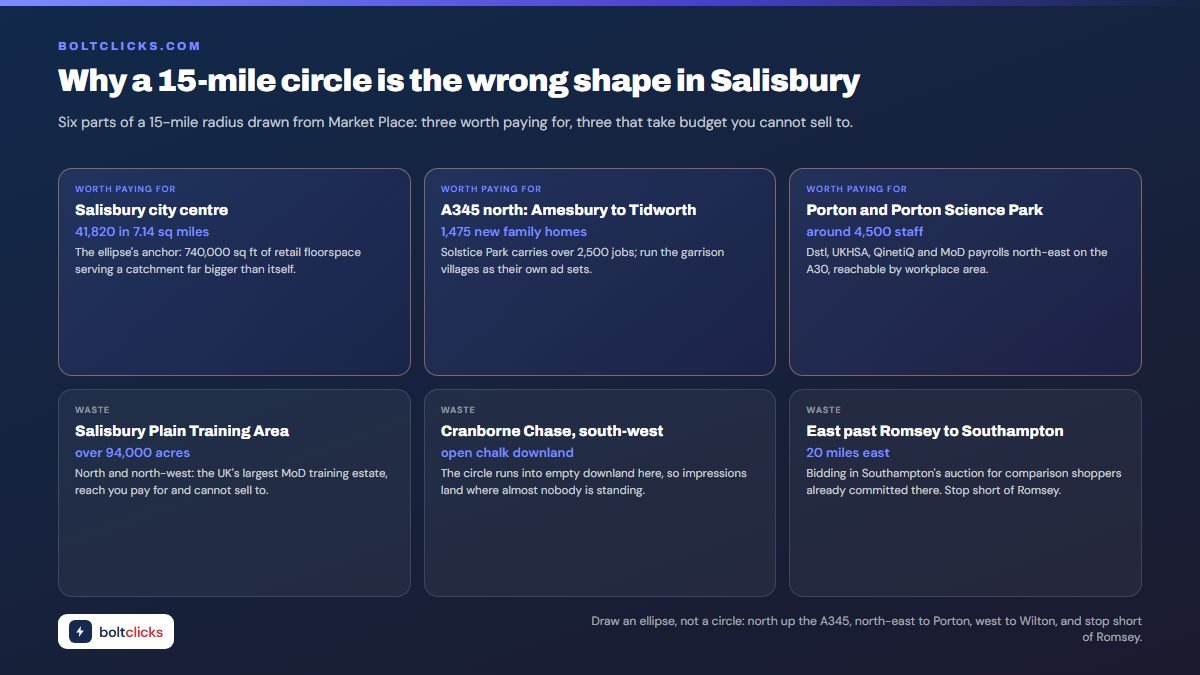
Two rules worth writing into the account itself: run the garrison villages as their own ad sets rather than folding them into the city audience, and exclude the Stonehenge visitor centre area from local-customer campaigns entirely, or the budget goes on coach passengers who will never come back.
Where to stop before Romsey: keeping Salisbury money out of Southampton’s auction
Push the radius east and it reaches Romsey, then Southampton twenty miles out. Southampton is the single biggest pull on Salisbury’s comparison shopping, on scale, rents, retailer choice and proximity. Every Salisbury retailer already knows this, because they watch the comparison spend leave. What they often do not know is that their ad account is paying for it a second time.
Cross into the Southampton travel-to-work area and you are bidding in a denser, dearer auction against national retailers with national budgets, to reach people whose Saturday is already booked twenty miles away. Cost per result rises, the reported volume still looks acceptable, and none of it turns into someone walking up Queen Street. Bath at thirty-two miles and Bournemouth pull real trade too, but they are far enough that you cannot defend against them inside an ad account, so do not try.
Include and weight
- Salisbury city centre, Wilton, Old Sarum Business Park and the Portway Centre
- Amesbury, Solstice Park and the A303 corridor
- Porton and Porton Science Park, north-east along the A30
- Downton and Fordingbridge, south down the A338
Exclude or clip
- Everything east of a line drawn short of Romsey
- The Southampton built-up area entirely
- The Salisbury Plain Training Area, north and north-west
- Cranborne Chase downland, to the south-west
Advertising to Army families as they arrive at Larkhill, Bulford and Tidworth
The Army Basing Programme moved thousands of soldiers and their families into Larkhill, Bulford, Tidworth and Perham Down, with new family housing and single-living accommodation built for them. For a local service business that is not a growth market in the ordinary sense. Demand does not build year on year; it refreshes. The same houses empty and refill on the posting cycle, and each refill is a household that needs everything at once.
Think what a family does in its first fortnight. Register with a dentist. Find a nursery or a childminder, a vet, a gym, a garage, a driving instructor, a removals or storage firm. Those decisions are made under time pressure, with no local knowledge and no recommendations, inside about three weeks. Miss that window and the family is settled with someone else until the next posting moves them on.
- Separate ad sets by village. Larkhill, Bulford, Durrington, Tidworth, Ludgershall and Perham Down behave differently from the city and from each other, and deserve their own budgets and their own lines in the weekly report.
- Weight July to September. Postings cluster around the summer, so arrival campaigns should be loudest exactly as the coach season starts to thin.
- Write for week one. “New to the area”, “registering takes five minutes”, “we can see you this week” beats anything built on a reputation the reader has had no chance to hear.
- Keep it running quietly between waves. Arrivals trickle all year, and a cold audience in July usually costs more to warm than a year of low-level delivery would have.
Reaching the Porton Down, Boscombe Down and hospital payrolls without keywords
A substantial share of working Salisbury residents commute out along the A303 corridor to Porton Down and Boscombe Down. Dstl and UKHSA at Porton Down, Porton Biopharma, and the MoD and QinetiQ operations at Boscombe Down together employ several thousand scientific, military and support staff, with Porton Science Park — Wiltshire Council-owned, opened in 2018 — adding private life-science and defence firms beside them. Salisbury NHS Foundation Trust employs over 4,000 people at Salisbury District Hospital, serving south Wiltshire, north and east Dorset and south-west Hampshire.
That is several thousand well-paid, time-poor, shift-bound people a few miles from a city of 42,000, and they are close to invisible through keywords. Nobody searches in a way that reveals they are a cleared defence engineer or a theatre nurse coming off nights. They are entirely reachable by workplace area, by demographic, and by the hours at which they are awake and holding a phone.
For private physiotherapy, dentistry, counselling, financial advice or home improvement, this is the most under-used audience in the city. Two details matter more than the targeting itself: shift patterns mean ads should deliver at 07:00 and late evening rather than only at lunchtime, and the offer should lead with appointment availability outside working hours, because that is the real barrier here, not price. A modest Google Ads budget alongside still earns its keep for demand that announces itself — but it will not find these people first.
The Salisbury year: race fixtures, the Tuesday and Saturday market, and Christmas on the Square
Salisbury runs four demand cycles on four clocks, and they do not line up the way they would in a pure tourist town. Coach season runs Easter to late October, spiking at the summer solstice on 21 June and again at the winter solstice. The Racecourse stages roughly fifteen fixtures from early May to mid-October, each a fixed date that fills restaurants, taxis and rooms inside a known 48-hour window. The autumn festival run keeps the city trading once the coaches thin. And the Army assignment cycle cuts across all of it in the summer. Underneath sits the charter market in Market Place on Tuesdays and Saturdays, held since 1227 — a twice-weekly rhythm worth building into ad scheduling.
| Window | What is happening | What the budget should do |
|---|---|---|
| January to February | Genuinely flat, and the months when the Avon, Nadder and Bourne matter most; nobody is browsing | Reduced retention budget rather than going dark, so nothing cold-starts in March |
| April to June | Coaches return, race fixtures start, solstice on 21 June | Event-dated campaigns against individual fixtures, not always-on awareness |
| July to September | Peak visitors, plus the posting wave into the garrison villages | Heaviest weighting for service businesses; garrison ad sets at full budget |
| September to October | Celebrate Voice and the rest of the autumn festival programme | Weekend-dated offers per festival, with creative refreshed for each |
| Late November to December | the Christmas market and lights in Market Place and Guildhall Square, and the festive Sunday trading | The biggest retail window of the year; retail and hospitality should spend most of the annual budget here |
The instruction that follows is simple, and most accounts ignore it: do not spread the budget evenly across twelve months. An even monthly spend in Salisbury underfunds December and overfunds February, which is exactly backwards.
Facebook or Instagram when one in five Wiltshire residents is over 65
21.8% of Wiltshire residents are aged 65 or over, against 18.4% for England, and the county median age has climbed from 42 to 44 in a single decade. That is not a rounding difference, and it changes where the ads should appear. The national default, and most agency habit, leans towards Instagram and Reels. In this catchment the paying customer for a garden centre, a private clinic, a carpet shop or a Sunday carvery is disproportionately on Facebook, in the feed, on a tablet, in the evening.
Let placement follow the customer rather than the fashion. In practice that means a heavier Facebook feed weighting than a national playbook suggests, creative that survives being read rather than skipped past, and copy that says the thing instead of implying it. Older buyers in Wiltshire are not baffled by online advertising; they are simply unmoved by ads built for a twenty-four-year-old’s thumb.
One exception is worth naming, because it is real here. Two selective state grammar schools, Bishop Wordsworth’s and South Wilts Grammar, give Salisbury a genuine 11-plus preparation market that most English cities of this size do not have. That audience is parents in their late thirties and forties, and they sit on both platforms, so tutors and enrichment businesses should split properly rather than default to either side.
What Churchfields trade counters and Old George Mall independents should actually run
Churchfields Industrial Estate, beside the railway station, is the city’s main trade-counter and builders’ merchant quarter and is dominated by trade counters and builders’ merchants — national and regional builders’ merchants among them. An unusually large share of Salisbury’s business-to-business trade sits inside one estate. On the other side of the city, Salisbury BID covers several hundred city-centre businesses and reinvests its levy in footfall counting, events and street improvements. These two groups need opposite campaigns, and the mistake that quietly costs them money is running the same one.
Trade counters and trades
Your buyer is a self-employed builder, roofer or landlord inside a short drive who will never search for a merchant by name, because they already have one.
- Tight radius over Churchfields and the Southampton Road corridor, plus the villages your vans already serve
- Employment and interest targeting for construction trades rather than broad local reach
- Stock, price and availability creative — in today, cut to size, account opened in ten minutes
- Delivery weighted to 06:30 to 08:00, while the trade is loading up and not yet on site
City-centre independents
Your buyer is footfall-dependent and event-driven, walking between Market Place, Guildhall Square, the Old George Mall, the Cross Keys arcade and The Maltings.
- Short-window offers built round a dated event — a race fixture, a festival weekend, a Sunday festive market
- Creative that names the street or the arcade, because locals navigate by New Canal and Catherine Street, not postcode
- Retargeting of people already seen in the city centre, usually the cheapest audience you will run
- Spend concentrated into late November and December rather than smoothed across the year
Hotels, B&Bs and guided-tour operators are a third case. Their problem is not visibility; it is converting a day-tripper into an overnight stay. That is an audience and creative problem, solved by retargeting people already physically in the city with a reason to stay the night, not by bidding on “Stonehenge tickets” against the people selling the tickets.
What it costs, what arrives every week, and how you cancel
Salisbury owners have a particular reason to be wary of marketing promises. In the spring of 2018 the city lost demand it had not caused and could not advertise its way out of: the city centre was cordoned off for months, shops beside the cordons lost 60–80% of their footfall, tourism fell away, businesses closed, and government recovery money was needed before trade came back. People here have watched spend return nothing through no fault of the advertising. So the terms come first on this page, and the ambition second.
| Option | Price | Terms |
|---|---|---|
| Entry retainer | £650 a month | Paid in advance, month to month, cancel any month |
| Mid retainer | £1,200 a month | More campaigns and creative rotation, same terms |
| Full retainer | From £4,000 a month | Wider multi-channel scope, same terms |
| SEO Foundation | £850 one-off | Standalone, no retainer required |
| International | USD 800, 1,500 or 5,000 | For non-UK businesses, same monthly terms |
The fee is never a percentage of your ad spend. That matters more than it sounds: a percentage rewards whoever advises you for telling you to spend more, and in a market with a genuinely flat January somebody in the room needs an income that does not rise with the budget. Every tier and what sits inside it is set out on the pricing page.
You own the ad account and the Business Manager. Access is partner or delegated permission only, never your passwords, so if the relationship ends nothing has to be handed back, because nothing left your control. A written report arrives every week, and before anything starts you get a free written audit of the existing account, or of the targeting and offer if there is no account yet.
The one published result. One campaign result is published so far: an independent UK artist, £25 of spend, 500+ Spotify saves and 10 new followers across five days, with a verified five-star review. That is a small music campaign in one niche. It is not evidence about a Salisbury restaurant, a Churchfields merchant or a dental practice near the garrison, and it should not be read as a prediction of what yours will do.
What a client said, and what you can check
“Great communication and very helpful throughout the process. Took the time to explain everything clearly and set up the campaign professionally. Focused on quality results rather than just numbers. Highly recommended.”
This is one of three client reviews published so far; the other two, from a UK SEO client and a US Google Ads client, are on the home page. Every figure comes from the client’s own ad account, and a review goes on this site only when it is real.
What you can check before you pay
- Prices published in full on the pricing page, not hidden behind a sales call
- Month to month, with one month’s notice and no lock-in contract
- Every account, profile and file stays in your name; I work through partner access
- A written report every week, in plain English
- One specialist does the work, from the audit to the report
Salisbury Facebook ads: frequently asked questions
Do you have an office in Salisbury?
No. One specialist working remotely from Lahore on British hours. No Salisbury address, no local number, no drop-in studio — and that is exactly why there is no office overhead priced into the retainer.
Should I be targeting Stonehenge visitors?
Usually not directly. Stonehenge admission is timed and booked in advance, and many of those visitors never enter the city. The better plays are retargeting people already seen in the city centre or near the Close, and selling the overnight stay rather than the day visit.
How far should my radius reach, and should I include Southampton?
Almost never include Southampton. It is twenty miles east and is the main force pulling Salisbury’s comparison shopping away, so you pay more to reach people who were always going to shop there. Pull the radius north and west instead — the A345 to Old Sarum, Amesbury and Solstice Park, the A30 to Porton, Wilton, Downton and Fordingbridge — with a hard stop short of Romsey.
Can you reach the Army families at Larkhill, Bulford or Tidworth?
Yes, as separate ad sets with their own creative rather than folded into a Salisbury city audience. Timing matters too, because postings cluster around the summer, so a family’s decisions about a dentist, a nursery, a vet and a gym all land in the same few weeks.
Is Facebook still the right platform if my customers are older?
In this area, often yes. 21.8% of Wiltshire residents are 65 or over against 18.4% nationally, and that group sits on Facebook rather than Instagram, so the placement split here usually leans further towards Facebook than a national default would.
What happens in January and February when the city goes quiet?
Salisbury genuinely does go flat then. The recommendation is a reduced retention budget rather than switching off, so the pixel keeps learning and the audiences stay warm. Go dark and you spend March paying to relearn what the account already knew, just as the first coaches return and the race fixtures start in May.
What does it cost and am I tied in?
Retainers start at £650 a month, with £1,200 and £4,000-plus tiers, plus an £850 SEO Foundation if that is what you need. International pricing is USD 800, 1,500 and 5,000. Paid in advance, month to month, cancel any month, and never a percentage of your ad spend.
Who owns the ad account, and will you need my passwords?
You own the ad account and the Business Manager. Partner or delegated access only, never your passwords. If the relationship ends, nothing has to be handed back, because nothing left your control.
What results can you actually show me?
One published campaign result so far: an independent UK artist, £25 of spend, 500+ Spotify saves and 10 new followers across five days, with a verified five-star review. That is a small music campaign. It is not evidence about a Salisbury restaurant, a builders’ merchant on Churchfields or a dental practice near the garrison, and it should not be read as if it were.
A free account review, before anything is agreed
Send over the ad account, or just the website if there is no account yet, and you get a written review of what is set up, what is leaking and what I would change first. It costs nothing and there is nothing to sign. If the honest answer is that ads are not the right spend for a business your size in Salisbury, that is what the review will say.