
Facebook Ads Agency Durham: Term-Time and Tourist Targeting
Durham is a city of 50,510 people sitting a short drive south of Tyneside and Wearside, and Meta’s location picker will offer you North Carolina before it offers you County Durham. This page is about building a Durham audience by hand, around term dates, day visitors and the county line, run remotely by one specialist on UK hours, with a written report every week.

There is no BoltClicks office in Durham, and that is the point
There is no desk on Saddler Street, no meeting room off the Market Place, no County Durham landline and nobody in Prince Bishops Place waiting for you to call in. BoltClicks is one person, Moeez Abbas, running Meta Ads remotely from Lahore on UK hours, which is said here in the first paragraph rather than buried.
At least one of the pages competing for this phrase was written hundreds of miles from the North East by an agency that never says so, on a template that works for any town once the name is swapped. Distance is not really the problem; being quiet about it is. Judge instead whether whoever wrote the page knows Meta offers you a city in North Carolina first, and what they do about it.
Remote means the fee carries no office overhead, the work happens on UK hours, and you get a written report every week rather than a meeting in town. Access is partner or delegated access through Meta Business Manager (now called a business portfolio in Meta’s help centre), never your passwords: the page, the ad account and the pixel stay in your name.
Elsewhere in the north, Facebook ads in Carlisle deals with a standard radius that spends half its budget on the Solway Firth and the Pennine moor, and Facebook ads in Lancaster with students and staff who live outside the city they shop in.
- One specialist, not a pod. Whoever writes the report built the audience and wrote the advert.
- A written report every week, covering what was spent, what came back and what changes next.
- No fake local address, no stock photograph of an office, no number forwarding somewhere else.
- A free written account review first, so you read the thinking before buying any of it.
Why typing Durham into Meta Ads Manager is the first place money leaks
Type Durham into the location box in Meta Ads Manager and the first suggestion is usually Durham, North Carolina, a US city several times the size of this one, with Durham Region in Ontario behind it. Durham, County Durham, England is somewhere further down that list.
On its own that is a five-second mistake. It becomes expensive when Advantage audience expansion is left on and the account carries no country-level exclusion, because Meta then finds cheaper attention outside the shape you drew, and attention in North America is cheaper than in a city of 50,510 people. The regional breakdown shows it inside a week, if anybody opens it.
Pin the location, do not type it
Select Durham, County Durham, England explicitly and check the pin landed on the peninsula, not in the Piedmont. Save it as a saved audience so nobody rebuilds it from the search box.
Exclude the United States and Canada at account level
At account level, not inside one campaign where it vanishes the first time an ad set is duplicated. Switch off Advantage audience expansion wherever geography is the targeting.
Read the region breakdown before the first weekend
On day three or four, not day thirty. If spend is landing outside County Durham and the neighbouring authorities you deliberately included, you want to know while the budget is intact.
This is a first-hour check, not a clever optimisation, and it is the first thing examined when a Meta Ads account is set up here. Not many UK cities share a name with a far bigger American one, and in Durham that name carries a price before the first advert runs.
The city is 50,510 people. The county is ten times that. Which one are you advertising to?
Durham’s built-up area was 50,510 people at the 2021 Census. Durham County Council, meanwhile, is a unitary authority for the whole of County Durham, well over half a million people from Consett and Stanley in the west to Peterlee and Seaham on the coast. Both are called Durham, and a campaign named Durham means nothing until somebody decides which one is being bought.
What settles it is whether your customer travels, and in which direction. A cafe on Elvet Bridge needs people already within walking distance that day. Somebody fitting bathrooms will load a van for Bishop Auckland, so the county shape there is the truth about the business, not ambition.
| Type of business | Shape to target | Why that shape |
|---|---|---|
| Restaurant, bar or cafe in the centre | Five to seven miles over the city and inner suburbs | The trade walks in; anyone further has closer options |
| Market Hall or Saturday market stall | City plus Gilesgate, Claypath, Newton Hall, Framwellgate Moor | Stall margins cannot carry impressions in Sunderland |
| Trades, installers, home services | Custom County Durham shape, Consett to Peterlee | The van crosses the county, so the audience should |
| Wedding and event suppliers | Tyneside, Wearside and Teesside by interest and life event | The couple is not in Durham, only the backdrop is |
| Student lettings and services | City ring plus age band plus term dates | Known population, known geography, known leaving date |
| Employers recruiting at Aykley Heads | County shape plus the Tyneside commuter belt | Staff travel in even when customers will not |
The expensive error is almost always the generous one: a city-centre salon targeting the whole county pays to reach Peterlee, where somebody has a salon at the end of their own street.
A fifteen-mile ring around the Market Place lands your budget in Gateshead and Sunderland
The default instinct is to drop a pin on the Market Place and pull the radius out to fifteen miles, because fifteen looks reasonable on a map. In Durham that costs more than the name does. A fifteen-mile ring takes in Newcastle and Gateshead to the north, Sunderland and Washington to the north-east, Chester-le-Street at about seven miles, Consett to the west, Bishop Auckland and Spennymoor to the south-west, and Peterlee and Seaham to the east. That is well over a million people, and it feels like progress until the invoice.
Most of them are never coming. They have the Metrocentre or Eldon Square closer to hand than Silver Street, and Durham asks them to drive into a centre whose only vehicle access onto the peninsula, Saddler Street, has been tolled since October 2002, the first congestion charge in the country, and carries up to 17,000 pedestrians a day. Without evidence that people already travel in, a ring reaching Tyneside is not reach, it is dilution.
The ring that usually works
- Roughly five to seven miles centred on the city, not fifteen
- Residential belts named in: Newton Hall, Framwellgate Moor, Belmont, Bearpark, Brandon
- Chester-le-Street treated as a decision, not an accident, at about seven miles
- A separate county campaign where the trade travels, budgeted on its own
What to exclude outright
- Newcastle, Gateshead and Sunderland city centres, unless bookings prove otherwise
- The United States and Canada, at account level, permanently
- Advantage audience expansion wherever geography is the targeting
- Weekday daytime delivery for anything aimed at working residents
That last exclusion matters. Of the roughly 4,800 out-of-term economically active residents, only 47 per cent work locally; the rest commute out, mostly north to Tyneside. So the people in Durham at eleven on a Tuesday are largely students, visitors and public-sector staff, and the residents you want are reachable in the evening and at weekends.
Advertising to 21,150 students who disappear from late June until October
Durham University had 21,150 students in 2024/25, 16,560 undergraduate and 4,590 postgraduate, and employs over 4,000 people locally, which makes it one of the city’s largest employers alongside the hospital and the county council. Set 21,150 against a built-up area of 50,510 and you have the number that governs advertising here: during term, roughly two residents in five are students.
The terms are Michaelmas from early October to mid-December, Epiphany from mid-January to mid-March, Easter from late April to late June. From late June to the start of October that two in five is not in the city. A student-facing campaign left running through July and August is paying to show adverts to an empty street; cut it close to zero rather than let it drift because pausing feels like giving up.
The other side of it is that a whole year’s income for letting agents, purpose-built accommodation and student services is settled in a house-hunting window of a few weeks, among people spread across Gilesgate, Claypath, the Viaduct and Neville’s Cross. Known age band, known geography, known departure date: that is the shape Meta handles well and search does not, because nobody types a query when a housemate drops a link into a group chat.
For a student-facing business the year is not twelve months of budget. It is three pushes: the fortnight after Michaelmas arrivals, the house-hunting weeks in Epiphany, and graduation week in June.
Twenty-two million visits a year, and ninety-two per cent of them go home the same day
County Durham’s visitor economy is worth about £1.49 billion a year across 21.98 million visits and supports 14,069 tourism jobs, and the cathedral and castle have been a UNESCO World Heritage Site since 1986. The number that changes how you advertise is the split: 92 per cent of those visits are day trips against only 8 per cent staying visitors. Durham is a city people come to for six hours.
A day-trip decision is made that same morning or a few days out, which leaves a very short window between advert and booking. For a single independent restaurant, search volume in Durham is far too thin to fill a Saturday. A radius over the city, day-parted into the hours when the decision is made and pointed at a table-booking link, fits that window in a way a keyword cannot.
The creative also answers a visitor’s question rather than a resident’s. Somebody off the train an hour ago does not know your door is halfway up Saddler Street, or that you hold tables for walk-ins until two. Durham BID’s Restaurant Week in late January then gives a dated reason to say the same things to a local audience in the quietest month.
- Day-part around arrivals, not office hours, because the visitor decides after breakfast and again about five.
- Send traffic somewhere that books, a table link or a WhatsApp thread, not a number inside an image.
- Keep visitor and resident campaigns apart, because they want opposite things.
Two thirds of city-centre jobs are public sector: what that does to advertising here
Public services account for 66 per cent of the roughly 21,000 employee jobs in the Durham City neighbourhood plan area, and 38 per cent of all jobs there are part-time. University Hospital of North Durham accounts for around 7,000 jobs, Durham County Council around 2,000, and central government offices including the Land Registry and the Passport Office more than 700. HM Prison Durham sits at Old Elvet, in the middle of the city. Retail is thin for a place with this many visitors, at roughly 1,000 full-time-equivalent jobs, and jobs in the city area fell 12.5 per cent between 2007 and 2016.
Much of that working population is on shifts, so evening and early-morning delivery reaches the hospital and the prison in a way a lunchtime schedule never will. The resident consumer market is also smaller than the visitor figures make it look, so a Durham budget usually earns its keep from visitors, students or the wider county instead.
Then there are the roughly 80 professional services offices, estate agents, solicitors and accountants, in Georgian and Victorian buildings because purpose-built office space in the centre is scarce. They compete for staff as hard as for clients, and recruitment advertising is one of the few things Meta genuinely does better than Google at this size.
Gala Saturday, Restaurant Week, graduation weekend and the first November without Lumiere
Durham runs on three calendars and they do not line up. The student year empties the city from late June to October. The day-visitor year peaks over Easter weekend, across the summer holidays and before Christmas. The event year sits on top of both: Restaurant Week in late January, Fire and Ice in winter, Durham Regatta and graduation week in the cathedral in June, Durham Brass Festival and the Miners’ Gala on the second Saturday of July, Durham Book Festival in October, the Christmas Festival in December. A flat monthly budget is the wrong answer three times over.
What works instead is a low always-on base with a meaningful share held back for four dated spikes: Restaurant Week, graduation weekend, Gala Saturday and the December festival. Gala Saturday brings a very large crowd, historically estimated at around 100,000, into a centre closed to traffic, and that crowd is there for the banners and the brass bands. For food and drink it is the strongest Saturday of the year; for an appointment-based trade it is the worst day to run a come-and-see-us advert.
November has changed too. Lumiere ran nine editions from 2009, drew more than 1.3 million visitors and generated over £43 million for the local economy, and the November 2025 edition, 120,000 visitors across three nights with 116 local sponsors, was the last. Autumn 2027 is the first cycle that would have carried one, so any November plan copied from a Lumiere year rests on footfall that is not returning and needs rebuilding around the Christmas Festival and Fire and Ice.
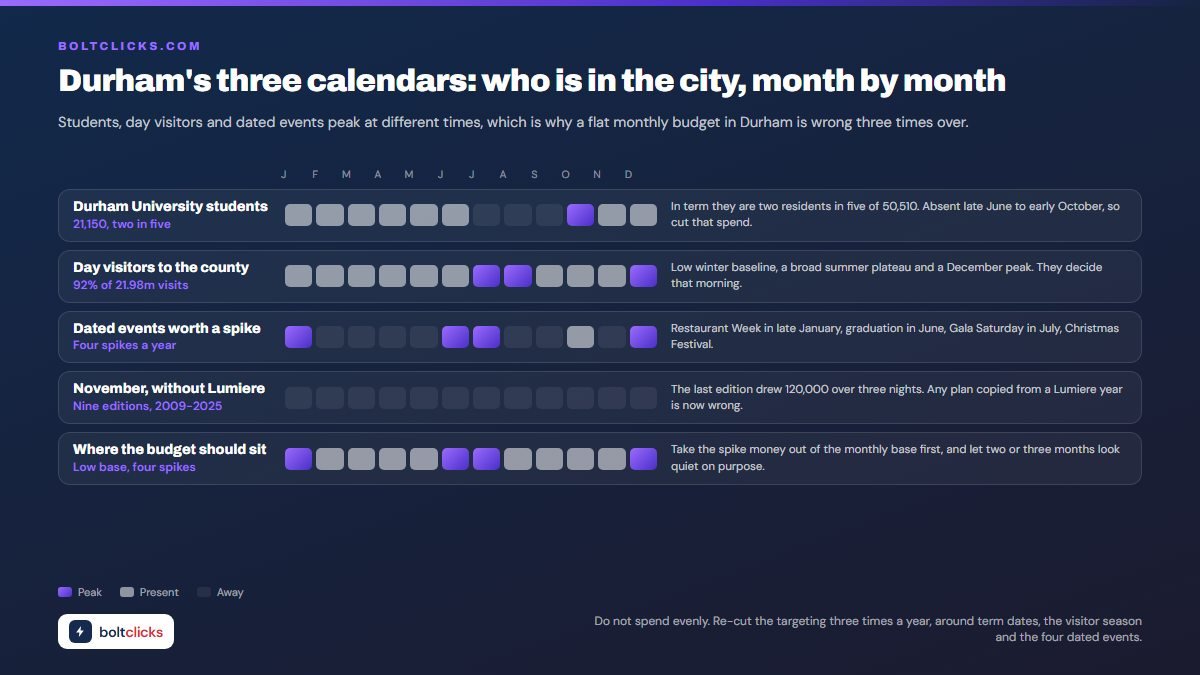
The practical version: decide in January what the four spikes are worth, take that money out of the monthly base first, and accept that two or three months will look quiet on purpose.
Market Hall stalls, Aykley Heads offices and the Newton Hall doorstep: which Durham trades need which campaign
Durham Market Hall has traded in the Market Place since 1851 and holds more than 40 independent stalls, Monday to Saturday, with the outdoor market outside on Saturdays. Most stalls have no website worth sending traffic to and almost no branded search. What works at a stall margin is a small daily budget behind a short Reel of whatever came in this week, aimed at the city and inner suburbs and judged on Saturday takings.
At the other end, the employment land is all outside the centre. Aykley Heads covers 15 hectares with outline permission for 39,000 sq m of commercial floorspace and up to 4,000 jobs, and already houses Atom Bank, Waterstons and the Durham City Incubator; Milburngate adds 450,000 sq ft on the riverside. County Hall is due for demolition this year, The Sands was sold to Durham University for £84 million to house its Business School, and the council is moving into Rivergreen. Firms taking that space are hiring, and hiring is an advertising problem first.
| Where you trade | Campaign that fits | What to judge it on |
|---|---|---|
| Market Hall or Saturday market | Daily Reel budget, tight city ring, no website needed | Saturday footfall and takings, not link clicks |
| Saddler Street, Elvet Bridge, Silver Street | Visitor radius, day-parted, booking link, Restaurant Week push | Covers booked and walk-ins on the day |
| Student lettings, Gilesgate to Neville’s Cross | Age-banded city campaign, heavy in house-hunting weeks, dark in summer | Enquiries per week inside the window |
| Trades in Newton Hall, Belmont, Brandon, Meadowfield | County shape, seasonal roof, boiler and driveway pushes | Cost per booked survey, not per lead form |
| Weddings selling the cathedral backdrop | North East interest and life-event audience, venue radius excluded | Enquiries naming the venue or a date |
| Employers at Aykley Heads and Milburngate | Recruitment campaign, county plus commuter belt, evenings | Applications from people who can get there |
What this costs, and the single result that is allowed to appear on this page
Retainers start at £650 a month, with £1,200 and £4,000-plus tiers, and there is a one-off SEO Foundation at £850 where search is the more urgent problem. International clients are priced at USD 800, 1,500 and 5,000. Payment is in advance, month to month, cancel in any month. The retainer is never a percentage of ad spend, so nobody gains by talking you into a bigger budget, and it is separate from the money you pay Meta directly. What sits inside each tier is on the pricing page, and every engagement starts with a free written audit or account review.
Now the proof, and it is deliberately small. One client result can honestly be published: an independent UK artist, one Meta Ads campaign, £25 of spend, which produced more than 500 Spotify saves and 10 new followers across five days, with a verified five-star review. That is all of it: no roster of Durham businesses behind this page, no case study from a Market Place restaurant.
That result is one campaign, in one niche, on a very small budget. It is not a prediction of what happens for a letting agent in Gilesgate or a bathroom fitter in Belmont. What it shows is that the mechanics work at a budget most agencies would not switch on.
- Advance payment, month to month, with no minimum term and no notice period to argue about.
- Never a share of ad spend, so the recommendation and the invoice do not pull in opposite directions.
- Partner or delegated access only, never your passwords, removable by you at any time.
When Meta Ads is the wrong answer for a Durham business
Meta is an interruption channel. It is very good at putting something in front of a defined group who were not looking for it, and poor at catching somebody who already is. If your trade is emergencies, a burst pipe in Framwellgate Moor at seven in the evening or a locked-out tenant in Claypath, the person is typing into a search box within thirty seconds and a search campaign will beat anything Meta can do here.
Four other cases get an honest no, or not yet. If your Business Manager or ad account has been disabled, nothing here matters until that is sorted. If your customers are students and it is July, the recommendation is to stop, not to spend. If you are an appointment-based trade advertising into Gala Saturday, that crowd is not your crowd. And if there is nowhere for the traffic to land, no booking link, no WhatsApp number, no page that loads quickly on a phone at the top of Saddler Street, the advert is not the constraint.
The last one is about the shape of the budget rather than its size. Durham asks a campaign to be re-cut three times a year, around term dates, the visitor season and four dated events. A business that can only manage an even monthly trickle gets a fraction of what the same money produces concentrated, and that is worth knowing before the first invoice.
What a client said, and what you can check
“Great communication and very helpful throughout the process. Took the time to explain everything clearly and set up the campaign professionally. Focused on quality results rather than just numbers. Highly recommended.”
This is one of three client reviews published so far; the other two, from a UK SEO client and a US Google Ads client, are on the home page. Every figure comes from the client’s own ad account, and a review goes on this site only when it is real.
What you can check before you pay
- Prices published in full on the pricing page, not hidden behind a sales call
- Month to month, with one month’s notice and no lock-in contract
- Every account, profile and file stays in your name; I work through partner access
- A written report every week, in plain English
- One specialist does the work, from the audit to the report
Durham Facebook Ads: frequently asked questions
Do you have an office in Durham?
No. One specialist, Moeez Abbas, working remotely from Lahore on UK hours, with a written report every week. No office on Silver Street, no County Durham phone number, no local team. The trade-off is that the fee pays for work rather than rent.
My adverts are showing in Durham, North Carolina. How do I stop that?
Pin the location to Durham, County Durham, England instead of accepting the first suggestion, turn off Advantage audience expansion, exclude the United States and Canada at account level, then read the delivery breakdown by region. Do that on day three, not at the end of the month.
Should I target Durham the city or County Durham?
It depends whether your customer travels. Walk-in trade wants a tight five-to-seven-mile ring over the city and inner suburbs. Anything delivered or installed wants the county shape, Consett and Stanley through to Peterlee and Seaham, which is over half a million people. Running both in one campaign gives you the worst of each.
Do Meta Ads work when the students leave?
For student-facing businesses, no. The honest answer is to cut that budget close to zero from July to late September, because roughly two residents in five are not in the city. For visitor-facing businesses the opposite holds: summer is the busy end of the day-trip season, and the budget should move there.
Is it worth advertising around the Miners’ Gala?
For food, drink and anything sold on the day, yes, and it deserves a real share of the year’s budget. For appointment-based trades it is the worst Saturday of the year: the centre is closed to traffic and around 100,000 people are there for the banners and the brass bands, not to book a consultation.
Lumiere has finished. What replaces it for November footfall?
Nothing has been announced. Lumiere ran nine editions from 2009 and the November 2025 edition, 120,000 visitors across three nights, was the last. Any November plan copied from a previous cycle is built on footfall that is not coming back, so rebuild it around the Christmas Festival and Fire and Ice.
How much do I need to spend?
The retainer is separate from your ad budget and is never a share of ad spend. Retainers start at £650 a month, with £1,200 and £4,000-plus tiers, paid in advance, month to month, cancel any month. The ad budget is paid to Meta directly and sized around the business.
Do I hand over my Facebook password?
No. Partner or delegated access through Meta Business Manager only. You keep ownership of the page, the ad account and the pixel, and you can remove access yourself in under a minute. If an agency asks for your login instead, that is a reason to stop and ask why.
What if my Business Manager or ad account has been disabled?
That is a separate service and a common reason people get in touch. It needs sorting before any campaign discussion is worth having, because a disabled asset cannot be targeted, reported on or rebuilt around. Start there, then talk about term dates and radius shapes.
A free account review, before anything is agreed
Send over the ad account, or just the website if there is no account yet, and you get a written review of what is set up, what is leaking and what I would change first. It costs nothing and there is nothing to sign. If the honest answer is that ads are not the right spend for a business your size in Durham, that is what the review will say.