
Facebook Ads Agency Lancaster: Meta Ads, Bailrigg to Bay
Lancaster has 52,660 residents, and its largest single block of customers, 18,620 students and roughly 4,380 staff, lives three miles south at Bailrigg, outside the city it is supposed to shop in. Facebook and Instagram campaigns here are built by one specialist working remotely on UK hours: no office, no local address, a written report every week.

Lancaster is a city of 52,660 whose biggest audience lives three miles out on the A6
There are three defensible population figures for this place and they are nowhere near each other. Lancaster the city had 52,660 residents at the 2021 census. The Lancaster, Morecambe and Heysham built-up area had 101,911. The district had 142,931, across 219 square miles running from the tide flats of Morecambe Bay to the edge of the Yorkshire Dales National Park. Whichever you had quietly in mind when you set a monthly budget is the number that decides whether that budget makes sense.
Then comes the part that catches almost everyone. The largest single concentration of customers in the district is not in the city. Lancaster University sits at Bailrigg, three miles south on the A6, with 18,620 students and roughly 4,380 staff in 2024/25. It is collegiate and residential: nine colleges, accommodation attached to each, its own catering and shops. A first-year can arrive in late September and go weeks without walking down Market Street. The University of Cumbria then adds a second, entirely separate student population inside the city on Bowerham Road, on the former Bowerham Barracks, studying nursing, radiography, teacher training and social work, older on average, more vocational and more local.
So the useful question here is never how you reach people in Lancaster. It is which Lancaster, in which week, with which creative and at which pin on the map. That is a question about how an ad account is structured, and structuring ad accounts is the whole of the job.
The five Lancasters, and why one ad set cannot talk to all of them
Most small English cities are one catchment with a tourist top-up. Lancaster is five audiences sharing a postcode district. They sit in different places, arrive and leave at different times of year, and respond to completely different creative. Put them in one ad set and Meta spends most of your money on whichever of the five is cheapest to reach that week, which is rarely the one that buys.
This is the argument for paid social here ahead of almost anything else. The way I build a Meta Ads account starts by separating those audiences deliberately, each with its own budget, age band and creative, so that at month end you can see which Lancaster is actually paying you.
- Bailrigg, 18,620 students and 4,380 staff on a self-contained campus three miles south on the A6. Most of them are not from Lancaster, so hyper-local references land flat.
- Bowerham, the University of Cumbria campus inside the city, a smaller, older, more vocational student body on a different site and a different calendar.
- The institutional payroll, the staff of the Royal Lancaster Infirmary and of the wider NHS trust that runs it, plus university staff. Salaried, professional, resident all year.
- Heysham, six miles west: the port, the freight and the Isle of Man sailings, and the EDF site, a shift economy that does not keep office hours.
- The hinterland, the Lune Valley through Caton and Hornby, Bowland, Arnside and Silverdale, the canal towards Glasson Dock. Long booking windows, decisions made on a sofa in Leeds or Manchester.
A ten-mile radius on Dalton Square is half Morecambe Bay
Drop a radius pin on Dalton Square and watch what each ring catches. Three miles reaches Bailrigg and Galgate, the largest block of people in the district, but not Morecambe at all. Five miles brings in Morecambe and its 34,590 residents, plus Bare and Bolton-le-Sands, a seaside market with its own seasonality and its own reasons for buying. Seven miles adds Heysham, the port, the EDF site and Carnforth. Ten miles adds a great deal of open bay, which is water, and the western edge of Bowland, which is fell.
That is why reach estimates flatter here and delivery disappoints: a meaningful share of a ten-mile circle drawn on this city contains almost nobody, and the estimate will happily quote you the acreage.
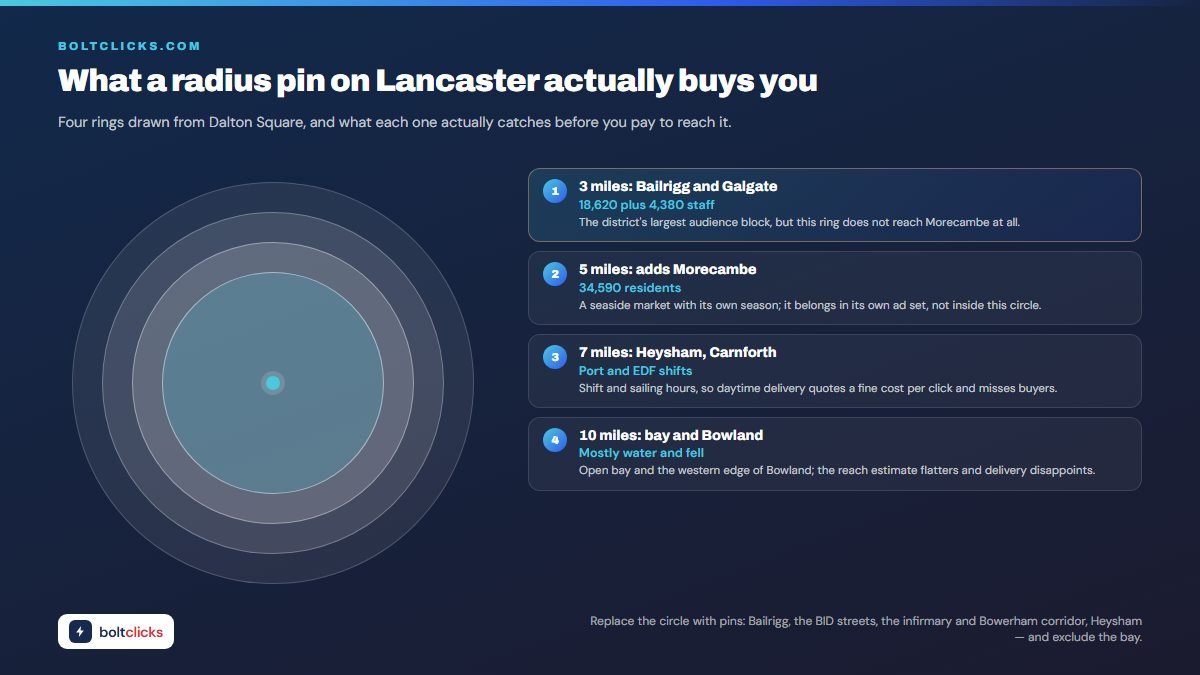
The fix is pins rather than a circle. A tight pin on Bailrigg with its own creative and age band. A city-centre pin over the pedestrianised core around Market Square, Church Street and Market Street rather than the whole postcode district. A separate Morecambe and Heysham ad set. For trades and visitor businesses, a drive-time-shaped strip up the Lune Valley through Caton and Hornby rather than a ring, because in a district this shape the constraint is drive time, not distance. And the bay drawn in as an explicit exclusion.
Preston is twenty minutes down the West Coast Main Line, and your ad is competing with the train
Lancaster station handled 2.184 million entries and exits in 2024/25 as a principal West Coast Main Line stop. Avanti runs to Euston, Glasgow and Edinburgh; TransPennine to Manchester Airport and Liverpool; Northern to Barrow, Windermere, Morecambe, Heysham Port, Leeds and Carlisle. M6 junctions 33 and 34 sit either side of the city. Preston is twenty miles south and twenty minutes by train, Kendal a similar distance north, and a day out in Manchester entirely routine.
For a considered purchase, then, you are not only competing with the shop three doors down; you are competing with a train ticket and an afternoon somewhere bigger. A price alone rarely answers that: the creative has to give a reason to stay, which usually means the specific thing, in stock, here, now, with a date attached.
It also explains why search alone will not carry many independent Lancaster retailers. Monthly search volume for what they sell is often close to zero inside the district, because nobody types it. Meta’s job there is demand creation: reminding a fifteen-minute-drive audience that a product exists in this city at all. The search groundwork is a separate discipline and I treat it that way, on the local SEO side rather than asking an ad account to do both jobs.
The term calendar at Bailrigg and Bowerham, month by month, against an advertising budget
Lancaster has one of the sharpest and most predictable demand calendars of any small English city, and it runs on term dates rather than weather. An account spending the same amount every month is quietly overpaying in February and underspending in the first week of October. Here is the year, and what a budget should do against it.
| Window | What happens here | What the budget does |
|---|---|---|
| Mid-Sept to early Oct | 18,620 students return to Bailrigg and a second intake lands at Bowerham; hospitality, barbers, phone repair, takeaways, gyms and letting agents all move at once | The heaviest window of the year. Spring’s tested creative gets spent behind now |
| 8 to 11 October | Lancaster Music Festival across more than 50 venues | Launch ten days early so learning ends before the footfall arrives |
| Late Oct to Nov | Explore Week over the 26 to 30 October half term, then Light Up Lancaster on 5 to 7 November | Short, dated campaigns aimed at families rather than students |
| December | Lights switch-on, panto season and Christmas trade, then the students leave from roughly the second week | Front-loaded. Student-facing spend comes out as term ends, not after |
| Mid-Dec to mid-Jan | The thinnest four to five weeks for student-facing and city-centre leisure; the strongest enquiry window for resident-facing trades and health | Opposite instructions for opposite businesses in the same city |
| Jan to March | Resident and professional trade, plus student house-hunting, which peaks long before the tenancies begin | Light on student-facing selling; cheap attention bought for later |
| May | Highest Point in the 53.6-acre Williamson Park, the bank holidays, and the start of the Lune Valley and bay visitor season | Spend climbs again, weighted to visitor and leisure businesses |
| Jun to Aug | Students leave around mid-June, graduation pulls families in briefly, then a split market: tourism in Morecambe and Bowland, student economy at zero | Two different campaigns, never one averaged campaign |
January to March is the window most often wasted here: the cheapest time of year to buy attention in this city and close to the worst time to ask a student for a sale. So it goes on video-view and engagement audiences, refreshed customer lists, and testing the creative you will spend behind in September.
Four days in October: what 50,000 festival visitors across fifty venues does to a Lancaster ad account
Lancaster Music Festival runs from 8 to 11 October 2026 across more than 50 venues, with over 300 acts and more than 500 performances, almost all free, and around 50,000 visitors expected over four days; the 2024 edition used 66 venues and 536 performances. For anything on Church Street, Market Street or the quay that is the highest-footfall weekend of the year, and it lands a fortnight after the students arrive. Handled properly it pays for a slow February. Handled badly it is four days of an ad account learning who your customers are while they are already standing in the room.
Start ten days early
A campaign launched on the Thursday of festival week spends the weekend in its learning phase. Launch in late September so delivery has settled before the crowd arrives, and treat those ten days as the cost of the weekend, not a separate campaign that underperformed.
Switch the location setting
For term-time student targeting, people living in this location is right, because students genuinely live at Bailrigg for thirty-odd weeks. For the festival it is wrong and will miss most of the money, because roughly 50,000 of the people worth reaching do not live here. That ad set needs people recently in this location.
Separate the weekend from the fortnight after
The festival campaign sells that night: a venue, a set time, a table, a walk-in. The more valuable one is the retargeting campaign that runs for the fortnight afterwards against everyone who engaged, because somebody who travelled in from Preston or Kendal for a free gig is a plausible customer again in November for Light Up Lancaster.
Advertising to the Royal Lancaster Infirmary and university payrolls without tripping Meta’s rules
Lancaster carries an unusually large salaried, insured, professional audience for its size. University Hospitals of Morecambe Bay NHS Foundation Trust runs the Royal Lancaster Infirmary and employs around 6,000 people serving roughly 350,000 residents across north Lancashire and south Cumbria, though its headquarters is at Westmorland General in Kendal. Add roughly 4,380 university staff at Bailrigg, 2,270 academic and 2,110 professional, and the city hosts a very large payroll it does not administer. For private dentistry, physiotherapy, aesthetics and counselling, that payroll is the audience.
Two constraints follow, and they are where a generalist comes unstuck. First, you cannot target an employer. There is no honest way to build an ad set of people who work at the infirmary, so the work turns geographic and behavioural: a pin over the hospital and the Bowerham corridor, sensible dayparting, and creative written for somebody finishing a shift at eight in the evening rather than browsing at lunchtime.
Second, Meta’s personal-attribute policy applies to every one of these accounts. Copy that implies it knows something about the reader, the classic are you unhappy with your teeth opening, gets rejected, and repeated rejections put the account at risk rather than just the ad, which bites harder in a city of 52,660 because there is no second audience here to advertise to while that gets sorted out. Some practices also land inside a Special Ad Category, where detailed targeting is deliberately stripped back, and that matters more here than in a town with one catchment: the five-way split this city needs then has to be carried by geography, creative and timing instead. The fix is dull and it works: write about the service rather than the reader’s body, keep claims inside what the practice can evidence, and structure the account so one rejected variant never takes a campaign down with it.
Heysham, the port and the March 2028 and March 2030 dates: selling into a shift economy on a clock
Six miles west, EDF runs four advanced gas-cooled reactors across Heysham 1 and Heysham 2. Both carry published end-of-generation dates: Heysham 1 to March 2028, extended in September 2025 after graphite core inspections, and Heysham 2 to March 2030. Beside them the port has run since 1904, with Isle of Man sailings and eastern Irish Sea freight, plus the Stanlow oil pipeline terminus and the Morecambe Bay gas pipeline. The Bay Gateway, open since October 2016, ties all of it to the M6.
Two things follow for anyone advertising into that economy. The obvious one is hours. A workforce on shifts and sailings is not reliably scrolling at eleven on a Tuesday morning, and standard daytime delivery will quote a respectable cost per click while missing the people who can buy. Dayparting, weekend weighting and separate creative for that ad group are not sophistication here, they are the minimum.
The less obvious one is that those two dates are visible to everybody who works there. A dated horizon in local employment changes how a household weighs a big-ticket purchase, whether that is a kitchen, a car or a course. It is not a reason for gloomy advertising, or for mentioning it in the copy. It is a reason to keep finance messaging honest, offers short and dated, and to avoid building a whole Lancaster account on the assumption that one employer’s payroll behaves in 2029 as it did in 2024.
Morecambe is not Lancaster, and the Eden domes have not arrived yet
Morecambe had 34,590 residents in 2021 and sits four miles west. It is a seaside market with its own season, its own visitor economy and its own price expectations. Merging it into a Lancaster ad set flattens your cost data, so you can no longer tell which town is working, and forces one piece of creative to speak to a student city and a promenade town at once. Neither audience quite believes it.
The Eden Project at Morecambe deserves a straight answer rather than the excitement it usually attracts. Awarded £50m from the Levelling Up Fund in January 2023, it was cut back in February 2026 to a half-sized two-dome scheme costing around £100m, with 500 jobs and 8,000 daily visitors projected. Those are projections attached to a building that is not open. They are a good reason for a Morecambe holiday let or a Lancaster restaurant to watch the timetable and start building a cheap audience of bay-curious visitors now. They are not a figure to put in a cash flow forecast, and I would not build a campaign on them.
If you trade in both towns, the honest structure is two ad sets, two budgets and two sets of numbers side by side each week. Sometimes that shows one town has quietly subsidised the other for a year.
Run from Lahore, on UK hours, with a written report every week
The plain version: I am Moeez Abbas, I work from Lahore on UK hours, with UK and US businesses. There is no office in Lancaster, no desk on Dalton Square and no local number, and I will not invent one by renting an address. Everything above is what I know about this city; none of it needed a postcode here.
Further north, the same groundwork is written up for Facebook ads in Carlisle, eight miles from Scotland, where the customers sit along the roads out of the city, and for Facebook ads in Durham, where term dates, day visitors and the county line shape the audience.
That is a saving rather than a compromise. An ad account is worked on inside Meta Business Manager (now called a business portfolio in Meta’s help centre), not in a meeting room, and the rent on the meeting room would come out of the fee you are paying. What you get instead of proximity is written evidence: a report every week saying what changed, what it cost, what it returned and what happens next, so the value never depends on how convincing somebody sounds on a call.
Access and ownership
- Partner or delegated access through Meta Business Manager, never your passwords
- You own the ad account, the page, the pixel and the creative
- Access removed in two clicks, any time, without asking me first
- Nothing set up in a name that is not yours
The working week
- Work done on UK hours, so a Bailrigg launch goes live when Lancaster is awake
- A written report every week, not a dashboard link to interpret yourself
- Changes explained in plain English, with the reason, not just the metric
- One person doing the work, so nothing is handed on after month one
What it costs, what you own, and the one result I am allowed to show you
Retainers start at £650 a month, with £1,200 and £4,000-plus tiers as the work grows, plus an £850 one-off SEO Foundation for businesses wanting groundwork done before any monthly commitment. International clients are quoted at $800, $1,500 and $5,000. Payment is in advance, month to month, cancel any month, and never a percentage of your ad spend, because a percentage pays me for spending your money rather than for spending it well. The full list sits on the pricing page and does not move depending on who is asking.
Everything starts with a free written audit or account review. If your account is already structured sensibly and simply needs a smaller budget aimed at Bailrigg in the third week of September, the audit will say so, and it costs nothing to find out.
The one result I can show. One client result with published figures so far: an independent artist in the UK. One Meta Ads campaign, £25 of spend, and across five days it produced more than 500 Spotify saves and 10 new followers, followed by a verified five-star review. That is one campaign, in one niche, on a very small budget. It is not a prediction of what a Lancaster business will get.
What I will commit to is the work itself: audiences built as separate pins rather than one circle over the Castle, a budget shaped around the Bailrigg and Bowerham term calendar, festival week launched ten days early, Morecambe in its own ad set, the bay excluded, and a written report every week. If that stops being worth £650 a month, you stop at the end of that month and take the account, the pixel and the creative with you.
What organic posting actually does in Lancaster
Paid reach and organic reach are not the same thing wearing different hats. When you pay, the platform puts your post in front of people it picks for you. When you post for nothing, it shows the post to a slice of the people who already follow you, and it decides how wide that slice is. Both are worth having. The expensive mix-up is paying for one while quietly expecting the other, and in a city the size of Lancaster that shows up fast: a page can post every day for a month and still be talking to the same few hundred people who already walk past the door.
The way this city is spread out widens the gap. The university sits on a parkland campus at Bailrigg, three miles south of the centre, with around 18,000 students, residential accommodation attached to each of its nine colleges and its own shops, cafes and bars — so a large, young audience lives, eats and scrolls up there rather than on Penny Street. The Royal Lancaster Infirmary and the two power stations at Heysham run around the clock, so a fair share of your audience is asleep at the hour you post. A city-centre shop with two thousand followers is therefore not looking at two thousand people who could walk to the door on a Tuesday afternoon. Follower count flatters; reach on a wet February Wednesday tells the truth. And if the person you want has never heard of you and is searching for the thing you sell right now, that is a different job again, closer to SEO than to posting.
The plain version before you read on: I work remotely from Lahore on UK hours, and I have no office in Lancaster — no address off Market Square, no local landline, no desk anyone can visit. I would rather say that here than have you find it out later. It buys you two concrete things: no city-centre rent buried in the fee, and a written report every week instead of a meeting you have to find parking for.
What organic posting is good at
- Keeping people who already chose you from forgetting you exist
- Short-notice news: a change of hours, a sold-out night, a delivery that just landed
- Showing the person behind the counter, which is most of why independents get followed at all
- Answering questions in comments and DMs before they turn into a phone call
- Hiring — local job posts travel further on a page people already follow
What it will not do on its own
- Reach anyone who has not already followed you, in any reliable volume
- Fill a quiet week to order, because you cannot schedule organic reach
- Grow steadily while you stop posting for a fortnight in August
- Show its working with clean numbers the way a paid campaign does
- Replace search for someone with a problem and an open browser
When posting is enough, and when it is not
The city’s calendar settles this argument more often than any rule I could write. The new intake arrives in a single week at the turn of September and October and teaching runs to mid-December, so a chunk of your audience physically turns up on a fixed date. The Music Festival then takes the city for four days in October — hundreds of performances, almost all of them free, across more than fifty venues from the castle courtyard to the pubs and coffee shops in between. Light Up Lancaster follows in the first week of November, free and after dark, from five in the evening until ten. In those weeks organic posting genuinely works, because people are already opening Instagram to find out what is on tonight — your post is answering a question rather than interrupting one. The Charter Market works the same way on a smaller clock: it runs on fixed days each week in the pedestrianised centre, and a trader posting the evening before the stall goes up is talking to people who were coming anyway and now know what to come for.
The rest of the year is where the money goes missing. A wet fortnight in February, or the flat stretch after the students go home in summer, is not an organic problem and posting harder will not fix it. That is when you either pay to be in front of people who do not follow you, or accept a quiet week. Out on Morecambe seafront the Eden Project build is the opposite shape again — ground was broken this June and it is not due to open until 2028. For a guest house or a cafe out that way, that is a long, slow audience-building job where organic earns its keep, and a poor place to aim an advertising budget this year.
Organic management is part of a monthly retainer, which starts at £650 a month, paid in advance, month to month, cancel any month you like, and never a percentage of what you spend on ads. Every figure I charge is written down on the pricing page rather than quoted after a call. A free written review of your existing accounts comes first, and it will sometimes tell you that you do not need this.
| What you want to happen | Which one does it |
|---|---|
| Shift Wednesday’s stock at the market | Organic. The people who buy from you already follow you |
| Fill a dead Tuesday in February | Paid. There is no organic lever for this |
| Bring back last year’s customers | Organic, plus a list of people who already bought |
| Reach the new intake at Bailrigg | Paid. They have never heard of you in September |
| Fill a vacancy behind the bar | Organic first — local pages spread job posts well |
| Catch someone who needs you today | Neither. That is search, not social |
- A month planned around this city’s year, not a generic grid of posts that would suit anywhere in Lancashire.
- Written in your voice, with your photos where you have them, because a polished stock image is the fastest way to look like you are not really from here.
- Comments and messages answered during UK working hours, not left sitting for a week.
- One written report a week, covering reach, saves, shares and messages received, in plain English with what I changed and why.
- Partner or delegated access only through Meta Business Manager. Your pages stay yours and I never hold your passwords.
Honest limit: I have one measurable campaign result to my name, and it is a paid one — an independent UK artist, £25 spent over five days, 500+ Spotify saves and 10 new followers, with a verified five-star review. One campaign, one niche, and not a prediction for your business. I have no organic case study to show you yet, and I would rather say so than describe results I cannot evidence.
What a client said, and what you can check
“Great communication and very helpful throughout the process. Took the time to explain everything clearly and set up the campaign professionally. Focused on quality results rather than just numbers. Highly recommended.”
This is one of three client reviews published so far; the other two, from a UK SEO client and a US Google Ads client, are on the home page. Every figure comes from the client’s own ad account, and a review goes on this site only when it is real.
What you can check before you pay
- Prices published in full on the pricing page, not hidden behind a sales call
- Month to month, with one month’s notice and no lock-in contract
- Every account, profile and file stays in your name; I work through partner access
- A written report every week, in plain English
- One specialist does the work, from the audit to the report
Lancaster Facebook ads: frequently asked questions
Can Facebook ads actually work in a city of 52,660 people?
Yes, but it has to be built differently from one aimed at Manchester. Audiences here are small enough that broad targeting behaves oddly, so budget is concentrated rather than spread across several ad sets, and learning phases are planned around the calendar instead of being interrupted by it. Small audiences are a structural problem, not a reason to stay off the platform.
How do I reach Lancaster University students when the campus is three miles outside the city?
Give Bailrigg its own ad set, its own tight location pin, its own age band and its own creative. Remember too that most of those 18,620 people are not from Lancaster and have no attachment to it yet, so references that work on lifelong residents fall flat. Sell the thing, the distance from campus and the price, not the heritage.
Should I target Morecambe as well?
Only in a separate ad set. It is four miles away, a different market with different seasonality and a different visitor economy, and merging it into a Lancaster ad set makes your reporting useless because you can no longer see which of the two towns produced the result.
Is it worth advertising between mid-December and mid-January?
It depends entirely on who your customers are. For student-facing and city-centre leisure businesses, no: the students have gone and the city empties for four or five weeks. For resident-facing trades, dentistry, gyms and accountancy it is one of the strongest enquiry windows of the year. For everybody it is a cheap period in which to build audiences rather than chase sales.
Should I spend more during Lancaster Music Festival week?
Usually yes, but start roughly ten days early so the campaign is out of its learning phase before around 50,000 visitors arrive on 8 October, not during. Switch the location setting to people recently in the area rather than people who live there, and put budget aside for retargeting everyone who engaged during those four days.
Why does living in this location versus recently in this location matter so much here?
Because the population swings hard between term and vacation, and again over festival weekends, and Lancaster is unusual in having both. Get that toggle wrong and you can run a technically competent campaign that spends the month reaching the wrong half of the city. It is the setting that most often quietly ruins a Lancaster account.
You are not in Lancaster. How does that work?
One specialist working remotely, on UK hours, inside your ad account rather than from an office. There is no local address and I will not pretend otherwise. You get a written report every week showing exactly what changed, what it cost and why, which is more evidence than a monthly meeting on Dalton Square would give you.
Do you need my Facebook password?
No, and you should not give it to anyone. Partner or delegated access through Meta Business Manager only. You keep the ad account, the page, the pixel and the creative in your own name, and you can remove my access in two clicks without asking me first.
What does it cost, and can I stop?
Retainers start at £650 a month, paid in advance, month to month, cancel any month, never a percentage of your ad spend. Nobody honest can promise you leads or sales, and be wary of anyone who does. What you can rely on is the work, the weekly written report and the ability to walk away at the end of any month with everything still in your name.
A free account review, before anything is agreed
Send over the ad account, or just the website if there is no account yet, and you get a written review of what is set up, what is leaking and what I would change first. It costs nothing and there is nothing to sign. If the honest answer is that ads are not the right spend for a business your size in Lancaster, that is what the review will say.