
Why isn’t my dental website ranking?
“Not ranking” hides two completely different problems: a site Google cannot see, and a site Google sees and ranks below everyone else. They need opposite responses, and telling them apart takes about two minutes. This is the order to check things in — starting with what you can do yourself, then what Search Console will tell you, then the parts that genuinely need somebody technical — plus what the General Dental Council and the ASA actually require of a dental practice’s advertising, which is not what a lot of marketing advice claims.

Two different problems wearing one name
“Our website isn’t ranking” covers two situations that look identical from the outside and need opposite responses.
Either Google cannot see the page at all — in which case nothing you publish changes anything until the fault is found, and finding it is usually free — or Google sees it perfectly well and has decided other pages answer the query better, which is slower and harder to put a date on.
A practice that is not indexed does not need more content. One that is indexed but buried deep in the results does not need another technical audit. The checks below run in that order: what you can do yourself, then what needs Search Console, then what needs somebody technical.
Five things to check before you call anyone
- Search your practice name and town. Website and map listing both showing means a competitiveness problem, not an invisibility one. Website but no listing means the problem is the Business Profile.
- Do not treat a site: search as your index test. Google says the operator “doesn’t necessarily return all the URLs that are indexed under the prefix specified in the query”, and that one used without a query does not rank the results. Use URL Inspection in Search Console instead.
- Check the WordPress reading setting. Under Settings then Reading, ticking “Discourage search engines from indexing this site” makes WordPress generate
<meta name="robots" content="noindex,nofollow" />into the head of the site’s source (since WordPress 5.3). It does not block access — WordPress notes it is up to search engines to honour the request — and the box is routinely left on after a launch from staging. - Read your homepage as a stranger. Does it say, without hunting, whether you are NHS, mixed or wholly private? The GDC requires it: “You must make clear in advertisements and other practice publicity whether the practice is NHS (or equivalent health service), mixed or wholly private.”
- Check the items the GDC makes mandatory. A practice website must display the name and geographic address where the service is provided; contact details including email and telephone; the GDC’s address or a link to its website; the complaints procedure and who to contact if a patient is not satisfied — the relevant NHS body for NHS treatment, the Dental Complaints Service for private; and the date the site was last updated.
Your Business Profile is a separate product
Owners who cannot find themselves in Google usually mean the map results, not the blue links — a different system with different rules, which website work will not fix.
Eligibility rules itself out fast. Google states that “To qualify for a Business Profile, a business must make in-person contact with customers during its stated hours”, and that a P.O. box or remote mailbox is not eligible. A practice with premises and opening hours clears that easily, so a missing profile is nearly always a verification failure.
Check suspension at account level, not profile level. Google states that “If a merchant’s account is restricted, all Business Profiles associated with that account will be suspended”, and that “The account must be reinstated before any previously removed content can be successfully reinstated or new content added to the profile.” Causes it lists include a pattern of policy violations, restriction of another linked Google account, a determination that the business does not exist at the claimed location, a P.O. Box address, and inactive ownership — which catches profiles set up by somebody who has since left.
Then the listing everyone forgets. Practices in England must confirm their NHS website profile quarterly, by 30 June, 30 September, 31 December and 31 March, covering contact details, opening hours, services and facilities, and whether they are accepting new NHS patients. Miss one and NHSBSA says the local commissioning team’s contract manager may be in touch. England only — and a stale “not accepting new NHS patients” flag undoes a lot of marketing.
Reading Search Console without fooling yourself
Two definitions matter most. Google defines an impression as meaning “that a user has seen (or potentially seen) a link to your site in Search, Discover, or News” — note “potentially”, and note it is not only Search. Position is “A relative ranking of the position of your link on Google, where 1 is the topmost position, 2 is the next position, and so on.”
Average position is the number people misread. It is built from the topmost position your property occupied for each query, averaged across all queries, so it is not where any one page sits in any one result. Google cautions that “a position number can mean different things in different situations”, and advises watching change over time.
- Impressions, deep average position. Indexed, not competitive. More technical work will not move it.
- No impressions for a page live for weeks. Run URL Inspection on that exact URL. That is the index test.
- Impressions only for your practice name. Visible to people who already know you, invisible to people looking for a dentist.
- Impressions falling off a cliff on one date. A relaunch, a plugin, a hosting move, a robots rule. Find the date, then go looking.
Whichever pattern you find, write down the date you checked and what the figures were on that date. The comparison a month later is worth considerably more than the reading you take today.
Treatment pages that all say the same thing
Plenty of dental sites are one template with the treatment name swapped: implants, veneers, aligners, whitening — same structure, same reassurance paragraph, same stock photograph. Add a page per surrounding town and you have a pattern Google has named policies for.
Google defines scaled content abuse as when “many pages are generated for the primary purpose of manipulating search rankings and not helping users”, typically unoriginal content of little value. Doorway abuse covers pages built to rank for specific, similar queries that lead users to intermediate pages less useful than the final destination — Google’s own example being “Having multiple domain names or pages targeted at specific regions or cities that funnel users to one page.”
The fix is not deletion. It is asking what each page could say that only your practice could say: who performs the treatment, what the assessment involves, what happens when a case is not suitable. That is also most of what the regulator wants on the page anyway.
Which treatment and location phrases deserve a page of their own is the subject of which dental keywords to target, listed by treatment, NHS status and location.
The NHS-or-private split does the same job and divides the audience cleanly. Access to NHS dentistry is a live public issue, and patients arrive already sorting practices into one bucket or the other before they read a word about treatment. Say plainly which you are — the GDC requires the statement in any case, as above, and a practice that leaves the impression it might take NHS patients generates enquiries it cannot convert.
What the regulator actually requires
It is easy to overstate what the GDC forbids, and over-caution costs visibility. The document is the GDC’s “Guidance on advertising”, which carries the line “Effective from 30 September 2013” and is still listed among its current guidance. An older document, “Principles of Ethical Advertising”, no longer appears on that list — if a proposal quotes it at you, the proposal is out of date. Anchored to standard 1.3.3 of “Standards for the Dental Team”, it warns that advertising which “is false, misleading or has the potential to mislead, is unprofessional, may lead to a fitness to practise investigation and can be a criminal offence.”
- Six duties wherever your name appears. Information current and accurate; your GDC registration number included; clear language patients understand; claims backed up with facts; no ambiguous statements; and nothing likely to create an unjustified expectation about the results you can achieve — the real constraint on smile-transformation copy.
- Named registrants. Anyone “mentioned on a website as a dental professional providing dental care” must display their professional qualification, the country it derives from, and their GDC registration number.
- No comparisons. You “must not display information comparing the skills or qualifications of any dental professional providing any service with the skills and qualifications of other dental professionals”. So much for “more experienced than others in the area”.
- Specialist titles. A dentist on a GDC specialist list may use “Specialist” or “specialist in…”. One who is not “must not use titles which may imply specialist status such as Orthodontist, Periodontist, Endodontist etc.”, though “special interest in..”, “experienced in..” or “practice limited to..” remain available. If the site targets “orthodontist [town]”, check who is on the list.
- Posts about cases. The separate “Guidance on using social media”, also effective from 30 September 2013 and still current, says: “You must not post any information or comments about patients on social networking or blogging sites.”
| Body | Applies to | Bears on |
|---|---|---|
| General Dental Council | UK-wide | Advertising, website items, titles, social conduct |
| ASA and the CAP Code | UK-wide | Testimonials, before-and-after images, evidence |
| Care Quality Commission | England only | Registration for regulated activities, required for primary dental care from 1 April 2011 |
| Healthcare Inspectorate Wales | Wales | Registration under the Registration of Private Dentistry (Wales) Regulations 2017 |
| Healthcare Improvement Scotland | Scotland | Independent clinics since April 2016 — entirely private clinics |
Testimonials, reviews and before-and-afters
Here is the correction worth making. The GDC’s “Guidance on advertising” does not mention testimonials, before-and-after photographs, reviews, prices or fees anywhere, so the widely repeated claim that the GDC bans patient testimonials is not supported by it. That is a finding about one document, not a licence: testimonials are regulated, by a different body.
Your own website is within the ASA’s remit: since 1 March 2011 the CAP Code has applied to marketing communications on companies’ own websites and other non-paid-for online space under their control, including their own social channels.
- Testimonials. Rule 3.47 requires documentary evidence that a testimonial is genuine plus contact details for the person who gave it; 3.48 that it relates to the product advertised; 3.49 that claims within it do not mislead; 3.50 that you have permission.
- Before-and-after photographs. CAP and the ASA “regard the use of ‘before and after’ photos in the same way” as testimonials, pointing to rules 3.47-3.50 — so a smile gallery needs the same evidence and permission trail.
- Aesthetics alongside dentistry. Prescription-only medicines may not be advertised to the public under rule 12.12, and CAP warns such imagery, “even in isolation without any accompanying claims, is very likely to be seen as an implied ad for a prescription-only product”. Botox is prescription-only.
- Endorsements. Rule 12.18 prohibits health professionals or celebrities endorsing medicines, and 15.6.3 health claims referring to an individual health professional’s recommendation.
Reviews carry a second regime. Under the Digital Markets, Competition and Consumers Act 2024, the unfair commercial practices rules apply from 6 April 2025, and banned practice 13 covers fake reviews, reviews that conceal an incentive, and failing to take reasonable steps to prevent either being published. Concealment is the trigger, so incentives must be disclosed.
Google’s policy runs alongside it. Merchants may not offer incentives “such as payment, discounts, free goods and/or services – in exchange for posting any review”, and “should not require or pressure users to leave ratings or write reviews while on the premises”; Google’s actions “range from suspending the account privileges to account termination”. What it restricts is incentives, pressure and content-steering — not asking for honest reviews. So the discount-for-a-review card at reception can breach both regimes at once, and the Google half can take your map listing down.
The checks that need somebody technical
Listing verified, pages distinct, impressions showing? Then what remains needs access to the site’s code or hosting.
- A noindex nobody meant to leave. Set with
<meta name="robots" content="noindex">or anX-Robots-Tag: noindexheader. Both need checking, on live pages, not just the homepage. - The robots.txt trap. Google: “If a page is blocked by a robots.txt file or the crawler can’t access the page, the crawler will never see the noindex rule, and the page can still appear in search results.” Blocking the crawler and instructing the crawler are different actions, and doing both cancels out.
- Platform-level switches. Builders and hosting panels carry their own visibility toggles inherited from staging. After a relaunch, look here first and check the date against Search Console.
- Speed, measured with the current metric. Interaction to Next Paint is a stable Core Web Vital and the successor to First Input Delay, which it replaced on 12 March 2024. At the 75th percentile of field page loads: 200ms or below is good, above 200ms to 500ms needs improvement, above 500ms is poor. A report still quoting First Input Delay was assembled from a template rather than measured.
Indexed, compliant and still not winning
Sometimes everything checks out and the practice still is not visible. That is competing and losing, not broken — a different conversation entirely, and the one my dental SEO services are built for.
Fixable this month
- Visibility setting left switched on
- Unverified or suspended Business Profile
- A noindex rule or robots.txt block
- Missing GDC-required website items
- No NHS, mixed or wholly private statement
- A stale NHS profile in England
Measured in quarters
- Pages rewritten to say what only you could say
- Prominence, which Google names but does not hand out
- Practices that started publishing years earlier
- Distance, which no work changes
Google names exactly three local ranking factors — relevance, distance and popularity — and states plainly: “There’s no way to request or pay for a better local ranking on Google.” Distance being one of the three is the honest answer to why you appear at your own front door and vanish four miles away.
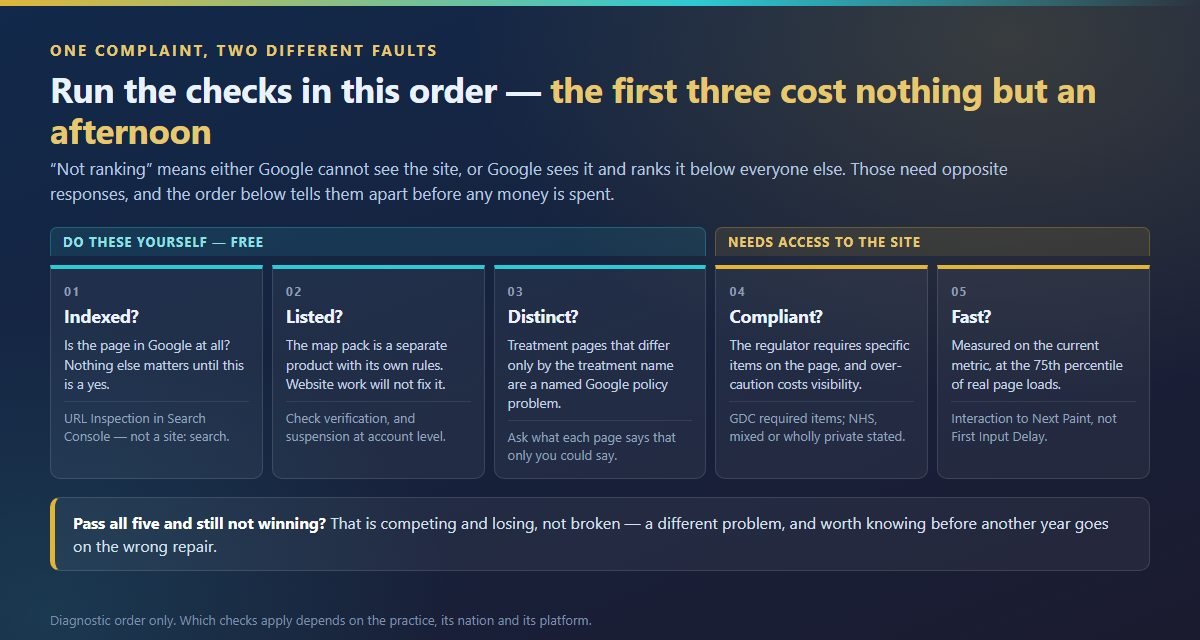
So run it in order: indexed, listed, distinct, compliant, then fast. The first three cost nothing but an afternoon of your own time, which is exactly why they come first.
“Indexed, compliant, and simply not competitive yet” is still a diagnosis — and the one worth having before spending another year on the wrong repair.
Dental ranking questions, answered plainly
How quickly should a new dental website start ranking?
Split the question. Being indexed is a yes-or-no state you can confirm with URL Inspection within days of launch; if a page still cannot be indexed weeks later, patience is not the fix. Being competitive against practices publishing for years is not a date anyone can give.
Does the GDC ban patient testimonials?
Not in its “Guidance on advertising”, which does not mention testimonials, before-and-after photographs, reviews, prices or fees anywhere. They are still regulated, by the CAP Code: rules 3.47 to 3.50 on holding evidence a testimonial is genuine, relevance to the product, claims not misleading, and permission.
Can we offer a discount in exchange for a Google review?
No, on two counts. Google’s policy prohibits incentives “such as payment, discounts, free goods and/or services – in exchange for posting any review”, with actions that “range from suspending the account privileges to account termination”. And banned practice 13 under the Digital Markets, Competition and Consumers Act 2024 covers reviews concealing an incentive.
Can we publish before-and-after photographs?
CAP and the ASA regard them in the same way as testimonials, so rules 3.47-3.50 apply. Take extra care if you also offer facial aesthetics: prescription-only medicines may not be advertised to the public under rule 12.12, and CAP warns such imagery is very likely to be read as an implied ad.
Why do we show up near the practice but not across the city?
Distance is one of only three local ranking factors Google names, alongside relevance and popularity — how far each business is from the customer who is searching. Google also states there is no way to request or pay for a better local ranking.
Should each dentist have their own Google Business Profile?
Sometimes, within limits. Google’s guidelines treat an individual practitioner as a public-facing professional with their own customer base, and name dentists as an example. But a practitioner should not have several profiles for different specialisations, the profile should carry their name rather than the organisation’s, and support staff should not create profiles.
A site: search shows nothing. Are we penalised?
Probably not, and the test is unreliable. Google says the operator “doesn’t necessarily return all the URLs that are indexed under the prefix specified in the query”, and that one used without a query does not rank the results. Use URL Inspection.
Our average position is deep in the results. What does that mean?
That you are indexed but not competitive, which rules out the mechanical faults. Average position is built from the topmost position your property occupied for each query, averaged across all queries — not where any page sits in any single result, so treat it as a trend line rather than a rank.
Find out which of the five it actually is
Send the practice website address and you get a written answer: whether the pages are indexed, what the Business Profile is doing, whether the treatment pages say anything only you could say, and which of the required items are missing. It costs nothing and there is nothing to sign. If the honest answer is that the site is fine and simply has not been going long enough, that is what the answer will say.