
Local SEO in Worcester: distance, districts and the map pack
Worcester is a compact cathedral city with a river down the middle of it, and that geography settles more of your local search visibility than any keyword does. This page covers how the map pack actually decides who shows here — relevance, distance and popularity — what a Google Business Profile can and cannot be made to do, what the new reviews law requires, and what a business can fix itself in an afternoon. It is written by one person: I am Moeez Abbas, and I work remotely from Lahore in Pakistan for businesses in the UK. There is no Worcester office behind this, only the parts of local search you genuinely control.

Worcester is a small market with a river through it and local search is shaped by both
The Office for National Statistics put Worcester’s Census 2021 population at 103,900, up 5.2% on 2011, against 6.6% for England and 6.2% for the West Midlands. The city aged as it grew: median age moved from 37 to 39, and the 50 to 64 group rose by 3,100 people, up 18.2%. Next door, Wychavon — Droitwich Spa, Pershore, Evesham — grew 13.3% to around 132,500. Nobody trading in WR1 is carried along by a rising population. You take share, or sell outward into the ring.
Now the honest bit. I am one person. My name is Moeez Abbas and I work remotely from Lahore in Pakistan, for businesses in Britain. There is no office of mine on Foregate Street. What I can do from here is read this city the way Google reads it — coordinates, categories, hours, citations, reviews — and be straight about which of those you control.
The trading base splits four ways, and each part meets Google differently. First, manufacturing and engineering on the eastern and northern edge, hung off M5 Junction 6 and Junction 7: boiler and heat-pump manufacturing at Cotswold Way in Warndon, on a site occupied since 1990; CNC machine-tool building on Badgeworth Drive in WR4; and Worcestershire sauce still made at the Midland Road factory, where Lea & Perrins has produced it since 1897 after starting on Broad Street in 1837. Add Worcester Six off Junction 6, a £120 million park developed by Stoford across 90 acres with consent for up to 1.5 million sq ft, whose occupiers include MiTek, Bidfood, Kimal, Spire Healthcare, IONOS, Kohler Mira, ZwickRoell, Alliance Flooring Distribution, Material Solutions and Sierra CP Engineering.
Those firms are not scrapping over a three-result map pack. Their supply chains are: the tooling shops, fabricators, hauliers, industrial cleaners, calibration labs and contract packers on Blackpole Trading Estate, Checketts Lane, Shrub Hill Industrial Estate, Perry Wood Trading Estate, Newtown Road, Everoak, Tolladine Goods Yard and the Great Western Business Park on Tolladine Road.
Second, the anchor institutions: Worcestershire Royal Hospital on Charles Hastings Way in WR5, run by Worcestershire Acute Hospitals NHS Trust alongside the Alexandra Hospital in Redditch and Kidderminster Hospital and Treatment Centre; Herefordshire and Worcestershire Health and Care NHS Trust; the University of Worcester across its St John’s, City, Severn and Lakeside campuses; Worcester City Council at the Guildhall on High Street; and Sanctuary, one of the country’s largest housing associations, headquartered at Sanctuary House on Chamber Court off Castle Street and managing around 120,000 homes. Around them cluster care homes, domiciliary care agencies, nurseries, student lettings, training providers and recruiters — the hardest fighters over “near me” searches here.
Worcestershire County Council shows how fast a local fact rots. County Hall on Spetchley Road shut for good in 2024 after legionella bacteria was found in the water supply, parts of it already closed because of reinforced autoclaved aerated concrete; staff moved to the Wildwood offices, meetings scattered to Kidderminster and Pershore, and the site went up for disposal.
Third, an unusually independent city-centre economy along High Street, The Shambles, Friar Street, New Street, Pump Street, Cathedral Square, Mealcheapen Street, Broad Street, Angel Street, The Cross, Lowesmoor and Sidbury. Worcester BID was established in 2010, represents more than 650 city-centre businesses and is in a fourth term running from 1 April 2025 to 31 March 2030. The old Crowngate centre was taken over by Starburst UK and rebranded in April 2025 into Chapel Walk and Friary Walk, reviving two historic names, with Worcester City Bus Station and the Friary Walk car park on the same footprint and the Shambles Market alongside. A page still calling it Crowngate tells a local reader who wrote it, and when.
Fourth, the trades, construction, property and professional services through the suburbs, from St John’s and Dines Green in the west to Warndon Villages and Ronkswood in the east. For them the map pack is the whole argument.
Relevance, distance and popularity are the only three words Google gives you
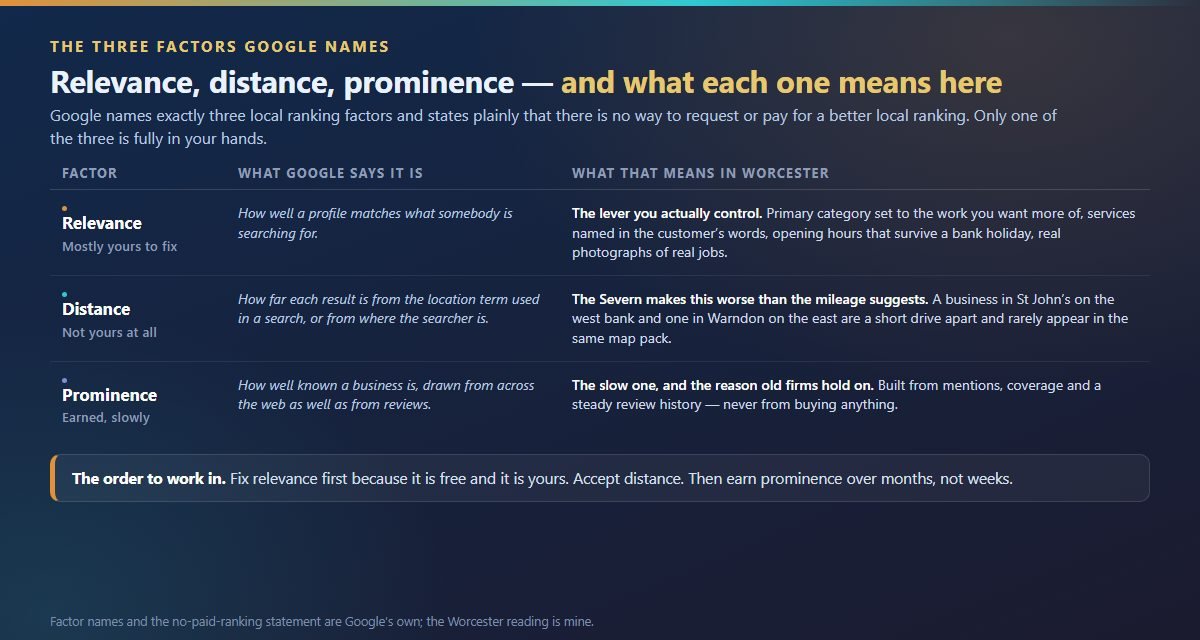
Google publishes a support page on improving your local ranking, and it names exactly three factors. Relevance is how well a profile matches the search. Distance is how far the business is from the searcher. Popularity, which the page explains under the heading prominence, is how well known it is, drawn from what Google can see about it across the web. On that same page Google states there is “no way to request or pay for a better local ranking”.
What you compete for is small: three listings above the blue links with a map beside them, plus the Google Maps app as a separate surface. Ads appear in both, but they are labelled, bought separately through Google Ads, and buying them does not lift the unpaid results underneath.
Relevance is the factor most Worcester businesses under-use, because it is settled largely by the primary category and the plain words on the website behind it. A firm describing itself only as a “property maintenance company” is asking Google to guess whether it wants gutter clearance in Northwick or a bathroom refit in Battenhall.
Prominence is where Worcester’s scale punishes the lazy approach, because the earned-media map is short. One daily paper, the Worcester News. One weekly freesheet, Berrow’s Worcester Journal, descended from the Worcester Post-Man founded by Stephen Bryan in 1690, named when Henry Berrow attached his own in 1753, published today by Newsquest. BBC Hereford & Worcester on the radio, the Worcester Observer, and for the western catchment the Malvern Gazette. There is no long tail of local publishers to farm here.
So prominence is built slowly. Real membership of the Herefordshire & Worcestershire Chamber of Commerce, whose Annual Business Awards were held on 12 June 2025 at the University of Worcester Arena in front of more than 700 people across fifteen categories. A Visit Worcestershire listing if you are in the visitor economy. The Worcestershire Growth Hub. Sponsoring something real: cricket at New Road with Worcestershire County Cricket Club; rugby at Sixways with Worcester Warriors, who returned to professional rugby there for the 2025–26 season in the second-tier Champ competition after the administration of 2022; or basketball with Worcester Wolves, who now field teams in the National Basketball League and the women’s leagues rather than the old British Basketball League. All of it is checkable by a human being.
The Severn decides more of your visibility than your keywords do
Distance is measured from wherever the searcher is standing, not from an agreed city centre. Worcester is long, thin, split by a river and served by very few crossings.
The River Severn runs north to south through the city, about a mile and a half north of the point where the River Teme joins it. Everything west of the water — St John’s, Henwick, Lower Wick, Dines Green, the Hylton Road and Bransford Road frontages — sits on one bank. Everything else, from Barbourne and Claines in the north through the centre down to Diglis, Battenhall and Red Hill, and out east to Warndon, Warndon Villages, Ronkswood and Tolladine, sits on the other. The Salwarpe past Droitwich, the Barbourne Brook, and further out the Avon through Pershore and Evesham shape the edges of the same catchment.
The crossings are the whole story. Worcester Bridge carries the A44 over the water into the centre; the Sabrina and Diglis footbridges take people across on foot. The Kepax walking and cycling bridge opened on 5 December 2024: 145 metres long, a £16 million scheme designed by Moxon Architects and built by Griffiths, linking Gheluvelt Park to the Hallow Road side in St John’s. It is the city’s third crossing dedicated to walking and cycling, and a real change to the catchment for WR2 businesses. To the south, Carrington Bridge carries the A4440 Worcester Southern Link Road between the Ketch Roundabout and the Powick Roundabout; the final phase of that dualling, with a second structure at Powick Common viaduct, opened to traffic on 2 August 2022, and the new bridge was the first in the country built with S460W weathering steel.
The effect is blunt. A customer in Warndon Villages and a business in Dines Green are a few miles apart on a map and a different proposition entirely in a rush-hour queue at the bridge. Google does not model your bridge queue; it models straight-line distance, and a single-location business at one end of Worcester will not dominate the other end.
So you cannot move the pin. Putting it at a mailbox address near the Cathedral when you work out of Perdiswell is the fastest route to losing the profile. What you can do is set service areas honestly and build relevance for those districts on your own website, where distance does not work the same way. And let go of the idea that Google ranks from a fixed city-centre point: it ranks from the searcher, so “where do I rank in Worcester” has a different answer at the Cathedral, at Sixways, at Perdiswell and at Powick.
Test it without buying anything. Ask three people — one in Barbourne, one in St John’s, one out by Worcester Woods Country Park — to search the same phrase on their own phones and send a screenshot. That is your real ranking picture.
Districts, postcodes and the words people type when they mean your end of town
Worcester’s postcode districts are commonly described as WR1 for the city centre, WR2 west of the Severn taking in Powick and Hallow, WR3 north including Claines and Fernhill Heath, WR4 east including Warndon and Long Meadow, and WR5 south and east including Kempsey and Broomhall. Treat that as a guide, not gospel: boundaries do not map neatly onto named suburbs, several straddle Worcester, Wychavon and Malvern Hills, and the wider WR area runs to fifteen geographic districts plus two non-geographic codes, reaching to Droitwich, Pershore, Evesham, Broadway, Malvern and Tenbury Wells. Check any postcode claim against Royal Mail first.
In any case, almost nobody searches in postcodes. People search in names. St John’s. Barbourne. Warndon Villages. Ronkswood. Diglis. Battenhall. Northwick. Red Hill. Dines Green. Blackpole. Perdiswell. Rainbow Hill. Cherry Orchard. Henwick. Lower Wick. Claines. Tolladine. St Peter the Great. And when they are not using a district they use a landmark: near the Cathedral, by The Hive, up at Shrub Hill, down at the Ketch, out at Sixways, by Gheluvelt Park, near Fort Royal Park, round by The Commandery on Sidbury, or at Diglis Basin, where the Worcester and Birmingham Canal drops through its final locks into the Severn under the care of the Canal & River Trust.
Footfall is concentrated in ways worth knowing before you claim proximity to anything. Office of Rail and Road estimates put Worcester Foregate Street at 1.914 million entries and exits in 2024/25, against 0.577 million at Worcester Shrub Hill and 0.456 million at Worcestershire Parkway, which opened on 23 February 2020 near Norton by M5 Junction 7. So “near the station” here means Foregate Street.
Shrub Hill is the regeneration story rather than the footfall one. The Shrub Hill Quarter programme covers roughly fourteen hectares west of the railway line, spanning Canalside and Lowesmoor, and its Supplementary Planning Document sets out more than 500 new homes and capacity for up to 5,000 jobs, with £1.1 million secured from the Government’s Brownfield Land Release Fund. The listed buildings inside it — Worcester Engine Works, the former Great Western Hotel, Isaac Maddox House and Shrub Hill station itself — are to be kept.
The biggest single footfall magnet is Worcester Cathedral, which reported more than 250,000 visitors in 2024, around ten per cent up on the year before. Construction began in 1084; it holds the tomb of King John and Prince Arthur’s Chantry, and the only circular chapter house in the country. It receives no regular government funding and says it costs over £8,000 a day to open the doors. If your trade depends on visitors in WR1, that is the scale of the pool.
The point is not to sprinkle place names about, but to make your service pages, photo captions and review replies reflect where you genuinely work. A roofer who covers Warndon Villages and Ronkswood, says so, and shows pictures from both is doing something a template cannot. One who lists forty districts has told a local reader something unflattering.
Your primary category is the biggest single lever on the profile itself
Inside a Google Business Profile the primary category does the most work, because it largely decides which searches you are eligible for. Google’s guidance on additional categories is to use as few as genuinely describe the business.
The decision is harder than it looks, because Worcester is full of businesses that honestly fit three at once. Take the density of the heating trade, no accident in a city where boiler and heat-pump manufacturing has sat at Warndon for more than three decades. A one-van business might sit under a plumbing category, a heating contractor category or a boiler installation category. They surface for different searches. Pick the one matching the work you want to be quoting for in February.
The business name field is where profiles get destroyed. Google’s guidelines for representing your business require the name to be your real-world name, used consistently on shopfront, website and stationery. “Worcester Heating Services Ltd” is fine if that is genuinely the name. “Worcester Heating Services — Boiler Repair Worcester, Droitwich, Malvern” is a breach, and one of the most commonly reported reasons a profile is pulled. It works for a while, which is why people keep doing it and keep losing profiles.
Services, products and the language customers use
Beneath categories sit services, each taking a free-text description. This is rare controllable surface area and most businesses leave it empty. Write what people ask for, in their words: a landlord gas safety record from a Gas Safe Register engineer, a power flush, an electrical installation condition report, an emergency board-up, a bathroom rip-out and refit. Retailers get products instead, with images and prices.
Verification is the gate in front of all of it. Google may verify by postcard, phone, email or video, and video verification has become routine: it wants to see signage, the premises inside, stock or tools, vehicle livery. Plan the walk-through before filming, because a failed attempt is slow to unpick.
Change the primary category when it plainly does not match the work that pays, expect a re-review, and leave the name and address alone that week. Do not churn categories every few weeks to chase a ranking; it resets whatever signal you built.
Hours, bank holidays and flood days are ranking and reputation at the same time
Google lets a service-area or hybrid business define up to 20 service areas. Twenty is a limit, not a target. An electrician covering the city plus Droitwich Spa, Malvern, Powick and Kempsey should list those and stop; padding out to Birmingham does nothing for distance.
A pure service-area business can hide its street address, which is right for a trade run from a house in Northwick or Cherry Orchard. A shop, salon or restaurant must show it, and a hybrid — a workshop customers sometimes visit — does both. Getting it wrong costs either way: a hidden address for a shopfront throws away walk-in relevance, and a published home address you cannot staff is a suspension risk.
Opening hours are a live fact, and wrong ones are the quickest route to a one-star review that is your own fault. Set special hours for the England bank holidays listed on GOV.UK — New Year’s Day, Good Friday, Easter Monday, the early May, spring and summer bank holidays, Christmas Day and Boxing Day — twelve months ahead.
Then the Worcester-specific ones. The Worcester Victorian Christmas Fayre, organised by Worcester City Council, draws over 125,000 visitors across four days, and the event’s own information for residents and businesses puts the additional economic boost at more than £7.3 million a year. That page also confirms permissions for tables and chairs on the highway are removed for the duration on High Street, Cathedral Square, Pump Street, New Street and Friar Street. If your outdoor seating disappears and a park-and-ride is running into the city, that belongs in your hours.
And then there is the river
Worcester floods, repeatedly, and on the west bank it is part of the trading year rather than a disaster film. The Environment Agency publishes named impact levels for its Worcester (Barbourne) gauge on the Severn, station 2092 on the GOV.UK flood service, with a typical range of 0.55 m to 3.35 m.
| Level at the Worcester (Barbourne) gauge | What the Environment Agency records at that level |
|---|---|
| 3.35 m | Top of the normal range; low-lying land flooding possible above this, and flood alerts may be issued |
| 4.70 m | Flooding at the upstream end of the Pitchcroft |
| 4.75 m | Flooding to properties on Pitchcroft Lane and Waterworks Road |
| 5.00 m | King Stephen’s Mount, Newport Street via the drains, Park View Terrace, The Butts, and properties at Hawford Wood and Bevere |
| 5.25 m | Flooding on Croft Road |
| 5.40 m | Lyttleton Street, North Parade, Severn Terrace and Stephenson Road |
| 5.45 m | The A449 North Quay, the A44 New Road, the Hylton Road gyratory, and sewer surcharge on Tybridge Street |
| 5.79 m | The highest level ever recorded at this gauge, on 26 February 2020 |
The same service maintains named warning and alert areas your customers see on their phones: River Severn at Hylton Road, at Pitchcroft, in North Worcester and in South Worcester; Barbourne Brook at Barbourne; Blackpole and Perdiswell on the Barbourne Brook; River Teme at Powick, at Lower Wick and at Toronto Close; River Severn at Court Meadow, Kempsey and Callow End; Kempsey Village; and River Severn at Hawford Wood and Bevere.
New Road, home of Worcestershire County Cricket Club since 1896 and built on a flood plain that relieves the Severn, went under seven times over the winter of 2023–24, pushing the first two home County Championship matches of 2024 out to the Chester Road North Ground in Kidderminster and costing the club over £500,000 in ground improvements. On those days a profile still saying “Open” does you active harm.
Photographs, posts, and the handful of things that get a profile pulled
Photographs are what people judge you on before they read a word. Google has never named photo metadata as a local ranking factor, so writing coordinates into image files is an afternoon wasted. Pictures that could only have been taken in Worcester are not: the frontage with enough street visible to be recognisable, the van with the plate readable, the work halfway through.
Posts have a short shelf life and work best as an operational channel: flood days, the four days of the Fayre, bank holiday cover, the week the Three Choirs Festival is in town, a match day at Sixways.
On messaging, be clear about what no longer exists. Google retired chat and call history from Business Profiles: per its own support notice, customers could no longer start new chats from 15 July 2024, and the feature was gone on 31 July 2024. What remains is the call button, the website link and whatever booking link you attach, which puts a boring obligation back on you. The number has to be answered by a person during your stated hours.
What actually gets profiles suspended
- Keyword stuffing the business name. The most commonly reported cause, and the easiest to avoid.
- An address you cannot staff. A virtual office, mailbox address or hot desk used as a verified location for a business not genuinely there during stated hours.
- Two profiles at one address for one business. Separate legal entities sharing a building need to look separate on the ground, with their own signage and staff.
- A website URL that redirects. Pointing the profile at a social page, marketplace listing or directory rather than your own site.
- Changing everything at once. Address, name and primary category edited in one session is the pattern most likely to trigger a re-review.
“Soft” and “hard” suspension are industry shorthand rather than Google’s terms: losing management access while the listing stays visible, as against the listing vanishing from Search and Maps. Either way the route back is the appeal inside the profile, and it moves faster if you already hold photographs of signage, a utility bill, insurance documents and the Companies House record. Check, too, who actually owns the profile.
The law on reviews changed and a lot of local advice has not caught up
Here are the facts with names attached. The Digital Markets, Competition and Consumers Act 2024 rewrote the rules on consumer reviews in the United Kingdom. Its unfair commercial practices provisions, including the banned practices in Schedule 20, came into force on 6 April 2025, and the Competition and Markets Authority published its fake reviews guidance, CMA208, two days earlier.
Those banned practices cover submitting a fake consumer review, commissioning or incentivising somebody else to submit one, publishing reviews without taking reasonable and proportionate steps to establish they are genuine, and concealing that a review was incentivised. Because they sit on a banned list, the regulator does not have to prove an average consumer’s decision was affected before acting. Under the same Act the CMA gained direct enforcement powers, with civil penalties reaching up to 10% of global turnover, and said it would spend the regime’s first three months supporting compliance rather than enforcing.
Separately, Google’s review policies prohibit incentivised reviews outright: offering or accepting money, goods or services in exchange is against them, and content not based on a real experience can be removed. A free coffee for five stars is two problems in one gesture, and the coffee is much the smaller.
What is still completely fine
Asking. Asking everybody, at the moment the job is finished, by text or a card with a short link, with no condition attached. Making a review easy to leave is not the same as making it conditional.
What is not fine is review gating: screening customers by sentiment first, sending the happy ones to your Google link and routing the unhappy ones into a private feedback form. That breaches Google’s policies and is the misleading presentation the newer regime targets. Plenty of packages still bundle it without naming it, so ask any supplier whether their tool screens by sentiment, and get the answer in writing.
The wider question of whether reviews help rankings at all, and what Google has actually published on it, is covered in the guide to reviews and SEO.
Replies matter more than most owners think, because the person reading them is the next customer, not the last one. Mentioning the district naturally — a job in Barbourne, a callout to Dines Green, a bathroom in Claines — helps a reader place you because it is true, not because a keyword is hiding in it. Never publish a customer’s personal details in a reply; the Information Commissioner’s Office takes a dim view and so will everybody reading. And a fair negative review cannot be removed at any price. You can only answer it well, in public.
Name, address and phone consistency and the citation lists that waste your money
NAP is the least glamorous topic in local search and quietly the most expensive to get wrong. Name, address, phone number: one canonical version of each, written the same way everywhere, ideally in the format Royal Mail’s Postcode Address File uses.
It has to match on your website footer and contact page, in your structured data, on your Google Business Profile, on Bing Places, in Apple Business (formerly Apple Business Connect) for Apple Maps, on your Facebook page, on your LinkedIn company page and on your invoices. One legitimate exception is Companies House: your registered office is often your accountant’s address. Publish the trading address as your NAP and keep the two distinct, because that drift takes years to clean.
The citations that actually earn their place
Ignore volume. The test is whether a human might plausibly use the listing, or whether a regulator maintains it. In most trades that means sector registers: the Gas Safe Register, NICEIC, NAPIT, TrustMark, FENSA, RICS, ARLA Propertymark, the Financial Conduct Authority register, the Solicitors Regulation Authority register, the ICAEW and ACCA member directories, the Care Quality Commission for care providers, Ofsted for nurseries and training providers, the DVSA listing for driving instructors, and the Food Standards Agency hygiene rating for anybody handling food. They carry weight precisely because you cannot buy your way onto them.
Then the consumer platforms that genuinely generate enquiries here: Checkatrade, Rated People, MyBuilder, Trustpilot, Yell, Thomson Local, Yelp, and for hospitality TripAdvisor and OpenTable. Then the Worcester layer that national packages miss: Worcester BID, the Herefordshire & Worcestershire Chamber of Commerce member directory, the Worcestershire Growth Hub, Visit Worcestershire, and listings through the Worcester News. Twenty to thirty in total, all checkable by a person.
A package promising three hundred listings is automated submissions to directories no Worcester customer has opened. They duplicate one another, and the day you move premises they become three hundred wrong addresses somebody must correct by hand. The citation work worth paying for is the cleanup after a move or a rebrand. One related trap: swapping your website number for a call-tracking number breaks NAP consistency unless the primary number stays in the structured data and on the profile.
Selling into Droitwich, Malvern, Evesham and Pershore without writing doorway pages
Very few Worcester service businesses sell only inside the city boundary. The catchment runs out to Droitwich Spa, whose salt works date to the Roman occupation and whose brine baths were opened by John Corbett in the nineteenth century; Great Malvern, where Malvern Hills Science Park opened in October 1999 next to QinetiQ and houses the National Cyber Skills Centre and around 400 people working in science, technology and cyber businesses, inside the Malvern Hills National Landscape, designated in 1959, covering 105 square kilometres across three counties and renamed from Area of Outstanding Natural Beauty in November 2023; Evesham and Pershore in the Vale of Evesham with its market gardening, asparagus and plums; Kidderminster and its carpets; Bromsgrove; Redditch, built on needle-making and precision manufacturing; and Tenbury Wells and Upton-upon-Severn on the water. Closer in sit Powick, Kempsey, Hallow, Rushwick, Fernhill Heath and Norton.
Every one raises the same question: does it deserve its own page? Google answers that in its spam policies under doorway abuse, described as pages created to rank for specific, similar search queries, leading users to intermediate pages less useful than the final destination. Ten near-identical pages with the town name swapped are the textbook case, and the thing I would argue hardest against building.
A separate page is justified when
You have different evidence for that town: jobs actually done there, named streets, photographs, reviews from customers there, a different call-out charge, or a different council with different rules.
It is a doorway when
The only difference between two pages is the place name, and a reader in either town would learn nothing they could not have got from the Worcester page.
There is an expiry date lurking in this kind of content. On 15 July 2026 the Government confirmed that Worcestershire’s two-tier local government ends on 1 April 2028, the seven existing county, city, district and borough councils replaced by two unitary authorities, North Worcestershire and South Worcestershire. Worcester City falls into the southern one with the areas served by Malvern Hills District Council and Wychavon District Council, while Bromsgrove District Council, Redditch Borough Council and Wyre Forest District Council go north. Shadow elections are expected in May 2027. Anything your site says about “the council” for licensing, rates, planning or highways has a hard shelf life.
The planning picture is firmer. The South Worcestershire Development Plan Review came into effect on 26 March 2026, covers 2021 to 2041 and was adopted jointly by Worcester City, Malvern Hills District and Wychavon District Councils. It requires more than 25,000 new homes by 2041, of which 6,175 had been built at adoption, and the councils can now demonstrate a five-year housing land supply, removing the tilted balance that had been tipping decisions towards approval. If you are a builder, surveyor, architect, removals firm, flooring supplier or landscaper, that is your local pipeline written down.
The profile cannot carry this alone and the website is where relevance is settled
A Google Business Profile with nothing behind it tops out quickly. Relevance is assessed partly from the site the profile points at, and prominence is earned largely by the things that link to it. The website is half the job.
The structure that works is unfashionably simple: one page for each service you would quote for, written for somebody in this city rather than a generic reader anywhere in England. A page on emergency water damage drying that explains what happens when the Teme and the Severn come up together behaves differently from one that could have been published in any town in the country.
Structured data is the plumbing underneath. JSON-LD using Schema.org vocabulary, a LocalBusiness type with a PostalAddress, geo coordinates, an openingHoursSpecification agreeing with the profile, areaServed reflecting the service areas you set, a telephone matching your NAP, and sameAs pointing only at profiles you genuinely run. Avoid marking up your own aggregate rating, which Google’s structured data guidelines restrict as self-serving. Validate with the Rich Results Test rather than trusting a plugin.
Then the technical floor. Mobile-first indexing means the phone version counts. Core Web Vitals — Largest Contentful Paint, Interaction to Next Paint, Cumulative Layout Shift — are measurable in PageSpeed Insights against real Chrome User Experience Report data rather than a lab score you can flatter. Add a robots.txt that does not block what you want indexed, an XML sitemap, correct canonical tags, HTTPS throughout, and a phone number as text rather than baked into an image.
The content that earns local links is useful to somebody who lives here: a page on trading through a flood week naming the Environment Agency warning areas, a note for hospitality on what the Fayre pavement rules mean for December bookings, a plain-English explanation of what the new development plan changes about extensions.
What to measure, and the seasonality that will fool you if you ignore it
The performance report inside the Google Business Profile gives you calls, website clicks, direction requests, bookings and the searches that surfaced you. Google Search Console gives you queries, impressions, clicks, average position and landing pages; the most useful thing you can do with it is separate branded searches from unbranded ones. Google Analytics 4 tells you what happened after the click. Tag the profile’s website link with UTM parameters so profile traffic is not counted as ordinary organic search, and put the result on one screen in Data Studio.
Three warnings. Map pack impressions are not visits. Direction requests are not customers, and some are your own staff. And an average position for a city-wide term is close to meaningless when distance varies by searcher, which is why the three-friends-with-phones test tells you more than a rank-tracking chart.
Worcester’s own rhythm
Local demand moves on a calendar that is easy to name, which is what makes month-on-month comparison misleading. Heating and plumbing spike with the first real cold snap, not the arrival of October. Flood-reactive trades — drying, damp proofing, restoration, flood-resilience installation, groundworks, loss adjusting — spike on named events rather than in named months: Storm Ciara and Storm Dennis back to back in February 2020, the July 2007 floods that cut the city around the Powick roundabout and the Cattle Market, Storm Henk in January 2024, and Storm Bert from 22 to 25 November 2024, which put the centre of Tenbury Wells under water when a wall holding the Kyre Brook gave way.
Hospitality and retail run to a different clock: the Fayre in December, the Three Choirs Festival at the end of July in the years the rotation brings it here — Gloucester took 2026, Worcester has 24 to 31 July 2027, Hereford follows in 2028 — and cricket at New Road whenever the river allows. Compare year on year, annotate the chart with the storms and the events, and give any change a full quarter before judging it. The county’s visitor economy generated £1.05 billion in 2024 on Worcestershire County Council’s STEAM-based figures, a 9% rise on 2023, supporting 21,185 jobs and 1.3 million overnight stays. That is county-wide rather than city-only, and should be quoted as such.
What a Worcester business can fix in one afternoon before paying anybody at all
Everything below is free and worth doing before money changes hands. If somebody quotes you for local SEO and their entire first month is this list, you have your answer.
- Claim and verify the profile. If it exists but you do not control it, start the ownership request now. Otherwise create it and prepare for video verification.
- Fix the business name. Strip anything that is not your real trading name. Do this first, because it is most likely to cost you the listing.
- Set the primary category deliberately. The one matching the work you want more of, plus only those additional categories that are honestly true.
- Set service areas honestly. The districts and towns you will genuinely drive to. Most need far fewer than the maximum allowed.
- Load special hours for twelve months. Every England bank holiday, any day you know you will be shut, and the Fayre days if the city centre is your trading ground.
- Add ten real photographs. Frontage, van, team, work in progress, interior. Taken on a phone, this week, in Worcester.
- Write the services list properly. Every service you offer, each with two or three sentences in customer language rather than trade shorthand.
- Make NAP agree in three places. Website footer, contact page and profile. Then check Bing Places and Apple Business say the same.
- Ask your last twenty customers for a review. All of them, no incentive, no screening, one short message each with a direct link.
- Turn on Search Console. Verify the site, submit the sitemap, and run URL Inspection on your three most important pages to confirm they are indexed.
Paying somebody makes sense when that list is finished and the constraint is something an afternoon cannot fix: a technically broken website, a competitive category where content and links are the only levers left, a multi-location structure, or no hours in the week. SEO packages start at £299 a month on the pricing page; monthly retainers are £650, £1,200 or from £4,000 depending on scope, and one-off local work starts with Local Launch at £650 per location on the packages page. What I will not do is tell you where you will rank or when. In a city where distance does this much of the work, anybody promising position one across the whole of Worcester has not looked at a map of it.
If the constraint is that nobody is searching for you yet, paid social is the other route, covered on the Facebook ads agency Worcester page.
What a client said, and what you can check
“Great communication and very helpful throughout the process. Took the time to explain everything clearly and set up the campaign professionally. Focused on quality results rather than just numbers. Highly recommended.”
This is one of three client reviews published so far; the other two, from a UK SEO client and a US Google Ads client, are on the home page. Every figure comes from the client’s own ad account, and a review goes on this site only when it is real.
What you can check before you pay
- Prices published in full on the pricing page, not hidden behind a sales call
- Month to month, with one month’s notice and no lock-in contract
- Every account, profile and file stays in your name; I work through partner access
- A written report every week, in plain English
- One specialist does the work, from the audit to the report
Questions worth asking before anybody spends money on this
Can I pay Google for a better local ranking?
No. Google’s support page on local ranking is explicit that a better position in the unpaid local results cannot be requested or bought. Ads in Search and Maps are labelled and bought through a separate auction in Google Ads, and running them does not lift the unpaid results beneath.
How far across Worcester can one location realistically rank?
Further than its own street, nowhere near the whole city consistently. A business in Warndon will do well across the east side and struggle in Dines Green; from St John’s it is the other way round. Your website can rank city-wide; the map listing is anchored to where you are.
I am in St John’s and my customers are in Warndon Villages. What can I do?
Three legitimate things. Set service areas to include the districts you genuinely cover. Build real content about the work you do on that side of the river, with photographs from those jobs. And collect reviews from customers there. What you cannot do is move the pin.
Should I build separate pages for Droitwich Spa, Malvern, Evesham and Pershore?
Only where you have something different to say. Google’s spam policies name doorway abuse, and near-identical pages with the town name swapped are the textbook example. A page for a town where you have done real jobs and earned reviews is genuine. One built by find-and-replace is not.
Can I offer a discount in exchange for a Google review?
No, on two counts. Google’s review policies prohibit offering or accepting money, goods or services in exchange for reviews. Separately, concealing that a review was incentivised is a banned practice under the Digital Markets, Competition and Consumers Act 2024, enforceable by the Competition and Markets Authority.
Why has my Business Profile been suspended?
Usually keywords added to the business name, an address that cannot be staffed such as a virtual office, duplicate profiles at one address, a website link redirecting to a social page, or several major edits at once. The route back is the appeal inside the profile, and it moves faster with signage photographs and the Companies House record to hand.
Do I have to show my address if I work from home?
No. A service-area business can hide its street address and set the areas it covers instead, which is correct for most trades run from a house in Barbourne or Northwick. If customers do come to you — a workshop, a salon room — you are a hybrid and should show the address.
Are paid citation packages worth buying?
Almost never at volume. A few dozen listings a human might use, plus the regulator registers for your trade such as the Gas Safe Register, NICEIC or the Care Quality Commission, plus Worcester BID, the Herefordshire & Worcestershire Chamber of Commerce directory, the Worcestershire Growth Hub and Visit Worcestershire, will beat hundreds of automated submissions.
What should I do with my profile on a flood day?
Set special hours the moment you know, rather than leaving the profile showing open while the North Quay is under water. Add a post explaining access, parking and when you expect to reopen. Customers checking the Environment Agency warnings for Hylton Road or Pitchcroft are already on their phones.
Does any of this help if I sell to manufacturers rather than consumers?
Yes, differently. A buyer at a plant on Cotswold Way or a facilities manager at Worcester Six still searches for a calibration lab or a fabricator, and still glances at the map results before making contact. Prominence for business-to-business work comes from trade registers, Chamber membership and citations inside your sector.
Do the free list first, then send me what is left
Work through the afternoon list on this page before you pay anybody, including me. If the profile is claimed, the name is clean, the categories are right and the hours are loaded and you are still not showing, send me the website address and the profile link. You get a written answer on what is actually holding it back, and whether it is something worth paying to fix. Nothing to sign.