
Marketing agency work for Cheltenham businesses
I am Moeez Abbas. I work on search, content and paid social for businesses in Cheltenham, on my own, remotely from Lahore in Pakistan — there is no office here, in Gloucestershire or anywhere else. What follows is not a pitch about a town I have never traded in; it is what I have actually read about how demand behaves in Cheltenham, from the borough’s shopfront rules to the four-day March spike that reorganises half the local economy. If you only read one section, read the one on what you can get for free.

Cheltenham is not Gloucester and the marketing cannot be either
Let me get the awkward part out of the way first. I am one person — Moeez Abbas — working from Lahore, in Pakistan, for businesses in the UK and the US. There is no Gloucestershire office behind this page and nobody who can walk down the Promenade to look at your window display. Everything I do is remote: search, content, paid social, the technical side of a website, the measurement underneath it. If you want somebody who will sit in your back room on a Tuesday, I am the wrong choice, and I would rather you knew that in the first paragraph than the fifth email.
What I can do is read a town from primary documents rather than adjectives. Cheltenham rewards that, because it does not trade like its neighbour. Ten miles south-west, Gloucester is a cathedral and docks city with a manufacturing, logistics, public-sector and regeneration-led economy. Cheltenham, population 118,836 at the 2021 Census against 115,732 in 2011 according to the Office for National Statistics, is a Regency spa town that turned into a services and knowledge economy. Same county, same Shire Hall for county matters, same M5 — completely different customers.
The Gloucester side is written up separately: digital marketing agency Gloucester, on why the city and the county are not the same market.
Four buyer groups dominate here, and a marketing plan that treats them as one audience will waste money on at least three of them.
- Cyber, defence and technology. GCHQ sits at Benhall, and a cluster of security and data firms has grown around it, including Ripjar and North Green Security, with coworking at Hub8 and a long-running local network in CyNam. B2B sellers with security clearances, long procurement cycles and government or enterprise buyers.
- Professional services. Accountancy, law, insurance, wealth management and recruitment, concentrated on the Promenade, in Montpellier, up Lansdown and inside Eagle Tower. Hazlewoods, Randall & Payne, BPE Solicitors, Endsleigh Insurance, UCAS, Spirax Group and Superdry are part of this town’s white-collar centre of gravity. Referral-led, trust-priced, slow to switch.
- Hospitality, retail and leisure. Violently seasonal. The Cheltenham Festival at Prestbury Park, the four cultural festivals run by the charity Cheltenham Festivals, parents’ weekends at Cheltenham Ladies’ College, Cheltenham College and Dean Close School, and the everyday trade of the Brewery Quarter, Regent Arcade and Montpellier.
- Independents inside a protected townscape. Conservation areas and an adopted Shopfront Design Guide mean a salon on Suffolk Parade or a clinic on Bath Road often cannot legally change its own fascia without consent.
Almost every generic “marketing agency” page written for this town could be search-and-replaced to Swindon and still read fine. That is the problem I am trying to avoid below.
Why a Cheltenham shopfront is a planning job, not a design job
This is the single most under-discussed commercial fact about trading in central Cheltenham, and it changes where your marketing budget has to go.
Cheltenham Borough Council designates seven conservation areas: the Central Conservation Area, Cudnall Street and Bafford in Charlton Kings, Poets in St Mark’s, Prestbury, Swindon Village and St Mary’s. Most of the commercial core — the High Street, the Promenade, Montpellier Walk, Montpellier Street, the Suffolks, Imperial Square, Cambray Place, Clarence Street, Winchcombe Street, Royal Crescent and the Regency terraces around Bayshill and Lansdown — sits inside the Central area, which the council subdivides into character areas with their own appraisals, among them Bath Road, Bayshill, College, Eldorado, Fairview, Lansdown, Leckhampton and Ledmore Road. The statutory development plan behind all of it is the Cheltenham Plan, adopted in July 2020.
Inside those boundaries, things you would assume were permitted development are not. The council states that side extensions, two-storey rear additions, external cladding, roof alterations involving dormers and some window and door changes all require permission in a conservation area. Demolishing a structure over 115 cubic metres needs planning permission, and felling or lopping a tree needs six weeks’ written notice. And on a listed building — of which this town has an unusual density, from stuccoed Regency frontages to the ironwork balconies Historic England has catalogued street by street — any alteration affecting significance needs Listed Building Consent. For a shop that means the fascia, a projecting sign, internal illumination and even the fixings.
Then there is advertisement consent, a separate process, and the council enforces separately against illegal advertisements. So a Montpellier retailer wanting a new illuminated sign may be looking at two consents, the adopted Shopfront Design Guide Supplementary Planning Document, and a character appraisal for their own street.
Read the appraisal for your own street before you pay anyone to design a sign. It is free, it is a PDF on the council’s website, and it is the document a planning officer will decide your application against.
What does that have to do with me? Everything. Where physical brand visibility is legally constrained and expensive to change, the cheap variable is digital: your Google Business Profile, your photography, the words on your site, the reviews you ask for, the map pack you appear in when somebody standing outside Neptune’s Fountain searches for what you sell. The Brewery Quarter is the exception — a 2016 mixed-use scheme of roughly 100,000 sq ft of retail and leisure with a 104-bedroom hotel and 34 apartments, owned by NFU Mutual Insurance Society Ltd and managed by Martin Commercial Properties — where a modern fascia is straightforward. Its operators, reported to include The Alchemist, The Botanist, Cosy Club, Mowgli, Five Guys, Pho and Nando’s, with Siren Craft Brew reported to be taking the former BrewDog unit, can buy visibility that an independent on Great Norwood Street legally cannot.
So the independents have to out-think them online. That is a strategy, not a consolation prize.
A calendar-shaped town, and the months that actually pay
Cheltenham calls itself the Festival Town and, unusually for a marketing slogan, it is a description of the cash-flow.
Racing first. Cheltenham Racecourse is at Prestbury Park, on the northern edge below Cleeve Hill, operated by The Jockey Club — not, as half the internet implies, in the town centre. The 2026 Cheltenham Festival ran Tuesday 10 to Friday 13 March, and day one drew 57,242 people against a reduced daily capacity of 66,000, down from 68,500, according to The Irish Times on 10 March 2026. Each day carries its championship: the Unibet Champion Hurdle on Tuesday, the Queen Mother Champion Chase on Wednesday, the Ryanair Chase and the Paddy Power Stayers’ Hurdle on St Patrick’s Thursday, the Boodles Cheltenham Gold Cup on Friday.
If you are reading this in late 2026, the dates that matter are the next ones: The Jockey Club has the Cheltenham Festival 2027 running Tuesday 16 to Friday 19 March 2027, Gold Cup on the Friday, gates at 10:30, first race 13:20, last race 17:20, 28 races across the week. Work backwards from those, not from last March.
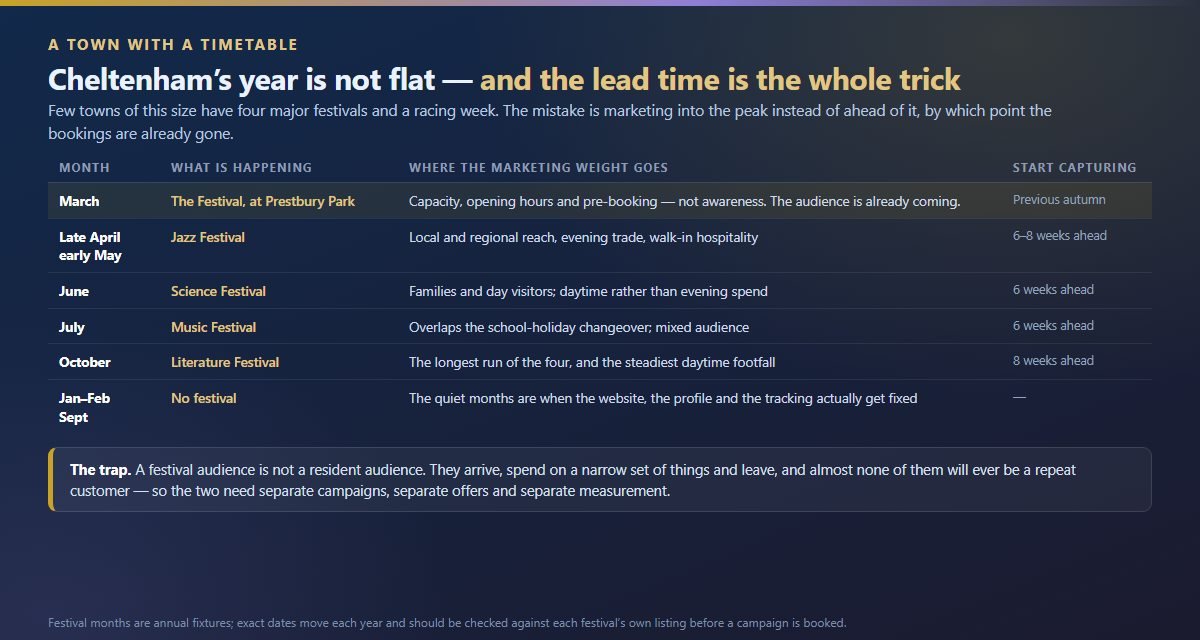
Then the cultural four, all run by Cheltenham Festivals: Jazz, which ran 29 April to 4 May in 2026 as its thirtieth anniversary edition; Science, 2 to 7 June; Music in early July; and Literature, which runs 9 to 18 October 2026 with more than 500 events, across Cheltenham Town Hall, the Everyman Theatre, the Playhouse Theatre, Montpellier Gardens, Imperial Gardens and the Pittville Pump Room. Add the Cheltenham Ladies’ College and Dean Close parents’ weekends, Pate’s Grammar School, Balcarras and Cheltenham Bournside open evenings, University of Gloucestershire term dates at Francis Close Hall and Park, Cheltenham Town FC fixtures at the Completely-Suzuki Stadium on Whaddon Road, and the Gloucestershire Warwickshire Steam Railway’s runs from Cheltenham Racecourse station, and the demand curve looks nothing like a flat national average.
The economic weight of the racing week is documented rather than guessed. A University of Gloucestershire study, led by the Finance in Society Research Institute and published in March 2023, estimated the total economic impact of the 2022 Festival at £274 million, up from roughly £100 million measured in 2016. No comparable figure has been published for 2025 or 2026, so that number belongs to 2022 and should never be quoted as current.
Practically, here is the operating rhythm I would plan against for a Cheltenham hotel, restaurant, taxi firm, short-let operator or event supplier.
- November to January. Build the March list. Search demand for accommodation and hospitality here moves long before the racing. Email capture and content season, not discount season.
- February. Confirm and upsell. Your customers from last year are the cheapest bookings you will ever take.
- March. Do almost no acquisition marketing. You are full or you are not. Spend the week collecting reviews, photographs and consent to email.
- April to July. Jazz, Science, Music. Three audiences, three creative treatments, much lower budgets.
- September to October. Literature. The longest festival, and the one Gloucester has no equivalent of.
Miss that shape and you will spend evenly across twelve months in a town that earns unevenly.
The expensive mistake is talking to a festival crowd as though they lived here
A visitor in Cheltenham for four days in March has nothing in common with somebody who lives in Charlton Kings. Same map pin, opposite behaviour.
The visitor searches on a phone, close to where they are standing, with no brand knowledge and no patience. They convert on availability, distance and photographs, in that order. The resident searches at home, compares three options, reads reviews properly, asks a neighbour, and once they choose you they may stay for a decade.
Those two have different cost structures, and confusing them is how budgets die.
Visitor-shaped marketing
- Google Business Profile accuracy, opening hours and holiday hours
- Photographs of the door they will walk through, not a stock interior
- Booking friction removed — a phone number that is answered, not a form
- Short bursts of paid search on high-intent terms during known peaks
- Speed: Core Web Vitals matter more on a crowded mobile network
- Apple Maps and Bing listings, because a visitor uses whatever their phone opens
Resident-shaped marketing
- Organic search on service terms, built over months, not bought in a week
- Reviews as a body of evidence rather than a score
- Email to people who already bought — the only channel you own
- Content that answers the questions a Cheltenham customer actually asks
- Paid social for awareness at low frequency, tightly geofenced
- Service pages written for Prestbury, Leckhampton or Bishop’s Cleeve rather than for “the South West”
There is a related trap on the paid side. Advertising near racing puts the Gambling Commission, the Advertising Standards Authority and the CAP Code close by; hospitality businesses drifting into betting-adjacent creative to catch March traffic can create compliance problems they did not price in. Sell the bed, the table or the taxi.
On what small paid budgets realistically do: the one result I can point to is not from Cheltenham and not from hospitality. An independent UK artist spent £25 on Meta Ads and saw over 500 Spotify saves and ten new followers across five days, verified in a five-star Fiverr review. It is the only outcome I can evidence, and in the same breath: one small result, on a tiny budget, over a very short window, in a niche with unusually cheap attention. Not a benchmark, not a prediction, and not transferable to a Montpellier restaurant in Gold Cup week.
Anyone who shows you a bigger number without a source is showing you a number they made up.
The Benhall effect: a B2B market that behaves nothing like the High Street
GCHQ’s original Cheltenham site at Oakley opened in 1952 and ran for nearly sixty years. The Benhall headquarters known as the Doughnut — staff moved in during 2003 and Queen Elizabeth II opened it officially in 2004 — is why this town has a seventy-year-deep security industry rather than a recent policy invention.
Two honest caveats, because this is where marketing pages start inventing things. GCHQ publishes no Cheltenham headcount; its own site says only that a large proportion of its workforce is based here. The only official employment figure I can cite comes from the Intelligence and Security Committee of Parliament, which recorded 7,082 full-time-equivalent staff in the year ending March 2022, down just over 1% from 7,181 — the agency’s total across all sites, not the Cheltenham site’s. Figures circulating for 2026 are non-official estimates, and I am not putting one on this page.
What is concrete is the Golden Valley development. Phase one construction started in July 2026, with Cheltenham Borough Council, development partner HBD — part of Henry Boot — GCHQ and contractor Bowmer + Kirkland present for the ground-breaking. The scheme sits roughly 100 metres from GCHQ’s headquarters and is built around named components: IDEA, the landmark cyber and tech centre, a Skills Hub, the ROUTER transport hub with 453 parking spaces and e-bike charging, and residential. The council said in July 2026 that more than half of IDEA’s occupancy was already reserved and that phase one completes in early 2028. Headline projections for the £1 billion scheme are around 12,000 jobs and roughly 1,000 homes at 32% affordable. Numbers beyond those — site area, annual local spend, carbon savings — are not ones I can source, so do not let anyone quote you one.
Now the marketing point. Selling to this cluster is not local marketing at all. The buyers sit in Whitehall, in enterprise security teams, in the National Cyber Force’s orbit, in frameworks run by the Crown Commercial Service. The relevant credentials are Cyber Essentials, Cyber Essentials Plus and ISO 27001, not a five-star review, and staff holding SC or DV clearance constrains what can be said publicly about the work at all.
| Channel | Cheltenham hospitality | Cheltenham cyber and professional B2B |
|---|---|---|
| Google Business Profile | Decisive | Near irrelevant |
| Paid search | Short bursts, high intent | Narrow, expensive, worth it on solution terms |
| Facebook and Instagram | Core for reach and offers | Wrong room |
| Recruitment only | Primary channel | |
| Long-form content | Supporting | The whole engine — whitepapers, technical posts, talks |
| Sales cycle | Minutes to days | Months to years |
One verification habit is worth stealing, because applying it to this page changed a paragraph. Before naming a company as local, check its registered office at Companies House rather than a press mention: Immersive Labs Ltd, company number 10553244, is often swept into lists of Gloucestershire cyber firms, and its registered office is in Bristol. If someone proposes the same channel mix for a Bath Road bistro and for a firm at Eagle Tower, they have not read either business either.
Trust-priced firms on the Promenade do not compete on offers
Cheltenham’s second B2B group is the white-collar belt: accountants, solicitors, insurance brokers, wealth managers, recruiters, surveyors and consultants clustered around the Promenade, Imperial Square, Montpellier, Lansdown and Eagle Tower.
These firms have a structural marketing problem that discount-led advice cannot touch. Their buyers choose on trust, not price, and their output is regulated: a financial planner answers to the Financial Conduct Authority, a solicitor to the Solicitors Regulation Authority, an accountancy practice to ICAEW or ACCA rules, a clinic to the Care Quality Commission. The claim-heavy, urgency-driven copy that works for a gym does not merely underperform here — it can be non-compliant.
What works instead is slower and more boring, and it compounds.
- Named expertise. Individual practitioner pages that rank, because people search for a person as often as a firm.
- Genuinely technical content. A clear explanation of a change to HMRC reporting or a Making Tax Digital deadline, written the week it happens, beats a year of platitudes.
- Search intent mapped to service lines, not to internal department structure.
- Referral infrastructure. Most professional work here arrives by introduction. Your job online is to survive the check that follows it: reviews, a credible site, a LinkedIn profile that matches.
- Local proof without puffery. Membership of a chamber of commerce, sponsorship of something real, involvement with The Cheltenham Trust venues — The Wilson, Cheltenham Town Hall, Sandford Parks Lido, the Pittville Pump Room.
One piece of Cheltenham detail worth knowing if you are venue-adjacent: Pittville Pump Room was built between 1825 and 1830 to designs by John Forbes for Joseph Pitt, opening in 1830 as the last and largest of the town’s spa buildings. It is Grade I listed under Historic England list entry 1387559, designated on 12 March 1955, and overlooks the lawns and lake of Pittville Park at the centre of Pitt’s planned 1820s new town. The Cheltenham Trust runs it as an events and wedding venue. Wedding suppliers, photographers, florists, caterers and musicians here have a Pittville-shaped search market that does not exist ten miles away.
For regulated firms I will not write a claim I cannot source, and I will not put a performance promise in a headline. If that makes copy less punchy, good — your regulator reads punchy copy too.
There is also a data-protection dimension people skip. Email and lead handling runs into UK GDPR and the Privacy and Electronic Communications Regulations, with the Information Commissioner’s Office as the regulator. Consent wording, a working Google Tag Manager consent setup and a privacy notice that matches what the site actually does are part of the build, not optional extras. Pricing and comparison claims sit under Advertising Standards Authority rules and, where a practice is misleading, under the Competition and Markets Authority’s remit.
Search behaves differently in Montpellier and on the High Street
One of the reasons generic local SEO underperforms in Cheltenham is that “Cheltenham” is not one market. The town has distinct commercial quarters with distinct customers, and the borough’s own character appraisals map them more honestly than most marketing does.
- The Promenade and Imperial Square. Professional, high-value, destination retail. Brand searches dominate.
- Montpellier and Montpellier Walk. Independent food, drink, salons and boutiques. Discovery searches and social referral matter most here.
- The Suffolks, Suffolk Parade and Great Norwood Street. Antiques, independents, neighbourhood trade. Small catchments, fierce loyalty.
- The High Street, Regent Arcade and Clarence Street. Volume footfall, chain competition, price-sensitive.
- Bath Road and Tivoli. A local high street inside a wealthy catchment.
- Pittville and Prestbury. Residential, venue-adjacent, event-driven.
- Kingsditch and the Tewkesbury Road corridor. Retail parks, trade counters and light industrial — drive-time targeting country.
Outside the ring, the honest service catchment runs through Bishop’s Cleeve, Prestbury, Charlton Kings, Leckhampton, Up Hatherley, Warden Hill, Benhall, Swindon Village, Southam and Woodmancote, with Winchcombe, Tewkesbury, Stroud and Gloucester as the nearby towns, and postcodes running GL50 to GL54 into Tewkesbury Borough and the Cotswold District. That is a real service area. “We cover the whole of Gloucestershire and the South West” is not.
Geography constrains where new customers appear, too. Cheltenham is hemmed in to the east by the Cotswolds National Landscape and Cleeve Hill, the highest point in the Cotswolds. Growth therefore goes west and north-west — toward Benhall, Swindon Village, the A4019 Tewkesbury Road corridor and Bishop’s Cleeve.
Which brings in the roads, and several years of disruption you should plan advertising around rather than discover. The M5 Junction 10 Improvements Scheme had final approval for main construction in June 2026, with works starting in autumn 2026 and completion scheduled for spring 2029, at a total of £372 million after a further £71.5 million was secured in January 2026, according to Gloucestershire County Council. Galliford Try is the contractor and the scheme is consented as a Nationally Significant Infrastructure Project, reference TR010063, through the Planning Inspectorate. It converts a partial junction into an all-movements signalised junction, widens the A4019 Tewkesbury Road and adds a link road from the A4019 to the B4634. The county council states it enables over 20,000 new homes, including 7,000 affordable.
Until it finishes, most M5 traffic into Cheltenham keeps using Junction 11 and the A40 from the west, with the A46 carrying Gloucester movements, the A435 running north-east toward Evesham and the Arle Court park and ride on the western approach. If you are a garage, a trade supplier or a restaurant on the north-west side, drive-time targeting built on today’s traffic will be wrong repeatedly between now and 2029. National Highways diversions will do more to your Tuesday covers than your ad copy will.
Rail matters as well. Cheltenham Spa station recorded 2.418 million passenger entries and exits in 2024/25 with 0.276 million interchanges, up from 2.045 million in 2023/24, according to Office of Rail and Road station usage estimates. It is managed by Great Western Railway with most services run by CrossCountry, and Stagecoach West handles the bus network into town. The station sits at Lansdown, a walk or a short bus ride from the Promenade rather than on it — exactly the kind of thing worth putting on a directions page.
“Marketing agency” means five different jobs and you probably need two
Most disappointment in this industry is a scoping failure dressed up as a performance failure. The phrase covers five separate trades, sold under one label, at wildly different prices.
| The job | What it actually is | How you know it is working |
|---|---|---|
| Search (SEO) | Technical fixes, site structure, content, internal links, local listings | Impressions and clicks by query in Google Search Console, then enquiries |
| Paid media | Buying attention on Google Ads, Microsoft Advertising, Meta, LinkedIn or TikTok | Cost per lead and return on ad spend, tracked to a real sale |
| Content and brand | Positioning, words, photography, video, tone | Assisted conversions, branded search volume, sales conversations getting easier |
| Website build | WordPress, Shopify, WooCommerce or Squarespace, plus speed and accessibility | Core Web Vitals — Largest Contentful Paint, Interaction to Next Paint, Cumulative Layout Shift — and form completion rate |
| Social management | Posting, community, replies, reels | Saves, shares, DMs that turn into bookings — not follower count |
A salon in the Suffolks needs social management and local search. A cyber firm near Benhall needs content and LinkedIn. A Regent Arcade retailer needs paid media and a fast site. Nobody needs all five at once, and an agency that says you do is selling a retainer rather than solving a problem.
What I do, so there is no ambiguity: search, content, paid social and paid search setup, technical work on WordPress sites, structured data using schema.org types, measurement in Google Analytics 4, Search Console, Tag Manager and Data Studio, and local visibility work on Google Business Profile, Bing Places and Apple Business (formerly Apple Business Connect), with Ahrefs and Screaming Frog for diagnostics and PageSpeed Insights and Lighthouse for performance. What I do not do: photography and video on location, print, PR with UK journalists, event management, or anything requiring somebody physically in Gloucestershire. For those you want a local supplier, and I will say so rather than subcontract quietly.
If the honest answer to your problem is “you need better photographs and a working phone line, not a campaign”, that is the answer you will get.
One more distinction worth naming. Search is an asset; paid media is a tap. Turn the tap off and traffic stops the same afternoon. Businesses in a seasonal town often want the tap, because March is coming. That is legitimate — just do not confuse renting attention with owning it. The third thing, which nobody sells, is the email list: the only audience no platform can reprice on you.
What you can genuinely get for nothing and where free honestly ends
Plenty of businesses in this town do not need to pay anybody yet. Here is the version of that advice that does not end in a sales call.
Free and genuinely worth doing this week
- Google Business Profile, properly finished. Categories, services, hours, holiday hours for Festival week and Christmas, twenty real photographs, and a booking or chat link so a visitor can act without hunting for your number. For a Cheltenham independent this is the highest-return unpaid hour available.
- Google Search Console. It tells you which queries already show your site and where you sit. Most owners have never opened it.
- Google Analytics 4 with two or three conversions defined. Imperfect data beats none.
- Bing Places and Apple Business. Ten minutes each, and Apple Maps drives more visitor navigation than people assume.
- PageSpeed Insights on your three most important pages, on mobile. Fix the images first.
- Reviews. Asking every satisfied customer, by name, at the right moment, costs nothing.
- Your own character appraisal and the Shopfront Design Guide before spending anything on signage.
- The Meta Ad Library and Google Trends for competitor research, both free and public.
- Companies House to check who you are dealing with, including anyone selling you marketing.
I also publish a free SEO checklist on this site with no email address required — no gate, no drip sequence. Take it and never contact me; that is the point.
What a free audit is actually for
A free audit is a sales tool. A good one tells you three specific things that are wrong, with evidence you can verify yourself. A bad one is an automated report with dozens of red warnings, most irrelevant, designed to frighten you into a retainer. If anybody hands you a score out of 100 and a proposal in the same breath, you are being sold to, not advised.
Where free ends
Free covers diagnosis and the obvious wins. It does not cover the two things that take real time: sustained content written by somebody who understands your trade, and paid media managed week by week with real money at risk. Those are labour, and labour is what you pay for.
If your business is under real pressure — and plenty of independents here are, between rents, business rates and the cost of the protected townscape they trade in — do the free list first and give it eight weeks.
Nine questions that separate a plan from a nicely designed PDF
Whether you are reading mine or somebody else’s, the proposal is the product you are actually buying at the point of signing. Interrogate it.
- Who does the work? Not who is in the pitch — who types. If the answer is vague, it is a junior or an unnamed subcontractor. In my case it is one name, which has obvious limits: I cannot cover several urgent jobs in the same afternoon.
- What is the deliverable, in nouns? “Ongoing optimisation” is not a noun. “Four 1,200-word pages, twelve technical fixes, one campaign rebuild” is.
- What is the notice period? Twelve-month lock-ins with a 30-day exit for them and none for you are common. Read that clause before the strategy pages.
- Who owns the accounts? Your Google Ads account, Analytics property, Search Console, Business Profile and domain, in your name, with the agency as a user. If an agency holds your ad account, leaving costs you your entire history.
- What happens to the content if I leave? Anything written for you should be yours outright.
- How is a lead counted? A form fill, a call over 60 seconds, a booking, a quote request — and is a duplicate counted twice? That definition decides whether the reporting means anything.
- Where does the reporting data come from? Search Console, Analytics and the ad platforms disagree by design. A report that reconciles them is honest; one that quietly picks the flattering source is not.
- What is explicitly not included? The exclusions list tells you more than the inclusions.
- What would make you tell me to stop? Anyone who cannot answer this has never turned down work.
Two warning signs specific to local pages like this one. First, invented statistics: if a proposal quotes a precise percentage of Cheltenham consumers who search locally before buying, ask for the source and the date. There usually is not one. Second, guarantees. Nobody outside Google controls its ranking systems, and anyone promising position one, a timescale or a revenue figure is either misunderstanding their own trade or counting on you not checking.
Ask for three months of anonymised Search Console screenshots from work the writer has actually done. The reaction is more diagnostic than the answer.
Finally, check the claims about the town itself. If a proposal talks about “the Gloucestershire market” and never mentions the Festival calendar, the conservation areas or the cyber cluster, the author has not looked at where you trade. That is not a stylistic complaint: it means the channel plan was built for somebody else.
The actual numbers, published and unmoving
I publish prices because a business planning a March push in November needs a figure, not a discovery call.
| Engagement | Price | Who it suits |
|---|---|---|
| Monthly, entry | £650 | A single-location independent — one channel done properly, usually local search plus content |
| Monthly, standard | £1,200 | Two channels, ongoing content, managed paid media, monthly reporting |
| Monthly, extended | From £4,000 | Multi-service or B2B work with a long sales cycle and heavy content requirements |
| One-off project | £850 | A defined piece: technical fix list delivered, a site’s structure rebuilt, a campaign set up and handed over |
For US clients the equivalent tiers are $800, $1,500 and $5,000. Those are the only figures I quote. There is no bespoke pricing, no first-month discount and no annual prepayment deal, because all three exist to obscure what an hour of the work is worth.
Three things that are not included in any of those numbers, and never should be hidden inside them:
- Ad spend. Money paid to Google, Meta, Microsoft or LinkedIn goes from your card to them. It is not revenue of mine and it should never sit in a single blended invoice.
- Software. If a project genuinely needs a paid tool, you buy it and you own it.
- Anything physical or local. Print, on-site photography, venue work, signage applications. Those are Gloucestershire suppliers and Cheltenham Borough Council fees, published on the council’s own fee schedule rather than estimated by me.
Two sanity checks. First, the arithmetic has to survive contact with your own margin: divide £650 by your gross profit per customer and you have the number of extra customers a month the work must produce before it has paid for itself, never mind the ad spend on top. Do that sum before you sign anything, with anyone. Second, seasonality. Spending £1,200 a month evenly through a Cheltenham trading year is often worse than concentrating the same annual budget into November to February and September to October.
Third-party costs vary and I name their sources when they come up. My own figures are the four above and the three dollar tiers; if you see a different number attributed to me anywhere, it is wrong.
Who should not hire anyone yet, including me
This is the section most agency pages leave out, and it is the one that saves people the most money.
- You have not finished the free list. If your Google Business Profile is half-built and nobody has ever opened Search Console, paid help will mostly discover that for you at £650 a month.
- Nobody answers the phone. The most common reason local marketing fails in a service business is unanswered calls and unreplied enquiries. Fix the intake before you increase the input.
- You cannot tell me what a customer is worth. Without an average order value and a rough repeat rate, neither of us can judge whether anything worked. Spend a fortnight with your own numbers first.
- Your capacity is already full. A booked-out clinic or a restaurant turning people away in October does not need more demand; it needs pricing work or another table.
- The product is the problem. Marketing accelerates whatever is already happening. If reviews say the food is slow, faster ads deliver more disappointed people.
- You are mid-relocation or mid-refit. Wait until the address, hours and photographs are stable. Moving a Google Business Profile twice in a quarter costs visibility.
- You need somebody physically present. Shopfront and signage work, a photoshoot in Montpellier Gardens, a stand at a Cheltenham Festivals event, a relationship with SoGlos, Punchline or Gloucestershire Live — those need a local, and pretending otherwise would be dishonest.
- Your budget is under a few hundred a month and the goal is transformation. Small budgets can do useful, narrow things. They cannot rebuild a brand.
If you are in two or more of those categories, spend nothing on an agency this quarter and do the unpaid work first.
There is a Cheltenham-specific version of the timing question too. If your trade is Festival-dependent and it is already late February, the useful window for this year has largely closed: the searching, comparing and booking happened weeks ago. The sensible move is to start in the autumn for the following March, which is unglamorous advice that costs me a signing.
The same test, for a different city, is on the marketing agency Bath page: what is genuinely free there, what each tier costs and who should not hire anyone yet.
One person, four or five hours ahead, and how that is made to work
Lahore runs four or five hours ahead of the UK depending on the season, which is occasionally an advantage: work done in my afternoon lands before your morning. The constraints are real though, so here they are in plain terms.
- Communication is written first. Email and shared documents, with calls booked when a decision genuinely needs a conversation. Written trails also mean you can see what was agreed six months later.
- One response window a working day, not instant availability. If your business needs somebody reachable within minutes during UK trading hours, I am not it.
- You keep every account. Ad accounts, Analytics, Search Console, Business Profile, domain, hosting, all in your name.
- Reporting monthly, from Search Console, Analytics and the ad platforms, with the disagreements between them explained rather than hidden.
- Everything written for you is yours, during and after, with sources named so you can check a claim yourself.
On the local-knowledge question, which is the fair objection to hiring remotely: I cannot replace somebody who drinks in the Brewery Quarter and knows which unit has been empty since spring. What I can do is read the primary documents — the Cheltenham Plan, the character appraisals, the Shopfront Design Guide, Office of Rail and Road station data, Office for National Statistics census releases, Historic England list entries, Companies House filings, Jockey Club schedules, Cheltenham Festivals programmes, Gloucestershire County Council scheme pages and Planning Inspectorate documents — and build from those rather than from a stock phrase about a vibrant spa town.
It is also worth knowing who your planning authority actually is. Cheltenham Borough Council is both the local planning authority and Golden Valley’s development partner. Gloucestershire County Council handles highways, transport and education; Tewkesbury Borough Council and the Cotswold District sit on the borough’s edges; Gloucestershire Constabulary and the county’s NHS services, including Cheltenham General Hospital, cover the public side; and Gloucestershire College and the University of Gloucestershire supply much of the local workforce. If you are planning a three-year investment around Golden Valley or the Junction 10 works, check the current council composition and committee timetable on the council’s own website rather than trusting a figure on a marketing page, including this one.
And the last thing, since it is what most pages about a town get wrong: Cheltenham is a specific place, not a search term. Cheltenham Minster, Sandford Park, Hatherley Park, the Wishing Fish Clock in Regent Arcade by Kit Williams, Holst Victorian House, the escarpment view from Cleeve Common. If a marketing plan could not survive being read by somebody who knows those things, it is not a plan for your business.
What a client said, and what you can check
“Great communication and very helpful throughout the process. Took the time to explain everything clearly and set up the campaign professionally. Focused on quality results rather than just numbers. Highly recommended.”
This is one of three client reviews published so far; the other two, from a UK SEO client and a US Google Ads client, are on the home page. Every figure comes from the client’s own ad account, and a review goes on this site only when it is real.
What you can check before you pay
- Prices published in full on the pricing page, not hidden behind a sales call
- Month to month, with one month’s notice and no lock-in contract
- Every account, profile and file stays in your name; I work through partner access
- A written report every week, in plain English
- One specialist does the work, from the audit to the report
The questions worth asking before anybody mentions budget
Are you based in Cheltenham?
No. I am one person working remotely from Lahore in Pakistan, for businesses in the UK and the US. There is no office in Cheltenham, Gloucestershire or anywhere else in the UK, and nobody will visit you. If a supplier’s physical presence is important to you, hire locally — that is a reasonable requirement, not a prejudice.
Can you really understand a Cheltenham market from Pakistan?
Partly, and only for the parts that are documented: the Cheltenham Plan, conservation area boundaries and character appraisals, the Shopfront Design Guide, Jockey Club and Cheltenham Festivals schedules, census releases and rail usage data. What I cannot do is pick up the informal knowledge that comes from living somewhere.
Why does the Festival calendar change my marketing plan?
Because demand here is concentrated rather than continuous: racing in March, Jazz around the early-May bank holiday, Science in June, Music in July, Literature across ten days in October, plus independent-school parents’ weekends. Lead capture for the March window starts in the autumn, so spending evenly across twelve months usually means paying the most when the decisions have already been made.
Do I need a different approach for B2B than a restaurant would?
Completely different. A cyber or professional-services firm sells to enterprise and government buyers on long cycles, through content, search on solution terms and LinkedIn, with credentials such as Cyber Essentials and ISO 27001 doing much of the persuading. A restaurant is the inverse. The same retainer spent the same way on both will fail one of them.
Can I change my shop sign to match a new brand?
Often not without consent. Inside a conservation area, and especially on a listed building, fascias, projecting signs, internal illumination and fixings can each require advertisement consent and Listed Building Consent, judged against the council’s adopted Shopfront Design Guide and your street’s appraisal. Read the documents, or speak to a local planning consultant, before committing money to a design.
Will you guarantee I rank first for a Cheltenham search?
No, and I would not trust anybody who does. There is no ethical mechanism for guaranteeing a position, a date or a revenue figure. What I will commit to is the deliverables — specific pages, specific fixes, specific campaign work — and to reporting what actually happened, including when it did not work.
What does it cost?
Monthly retainers are £650, £1,200 or from £4,000 depending on how many channels and how much content are involved, and SEO packages start at £299 a month on the pricing page. Defined one-off projects are listed on the packages page, from £650. For US clients the retainer tiers are $800, $1,500 and from $5,000. Ad spend, software and any local or physical costs sit outside those figures and are paid by you directly, so nothing is marked up invisibly.
How much should a small independent spend on ads to start?
Less than most people suggest, and only after the free work is done. Small budgets can answer narrow questions — does this offer get clicks, does this audience respond — but they cannot carry a brand or fix a weak offer. Decide in advance what result would make you continue and what would make you stop, and set the budget where stopping is not painful.
Is there anything genuinely free that is worth doing?
Yes. Finish your Google Business Profile properly, open Google Search Console, define two or three conversions in Analytics, claim Bing Places and Apple Business (formerly Apple Business Connect), run your key pages through PageSpeed Insights on mobile, and ask every happy customer for a review by name. This site also publishes a free SEO checklist with no email address required.
How do I know when to stop working with an agency?
When the reporting stops explaining itself, when nobody can tell you what a lead is counted as, or when you cannot name a single thing that changed on your site or in your ad account in the last quarter. Check that you own your ad account, your Analytics property and your content before you raise it, because ownership is what makes leaving cheap.
Work out which audience you are actually after
Send the website address and tell me whether you want more residents, more visitors, or more business buyers. Those are three different jobs and most Cheltenham marketing tries to do all of them at once. You get a written answer on which channel fits, what it would take, and whether the honest recommendation is to fix something yourself first. The prices on this page are the prices, so there is nothing to negotiate and nothing to sign.