
Digital marketing agency in Gloucester and across Gloucestershire
I am Moeez Abbas, one person working remotely from Lahore in Pakistan for businesses in the United Kingdom and the United States. There is no office in Gloucester, Cheltenham or anywhere else in the county, and this page does not pretend otherwise. What it does instead is set out how demand actually behaves in the city and across the wider county, and what that means for search, local search and paid advertising. Where a figure appears, its source is named and it is stated once.

Digital marketing is four different jobs wearing one name
I am Moeez Abbas. I work on search and paid advertising on my own, remotely from Lahore in Pakistan, for businesses in the United Kingdom and the United States, and that includes businesses in Gloucester and across Gloucestershire. There is no office in Gloucester, no office anywhere in the county, and nothing here pretends otherwise. What I can do from here is study a market properly and build campaigns that match how demand behaves in it.
The phrase “digital marketing” is the problem before anything else is. A groundworks contractor in Quedgeley usually means one thing: appear in Google Maps when somebody in GL2 types a job description into their phone. A precision machining shop in Hucclecote means something almost unrelated: be credible to a buyer at an aerospace tier-one qualifying a new supplier. An independent homeware shop at Gloucester Quays means footfall, Instagram and an email list that still opens in November. Three businesses, one phrase, three different pieces of work.
It helps to break the term into its actual parts, because every proposal you read is really a selection from this list:
- Organic search (SEO). Making the site the asset: information architecture, intent matching, internal linking, technical health, Core Web Vitals, structured data in JSON‑LD, and content that answers a real question better than the page currently ranking.
- Local search. Different levers: Google Business Profile categories and service areas, review volume and recency, proximity to the searcher, and consistent name, address and phone number wherever they are published.
- Paid search. Google Ads and Microsoft Advertising on Bing. Buying intent that already exists, which lives or dies on match types, negative keyword discipline and correct conversion tracking.
- Paid social. Meta — Facebook and Instagram — plus LinkedIn, TikTok and Pinterest depending on the buyer. Creating demand rather than harvesting it, so creative and audience definition carry the result.
- Everything that makes those four pay. Landing pages, offer design, email through Mailchimp or Klaviyo, call handling, and measurement in Google Analytics 4, Google Search Console, Google Tag Manager and a Data Studio report you can read without a translator.
If a proposal uses “digital marketing” as the deliverable rather than as the category, that is the first thing to push back on. Ask which of the five lines above you are buying, in what proportion, and what the other four are not getting.
Gloucester is one district of six, and that changes the whole plan
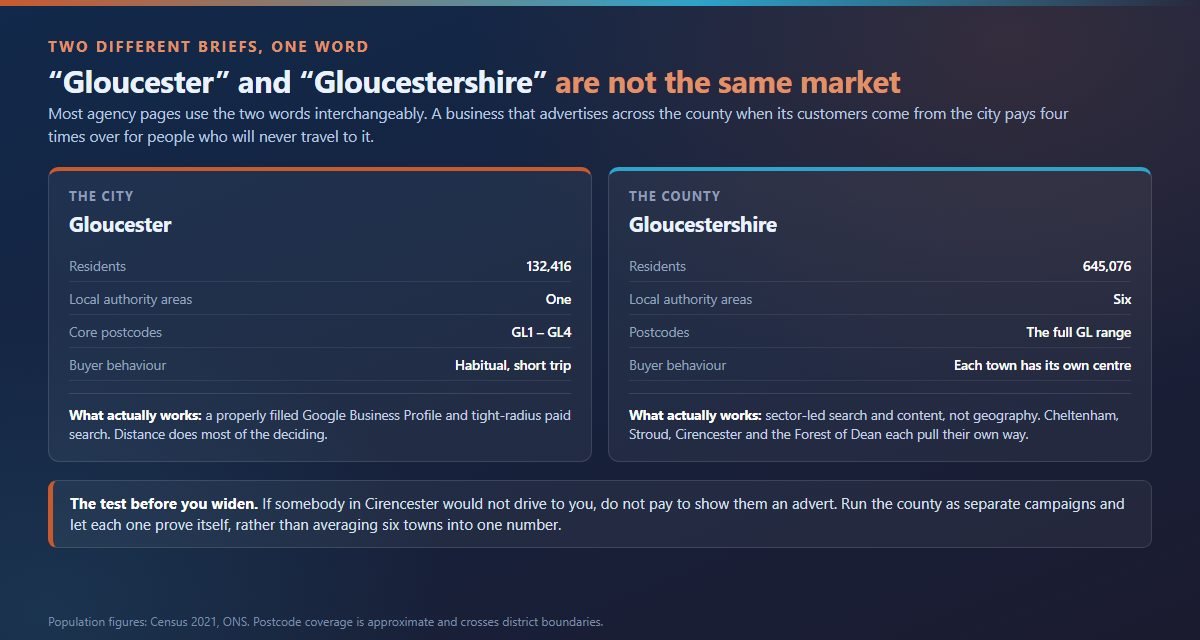
Start with the numbers, because they settle the argument faster than any opinion. At the 2021 Census the Gloucester local authority district recorded 132,416 usual residents, and the Gloucestershire county area recorded 645,076, an increase of 8.1% on 2011, split 48.9% male and 51.1% female, according to the Office for National Statistics area profiles. The city is roughly a fifth of the county. That single ratio is the clearest way to explain why “Gloucester” and “Gloucestershire” are two different marketing decisions rather than two words for the same thing.
Gloucestershire County Council currently covers six districts: Gloucester City, Cheltenham Borough, Tewkesbury Borough, Stroud District, Cotswold District and the Forest of Dean District. Gloucester City Council is the district authority for the city alone. So a Gloucester-only campaign is addressing one district out of six, and a county-wide campaign is addressing all six — with all the travel time, price sensitivity and sector differences that implies.
The ceremonial county trap
You will see a figure of around 935,500 quoted for “Gloucestershire”. That is the ceremonial county, and it includes South Gloucestershire, which is a separate unitary authority covering the Bristol fringe — Yate, Thornbury, Filton and the Severnside industrial area. Gloucestershire County Council does not cover it, and most Gloucester businesses do not serve it. If a proposal sizes your market at that level, it has quietly annexed the outskirts of Bristol into your catchment. For the county council area, the ONS figure above is the one to use.
And it is about to change again
The Government announced on 16 July 2026 that Gloucestershire will become a single unitary council, to be called Gloucestershire Council with 110 councillors, replacing seven authorities: Gloucestershire County Council, Gloucester City Council, Cheltenham Borough Council, Cotswold District Council, Forest of Dean District Council, Stroud District Council and Tewkesbury Borough Council. It takes effect on 1 April 2028, with shadow authority elections on 6 May 2027. Three proposals had been submitted on 28 November 2025; Cheltenham Borough Council argued instead for two unitaries, an East Gloucestershire of Cheltenham, Cotswold and Tewkesbury and a West Gloucestershire of Forest of Dean, Gloucester and Stroud, and the consultation closed on 26 March 2026. Proposal modelling and press reporting put savings at around £21m a year; treat that as an estimate.
That matters commercially: licensing, planning and procurement pages will move, so any content naming a district council needs checking through 2027 and 2028, and a single authority becomes a single procurement route.
Selling in the city
Trades, care, health services, independent retail and hospitality, plus a professional-services layer of accountants, solicitors, recruiters and insurance brokers. Catchment is usually GL1 to GL4 plus the near ring. The right first move is almost always Google Business Profile, reviews and a tight-radius paid search campaign — not a county-wide anything.
Selling across the county
Often business-to-business, often sector-led rather than place-led, and frequently national with a Gloucestershire address. Here the targeting logic is industry and job title, or the whole GL postcode range, and the “local” angle is credibility rather than proximity.
A working city with a cathedral and a rebuilt centre
Gloucester is compact, which is a marketing fact and not just a description. Gloucester Docks were built between 1827 and 1832, immediately after the Gloucester and Sharpness Canal opened, and Gloucester is Britain’s most inland port, roughly forty miles from the open sea. The canal runs about sixteen miles from the Docks down to Sharpness on the Severn Estuary, and when it opened it was the broadest and deepest ship canal in the country. Fourteen of the original Victorian brick warehouses survive as listed heritage; Victoria Dock was excavated in 1849, and the Victoria, Albert and Britannia warehouses were built in 1849, 1851 and 1861 respectively. The Gloucester Waterways Museum sits among them, in Llanthony Warehouse. “Britain’s most inland port” is the phrase residents recognise, and using it correctly — most inland, not deepest — costs nothing.
Adjoining the Docks, Gloucester Quays is a Peel L&P and Lifestyle Outlets asset which its own store guide describes as carrying around 123 stores and services, including a Marks and Spencer outlet and a cinema, restaurant and leisure cluster. Centre reporting in 2024 put footfall up by roughly 7% year on year; treat that as the centre’s own figure rather than an independent audit. Its Victorian Christmas market has drawn over 530,000 visitors across eleven days, though that figure dates from 2019 and should never be presented as this year’s. For a retailer or restaurant on that site, those numbers are seasonal, not flat.
Gloucester Cathedral does two jobs commercially. It is the city’s civic anchor, and its cloisters were used as Hogwarts corridors in three Harry Potter films: Philosopher’s Stone in 2001, Chamber of Secrets in 2002 and Half-Blood Prince in 2009. All four cloister corridors appear, including the Lavatorium where Harry and Ron hide from the troll, the north corridor carrying the “Chamber of Secrets has been opened” message, and the east corridor outside Moaning Myrtle’s bathroom. That hook is evergreen and it drives a different kind of visitor from the one the outlet centre attracts. The cathedral is also the burial place of King Edward II and hosts the Three Choirs Festival in its Gloucester years, rotating with Hereford and Worcester.
The centre has changed materially. The Forum, a £107m mixed-use scheme next to Kings Square, held its official opening in May 2026 with around 135,000 sq ft of Grade A office space, a Hotel Indigo of 131 rooms with restaurant, conference facilities and a rooftop bar, a 398-space Q-Park, plus retail, leisure and apartments. It was delivered by Reef Group with Gloucester City Council, with Kier as contractor, and early occupiers include the hosting firm Fasthosts and the flexible workspace operator Patch. Hotel Indigo Gloucester opened in March 2026 with more than 1,000 bookings taken before opening day. The wider Kings Square regeneration has been reported at around £200m, a press figure rather than an official council total.
Separately, the University of Gloucestershire bought the former Debenhams in Kings Square in 2021 and converted the roughly 20,000 sq m building into its City Campus, working with Morgan Sindall. Phased opening began in 2025 with over 1,000 students starting classes there, and phase one created lecture rooms, seminar rooms and study space plus room for the city’s central public library. It houses education, psychology and social work provision, a Health, Arts and Wellbeing Centre with the NHS Gloucestershire Integrated Care Board, and the library delivered with Gloucestershire County Council. Grade A offices, a business hotel and a city-centre campus together mean the footfall pattern your marketing assumes should be this year’s, not 2023’s.
The city’s biggest employers are industrial, not retail
Gloucester is an advanced-manufacturing city that happens to have a cathedral, and most marketing written about it gets that the wrong way round. Safran Landing Systems employs more than 1,200 people in Gloucestershire. The Gloucester site does landing-gear design, manufacture and assembly plus maintenance, repair and overhaul, working on the Airbus A320 and A350 and on defence programmes including the Eurofighter Typhoon and the Global Combat Air Programme. The site dates from 1937 and descends from George Dowty’s business, later merged with Messier and Bugatti into Messier-Bugatti-Dowty. Safran inaugurated a new engineering and support centre in Gloucester on 14 May 2025, and is a member of the trade body ADS Group.
One employer of that size pulls a long tail behind it: precision sub-contractors, machining shops, tooling suppliers, surface treatment, calibration, industrial cleaning, logistics and technical recruitment, scattered across Quedgeley, Hucclecote, Barnwood and the Gloucester Business Park corridor at Brockworth. Logistics and distribution sit on the M5 spine between junction 11A and junction 12. Businesses of this kind often conclude that search does not work for them, and they are half right for a reason that has nothing to do with search: the buying population is small, so volume metrics describe them badly even when demand is healthy.
The same logic extends up the county. In Tewkesbury borough over 23% of people work in manufacturing, with aerospace employers including Safran, GE Aviation and Dowty Propellers. Moog employs 463 people in Tewkesbury and is developing a £40m, 184,000 sq ft aerospace manufacturing and design centre of excellence on a ten-acre former Trelleborg site at Ashchurch. ONS figures made Tewkesbury Borough the fastest growing local authority area outside London in 2019 — a striking statistic, but one that must be quoted with its year attached. Named industrial locations matter because that is where prospects physically are: Ashchurch Business Centre sits adjacent to M5 junction 9, with Ashchurch Parkway adjoining it.
Aviation here is easy to get wrong. Gloucestershire Airport at Staverton, between Gloucester and Cheltenham, covers about 300 acres, was formed in 1936 as Staverton Airport, and has four runways, including 09/27 at 1,431m and 04/22 at 988m. It handles roughly 70,000 to 90,000 movements a year and topped the Civil Aviation Authority’s UK table for total aircraft movements in 2023. It is general and business aviation, flight training and air ambulance work, not a scheduled passenger airport, and the Jet Age Museum sits on the site. Gloucestershire Airport Limited, formed in 1993, has been jointly owned by Gloucester City Council and Cheltenham Borough Council; a preferred bidder in a sale process was agreed on 26 June 2025, so ownership is worth re-checking before anyone states it in an advert.
The county’s largest sector is the one nobody markets
Over 70% of Gloucestershire’s land is under some form of agricultural production. The agri-food sector employs around 50,000 people across the county, and the agri-food supply chain generates around £1.39bn, according to GFirst LEP and Invest in Gloucestershire material. That is not a rural footnote. It is the county’s under-marketed heavyweight, and a page about marketing companies in Gloucestershire that talks only about Cheltenham cyber has missed most of the economy.
It is also technical rather than folkloric. Hartpury University near Gloucester runs a £2m Agri-Tech Centre with demonstration, bio-security and livestock areas for smart-farming technology, and is a LEAF Innovation Centre with a Digital Innovation Farm. The Royal Agricultural University is at Cirencester, the Countryside and Community Research Institute works across the county, and Campden BRI at Chipping Campden serves food and drink manufacturers nationally. Between them they anchor a supply chain of machinery dealers, feed suppliers, veterinary practices, agronomists, food processors, packaging firms, cold-chain logistics, land agents, rural surveyors and farm insurance brokers.
The marketing consequence is specific. Buyers in this chain search for process terms, machinery model numbers and assurance schemes such as Red Tractor, not for “agriculture services near me”. Content that names equipment, standards and seasons converts here; content that talks about passion does not.
Food and drink has an obvious route to market
For a producer, Gloucester Services on the M5 between junctions 11A and 12, near Brookthorpe, is a genuine shop window for county food. It is operated by Westmorland Ltd — also behind Tebay Services on the M6 since 1972 — and opened in 2014 with the Gloucestershire Gateway Trust, a neighbourhood development charity holding a stake. Up to 3p in every £1 of non-fuel spend goes to the local community, around half a million pounds a year, and the site sells local produce rather than chain brands. Its postcode is GL4 0DN.
Two places Gloucestershire owners already go for support are The Growth Hub Gloucestershire and GFirst LEP, which publish the county’s sector groupings including an Agri-Food and Rural business group. If you are trying to reach county businesses rather than county consumers, understanding where they already gather beats inventing a new channel.
Distinct commercial characters inside one county boundary
Cheltenham
GCHQ relocated to Cheltenham in 1952 and has anchored a cyber and intelligence cluster there ever since. Golden Valley is the purpose-built cyber and technology campus next to it. Cheltenham Borough Council bought 45 hectares of land for the development, and the scheme is planned to deliver around one million sq ft of commercial space and 1,000 low-carbon homes, within a wider 200-hectare area of west Cheltenham. It is being developed with HBD, which submitted detailed phase-one plans on 9 January 2026; an advisory board was unveiled at CyberUK in April 2026 and a Golden Valley Skills Hub launched at a House of Commons reception in September 2025. Conflating the 45-hectare purchase with the wider 200-hectare area is a common error in local copy. Commercially, Cheltenham gives the county an unusual density of security-cleared technical talent.
Stroud and the valleys
Stroud’s economy reflects a long textile and crafts tradition, and the modern version is a strong independent, organic and sustainability-minded business community running down through Nailsworth and out to Dursley and Wotton-under-Edge. This is where purpose and provenance genuinely convert, and where a generic discount-led campaign reads as tone-deaf. M5 junction 13 serves Stroud, and Stroud District Council has published capacity assessments for junctions 12 and 13, so access constraints here are real rather than rhetorical.
Cirencester and Tetbury
These are affluent Cotswold market-town economies running on tourism, hospitality, antiques, equestrian, property and high-end independents. Cirencester was Corinium, the second largest town of Roman Britain, and the Corinium Museum still trades on it. Tetbury is a prosperous market town about nine miles south-west of Cirencester, known for historic woollen mills, independent shops and the Chipping Steps. Westonbirt, the National Arboretum, sits nearby and shapes visitor flows. Marketing here is closer to destination marketing than to local service marketing: the customer is often not local, the season matters enormously, and price is rarely the lever.
Tewkesbury
Manufacturing-led, as above, with Tewkesbury Garden Town planned near Ashchurch off the A46 about two miles from the old town centre and capable of delivering up to 10,000 new homes — though current status should be checked against the borough plan before anyone publishes a figure. Housing at that scale, if delivered, is a decade of demand for trades, estate agents, home services and local retail. The town itself has Tewkesbury Abbey, the Battle of Tewkesbury re-enactment and a medieval street pattern that limits what the centre can hold.
The Forest of Dean
The district has four key towns: Lydney, the largest, on the Severn and designated the district’s major growth area; Cinderford in the heart of the Forest; Coleford, the administrative centre; and Newent to the north. Lydney has by far the highest town-centre turnover in the district, over double Newent’s, which is lowest. Job concentrations are high in manufacturing, construction, education and social care, manufacturing being the largest sector and far above the national average share; historically the work was forestry, iron working and coal mining, and free mining rights still exist here. Named regeneration funding includes Gloucestershire College at £2.6m, the Cinderford Link Road at £3.8m, the Lydney transport and cycle scheme at £1m and Hartpury University developments at £1m. The Forest is neither one undifferentiated rural market nor tourism-first: the manufacturing weighting means trade buyers and long sales cycles, while the Dean Forest Railway, Puzzlewood and the Wye Valley pull a separate visitor economy alongside it.
Junctions and postcodes are how catchment is really drawn
Gloucestershire businesses describe their own reach in road numbers, not in radii. On the M5, junction 11 serves the A40 for Cheltenham and Gloucester, junction 11A serves the A417 for Gloucester and is the link to the A417 corridor, junction 12 is the Quedgeley Interchange for Gloucester south, and junction 13 serves Stroud. The A38 runs through Quedgeley as dual carriageway between the city centre and junction 12, the A40 runs east to Oxford and west into Wales via Ross-on-Wye, and the A48 runs down the west bank of the Severn through Lydney. Getting 11 and 11A the right way round is exactly the kind of detail a local reader notices.
The biggest change to county journey times in a decade has just landed. On the A417 Missing Link scheme, drivers began using a new permanent section from 6am on Friday 18 September 2026. The Air Balloon roundabout has been removed, and for the first time traffic can run the length of the A417 between the M5 and the M4 without negotiating a roundabout. The scheme is roughly four miles of new dual carriageway between Brockworth on the A46 and Cowley, with a new Shab Hill junction; it started in early 2023 and full completion is expected in spring 2027, with press reporting describing it throughout as a £500m scheme. Kier is building the remaining lanes alongside the live carriageway, and the old A417 between Air Balloon and Cowley is being converted for walkers, cyclists and horse riders. It is open in its final layout, not finished.
If your service-area content still describes the Air Balloon roundabout as an unsolved bottleneck, it is now out of date. Cirencester and the Cotswolds are a materially easier drive from Gloucester than they were, which changes what a realistic delivery or call-out radius looks like.
Postcodes are the campaign unit
Gloucestershire is served by the GL postcode area. Gloucester city sits mainly in GL1 to GL4, with the wider range covering Cheltenham at GL50 to GL53, Stroud at GL5 and GL6, Cirencester at GL7, Tetbury at GL8, Badminton at GL9, Stonehouse at GL10, Dursley at GL11, Wotton-under-Edge at GL12, Berkeley at GL13, Newnham at GL14, Lydney at GL15, Coleford at GL16, Drybrook at GL17, Newent at GL18, Gloucester outer areas at GL19 and Tewkesbury at GL20. Confirm each district against the Royal Mail postcode finder before publishing a list, because postcode boundaries do not follow council boundaries.
Ward names are the other local vocabulary worth using accurately. Gloucester City Council’s eighteen wards are Abbeydale, Abbeymead, Barnwood, Barton and Tredworth, Coney Hill, Elmbridge, Grange, Hucclecote, Kingsholm and Wotton, Kingsway, Longlevens, Matson and Robinswood, Moreland, Podsmead, Quedgeley Fieldcourt, Quedgeley Severn Vale, Tuffley and Westgate. Residents type the colloquial version — Kingsholm, Matson — while councils publish the official one, which matters when location content has to read naturally and still match how people search.
Catchment also rarely stops at the county line: Ross-on-Wye, Monmouth and Chepstow sit west and south, Worcester and Malvern north, Swindon and the M4 corridor south-east, and Bristol is close enough to compete on delivered price and speed.
The county calendar decides when budget should be spent
Flat monthly budgets are the default in most proposals and they are wrong for most Gloucestershire businesses, because demand here is unusually lumpy. A few of the cycles that actually move money:
- Rugby matchdays. Gloucester Rugby play at Kingsholm Stadium in the Kingsholm area of the city, with a capacity of 16,115, competing in Premiership Rugby; the all-seated grandstand on the south touchline holds around 7,500 and opened in 2007. Matchdays are a revenue cycle for pubs, restaurants, parking and retail near Kingsholm, and a sponsorship route for business-to-business firms.
- Cheltenham’s festival season. Cheltenham Racecourse at Prestbury Park and the town’s literature, jazz, music and science festivals pull large visitor volumes into the county at predictable times, which lifts accommodation, hospitality, taxi and transport demand well beyond Cheltenham itself.
- The Victorian Christmas market at Gloucester Quays, which compresses a disproportionate share of the retail year into a handful of days.
- School and university terms. The University of Gloucestershire, Hartpury University and Gloucestershire College move thousands of people in and out of the city and Cheltenham at fixed points, which shows up in lettings, furniture, phone repair, takeaway and gym demand.
The Severn Bore
The Severn Bore is a tidal bore on the River Severn, caused by the estuary’s extreme tidal range funnelling incoming spring tides into a wave that travels upstream. Bores occur on roughly 130 days a year, concentrated in the days just after new and full moon, with the biggest around the spring and autumn equinoxes. Size and timing depend on high-tide time, barometric pressure, wind, freshwater flow and how well the channels are scoured. It is a seasonal driver for riverside pubs and accommodation at Minsterworth, Over and Stonebench, and the Bore Riders Club follows the bigger events.
Water, the other way round
In the summer 2007 UK floods, floodwater overwhelmed Severn Trent’s Mythe water treatment works near Tewkesbury in July 2007. Around 350,000 people were left without running water, and a flood wall around 3.5m high has since been built to reduce the risk of recurrence. Reported headcounts vary depending on whether the figure counts the water-supply area or actual tap-water loss, so quote one source and attribute it. Gloucestershire County Council publishes flood-defence research guides and a Severn Bore factsheet, and holds lead local flood authority functions. For builders, roofers, loss adjusters and insurance brokers, weather is the demand spike no annual plan predicts, which argues for holding budget back rather than committing it all in January.
Two keywords, two SERPs, one piece of work
When I compared the results pages in September 2026, “digital marketing agency Gloucester” and “marketing companies Gloucestershire” shared five of their top ten domains. Google already treats city and county as heavily overlapping for this query type. The equivalent question for your business is whether your service terms behave the same way. Sometimes they do, and one strong page beats two thin ones. Often they do not, and the county query pulls a different competitive set. Check before deciding site structure, because structure is expensive to reverse.
Local search is its own discipline
For a business serving GL1 to GL4, Google Business Profile usually outranks the website in commercial importance. The levers are unglamorous and they are mostly operational rather than creative:
- Primary category chosen to match how buyers describe the job, not how you describe your trade, with secondary categories used sparingly.
- Service areas set to the postcode sectors you will genuinely travel to, so you stop generating enquiries from Lydney when you work in Quedgeley.
- A steady flow of reviews rather than a burst, with replies written by a human, because recency reads differently from volume.
- Consistent name, address and phone number wherever they appear, including the places you forgot about — old directory entries, Companies House filings, Trustpilot, sector platforms like Checkatrade, and any trade-body listing.
- Photographs that show the actual premises, van, team or product, because proximity and relevance are what the local pack is ranking and the profile is what gets tapped.
None of that pays until the site clears a technical floor: crawlable and indexable, correct canonicals and internal linking, structured data in JSON‑LD where it genuinely applies, no duplicate location templates, page speed measured through Core Web Vitals, and analytics that record what a real enquiry looks like. A common pattern on WordPress and WooCommerce sites is several plugins writing the same tag, and a contact form that fails silently on a phone; test both before buying traffic. Tools are worth naming only so you know what to ask about: Ahrefs or Semrush for keyword data, Screaming Frog for crawling, PageSpeed Insights for a baseline, Data Studio for reporting.
Location pages, done without padding
The standard failure is twenty near-identical pages with the place name swapped: Gloucester, Cheltenham, Stroud, Cirencester, Tewkesbury, Dursley, Lydney. A location page earns its place only when it carries something that place alone has — the parking situation, the response time, the authority whose rules apply, the postcode sectors covered.
One channel harvests demand, the other creates it
Paid search buys intent that already exists. Somebody in Barton and Tredworth types a job into Google, and you pay to be the answer. Paid social does something structurally different: it interrupts people who were not looking, which means the creative has to earn the attention that the search query would have given you for free. Businesses get into trouble when they judge one by the other’s standards.
Google Ads, honestly
For a local service business the whole game is waste control. Exact and phrase match on the terms that describe the job, a negative keyword list that grows every week, location targeting set to presence rather than interest so you are not paying for people merely reading about Gloucester, and ad schedules that match when the phone is answered. Broad match and Performance Max can work, but they need conversion data you trust first. Microsoft Advertising on Bing is often cheaper for older and business audiences — worth a small test.
Meta, LinkedIn and the rest
On Meta — Facebook and Instagram — the useful Gloucestershire applications are demand creation and remarketing: a Stroud independent launching a product, a Cirencester venue filling midweek covers, a Quays retailer pushing a seasonal range, a Lydney gym selling January. Reels carry disproportionate reach, Advantage+ placements reduce the number of decisions you must get right, and the Meta Pixel plus the Conversions API makes results attributable. LinkedIn is the channel for the county’s business-to-business mass — aerospace supply chain, cyber around Golden Valley, professional services in The Forum, agri-tech around Hartpury — where employer and job function beat place. TikTok and Pinterest earn a place in specific consumer categories. WhatsApp Business is often the real conversion surface for trades, and it sits outside the analytics you are paying for.
The only campaign result I will quote is a small one, and I will caveat it in the same breath. An independent UK artist spent £25 on Meta Ads and saw over 500 Spotify saves and ten new followers across five days, verified in a five-star Fiverr review. That is one small result, on a tiny budget, over a very short window. It is not a benchmark, it is not a prediction, and it says nothing about what a Gloucestershire plumber or a Tewkesbury manufacturer should expect.
Rules you cannot opt out of
Advertising in the United Kingdom sits under the CAP Code, enforced by the Advertising Standards Authority, and the Competition and Markets Authority takes an interest in misleading pricing and fake reviews under the Digital Markets, Competition and Consumers Act 2024. Tracking sits under UK GDPR and PECR, regulated by the Information Commissioner’s Office, which is why a functioning consent banner is a legal matter and not a design preference. Trading Standards sits with the county council. Any provider who treats those as optional is creating a problem you will own long after the contract ends.
Four clauses decide whether a contract is fair
1. Scope, in units you can count
“Ongoing SEO” is not a scope. “Two new pages a month, technical fixes implemented, Google Business Profile managed, one report reviewed on a call” is. Ask what happens in month one versus month six, and what is excluded — photography, copy sign-off, development time, ad spend. The exclusions tell you more than the inclusions.
2. Ownership of everything
This is the clause that costs people the most. The Google Ads account, the Google Analytics 4 property, Google Tag Manager, Google Search Console, the Google Business Profile, the domain at the registrar, the DNS at Cloudflare or wherever it sits, the site, the content, the ad creative, the tracking history. All of it should be in your name with the provider granted access, never the reverse.
3. Notice and term
A twelve-month lock with a ninety-day notice period on top is a fifteen-month decision dressed as a monthly service. Short notice periods signal that the provider expects the work to keep earning its place.
4. Reporting you can argue with
A report should let you disagree with it: enquiry counts you can reconcile against your own records, cost per enquiry, and a short written explanation of what changed and why — not impressions and “keyword movements” that cannot be tied to revenue.
Questions that expose a thin proposal quickly:
- What would make you tell me to stop spending?
- Which of my current pages would you delete?
- How will you tell the difference between a lead and an enquiry from my own existing customers?
- Who writes the content, and will they speak to anyone who does the job?
- What is the first thing you would fix that is not marketing?
- If I leave in month four, what do I keep?
Two warnings. Nobody can promise rankings, positions, timescales or results. And if a proposal sizes your Gloucestershire market using the ceremonial county figure, it has included South Gloucestershire, which means the research behind it was a search rather than a study.
Published figures, and what each one is for
These are my published figures. Advertising spend is separate and goes directly to Google or Meta, never through me, so plan against a monthly fee plus your own ad budget.
| Engagement | Figure | What it is for |
|---|---|---|
| Monthly, entry | £650 | One channel done properly. Typically local search and Google Business Profile for a city or single-district business, or a tightly controlled paid search account. Suits a trade, a clinic, a single-site hospitality or retail business working GL1 to GL4. |
| Monthly, core | £1,200 | Search plus one paid channel, with content production and proper measurement. The usual fit for a multi-service business, a county-wide service firm, or a business-to-business company that needs capability pages and a small always-on ad account. |
| Monthly, extended | From £4,000 | Multiple channels, multiple locations or product lines, technical work on a larger site, and continuous testing. Appropriate where there is genuine complexity — several depots, a national sell alongside a local one, or ecommerce with a real catalogue. |
| One-off project | £850 | A fixed piece of work with an end: a technical and content audit, a rebuilt Google Ads account, a Google Business Profile and local search overhaul, or a measurement setup that finally records real enquiries. |
| US dollar equivalents | $800 / $1,500 / $5,000 | The same three monthly tiers for clients billing in dollars. |
Working out which tier is honest for you
The arithmetic is yours to do. Take the value of one customer over a year, take the proportion of enquiries you convert, and work out how many enquiries a month would cover the fee and the ad budget together.
If the maths does not work at the entry figure — if you would need every lead to convert at an implausible rate just to break even — then the answer is a different offer, or a different price, or more capacity. That is a conversation worth having before any money moves.
Some businesses should not hire anyone yet
You cannot yet tell where your last twenty customers came from. Not approximately — specifically. Without that record, month one produces results nobody can interpret and month two produces an argument. Fix the recording first; it costs almost nothing.
You have no spare capacity. If you are already turning work away, more enquiries make you slower and worse, and the reviews that follow undo the visibility you paid for.
Your margin cannot carry acquisition cost. If a customer buys once, at a low ticket, and never returns, paid acquisition in a competitive category will not work, and no amount of optimisation changes arithmetic.
Your offer is not decided. If you cannot say in one sentence who you are for and what happens next, a campaign will not discover that for you. It will distribute the confusion faster.
What to do instead, in order
- Claim and complete your Google Business Profile, with correct categories, real photographs and service areas that match where you travel. For many Gloucester businesses this alone changes the phone volume, and it is free.
- Ask every customer how they found you, and write the answer in the same place every time. Four weeks of this beats any audit.
- Get reviews from the customers you already have, steadily rather than in a burst, and reply yourself.
- Make sure the website works on a phone, loads quickly, shows a phone number without scrolling, and has a form that delivers. Test it by sending yourself one.
- Install Google Analytics 4 and Google Search Console, even if you never open them, so in three months there is history rather than a blank slate.
- Write down the three questions every customer asks before they buy, and answer each honestly on its own page.
- Speak to The Growth Hub Gloucestershire or your local business network before you spend, because some of what you need may already be funded.
What a client said, and what you can check
“Great communication and very helpful throughout the process. Took the time to explain everything clearly and set up the campaign professionally. Focused on quality results rather than just numbers. Highly recommended.”
This is one of three client reviews published so far; the other two, from a UK SEO client and a US Google Ads client, are on the home page. Every figure comes from the client’s own ad account, and a review goes on this site only when it is real.
What you can check before you pay
- Prices published in full on the pricing page, not hidden behind a sales call
- Month to month, with one month’s notice and no lock-in contract
- Every account, profile and file stays in your name; I work through partner access
- A written report every week, in plain English
- One specialist does the work, from the audit to the report
Questions worth asking before anyone commits
Are you based in Gloucester?
No. I am one person, Moeez Abbas, working remotely from Lahore in Pakistan for businesses in the United Kingdom and the United States. There is no office in Gloucester, Cheltenham or anywhere else in the county. What I bring is research into how your market behaves and hands-on work in the accounts; what I cannot offer is a meeting at your premises.
Should I target Gloucester or the whole of Gloucestershire?
It depends entirely on whether your customer will travel. The city district holds a minority of the county’s residents, so a county-wide campaign multiplies your audience and your cost without necessarily multiplying reachable customers. A trade or a clinic in Quedgeley should usually work GL1 to GL4 plus the near ring. A firm selling into the aerospace supply chain or agri-food should target by sector and job function, because place is almost incidental to that sale.
Does one page really work for both “Gloucester” and “Gloucestershire” searches?
For agency-type queries the two results pages overlap heavily, which is why I treat them as one piece of work rather than building a separate county page. For your own service terms you have to check rather than assume. Sometimes the overlap is just as strong and one strong page wins; sometimes the county query surfaces an entirely different competitive set and deserves its own treatment.
How long before I see anything?
I will not give you a timescale, because nobody honestly can and the answer varies with your starting point, your competition and how quickly changes actually get published. What I will do is agree what to look for first — usually movement in impressions and enquiry quality — and report against that. Paid channels produce data within days; organic search does not.
Can you guarantee first position?
No, and neither can anyone else. Rankings are not sold, they are earned and they move constantly. If a proposal guarantees a position, ask for the clause that defines what happens when it is missed, and read it carefully. Usually the guarantee is scoped to a term nobody searches.
I run a manufacturing business and search volume looks non-existent. Is marketing pointless?
No, but volume-based marketing is. When there are a few dozen genuine buyers, the work is capability content in the language buyers use when qualifying suppliers, a site that survives a procurement check, a small always-on paid search account on exact-match process terms, and LinkedIn aimed at named accounts. The measurement has to change with the strategy.
Who owns the accounts if the work ends?
You do, and that should be true with any provider. Every account and asset belongs in your name, with access granted to whoever is working on them. If a provider owns the ad account, leaving them means losing the conversion history that makes the account efficient, and that is a cost you pay silently.
What does it cost?
The published figures are set out in the pricing table above: three monthly tiers depending on how many channels and how much complexity are involved, one fixed one-off for a defined project such as an audit or an account rebuild, and dollar equivalents of the monthly tiers for clients billing in dollars. Advertising budget is separate, paid by you directly to the platform, and should never be bundled into a single invoice without a breakdown.
Do local events and seasonality really matter to a campaign?
In this county, more than most. Matchdays at Kingsholm, the Cheltenham festival calendar, the Victorian Christmas market at Gloucester Quays, cheese-rolling at Cooper’s Hill each spring, the Severn Bore season and weather-driven spikes for builders all concentrate demand into short windows. A flat budget spread evenly underspends the weeks that pay.
What is the most common factual mistake you see on local marketing pages here?
Two, equally. Quoting the ceremonial county population for Gloucestershire, which silently annexes South Gloucestershire and the Bristol fringe into your catchment. And still describing the A417 Air Balloon roundabout as an unsolved bottleneck, when the roundabout has gone and traffic is using the new permanent section while the remaining works finish. Both are easy to check, and both tell a local reader whether anyone actually looked.
One channel at a time, in more detail
This page covers the choice between channels. Each one has its own mechanics, and those are set out separately:
- PPC in Gloucester — the five settings and reports where a small Google Ads account leaks money, and the order to check them.
- Facebook ads in Gloucester — why the usual fault is targeting that is too narrow rather than too broad, and what to widen first.
- Local SEO in Gloucester — what actually decides the map pack, which of the three factors you control, and what is free to fix.
- Social media in Gloucester — posting and paid campaigns are two different purchases, and only one can be judged on enquiries.
Tell me which one you actually sell to
Send the website address and say whether your customers come from Gloucester itself or from across the county. You get a written answer: which channel fits that answer, what the site is currently doing for it, and what I would fix first. It costs nothing and there is nothing to sign. If the honest recommendation is to spend nothing with me and fix something yourself first, that is what the answer will say.