PPC agency in Gloucester: where the wasted spend actually goes
A Google Ads account that loses money rarely loses it everywhere. It loses it in five specific, findable places, and each can be checked in an afternoon. This is that list, in the order worth working through it, with the one setting that is switched the wrong way on most accounts I am sent.

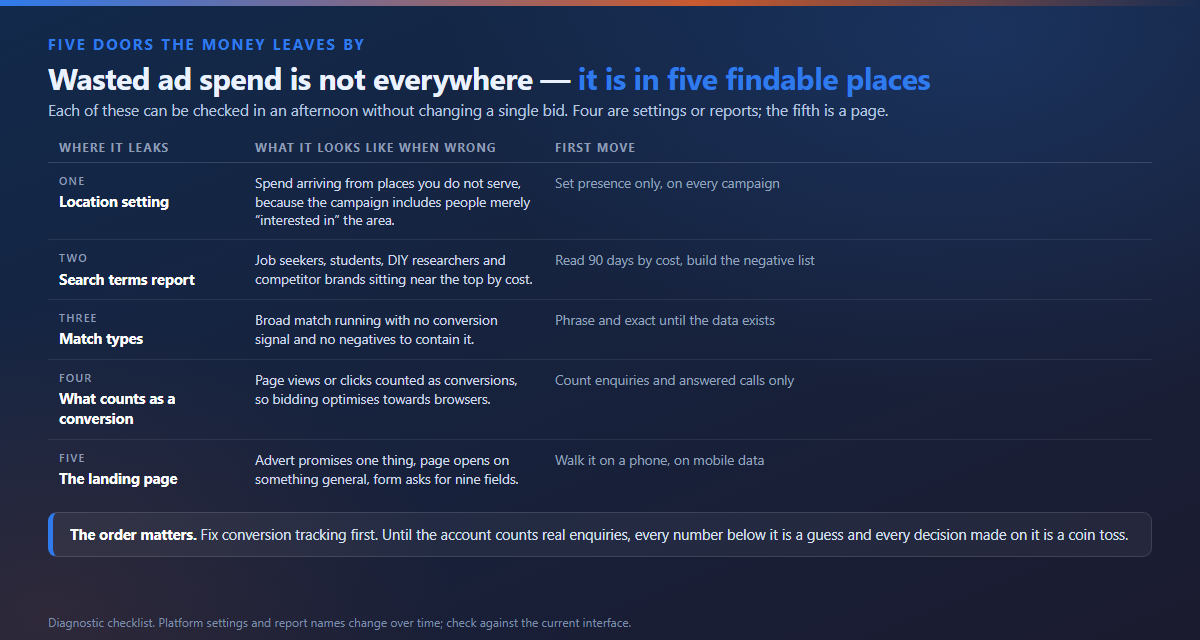
Most wasted ad spend leaves by one of five doors
A Google Ads account that is losing money rarely loses it everywhere at once. It loses it in a small number of specific, findable places, and every one of them can be checked in an afternoon by somebody who knows where to look.
This page is that list. Not a pitch about strategy — the five settings and reports where a Gloucester account most often bleeds, what each one looks like when it is wrong, and what you do about it.
If you already run ads, open the account alongside this and check as you read. Several of these are single toggles, and the first one is switched the wrong way on most accounts I am sent.
For the record, this is written by one specialist, Moeez Abbas, working remotely from Lahore, Pakistan, on UK hours. There is no Gloucester office; the Google Ads account stays in your name, and the work is reported in writing every week.
The location setting that is wrong by default
Inside every campaign there is a location option deciding what “targeting Gloucester” actually means. It offers you people who are in your chosen area, and people who have merely shown interest in it.
The second one is far broader than it sounds. It can serve your advert to somebody hundreds of miles away who searched for something Gloucester-related once, and to a business setting a radius round a single city that is a very expensive way to find out.
The fix is to set presence only — people actually in the locations you chose. For a trade or a clinic that has to physically see the customer, there is no argument for anything else. For an e-commerce shop that ships nationally, the wider option can be right, which is exactly why it exists and why it is left on.
Check it per campaign, not per account. It resets on new campaigns and it is the single most common cause of spend arriving from places you do not serve.
The search terms report, which nobody opens
Keywords are what you bid on. Search terms are what people actually typed. They are different lists and only one of them tells you the truth.
Open the search terms report for the last ninety days, sort by cost, and read the top fifty rows. On most accounts that have never had this done, a recognisable pattern appears within the first twenty: job seekers, students, DIY researchers, people looking for the trade rather than the service, and competitors’ brand names.
Each of those is money spent on somebody who was never going to buy. Each becomes a negative keyword, and the list becomes a permanent asset that keeps saving money every month afterwards.
The reason this is skipped is that it is dull and it does not produce a graph. It is also usually where the largest single saving in a small account sits.
Broad match without the discipline it requires
Broad match will find demand you never thought to bid on. It will also, on a small budget with no conversion data to learn from, spend a week discovering that your plumbing business is not relevant to plumbing courses.
The honest position is that broad match is a tool with a prerequisite. It needs a working conversion signal and enough volume to learn from. Without those two things it is not a clever setting, it is an expensive random number generator.
On a small Gloucester account I would normally start on phrase and exact, build the negative list from real search terms, get the conversion tracking recording properly, and only then test broad in its own campaign where the damage is contained and the comparison is fair.
Anyone who puts a new small account straight onto broad match with automated bidding and no negatives has not made a strategic choice. They have saved themselves the work.
Counting the wrong thing as a conversion
This is the one that makes every other number meaningless, and it is remarkably common.
If the account is counting page views, clicks to a contact page, or time on site as conversions, then the bidding algorithm is optimising towards people who browse. It will get very good at finding them. The report will look healthy and the phone will not ring.
What should be counted is the enquiry itself: the form submitted, the call connected and answered, the booking made. For most Gloucester service businesses the phone matters more than the form, which means call conversions need setting up deliberately — they do not appear on their own.
There is a blunt test. Add up the conversions the account claims for last month, then ask whoever answers the phone how many genuine enquiries they handled. If those two numbers are not in the same neighbourhood, the tracking is wrong and every decision made on it has been a guess.
The page the click lands on, which is not the ad’s fault
When an account underperforms, the ad account gets blamed. Often the problem is one step later.
Three things do most of the damage. The advert promises one thing and the page opens on something more general, so the visitor has to hunt. The page takes too long on a phone on mobile data, which is how most of these clicks arrive. Or the way to get in touch is below the fold, in a form asking for nine fields, when a tap-to-call button would have done.
None of that is fixed by bidding differently. A campaign sending traffic to a page that loses people is paying full price for the click and collecting none of the value, and the page itself is the thing that needs the work.
Walk your own journey before you change a bid: click your own advert on your own phone, on mobile data, and try to enquire as a stranger would. Most owners have never done it once.
Why Gloucester clicks cost more than they should
One thing does make this harder here than the raw population would suggest, and it is worth knowing before you read your own cost per click and conclude something is broken.
Gloucester sits inside a corridor of larger agency markets. Bristol and Cheltenham firms bid on Gloucester service terms routinely, and national lead-generation companies bid on all of them. Several of the results for agency terms in this city are not Gloucester businesses at all.
Cheltenham is a different market again. The marketing agency in Cheltenham page covers how demand behaves there, from the borough’s shopfront rules to the four-day March spike that reorganises half the local economy.
The practical consequence is that you are often bidding against organisations with more budget and a higher tolerance for a bad month. Competing with them on the same broad head terms is a fight you lose slowly.
What works instead is being specific where they are general. Longer, more particular searches, service-plus-problem rather than service-plus-city, and tight geography that a national bidder will not bother to match. It produces fewer clicks and a better cost per enquiry, which is the trade worth making on a small budget.
What I would check first, and in what order
- Conversion tracking. Until the account counts real enquiries, nothing below can be judged. Everything else waits.
- Location setting to presence only on every campaign. One toggle, immediate effect.
- Search terms report, ninety days, sorted by cost. Build the negative list from what is actually there.
- Match types brought back to something the budget can support.
- The landing page walked on a phone, as a stranger, on mobile data.
- Then, and only then, bids and budgets. Changing these first is the most common order and the least useful.
Search is only one half of the picture, and it only harvests demand that already exists — somebody has to be looking for you before you can appear. Paid social does the opposite job, and which one you need depends on whether people are already searching for what you sell. If they are not, more budget on search will not create them.
If you would rather see how the same account is judged from the outside, what PPC management actually costs and what the fee is attached to is set out separately.
The organic side of the same city — the map pack and what decides it — is on the local SEO Gloucester page, and the plan across every channel for the city and the county is on the digital marketing agency Gloucester page.
What a client said, and what you can check
“Great communication and very helpful throughout the process. Took the time to explain everything clearly and set up the campaign professionally. Focused on quality results rather than just numbers. Highly recommended.”
This is one of three client reviews published so far; the other two, from a UK SEO client and a US Google Ads client, are on the home page. Every figure comes from the client’s own ad account, and a review goes on this site only when it is real.
What you can check before you pay
- Prices published in full on the pricing page, not hidden behind a sales call
- Month to month, with one month’s notice and no lock-in contract
- Every account, profile and file stays in your name; I work through partner access
- A written report every week, in plain English
- One specialist does the work, from the audit to the report
Gloucester PPC questions, answered plainly
How much should a Gloucester business spend on Google Ads?
I cannot give you a figure without knowing your trade, your margins and what one customer is worth over their lifetime, and anybody who quotes one before seeing those is guessing. What I can say is that the budget has to be big enough to generate conversion data, because an account with almost no conversions cannot be optimised, only watched. If your budget cannot produce a fair four-week test, the honest answer is to fix the free things first.
Why is my cost per click higher than I expected?
Usually because you are bidding against organisations outside Gloucester. Bristol and Cheltenham agencies and national lead-generation companies bid on local service terms everywhere, and they set the auction price. It is not evidence that your account is broken. The response is to compete on specificity rather than on budget: longer searches, tighter geography, and terms a national bidder will not bother matching.
Should I run Google Ads or work on SEO first?
They answer different questions. Ads tell you within weeks whether people will pay for what you sell and what an enquiry costs. SEO takes months and then keeps paying. If you do not yet know whether the offer converts, ads answer that faster and more cheaply than waiting two quarters for rankings. If you already know it converts and simply want it cheaper over time, that argument runs the other way.
Is Performance Max right for a small local account?
It can work, but it is hard to diagnose when it does not, because much of what it did is hidden from you. On a small account with limited conversion data I would rather start with search campaigns where I can read the search terms and see exactly what the money bought. Once there is real conversion history and a proper negative list, testing it becomes a reasonable next step rather than a leap.
How long before I know whether it is working?
You usually get a readable signal in two to four weeks: whether the terms are relevant, whether people click, and roughly what an enquiry costs. That is not the same as knowing your final cost per customer, which needs longer. Anything shorter than a fortnight is noise, and judging an account in its first week is the most common way people talk themselves out of something that was about to work.
Do I need a separate landing page, or will my homepage do?
A homepage has to serve everybody, which means it rarely answers the specific promise your advert just made. That mismatch costs conversions quietly. It is not always worth building a separate page immediately, but if you are spending real money every month and sending it all to a homepage, that is usually the cheapest remaining improvement available.
Can you work on an account I already have running?
Yes, and it is usually preferable. An existing account has history, and history is worth more than a clean start because it tells us what has already been tried and what it cost. I take partner access rather than your password, the account stays owned by your business, and the spend stays on your card with the cap set by you.
What happens to the account if we stop working together?
It stays yours, in full. The campaigns, the negative keyword list, the conversion setup and the history all sit in your own account, usable by whoever comes next. If anyone proposes running your ads inside their own account, ask what happens to that history when you leave, because the answer is that it does not come with you.
Send the account, not a brief
Give me read access to the Google Ads account and you get a written answer: whether the location setting is costing you money, what the ninety-day search terms report actually contains, whether the conversions being counted are real enquiries, and which of the five to fix first. It costs nothing and there is nothing to sign. If the account is already clean and the constraint is budget, that is what the answer will say.