
SEO tools for medical practices: what you actually need
Search for SEO tools for a medical practice and you find comparison pages written mostly by the platforms being compared. For a single-location practice the honest answer is close to nothing: the things that move patient enquiries most are free. Here is what each category of tool really does, and the healthcare question to ask before any of it.

The honest answer is fewer than you are being sold
Search for SEO tools for a medical practice and you will find comparison pages listing a dozen platforms, most of them written by the platforms. The question underneath is usually simpler than the answer given: what does a practice actually have to buy?
For a single-location practice the answer is close to nothing. The things that move patient enquiries most are free, and the paid platforms mainly solve problems that appear at ten locations rather than one.
That is not an argument against ever buying anything. It is an argument for buying in the right order, and for knowing what each category of tool genuinely does before it becomes a monthly line item nobody reviews. One thing is specific to healthcare and comes before all of it, and it is covered further down.
The free things outperform most of the paid ones
Before any subscription, four free things do more for a practice than any platform will.
- The Google Business Profile, filled in properly. Primary category chosen precisely rather than broadly, every service listed individually, hours that are true, and photographs that are yours. For local searches this is the landing page, not your website.
- Search Console. It tells you which queries you already appear for and where. Practices routinely discover they are on page three for something they never thought to target, which is a cheaper win than anything new.
- A real review habit. Asking consistently after appointments beats any automation, and it is the single strongest visible signal a prospective patient reads.
- Your own phone log. Whoever answers knows which enquiries are new patients and where they said they found you. That is first-party data no platform sells you.
If those four are not in place, a paid tool will produce a dashboard describing a problem you could have fixed for nothing.
The question to ask a vendor before anything else
This is the part general SEO tool advice leaves out entirely, and it is the part that matters most in healthcare.
Under HIPAA, a vendor that handles protected health information on your behalf is a business associate and needs a business associate agreement in place. The fact that a named individual is your patient is itself protected information — not only their diagnosis.
That has direct consequences for the tools most often recommended to practices. A review-request platform that you upload a patient list into is handling protected information. So is anything connected to your scheduling or practice management system. A rank tracker that only looks at public search results generally is not.
So the first question to any vendor is not what it costs. It is whether they will sign a business associate agreement, and what data leaves your systems to reach them. A vendor who is vague about either is answering the question.
I am not a compliance advisor and this is not compliance advice. Run any tool that touches patient data past whoever handles that for your practice before you connect it, and get the agreement in writing rather than in an email reassurance.
Four categories, and what to ask of each
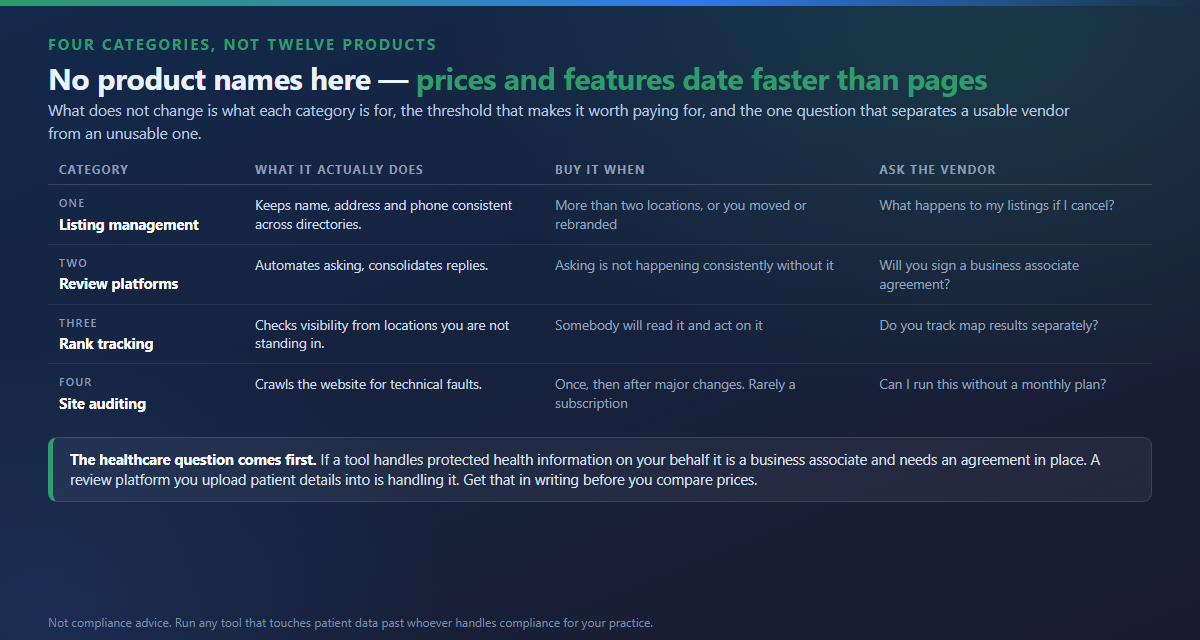
I am deliberately not naming products. Prices and features change faster than any page can track, and a list of brand names would be out of date before it was useful. What does not change is what each category is for and how to judge one.
Listing and citation management. Keeps your name, address and phone consistent across directories. Genuinely useful if you have moved, rebranded, merged, or have several locations. Ask: what happens to the listings if I cancel? Some services revert your data when the subscription stops, which is a trap worth knowing about in advance.
Review generation and management. Automates asking and consolidates replies. Ask the compliance question above first. Then ask whether it can request reviews without you uploading patient details at all, because some can.
Rank and visibility tracking. Tells you where you appear from different locations, which matters because local results differ by where the searcher stands. Ask whether it tracks the map results separately from the ordinary results, because those are two different systems and a tool that blends them is telling you very little.
Site auditing. Crawls your website for technical faults. Useful once, genuinely, and then rarely. Most practices need this as an occasional check rather than a subscription — what such an audit actually covers is a short list.
The thresholds that make a subscription worth it
Rather than a recommendation, here are the conditions under which each category stops being optional.
Buy listing management when you have more than two locations, or when you have moved or changed name and the old details are still circulating. Below that, correcting the handful of directories that matter by hand takes an afternoon once.
Buy review tooling when the asking is not happening consistently without it, and only after the compliance question is settled. The tool does not fix a practice that never asks; it scales a habit that already exists.
Buy rank tracking when somebody is going to read it and act on it. A dashboard nobody opens is a subscription, not a tool. If you are checking rankings from your own front desk and calling that data, a tracker is worth more to you than most things on this page.
Do not buy site auditing on subscription unless the website changes constantly. Run it, fix what it finds, run it again in six months.
The pattern is the same throughout: tools scale work that is already happening. None of them starts it.
For most practices the bottleneck is not software
Having looked at a fair number of these setups, the limiting factor is rarely the absence of a platform.
It is usually that the profile category is wrong, so the practice is not eligible for the searches it wants. Or that nobody asks for reviews. Or that new-patient calls ring out at lunchtime and nobody counts how many. Or that the site has one page covering six services, so none of them ranks for anything specific.
Every one of those is free to fix and none needs a subscription. A platform laid over the top of them produces a very tidy report about a practice that is still invisible.
If you want to know which of those applies to you, that is a reading job rather than a buying job — what actually decides local visibility is a short enough list to check by hand, and what changes when the business is a clinical one is mostly about trust signals and compliance rather than tactics.
Counting what the practice actually gets — calls, forms and bookings rather than positions — is covered in medical SEO leads.
Medical SEO tool questions, answered plainly
What is the single most useful free tool for a practice?
The Google Business Profile itself, treated as a product rather than a listing. For local searches it is what patients actually read and act on, it decides which searches you are eligible for through the category you choose, and it is free. Most practices have filled it in once and never returned to it.
Do I need a HIPAA business associate agreement with an SEO tool?
If the tool handles protected health information on your behalf, yes. A review platform you upload patient contact details into is handling it, because the fact that somebody is your patient is itself protected. A tool that only reads public search results generally is not. Ask the vendor directly, get it in writing, and confirm with whoever handles compliance for your practice rather than relying on this page.
Are all-in-one healthcare marketing platforms worth it?
They can be for multi-location groups, where the value is consolidation rather than capability. For a single location they usually bundle several things you could do free with one thing you needed, at a price set by the bundle. Price the one thing you needed separately before agreeing to the bundle.
Why do my rankings look different in a tool than in my own browser?
Because local results are calculated from the searcher’s location, and your browser also carries your history and your logged-in account. Checking from your own front desk always flatters you. That gap is the main legitimate argument for a tracking tool: it can check from locations you are not standing in.
Should I pay for citation building?
Only for the directories that genuinely matter in healthcare, and the list is shorter than a bulk service implies. Mass submissions to hundreds of low-quality directories is the pattern search engines treat as link spam, and it does very little for a profile. Consistency across a handful of real sources beats volume.
How often should I run a site audit?
Once properly, then after any significant change to the website, then perhaps twice a year. Practice websites do not change often enough to justify continuous crawling. What changes more often is the Business Profile and the reviews, and neither needs a crawler.
Can a tool tell me whether my SEO is working?
Not on its own. Tools report rankings and traffic. What you actually need to know is how many new patients called and what they said when asked where they found you, and that lives at your front desk rather than in any platform. Line the two up before concluding anything from a dashboard.
Is it worth buying a tool before hiring anyone?
Usually the reverse of what people do. A tool describes problems; it does not fix them. If nobody at the practice has time to act on what the dashboard says, the subscription is documentation of the problem rather than a solution to it. Fix the free things first, and buy tooling when there is somebody to use it.
Before you buy anything, find out what is missing
Send the practice website address. You get a written answer: whether the profile category makes you eligible for the searches you want, which of the free things are not in place, and whether any of the paid categories on this page would actually help you yet. It costs nothing and there is nothing to sign. If the honest answer is that you need no software at all, that is what the answer will say.