SEO in Wakefield: a city, the Five Towns and the high streets in between
The City of Wakefield district is far bigger than Wakefield itself. Castleford, Pontefract, Featherstone, Knottingley and Normanton, Ossett and Horbury, Hemsworth and South Elmsall each have their own high street and their own map pack, and fewer than one resident in three lives in the city. This is how local search actually behaves across the district, why the pages ranking for the Wakefield searches say so little about it, and what a business here should fix first, whether it is a Pontefract trade, a Glasshoughton restaurant or a supplier to the parks along the M62.

Wakefield is a district, not only a city
When a business owner types “seo wakefield” into Google, the picture in their head is usually the city: the cathedral with the tallest spire in Yorkshire, Westgate station, Trinity Walk, the Hepworth on the bank of the Calder. The council area that carries the name is far larger. The City of Wakefield metropolitan district reaches from Stanley and Outwood on the Leeds side down to South Elmsall and South Kirkby near the Doncaster boundary, and from Ossett and Horbury in the west to Knottingley and Ferrybridge in the east. Inside it sit the Five Towns of Castleford, Pontefract, Featherstone, Knottingley and Normanton, the former pit towns of Hemsworth, South Elmsall and South Kirkby, and villages and suburbs from Sandal, Walton and Crigglestone to Crofton and Wrenthorpe.
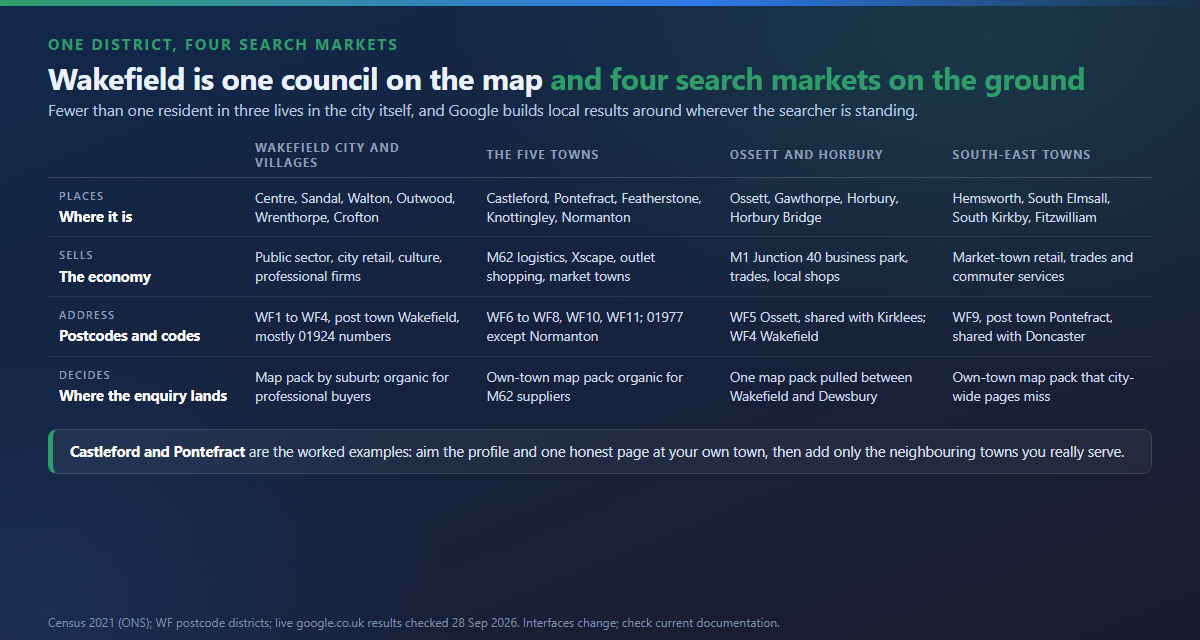
The numbers make the point. The 2021 Census counted around 353,400 people in the district and just under 98,000 in the Wakefield built-up area, so fewer than one resident in three lives in the city the district is named after. The rest live in towns with their own high streets, their own market days and, for search purposes, their own map packs. A plumber in Pontefract and a plumber near Westgate are not competing for the same customer, because Google weighs distance from the person searching when it builds local results.
This page covers what Google actually shows for the Wakefield searches, how a Castleford or Pontefract business should aim at its own town, how the logistics parks on the M1 and M62 are searched for, what trades and visitor businesses should fix first, and how to judge whoever offers you help.
One disclosure first, because most pages in this results set lead with a location. I am one specialist working remotely from Lahore, in Pakistan. I have no office in Wakefield, Castleford, Pontefract or anywhere else in the district, and nothing here claims otherwise.
What Google shows for the Wakefield searches, and why it is so thin
On 28 September 2026 I checked “seo wakefield” on Google UK alongside four variants: “seo agency wakefield”, “seo services wakefield”, “wakefield seo” and “seo company wakefield”. None of the five returned a People also search for block. My reading is that the search is small and self-contained: people type it, look at what comes back, and either get in touch with someone or leave.
The organic results are agency pages, and I read five of them closely. They are service pages with the city dropped into the headings, covering content, links, technical SEO, audits and reports in copy that would read the same with another town’s name in it. Only one lists a number with Wakefield’s 01924 dialling code, and none uses 01977, the code Pontefract, Castleford and Knottingley share. Only one mentions the Business Profile at all, in a single line about keeping business details consistent, and none explains how the map pack changes between a searcher in Wakefield and one in Pontefract. Only one mentions Castleford, Pontefract or Normanton, and apart from its own address and a single heading it does so inside a paragraph of district history. Not one discusses a Wakefield business park or how any local sector searches.
That thinness matters in two ways. For anyone shopping for help, a page ranking for the agency term tells you about the agency, not your market, so its position is no evidence that anyone behind it knows Knottingley from Normanton. More usefully, if the most obvious “seo wakefield” search is served this generically, the searches your own customers make, a trade or product plus a town, are often served no better. That is the gap a page written about the real place can fill.
Who types these searches? Mostly business owners in the district looking for help, some marketing managers at larger firms, and agencies checking each other. The map pack is drawn around each searcher, so someone in Knottingley and someone at Westgate see different agencies for the same words. Your customers, meanwhile, are not typing “seo company wakefield”. They are typing “electrician castleford”, “cold storage wakefield” or “cafe near yorkshire sculpture park”. Those are the searches the rest of this page is about.
One council area, many different addresses
The district was formed in 1974 under the Local Government Act 1972, when the county borough of Wakefield merged with the boroughs of Castleford, Ossett and Pontefract, the urban districts of Featherstone, Hemsworth, Horbury, Knottingley, Normanton and Stanley, and surrounding rural districts. Wakefield itself had been a city since 1888. Today the council has 63 councillors across 21 wards, with its main offices at Wakefield One on Burton Street.
The postal map does not follow the council map. Most addresses in the district use the WF1 to WF11 postcode districts, whose post towns are Wakefield, Ossett, Normanton, Pontefract, Castleford and Knottingley, and several spill over the boundary: WF3 takes in Tingley and East Ardsley in Leeds, WF10 includes Allerton Bywater, WF11 reaches Brotherton and Fairburn in North Yorkshire, and WF9 crosses into Doncaster. WF12 to WF17 belong to Dewsbury, Batley and the rest of Kirklees.
The detail matters more than it looks. Hemsworth, South Elmsall, South Kirkby, Fitzwilliam and Featherstone all have Pontefract as their post town, while Horbury, Crigglestone and Crofton have Wakefield. A shop in South Elmsall carries “Pontefract” in its postal address, though its customers would never describe it that way. The address is what Google’s systems read; the town name is what the customer types. A website and profile that only repeat the post town can miss the place people are actually searching for.
The phone codes split the district too: 01924 for Wakefield, Ossett and Normanton, shared with Dewsbury and Batley next door, and 01977 for Pontefract, Castleford, Knottingley and Featherstone. Nobody should expect a local number to move a ranking by itself, but customers notice it, and it should be identical everywhere the business appears.
One place name hiding several markets is a pattern that repeats at every scale, and I have written up how search behaves across Yorkshire as a whole separately. Here it is inside one district, split into four parts worth comparing side by side.
The Five Towns: five high streets, five map packs
The council’s own heritage pages name the Five Towns as Castleford, Featherstone, Knottingley, Pontefract and Normanton. They grew largely on coal, glass and the railways, lost most of their pits by the 1990s, and have rebuilt much of their economy around the M62. They are close enough for one business to serve all five, and far enough apart that a search made in each produces different local results.
Castleford is the largest, with a 2021 population estimate of 45,106 across its three wards, and sits near where the Aire and the Calder meet. It stands on the Roman site of Lagentium, was Henry Moore’s birthplace in 1898, and still makes things: Burberry has a factory here and sells a trench coat named after the town. Castleford Tigers play at Wheldon Road. For search, the town has two centres of gravity. One is the town centre, with the Forum Museum and library opened in 2013. The other is Glasshoughton at Junction 32 of the M62, where Xscape opened in 2003 beside the Junction 32 outlet centre, with its own station since 2005. A restaurant at Glasshoughton serves visitors from across the region; a hairdresser in Airedale serves the streets around it. They need different pages.
Pontefract is the historic one. The council records the castle as built by 1086 by Ilbert de Lacy, and Richard II is thought to have died there in 1400. The racecourse is the longest continuous flat-racing circuit in Europe. Liquorice was first recorded growing here in the 1500s. Haribo, based in the town for more than fifty years, makes Pontefract cakes there, and the council runs an annual Liquorice Festival. The market runs on Wednesdays and Saturdays, and three stations serve the town: Baghill, Monkhill and Tanshelf. As a post town, its name also appears in addresses well beyond the town itself.
Featherstone, two miles south-west of Pontefract, is a colliery town; a sculpture in the shopping precinct remembers the two men killed when soldiers fired on a crowd at the colliery gates in 1893. Its address says Pontefract, WF7, so a Featherstone business does more for itself by naming Featherstone, Purston and Ackton plainly than by hoping to appear in Pontefract’s results.
Knottingley sits on the River Aire and the Aire and Calder Navigation and grew on glass-making from the 1870s. Ferrybridge C power station stopped generating in 2016 and its last cooling towers came down in 2022; Kellingley Colliery, just over the boundary in North Yorkshire, closed in December 2015 as the last deep coal mine in Britain. The motorway took their place: Junction 33 and Ferrybridge services, the A1(M) interchange at Junction 32a, and the Yorkshire Employment Hub.
Normanton was a railway town whose station once had a platform a quarter of a mile long. Today it is Junction 31 and Wakefield Europort, the rail-connected warehousing estate that opened in 1996 and employed more than 3,000 people by 2012. Normanton’s shops and trades search like any small town’s; the firms supplying Europort search like the logistics sector, which is a different job.
Ossett, Horbury and the south-east towns search on their own terms
Ossett had 21,861 residents at the 2021 Census and sits between Wakefield and Dewsbury, sharing the WF5 postcode with a corner of Kirklees. It made its money recycling wool into shoddy and lost its station in 1964, which makes it one of the largest towns in Britain without one. Junction 40 of the M1 is on its doorstep, with Silkwood Park beside it, and Gawthorpe holds the World Coal Carrying Championships on Easter Monday. With customers arriving by car from both sides of the district boundary, an Ossett business competes towards Wakefield and towards Dewsbury at once, and its page should say which it really serves.
Horbury, about three miles south-west of Wakefield on the Calder, has a Georgian church by the locally born architect John Carr, and is where Sabine Baring-Gould wrote “Onward, Christian Soldiers” in 1865. Its addresses say Wakefield, WF4, so a Horbury business has to name Horbury, Horbury Bridge and Horbury Junction itself, because the post town will not do it.
Hemsworth, South Elmsall, South Kirkby and Fitzwilliam form a cluster of former mining communities in the south-east corner. South Kirkby Colliery closed in 1988 and Frickley Colliery at South Elmsall in 1993, and Fitzwilliam was built for the pit that became Hemsworth Colliery. They share the WF9 postcode, with Pontefract as post town. South Elmsall keeps a large traditional market, Hemsworth has its water park and Archbishop Holgate’s Hospital, almshouses founded in the 1550s, and Fitzwilliam, South Elmsall and Moorthorpe have stations. Hemsworth is about seven miles from Pontefract and nine from Wakefield, so the local results for a search made there are built around Hemsworth, and a business that only says “Wakefield” on its website is easy for its own neighbours to miss.
Then the villages and suburbs inside the Wakefield postcodes: Sandal, where the Battle of Wakefield was fought in 1460 near Sandal Castle; Walton, where Charles Waterton turned the Walton Hall estate into what is described as the world’s first nature reserve in 1820; Newmillerdam, Kettlethorpe, Crigglestone, Crofton, Outwood, Wrenthorpe and Stanley. Whether someone here types “near me” or adds the word Wakefield, the map pack is weighted by distance from where they stand, not from the cathedral. A dentist in Sandal competes with the dentists nearest Sandal first, and the profile should read like a Sandal practice.
A Castleford or Pontefract business should aim at its own town first
If your customers are in Castleford, Pontefract or any of the other towns, winning the word Wakefield is the wrong goal. Google says local results rest mainly on relevance, distance and how well known a business is, and that there is no way to request or pay for a better local ranking. Distance alone means a Pontefract searcher sees Pontefract businesses first. The job is to be the clearest answer in your own town, then in the neighbouring towns you genuinely serve.
Start with the Business Profile. That is local SEO in its narrowest sense, and it comes before the website. Use the real-world business name with no town or service stuffed into it. Choose the most specific primary category that completes the sentence “this business is a”. If customers come to you, show the address. If you go to them, Google’s guidelines say to hide it and set a service area: up to 20 areas, no more than about two hours’ drive from your base. Name towns rather than drawing a circle, and stop where your vans actually stop.
Then build the town page, written so it could not be relabelled for the next town along. For Castleford that means Glasshoughton, Airedale, New Fryston and the Junction 32 side of town, the streets you work in and the jobs you have done there. For Pontefract it means Monkhill, Tanshelf and Darrington, the market days, and race days if they change when you can reach people. Mark it up with the right Schema.org type, link it from the main navigation, and make it fast on a phone.
Add neighbouring towns only where they are true. Google’s spam policies give pages targeted at specific regions or cities that funnel users to one page as an example of doorway abuse, and a set of near-identical town pages is that pattern. Serve two towns, build two honest pages; serve one, build one.
Name the town your customer uses. If your address says Pontefract but you are in Featherstone or South Elmsall, say so on the page, in the profile description and in the service area. Make the details match everywhere, including the phone number. Earn the local links that exist: the Pontefract & Castleford Express or the Wakefield Express when you have real news, the chamber of commerce if you are a member, the club or festival you genuinely support. Slow and real is the point.
Logistics and B2B along the M1 and M62: a different search altogether
The district sits where the M1 and M62 cross at the Lofthouse Interchange, and that crossing explains a large part of its economy. Heading east on the M62, Junction 30 serves Oulton and Wakefield, Junction 31 Normanton and Castleford, Junction 32 Pontefract and Castleford, Junction 32a the A1(M) interchange, and Junction 33 Knottingley and Ferrybridge. On the M1, Junction 41 is Carr Gate, Junction 40 is Ossett, and Junction 39 brings the A636 into Wakefield from the south.
Invest Wakefield, the district’s inward-investment website, lists the logistics sites at those junctions: the Wakefield Hub at Junction 30, with Newcold, Kitwave, Phoenix Healthcare and Amazon named as occupiers; Wakefield 500, inside Europort, and Havertop Lane at Junction 31; Axiom at Junction 32; the Yorkshire Employment Hub, with TJX and Amazon, and Mountpark Ferrybridge at Junction 33; and Silkwood Park at M1 Junction 40.
Search in this part of the economy works nothing like the high street. The buyer is an operations manager, a procurement team or a shipper elsewhere in the country, searching by capability and corridor: cold storage, cross-docking, pallet network depots, racking inspection, forklift servicing, HGV driver training, site security, agency labour. They read before they call, compare several suppliers, and make little use of the map pack. The organic result and the page behind it do the selling.
For a firm supplying those parks, that changes the work. A page for each real service, with capacities, lead times and accreditations on the page rather than buried in a PDF: FORS for fleet operators, BRCGS Storage and Distribution for anyone holding food or consumer goods, ISO 9001 where it applies. The junctions and parks you actually serve, named plainly, because a transport manager at Europort will recognise them. Schema markup that describes a company and its services rather than a shop, and a quote form that works on a phone.
Two mistakes are common. One is treating a business-to-business firm like a shop and chasing a map pack for words its buyers never type. The other is claiming every junction from Leeds to Doncaster. Name what is true, show the evidence, and the page does its job for the buyer who lands on it.
Trades across the district: distance first, then the profile
For plumbers, electricians, roofers, builders, locksmiths and the other trades, the map pack is most of the game, and distance is the part you cannot change. A Normanton electrician will struggle to appear for someone searching from Hemsworth, and no website work alters that. What you can control is relevance and prominence, and both come down to the Business Profile and its reviews.
Category first: the most specific primary category that is true, and as few additional ones as describe the core business, which is what Google’s guidelines ask. Services listed one by one in customers’ words: boiler repair, consumer unit replacement, EV charger installation. A service area drawn by towns. Hours that are true, including any emergency cover you really offer. Photographs of your own work in streets people will recognise.
Reviews as a routine. Ask every satisfied customer, reply in a way that helps the next reader, and keep them arriving; a strong rating with nothing new for a year looks like a business gone quiet. Never buy or reward them. Since 6 April 2025 the Digital Markets, Competition and Consumers Act 2024 has made fake reviews, and incentivised reviews that hide the incentive, banned practices the Competition and Markets Authority can enforce directly.
Registration you can point to: Gas Safe for anyone working on gas, NICEIC or a comparable scheme for electricians, Companies House for a limited company. Put the numbers on the website and keep the name and address identical to the profile. The town page then answers what a customer wonders after seeing you in the map pack: do you cover my village, what does a callout involve, how soon can you come, what have you done nearby. That is what turns a profile view into a phone call.
The public sector and the visitor trade: searches that start elsewhere
Wakefield has long been an administrative centre. County Hall on Bond Street was built in 1898 for the West Riding County Council and housed West Yorkshire County Council from 1974 until its abolition in 1986. The city is the headquarters of West Yorkshire Police and of Yorkshire Ambulance Service, and Pinderfields Hospital is run by the Mid Yorkshire Teaching NHS Trust alongside Pontefract and Dewsbury hospitals. Employers of that size bring contractors, suppliers and a daytime workforce into the city, and the professional firms that serve them sell to buyers who research and compare before they commit.
The visitor economy is a different pattern, because the searcher usually starts outside the district. The Hepworth Wakefield opened beside the Calder in May 2011 in a building by David Chipperfield and was named the UK’s Museum of the Year in 2017. The Yorkshire Sculpture Park has occupied the 500-acre parkland of Bretton Hall at West Bretton since 1977, about a mile from Junction 38 of the M1. The National Coal Mining Museum for England is at Caphouse Colliery in Overton. Nostell, near Crofton, has belonged to the National Trust since 1953 and holds Chippendale furniture made for the house. Add Pontefract Castle and racecourse, Xscape, and the Rhubarb Triangle, whose forced rhubarb has had Protected Designation of Origin status since 2010.
A family driving in from Sheffield or Manchester is more likely to type the attraction than the city, then something like “cafe near yorkshire sculpture park” or “pub near nostell”, or simply open Maps on arrival. For a café in West Bretton, a pub near Crofton or a guest house in Pontefract, that means naming the attraction honestly in the profile description and on the page, never in the business name, keeping hours right on event days, and posting photographs that match what visitors will find.
City-centre shops have their own version. A shop inside Trinity Walk, opened in 2011, or The Ridings, opened in 1983, should say so on its profile and website, with directions from the car park or station, because someone searching on a phone nearby wants to know exactly where the door is.
What to fix first for a business in the district
- Name your town and your search. Write down the three searches your regular customers actually make. If none contains the word Wakefield, stop worrying about the city term.
- Fix the Business Profile. Name, primary category, services, hours, address or service area by town, photographs. It is free, it takes an afternoon, and it decides which searches you can appear for at all.
- Read Search Console. Which searches you already appear for, which page Google shows, how often people click. Look for town searches landing on a homepage that never mentions the town.
- Build or rebuild the town page until it could not be relabelled for the next town along.
- For business-to-business firms, build the service pages, one per real service, with specifications and accreditations on the page.
- Make the details match on the website, the Business Profile, Bing Places, Apple Business (formerly Apple Business Connect) and your trade bodies, and remove wrong listings rather than adding more.
- Start the review routine and keep it going.
- Only then think about links, and only the local, real kind.
- Measure for a quarter before changing direction. The map pack differs for every searcher, so one rank check tells you very little.
If you would rather have all of that checked before paying for ongoing work, a written SEO audit covering the profile, the website and Search Console is the sensible first step. A good one says plainly when most of the problem is the profile and the site is fine as it is.
How to choose SEO help in Wakefield without taking the brochure’s word for it
Whether you found someone through a search for an SEO agency in Wakefield, the chamber or a recommendation, a handful of questions separates the useful from the generic. None needs technical knowledge to ask, and a good answer to each is short.
Which town will you target for me, and why? If the answer is “Wakefield” for a Castleford business, or “all of West Yorkshire” for a plumber, the proposal has not looked at where your customers are. What would you change on my Business Profile first? Anyone competent can answer in a sentence after ten minutes with it. Will you build pages for towns I do not serve? The right answer is no. Who does the work? You should know the name of the person touching your website. What will the report show? Search Console queries and clicks, profile calls and direction requests, and the enquiries you received, not positions for phrases nobody types. Do you buy links or reviews? Again, no. What happens to the work if I leave? The pages, the profile and the accounts should stay yours.
Treat any promise of a position, a page-one date or a fixed number of new customers as a reason to walk away. Nobody controls a map pack that is built afresh for every searcher.
For what it is worth, this is how I work. I am one person, working remotely from Lahore, and I do the work myself: the profile, the pages, the markup, Search Console, and a written report each week saying what was done, what moved and what comes next. I will not claim a Wakefield address, promise a position, buy links or reviews, or build a page for a town you do not serve. If the honest answer is that your profile needs an afternoon’s work and your website is fine, that is the answer you will get.
What a client said, and what you can check
“Great communication and very helpful throughout the process. Took the time to explain everything clearly and set up the campaign professionally. Focused on quality results rather than just numbers. Highly recommended.”
This is one of three client reviews published so far; the other two, from a UK SEO client and a US Google Ads client, are on the home page. Every figure comes from the client’s own ad account, and a review goes on this site only when it is real.
What you can check before you pay
- Prices published in full on the pricing page, not hidden behind a sales call
- Month to month, with one month’s notice and no lock-in contract
- Every account, profile and file stays in your name; I work through partner access
- A written report every week, in plain English
- One specialist does the work, from the audit to the report
Wakefield SEO questions, answered plainly
Should I target “Wakefield” if my business is in Castleford or Pontefract?
Target your own town first. The map pack is weighted by distance from the person searching, so people in Castleford are shown Castleford businesses before Wakefield ones. Build the profile and one honest page around your own town, then add the neighbouring towns you genuinely serve. The word Wakefield can appear wherever it is true, but it should not be the goal.
My address says Pontefract but I am in South Elmsall. Does that matter?
It can. The WF9 postcode has Pontefract as its post town, so your postal address names a town your customers may not think of as yours. Keep the address exactly as it is, and name South Elmsall clearly in the profile description, the service area and the page. People search for the place they know, and the page should use the same word they do.
Is one page for the whole Wakefield district enough?
For a business-to-business firm selling across the region, often yes, backed by proper service pages. For a trade or shop serving several towns, one district page is too vague to answer any of them. Build a page for each town you genuinely serve and none for the rest; near-identical town pages are what Google’s spam policies describe as doorway abuse.
I supply the warehouses around Europort and Junction 32. Does the map pack matter to me?
Much less than the organic results. Your buyers are operations and procurement people who search by service and region, read several suppliers’ pages and then get in touch. Put capacities, lead times, the parks you serve and accreditations such as FORS or BRCGS on the page itself. Keep a Business Profile for the depot, but spend most of the effort on the pages.
Do I need a Wakefield address or phone number to appear locally?
For the map pack you need a real presence: premises customers visit, or a genuine service area covered from a real base. Virtual offices and borrowed addresses are against Google’s guidelines. A local 01924 or 01977 number is not required, but customers notice it and it should match everywhere. For the organic results, the page matters, not the address.
Why does the map pack look different when my customers search?
Because Google weighs distance from the searcher. It says local results rest mainly on relevance, distance and how well known a business is, so the same words typed in Sandal and in Knottingley produce different businesses. Checking your position from your own premises tells you about your premises. Search Console and the profile’s own figures give a far better picture of how customers actually find you.
How many reviews does a business in the district need?
There is no magic number, and anyone quoting one has invented it. What matters is that reviews keep arriving and get thoughtful replies. A good average with nothing new for a year looks dormant; a steady trickle looks like a working business. Never buy or reward reviews: fake and hidden-incentive reviews are now banned practices under the Digital Markets, Competition and Consumers Act 2024.
Should a café or pub near the Yorkshire Sculpture Park or Nostell mention them?
Yes, honestly and in the right places. Name the attraction in the profile description and on your website, with directions and hours that suit visitors, but never add it to the business name, which Google’s guidelines say must be your real-world name. Visitors often search for the attraction first and then for somewhere nearby to eat or stay.
How long before anything changes?
Business Profile fixes can show within days to weeks because they change which searches you are eligible for. A new or rebuilt town page takes weeks to be crawled and months to settle. Reviews and links build over a year or more. Anyone giving you a date for a specific position is guessing, because the map pack differs for every searcher and competitors keep moving too.
You are not in Wakefield. Does that matter?
For the work, no. Everything is done through your Business Profile, your website, Search Console and written reports, and none of it needs anyone standing in Castleford. What it does mean is that I will never claim to be a Wakefield business, never put a Wakefield address on anything, and never suggest you do either. The local detail on this page is checkable against the public record.
Tell me which Wakefield town you actually sell to
Send the business name, the website and the towns your customers really come from, whether that is the city, Castleford, Pontefract, Ossett or the south-east. You get a written answer: which searches they make, whether a town page or the Business Profile is the right first move, what Search Console already says, and what I would fix first. It costs nothing and there is nothing to sign.