Healthcare SEO services for clinics and medical practices
Every day people search for the exact care your practice provides — and book with whoever they find first. Straight-talking healthcare SEO for the UK and US that turns being found online into booked appointments.

By Moeez Abbas
Published · Updated
What is healthcare SEO and why it is different
Healthcare SEO is search engine optimisation applied to medical and care websites: improving your rankings in organic search so patients find you at the moment they need you. For many patients the journey starts with a search. Their search behaviour is specific: they look up symptoms, treatments and providers, compare options, and only then get in touch.
This is where the medical field differs from general SEO. When someone searches for care information, Google applies a far higher bar to what it will show them than it does for, say, a shoe shop. Getting a clinic to rank means meeting that higher standard, not just ticking the usual optimisation boxes.
Why your practice website is not bringing in patients
If your website exists but the phone stays quiet, one of these is usually the reason:
- Invisible for the searches patients actually make. The site looks professional, yet is nowhere for the phrases real people type — traffic but no enquiries, or no traffic at all.
- Slow, frustrating mobile experience. Most health browsing happens on a phone; slow loading pages send people straight back to the results, and every one is a missed call.
- No presence where patients look locally. Care is local — if you do not appear for your area, nearby patients never see you and your competitors’ diaries fill instead.
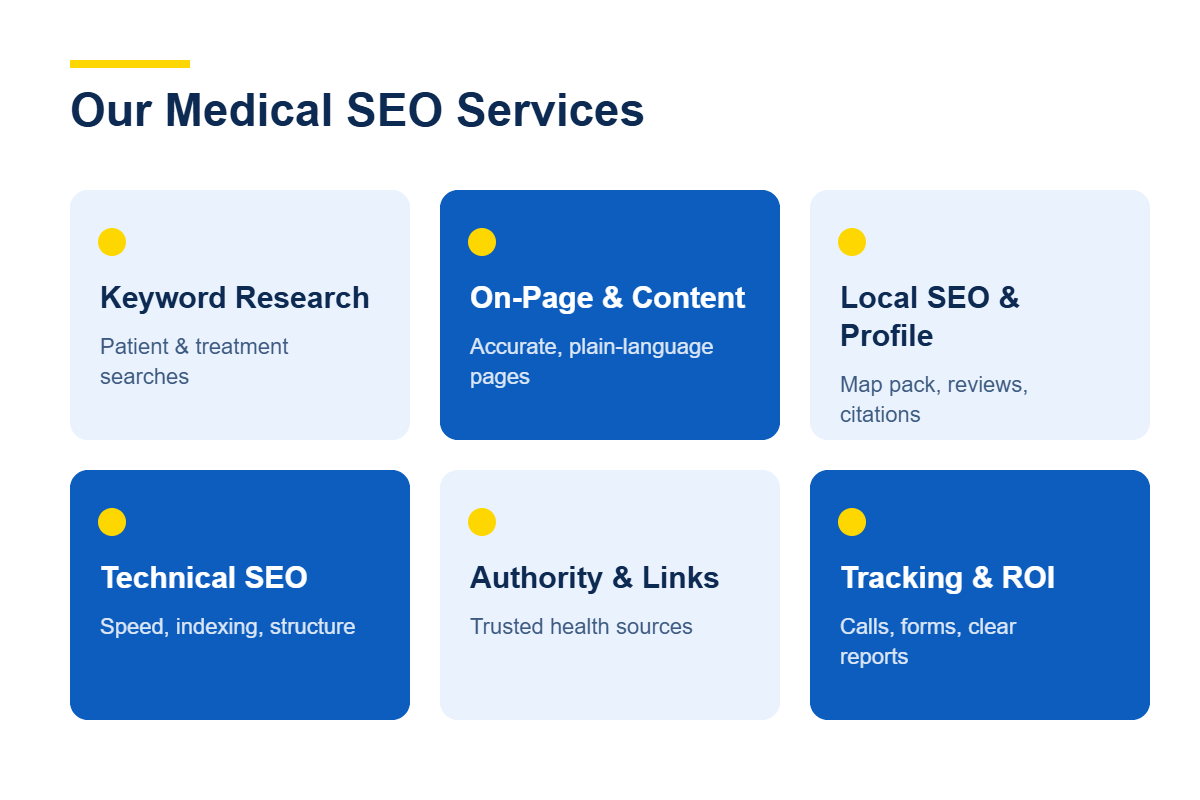
My medical SEO services
The same six areas, whether you run a single clinic or a growing group.
Keyword research for patient searches
I map the search terms that matter: condition keywords, treatment and procedure phrases, and the service queries people use when they are ready to book — weighing search volume against intent and finding the gaps your competitors missed.
For dental practices, the guide to dental SEO keywords groups the searches by treatment, NHS or private access, urgency and location, and explains how GDC, ASA and FCA rules limit the words a page can carry.
On-page optimisation and medical content
Title tags, meta descriptions and headings optimised across the site, plus service pages that answer what patients actually ask — medically accurate, written in plain language, with internal links guiding people from information to action.
Local SEO and Google Business Profile
For a clinic, the map pack is prime real estate. I optimise your profile, build consistent citations with matching NAP details, keep opening hours and location pages accurate, and put a sensible system behind reviews — so “near me” searches choose you. More on my local SEO service.
Technical SEO for healthcare websites
Clean crawling and indexing, a proper sitemap, healthy Core Web Vitals, fast page performance, HTTPS security and a logical structure. Patients never see this work — they just experience a site that loads quickly and works.
Authority building and trusted links
Rankings in a sensitive field depend on who vouches for you. I earn backlinks from relevant health publications, trusted directories and local sources — never bought-in shortcuts that put your domain at risk.
Tracking, reporting and ROI
GA4 and Search Console set up properly, with calls, form fills and booking clicks tracked. A clear weekly written report ties the work to return on investment — and if something is not working, you hear it from me first.
Patient reviews without breaking confidentiality
Reviews on your Business Profile count towards the map pack, and they are often the first thing a nervous patient reads. My guide to reviews and SEO sets out the general rules for asking for reviews and replying to them. In a clinic, three of those rules need more care.
- Never ask patients to name their clinician. Google’s Maps content policy says businesses should not ask for specific content in a review, and gives content that identifies a member of staff as an example. A “please mention your clinician by name” line in a follow-up message breaks that rule, however well meant. The same policy bans incentives, staff targets for reviews and asking only the patients you expect to be happy. I write one neutral request that your practice sends from its own booking system after the appointment, to every patient who has agreed to hear from you.
- Reply without confirming anything. The GMC’s Good medical practice says doctors must maintain patient confidentiality in all their professional written, verbal and digital communications, and a public reply to a review is one of them. Even confirming that someone is a patient says something about their health. So the replies I draft thank the reviewer, invite them to contact the practice directly, and say nothing about their care. For US practices I apply the same rule to protected health information.
- Reviews on your own website are your responsibility. Since 6 April 2025, the Digital Markets, Competition and Consumers Act 2024 has banned fake reviews and concealed incentivised reviews in the UK. The CMA’s fake reviews guidance (CMA208) says every business that publishes reviews or review information must take reasonable and proportionate steps to prevent and remove them, and should publish a policy that prohibits fake reviews. If your site shows patient testimonials or a star rating, I make sure that policy is published and that there is a process for checking reviews before and after they go up. In the US, the FTC’s rule on consumer reviews and testimonials has applied since 21 October 2024 and also covers review suppression, so a practice site should not quietly drop reviews because they are negative.
E-E-A-T and YMYL: the standard Google holds medical sites to
Google classifies health content as YMYL — “Your Money or Your Life” — because bad information here can genuinely harm someone. Its quality guidelines judge such pages on E-E-A-T: Experience, Expertise, Authoritativeness and Trustworthiness. In practice: author credentials matter, claims need cited sources, and clinician-reviewed content carries real weight. I build these trust signals in from the start — because in this field, meeting that standard is the ranking strategy.
AI search visibility for healthcare practices
AI Overviews and answer engines now sit above the traditional results, and a growing share of patients ask AI assistants instead of typing a query. I prepare your site for the shift: clean structured data and schema markup, clear entities (who you are, what you treat, where you are), and content formatted so generative results can cite you rather than lose you to a zero-click answer.
How we work — the process
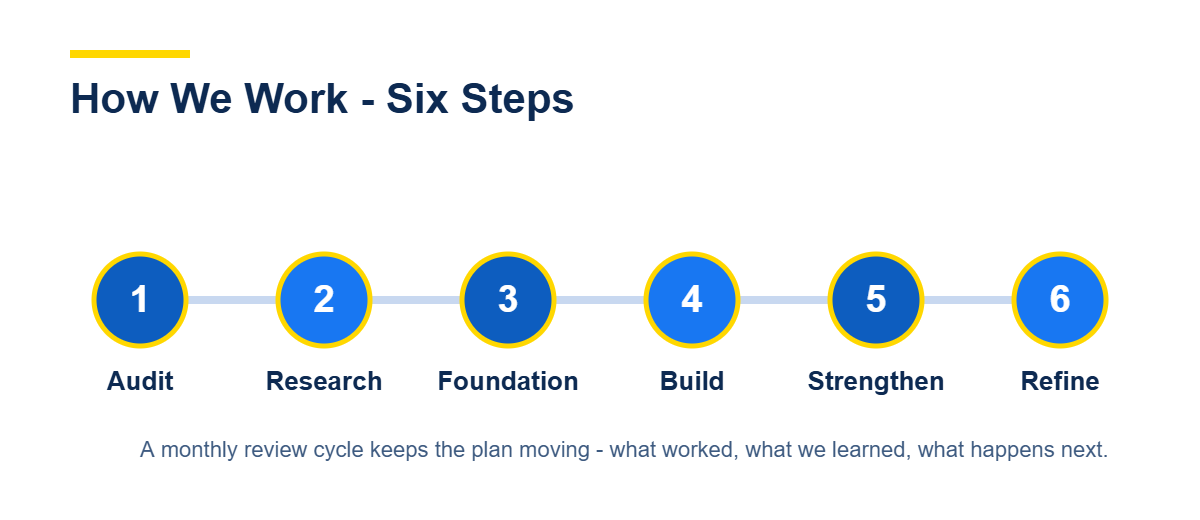
- Audit. Your site taken apart — what works, what is broken, what is missing.
- Research. Keyword and competitor research for your specialty and area, turned into a prioritised roadmap.
- Foundation. Technical base fixed first — no building on sand.
- Build. Content and local visibility rolled out month by month.
- Strengthen. Authority work begins once the foundation deserves it.
- Refine. A monthly review cycle: what moved, what I learned, what happens next.
Who we work with
SEO services for healthcare businesses of every shape: GPs and private clinics, dental practices (see dental SEO services), physiotherapy, mental health professionals, cosmetic and aesthetics clinics, care providers and health tech. Single-location or multi-location. See also my broader page on marketing for doctors and clinics.
SEO services for doctors, consultants and surgeons
For an individual clinician, the search that matters most is often your own name. A patient given your name by their GP or their insurer types it into Google before they book, and what comes back is typically a mix of hospital profiles, directories and official registers. You control only part of that page, so I work on both parts.
- Match the official records. Anyone can search the GMC’s registers to check a doctor’s registration status and whether they are on the GP or Specialist Register. Hospitals and consultants offering private treatment must also submit data to PHIN, which the Competition and Markets Authority approved in 2014 as the information organisation for private healthcare. Your own site should show the same name, specialty and GMC number as those records, and link to them, which makes it easier for search engines to connect every mention to the same person.
- Set up practitioner profiles correctly. Google’s Business Profile guidelines treat doctors as individual practitioners. Where several public-facing clinicians work at one location, the practice keeps its own profile and each clinician’s profile carries only their name, not the practice’s. For a sole practitioner at a branded clinic, Google’s advice is one shared profile named in the format “Brand: Practitioner name”. Support staff should not have profiles, and one clinician should not have several profiles for different specialisms. Google can suspend profiles that break these guidelines, so I audit them before optimising anything.
- Give each clinician a page that earns the click. Qualifications, registration number, special interests, where they practise and how to book, with structured data that ties the person to the practice. Every article they write or review links back to it, so a patient or a search engine can check the credentials behind the advice in one place.
Healthtech and healthcare SaaS SEO
Health tech is a different search problem. The person searching is often a practice manager, a clinical lead or a digital lead in an NHS organisation, not a patient. They search for the problem, the integration and the assurance: will this work with our systems, what evidence is behind it, and will it get through procurement?
- Answer the assurance questions on a page Google can crawl. NHS buyers assess digital health technologies against the Digital Technology Assessment Criteria (DTAC). NHS England has refreshed the DTAC form with fewer questions, and the old form was due to be retired by 6 April 2026. Every organisation with access to NHS patient data and systems must use the Data Security and Protection Toolkit, and NICE publishes an evidence standards framework for digital health technologies. A clear trust page that says where you stand on each one answers searches your product pages never reach.
- Keep claims inside the product’s intended purpose. The MHRA explains when software counts as a medical device, and in June 2026 the ASA ruled on three blood-pressure apps, one of which measured heart rate in a way that put it in medical-device territory (the ASA’s summary). Feature pages and keyword targets have to match what the software is intended and evidenced to do, so I agree the wording with your regulatory lead before anything is optimised.
- Separate the clinician track from the patient track. Pages for clinicians can go deeper and use clinical terms, while pages for patients need plain language. I keep them on separate URLs with separate keyword sets. The CAP Code exempts claims made to medical and allied practitioners only in media addressed solely to them, so a clinician page that anyone can open gets the same claim checks as a patient page.
Measurement follows the same rule as for clinics: demo requests and qualified conversations count, traffic for its own sake does not.
One agency, two markets: UK and US
In the UK, patients weigh NHS options against private care and visibility is won at postcode level. In the US, search is insurance-driven and city-level competition is fierce. Even the language differs — physiotherapy in one market is physical therapy in the other. A dedicated specialist, both markets, the same disciplined approach on either side of the Atlantic.
Compliance and patient privacy
Health data is not ordinary data. In the US I keep protected health information out of every tracking and measurement tool; in the UK the same setup follows UK GDPR. That means tracking that respects consent, and content that honours patient confidentiality and this sector’s advertising restrictions.
Advertising rules that shape a clinic’s SEO
In the UK, the advertising rules do not stop at paid ads. The CAP Code, which the Advertising Standards Authority enforces, also covers marketing on a business’s own website. Treatment pages, landing pages and any blog post that promotes a service you sell are in scope, so these rules decide which keywords a page can target and how it can be written.
- Prescription-only medicines. Rule 12.12 of the CAP Code’s health section says prescription-only medicines may not be advertised to the public. The ASA’s advice for clinic websites is to promote the consultation, not the medicine: no prescription-only medicine on the home page, including logos, testimonials and hover text, and only balanced, factual information on inner pages, presented as a possible outcome of the consultation. So we target the condition and the consultation (“a consultation for lines and wrinkles” is the ASA’s own example), never the name of a prescription-only medicine.
- Evidence before claims. The same section says objective claims must be backed by evidence, and that you need proof before suggesting a treatment is guaranteed to work, absolutely safe or without side-effects. The ASA’s advice adds that before-and-after photos for prescription-only treatments are likely to be read as a claim of efficacy, which makes them promotion and is not allowed.
- Doctors’ own duties. Good medical practice says doctors must not minimise or trivialise risks of harm or present opinion as established fact, and must not exploit people’s vulnerability or lack of medical knowledge when they advertise their services. A doctor-authored treatment page therefore sets out the risks next to the benefits.
- CQC ratings. In England, a CQC-registered service with a published rating must display it on websites where it describes the service, within 21 calendar days of publication. Some services, including primary dental care, are not rated. I check the CQC widget is on the right pages and that a redesign has not dropped it.
I am not a lawyer and I do not replace your clinical governance lead. I write inside these rules from the first draft, flag anything borderline for your sign-off, and check medicines questions against the MHRA’s Blue Guide.
Common healthcare SEO mistakes I fix
- One generic page trying to cover every treatment and area — so it ranks for none.
- Jargon nobody searches, while the phrases patients use go unanswered.
- Copy-paste content duplicated across locations.
- Risky shortcuts that trade a quick bump for a penalty.
- Guesswork without data — changes made on opinion, never measured.
What results to expect — and when
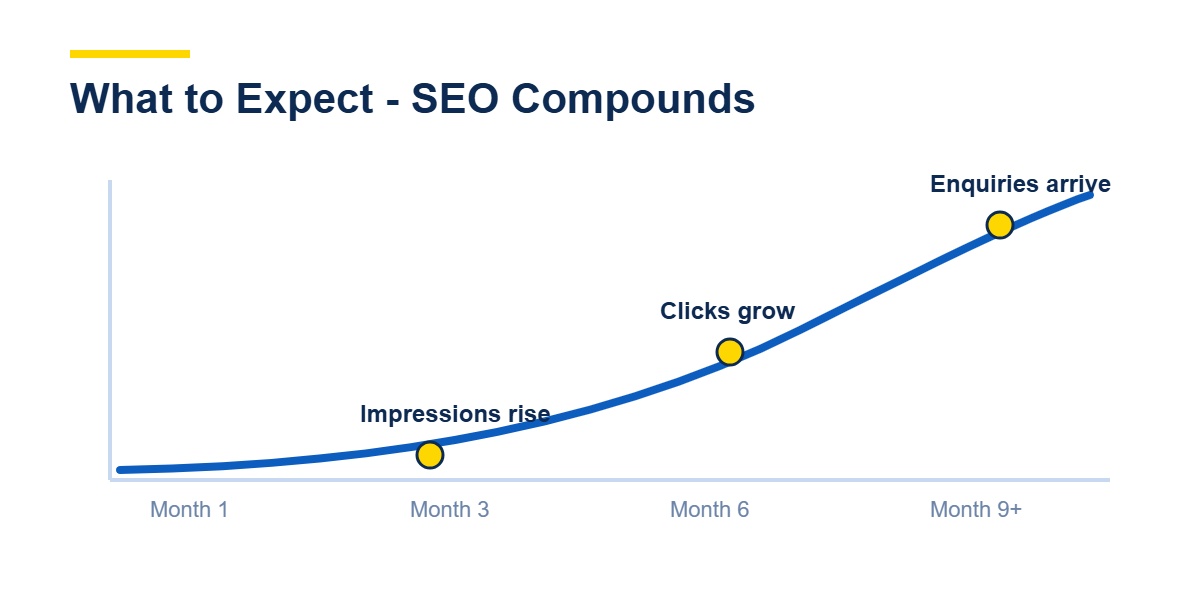
Honest answer: SEO compounds, it does not explode. Expect the first clear movement in 3–6 months — impressions rise first, then clicks, then enquiries — with momentum building from there. I promise the process and the effort, never a specific position. Anyone promising overnight rankings in this field is guessing or gambling with your domain.
Clinic SEO guides: medical SEO leads, on counting enquiries instead of rankings; SEO tools for medical practices, on what is worth paying for; the best medical SEO companies and how their rulebook differs; and, for paid campaigns alongside search, marketing for doctors and clinics.
Simple pricing
Straightforward monthly fees, simple packages, a clear list of what’s included — no long lock-in. SEO packages start at £299 a month on the pricing page. Every service uses the same three monthly prices: Basic £299, Standard £449 and Professional £649, per service, month to month. Ask for the right level for your practice size.
What practices ask first.
How long does healthcare SEO take to show results?
Typically 3–6 months for clear movement, with stronger compounding gains after that. Timelines depend on your starting point and local competition — I give an honest estimate after reviewing your site.
How much does medical SEO cost in the UK and US?
Most practices invest a fixed monthly amount based on scope and competition. SEO packages start at £299 a month on the pricing page. There are three levels, the same for every service: Basic £299, Standard £449 and Professional £649 a month, per service. Ask for a recommendation.
How is healthcare SEO different from normal SEO?
Health content is held to a much higher quality and trust standard, and patients search differently from ordinary consumers. Strategy, content and measurement all reflect that.
Can I do SEO for my clinic myself?
The basics, yes — and I will point you to them. The technical, content and authority work that moves competitive rankings is a specialist, ongoing job most clinicians do not have time for.
Do you need access to our patient data?
No. Nothing I do requires patient records, and measurement is set up so no sensitive information ever reaches any tool I use.
Do you work with single-location clinics?
Yes — single-location practices are often where SEO shows the fastest visible impact, because the target area is focused.
The parts this page leans on.
Tell us your treatments and your catchment.
That plus your website is enough for a free, no-obligation healthcare SEO audit — where you stand and what I would fix first.
What a client said, and what you can check
“Great communication and very helpful throughout the process. Took the time to explain everything clearly and set up the campaign professionally. Focused on quality results rather than just numbers. Highly recommended.”
This is one of three client reviews published so far; the other two, from a UK SEO client and a US Google Ads client, are on the home page. Every figure comes from the client’s own ad account, and a review goes on this site only when it is real.
What you can check before you pay
- Prices published in full on the pricing page, not hidden behind a sales call
- Month to month, with one month’s notice and no lock-in contract
- Every account, profile and file stays in your name; we work through partner access
- A written report every week, in plain English
- A dedicated specialist runs your account, from the audit to the report