Dental SEO services for dentists and practices
Patients open Google, search for a dentist, and book with whoever they find first. Straight-talking dental SEO for UK practices that gets you found – and turns visibility into booked appointments.

By Moeez Abbas
Published · Updated
What is dental SEO and why it is different
Dental SEO is search engine optimisation applied to a dental practice website: improving your rankings in organic search so patients find you when they need care. For most patients the journey starts on a phone, and the way they search is specific: they look up a symptom, compare practices, read about a treatment, and only then get in touch.
This is where the dental field differs from general SEO. Google holds health-related pages to a far higher bar than an ordinary business, because the care information on them affects real people. Getting a practice to rank means meeting that higher standard, not just ticking the usual optimisation boxes.
Why your practice isn’t getting found on Google
If your website exists but the appointment book stays quiet, one of these is usually why:
- Invisible in the local “dentist near me” map pack. Most patients tap one of the first practices shown – if you’re not there, nearby patients never see you.
- A slow or outdated website patients bounce from. Most dental browsing happens on a phone; a slow site sends people straight back to the results, and every bounce is a missed call.
- Ranking for the wrong terms. Traffic that isn’t for the treatments you want to attract earns nothing.
My dental SEO services
Six strands of work, whether you own one surgery or a group of practices. Here is what SEO for dentists looks like when it is done properly.
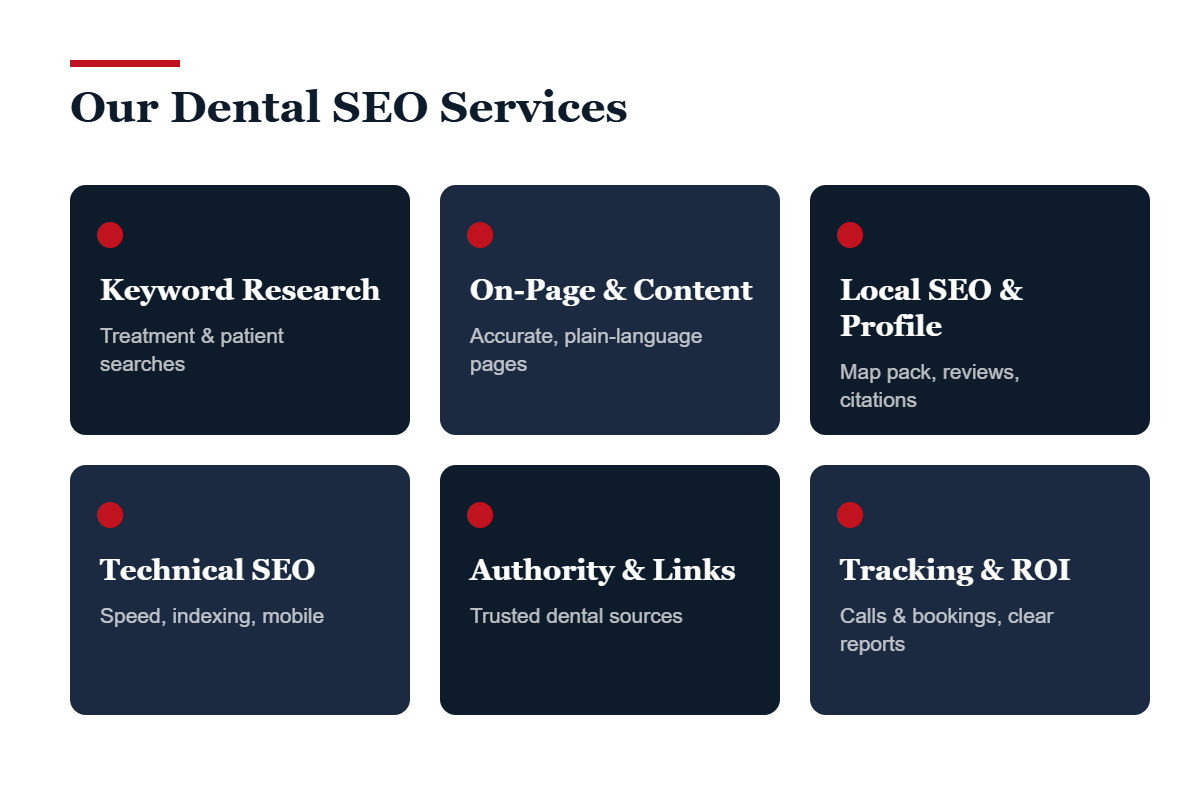
Keyword research for patient and treatment searches
I chart the searches that bring patients in: treatments such as implants, clear aligners and composite bonding, problems like a chipped tooth, and phrases typed by people ready to book. Each is judged on volume and intent, NHS or private, and on gaps rivals missed.
On-page optimisation and dental content
Headings, title tags and meta descriptions are reworked throughout. Treatment pages answer, accurately and in plain English, what patients ask before a consultation, without the “unjustified expectation” of results GDC guidance warns against, and link onward from reading to booking.
Local SEO and Google Business Profile
For a dental practice, the map pack matters most. I tidy the practice’s Business Profile (separate from dentists’ own profiles where several work there, per Google’s guidelines), match name, address and phone across directories, keep hours and location pages correct, and give reviews a steady routine – so “dentist near me” searches reach you. See my local SEO service.
Technical SEO for dental websites
Pages Google can crawl and index, an XML sitemap kept current, Core Web Vitals in good shape, smile-gallery images sized for phones, HTTPS throughout and a tidy hierarchy. None of it shows on screen; patients just find a site that opens quickly and works.
Authority building and trusted links
In dentistry, as in any health topic, rankings rest on which sites will vouch for you. I earn links from dental trade press, health sites, reputable directories and local community sources – never paid placements that could get your domain penalised.
Tracking, reporting and ROI
GA4 and Search Console configured properly, tracking what actually fills the diary: phone calls and online bookings, not rankings alone. A plain-English report each week tracks return on investment, and I flag anything falling short before you have to ask.
Business Profile set-up and the other listings patients check
Much of the local work for a practice happens inside the Business Profile itself, and the details matter. Google says the categories you choose affect your local ranking, and asks businesses not to add a category for every product or service. So I pick one primary category that describes the practice as a whole and add only the few extra categories that match real departments, not every item on the fee list. Google also lists health and beauty businesses among those that can add a booking button and a list of services. I point the booking link at the page where a patient can actually book, make the services list match the treatments you want enquiries for, and set special hours for bank holidays so nobody arrives at a locked door.
Google is not the only listing that counts for a UK practice:
- The NHS website. If you hold an NHS dental contract or agreement in England, the contract regulations require you to make sure NHS England has a comprehensive and accurate profile of your practice for the NHS.uk website, and to review it at least once in every 90 days. Patients reach that profile through the NHS Find a dentist search, so I check that its hours, services and contact details agree with your website and your Business Profile.
- Apple Maps and Bing. Apple Business (formerly Apple Business Connect) lets you claim your place card on Apple Maps and add your hours, including holiday hours, along with photos and your logo. Bing Places for Business does the same for Bing Maps.
I check all of these listings in the first month and again at each monthly review.
Patient reviews: more of them, within the rules
Reviews feed both the map pack and a patient’s choice of practice, but a dental practice has more rules around them than most businesses. This is the routine I set up:
- One request, sent to every patient. A short message after each appointment goes to everyone, not only the patients who seemed happy in the chair. Google’s Maps content policy does not allow businesses to selectively solicit positive reviews or to discourage negative ones.
- No incentives of any kind. No discount, free whitening or prize draw in return for a review. Google’s policy rules out incentives, and since 6 April 2025 UK law has banned submitting or commissioning fake reviews, and reviews that hide the fact they were incentivised (DMCC Act 2024, Schedule 20, paragraph 13).
- An honest picture on your own site. The same paragraph bans publishing reviews in a misleading way, which includes hiding negative reviews while showing positive ones, or giving the positive ones more prominence. The CMA sets out how it reads the rules in its fake reviews guidance (CMA208). If your website shows reviews, I link to or embed the full feed rather than a hand-picked set.
- Replies that protect confidentiality. The GDC’s guidance on social media says you must not publish information that could identify a patient without their explicit consent, and warns that details which are harmless on their own can identify someone when put together. I treat a public review reply the same way: the replies I draft thank the reviewer in general terms, never mention treatment, dates or fees, and invite anyone unhappy to contact the practice directly, where your complaints procedure takes over.
How reviews affect rankings in general is covered on my reviews and SEO page. For a practice, the aim is a steady flow of genuine reviews, and replies a regulator would be comfortable reading.
SEO for high-value treatments
Not every patient is worth the same to your practice, so I don’t treat every page the same. I build and optimise dedicated pages for your high-value treatments – implants, Invisalign and orthodontics, veneers, cosmetic dentistry, and emergency dental care – each targeting the way patients actually search for it. This is where a dental SEO expert earns their keep: capturing high-value private patients already looking for exactly what you offer, rather than chasing broad traffic that never converts.
Treatment pages, location pages and patient guides
A practice website needs three kinds of page, and each does a different job. Treatment pages, covered above, are for patients who are ready to book. Location pages and patient guides are easier to get wrong, so this is how I build them, along with the wording rule that runs through all three.
- One location page per real practice. A group with three sites gets three location pages, each with its own address, clinicians, opening hours, parking and transport details, and each linked from its own Business Profile. I do not build near-identical pages for every nearby town: Google’s spam policies give “pages targeted at specific regions or cities that funnel users to one page” as an example of doorway abuse.
- Patient guides for the research stage. Before they book, patients look for answers: what happens at an implant consultation, how clear aligners differ from fixed braces, what to do about a broken tooth out of hours. One clear guide per question, checked by one of your clinicians and linked to the matching treatment page, reaches patients well before they choose a practice.
- Wording that respects GDC titles. A practice may want to appear for searches that use the word “orthodontist”, but the GDC’s advertising guidance says a dentist who is not on one of its specialist lists must not use titles that imply specialist status, such as orthodontist, periodontist or endodontist, or describe themselves as “specialising in” a treatment. Unless your dentist is listed, I write for the same patients with “orthodontic treatment”, “braces” and “clear aligners”, and use the phrases the guidance allows: “special interest in”, “experienced in” or “practice limited to”.
To decide what to write first, I use the Search Console performance report to find treatment queries where one of your pages already appears just below the first page of results. Improving a page Google already shows is often quicker than ranking a new one, so those pages come first.
E-E-A-T, YMYL and compliance for dental websites
Google classifies health content as YMYL – “Your Money or Your Life” – because poor information can genuinely harm someone. Its quality guidelines judge these pages on E-E-A-T: Experience, Expertise, Authoritativeness and Trustworthiness, so clinician-reviewed content, visible credentials and cited sources carry real weight. On top of that, dental marketing in the UK sits under GDC advertising guidance, the ASA’s CAP Code and UK GDPR. I build these trust signals in from the start and keep your content within those standards – because in this field, meeting the bar is the ranking strategy.
What the GDC expects a practice website to show
The GDC’s guidance on advertising has a section on websites, and I check every practice site against it before optimising anything. If you are responsible for a practice website, you must make sure it displays:
- the practice name and the address where care is provided, with an email address and phone number;
- the GDC’s address and contact details, or a link to the GDC website;
- your complaints procedure, including who patients can contact if they are not satisfied with your response: the relevant NHS body for NHS treatment and the Dental Complaints Service for private treatment;
- the date the website was last updated.
Every dental professional named on the site as providing care also needs their professional qualification, the country it comes from and their GDC registration number, and the site has to be updated regularly so it reflects the people working at the practice now. The same guidance rules out comparing one dental professional’s skills or qualifications with another’s, and listing memberships, fellowships or honorary degrees as abbreviated letters. It also says practice publicity must make clear whether the practice is NHS, mixed or wholly private. The ASA adds that a dentist who uses “Dr” should take care not to imply a general medical qualification they do not hold.
Here compliance and search point the same way. A team page with a bio for each clinician, qualifications written out in full and a registration number patients can check on the GDC register gives each treatment page a named, checkable reviewer. I put the practice details and the “last updated” date in the site footer and give the complaints information its own page, so none of it drops off when pages are redesigned.
AI search visibility for dental practices
Google’s AI Overviews and other answer engines now appear above the ordinary listings, and more patients put dental questions to an AI assistant rather than a search box. I ready your site for that: tidy structured data and schema markup (schema.org has a dedicated Dentist type), plain facts on who you are, which treatments you offer and where the practice is, and pages laid out so AI answers can quote and credit you instead of a zero-click reply keeping the visit.
How we work – the process
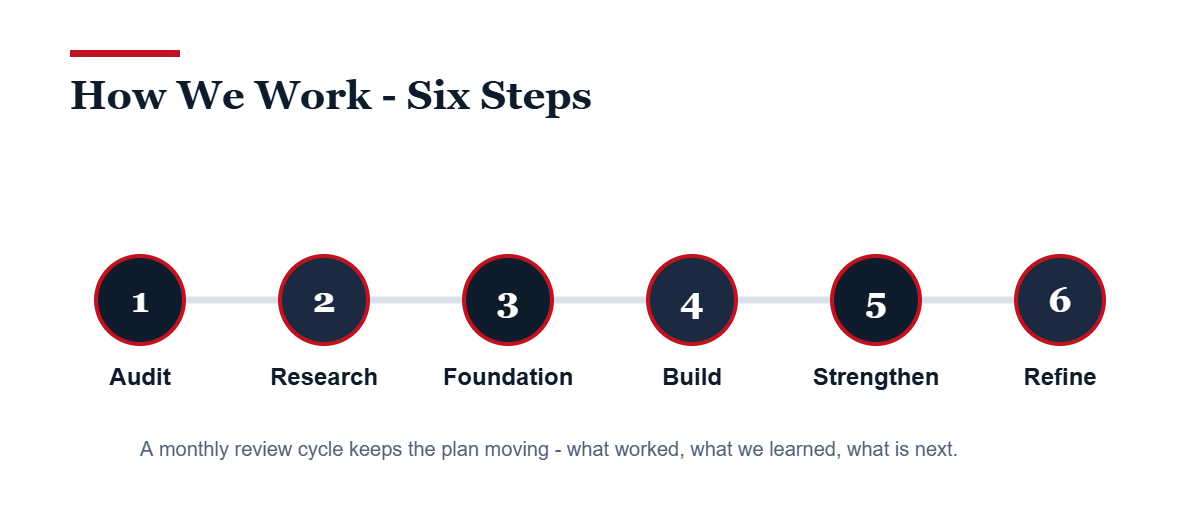
- Audit. Your current site checked end to end for strengths, faults and gaps.
- Research. Keyword and competitor research for your treatments and area, turned into a prioritised roadmap.
- Foundation. Technical faults are cleared before anything else is added.
- Build. Treatment pages and local presence grow in monthly stages.
- Strengthen. Link earning follows once the groundwork is solid.
- Refine. Every month: what shifted, what it taught me, and the next priority.
Who we work with
I work with dental practices of every shape: private practices, mixed NHS and private clinics, cosmetic and aesthetic clinics, orthodontists and implant clinics. Squat, single-location or multi-location – if patients are searching for what you do, I can help them find you. Dentistry is one part of how I help clinics grow; see my broader page on healthcare SEO for the wider picture.
Common dental SEO mistakes I fix
- One generic page trying to cover every treatment – so it ranks for none.
- Clinical terms like “malocclusion” instead of the plain words patients search.
- Ignoring the Google profile and reviews that drive local visibility.
- A slow mobile site that loses patients before they read a word.
- Buying links for a short-lived lift that can end in a penalty.
What results to expect – and when
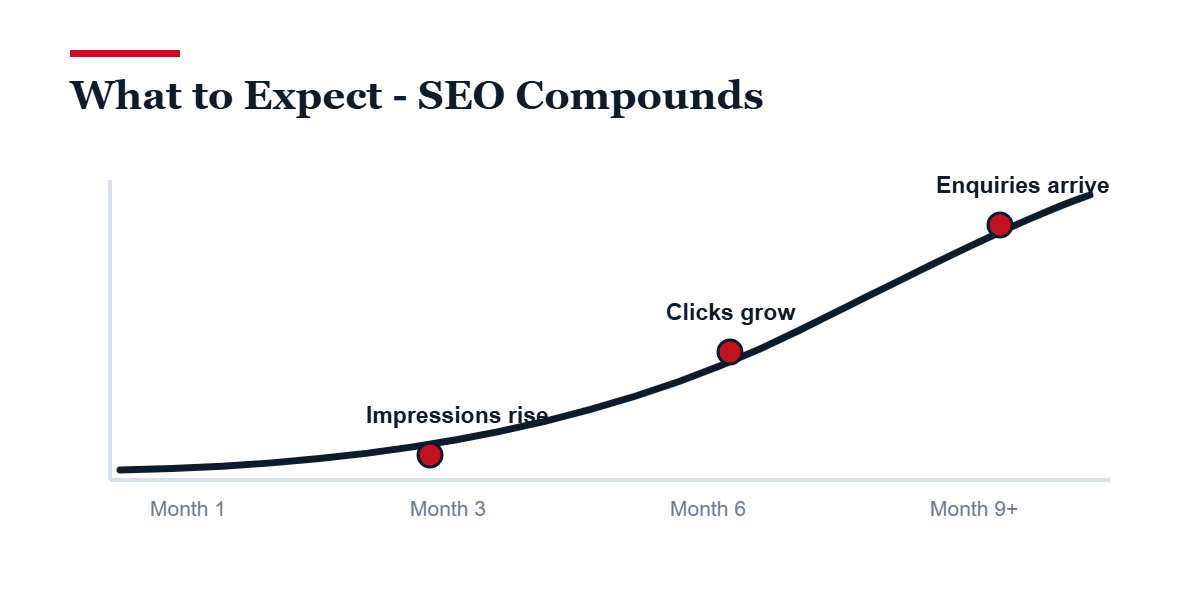
Honest answer: SEO compounds, it doesn’t explode. Expect the first clear movement in 3-6 months – impressions rise first, then clicks, then enquiries – with momentum building from there. You’ll see agencies promise guaranteed rankings or new patients in 90 days; I don’t, because no one can honestly guarantee a position on Google. I promise the process and the effort, report honestly against agreed milestones, and let the results speak.
Dental SEO guides: dental SEO keywords by treatment, NHS status and location; how to choose a dental SEO company from the published lists; and why a dental website isn’t ranking, with the free checks to run first.
Dental SEO alongside Google Ads
SEO builds over months, while a paid search campaign can start showing as soon as its ads are approved. For a squat practice with no rankings yet, a newly launched treatment or a quiet spell in the diary, I can run a tightly targeted Google Ads campaign while the organic work catches up. The two channels feed each other. The search terms report shows the searches that triggered your ads (Google leaves out terms used by too few people, for privacy) and, with conversion tracking in place, which of them led to calls or bookings. Those searches tell us which treatment pages and patient guides to write next, and once a treatment page ranks well, its ad budget can come down.
The advertising rules cover the ad and the page it sends patients to:
- Anti-wrinkle injections. If the practice offers them, the ASA states that Botox is a prescription-only medicine that cannot be advertised to the public (CAP Code rule 12.12), and that no reference to it should appear in a sponsored ad or on a website’s homepage. Google also restricts prescription drug terms in ads, landing pages and keywords. So the ad and the page behind it promote a consultation for lines and wrinkles, and I do not build search landing pages around the product name.
- Before-and-after photos. The ASA’s advice for the dental sector says before-and-after photos of dental treatment, whitening or straightening must be genuine and representative, and that you must hold signed and dated proof of this. I ask for that proof before any image goes into an ad or onto a treatment page.
Because we run both channels, the budget can go where it earns most. See my Google Ads management service for how I set up and run campaigns.
Simple pricing
Fees are plain monthly amounts in set packages, each listing exactly what it covers, clear from the start and with no long tie-in. One price list covers every service: Basic £299, Standard £449 or Professional £649 a month, per service. What each SEO level includes is listed on the pricing page. Google Ads, if you add it, is a second service at the same prices, with your ad budget paid separately and its scope agreed in writing before you pay. Ask which level suits your practice.
What practices ask first.
How long does dental SEO take to show results?
Expect clear movement within roughly 3–6 months, and bigger gains later. How quickly depends on where your site starts and how many practices compete nearby; I give a frank estimate after reviewing it.
How much does dental SEO cost in the UK?
A set monthly fee at one of three levels: Basic £299, Standard £449 or Professional £649 a month, per service. The right level depends on the scope of work and how crowded your local market is, and what each SEO level includes is listed on the pricing page. Ask and I will suggest one.
How is dental SEO different from normal SEO?
Dental pages are health information, so Google expects more care and expertise, and GDC advertising guidance applies too. Patients may want NHS or private care, and the plan covers both.
Will you need to see our patient records?
No. None of the work needs dental records, and tracking is built so no patient health details (special category data under UK GDPR) reach my tools.
Am I tied into a long contract?
No. I work month to month – if the work is good you’ll want to stay, and if it isn’t, you shouldn’t be locked in.
Do you work with single-location practices?
Yes. Practices with one site and a tight catchment often see dental SEO pay off soonest, since there is less ground to win.
The parts this page leans on.
Send me your treatment list and catchment area.
Add your website address and I can prepare a free dental SEO audit, with no obligation, showing your position today and the first fixes worth making.
What a client said, and what you can check
“Great communication and very helpful throughout the process. Took the time to explain everything clearly and set up the campaign professionally. Focused on quality results rather than just numbers. Highly recommended.”
This is one of three client reviews published so far; the other two, from a UK SEO client and a US Google Ads client, are on the home page. Every figure comes from the client’s own ad account, and a review goes on this site only when it is real.
What you can check before you pay
- Prices published in full on the pricing page, not hidden behind a sales call
- Month to month, with one month’s notice and no lock-in contract
- Every account, profile and file stays in your name; we work through partner access
- A written report every week, in plain English
- A dedicated specialist runs your account, from the audit to the report