
SEO for builders: how homeowners search, check and choose
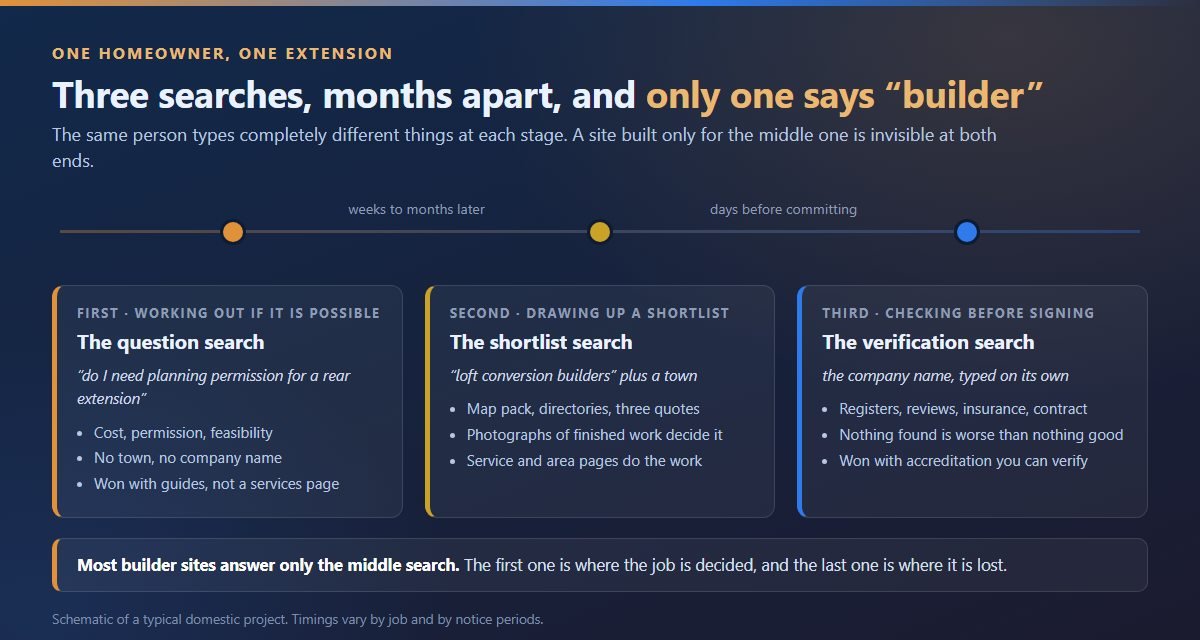
A homeowner planning an extension runs three completely different searches, months apart, and only one of them has the word builder in it. This page covers all three: the cost and permission questions typed first, the accreditations and registers checked last, and the project pages, photographs and profile settings that stand between them. Written by one person, Moeez Abbas, working remotely from Lahore for UK and US businesses.

SEO for builders, written for the domestic side of the trade
This page is about search for builders whose customer is a household. Extensions, loft conversions, garage conversions, renovations, and one-off new builds on a single plot. It is not about commercial work or public sector contracts, which have a different buyer and different searches, and are covered on the construction companies page.
The buyer here has usually never commissioned building work before. They are worried about paying a deposit to someone who disappears, they are holding two or three quotes they cannot properly compare, and by the time they reach a builder’s website they are checking rather than shopping. Search is where that checking happens: a cost question typed at midnight, a town-plus-job search a month later, a company name typed on its own the night before they commit.
Plainly, about who writes this. BoltClicks is one person, Moeez Abbas, working remotely from Lahore for businesses in the UK and the US. There is no UK office, no site visits and no van. The work is research, writing, technical fixes and search setup, done at a distance and handed over. Pricing is open on the pricing page: SEO packages start at £299 a month, monthly retainers start at £650, and there is a one-off SEO Foundation at £850.
What follows runs in three parts. How the search journey actually works for a domestic job, which trust signals survive a homeowner checking them, and what to build and publish. The groundwork every trade shares, from the Google Business Profile to citations, is covered in the trades SEO guide; this page stays with what is specific to domestic building. Every organisation, scheme and rule named below can be checked against the body that runs it.
Rules differ across England, Wales, Scotland and Northern Ireland. Where a scheme or a route applies in one nation only, this page says so rather than writing it as though the UK had a single rulebook.
One homeowner, three completely different searches
The person who signs a contract for a rear extension starts by searching things with no builder in them. They are working out whether the idea is possible and what it might cost, long before a company name gets typed.
Some of those early searches are for an architect rather than a builder. For design practices, the guide to SEO keywords for architects, written for American firms, groups those searches by project, place and stage of decision.
The length of that gap is not guesswork. Under the Party Wall etc. Act 1996, in force since 1 July 1997 and applying throughout England and Wales, notice for work to an existing party wall must be served at least two months before the planned start, and notice for excavation under section 6, or a new boundary wall under section 1, at least one month before. Add a planning route, a design and three quotes, and the search that produced a summer job happened in a different season. Where the design comes from an architect, that stage has searches of its own, covered in SEO for architects.
| Phase | What gets typed | What the searcher wants |
|---|---|---|
| Early research | Cost and feasibility, and permission questions: does an extension need an application, is a loft conversion notifiable | An answer, not a quote. Pushing a price this early loses them |
| Shortlisting | Near-me searches, and town-plus-job searches: extension, loft conversion, renovation | The same job, done nearby, with photographs of the finished thing |
| Verification | A company name alone, a name plus reviews, a name typed into a register or into Companies House | Proof the firm is real, insured and still trading under that name |
A site written only for the middle row leaves the other two rows to somebody else. The first is question territory rather than sales territory. The third is where a job is quietly lost.
Seasonality is real without an invented percentage. The Office for National Statistics publishes a monthly Construction output in Great Britain bulletin, including private housing repair and maintenance, and seasonally adjusts it using the X-13-ARIMA-SEATS approach, which removes variation associated with the time of year or calendar arrangement. A statistics agency stripping the calendar out of a series is clear evidence that the raw series moves with it. For direction, open a named release: the State of Trade Survey, a joint Federation of Master Builders and Chartered Institute of Building publication covering micro and SME building firms, published twice a year, with the H2 2025 edition released in March 2026; or the monthly S&P Global / CIPS UK Construction PMI.
- The early searcher is not a lost lead. They are a lead at the stage where nobody is competing for them on price.
- Lead time is structural. Notice periods, design and comparison shopping sit between the first search and the first spade.
- Publish ahead of the season. The page has to be live before the season it serves.
The questions a builder can realistically own
Permission questions sit right at the front of the journey, and they are easy to answer badly, because much of what is published about them is written as though the UK had a single rulebook. It does not.
The Planning Portal presents its permitted development guidance under an England region selector, governed by the Town and Country Planning (General Permitted Development) (England) Order 2015. It states that the rights applying to many common projects for houses do not apply to flats, maisonettes or other buildings, and that commercial properties have different rights. Scotland, Wales and Northern Ireland run separate regimes, so “permitted development in the UK” is wrong in three nations at once.
Questions with a real answer
- A Lawful Development Certificate, which the Planning Portal calls proof that household building work is lawful and states is “not the same as planning permission”. The council issues it, and a fee applies
- Prior approval, the middle category homeowners never expect: the authority considers proposals and their likely impacts in regard to certain factors, such as transport and highways
- An Article 4 direction, made, in the Portal’s words, “when the character of an area of acknowledged importance would be threatened”, plus conservation areas, national parks and listed buildings, where permission is needed for work that needs none elsewhere
Where the terminology changes by nation
- England and Wales: building control, with Local Authority Building Control as the membership body and Registered Building Inspector as the current term for an individual. From 6 April 2024 Approved Inspectors were replaced by Registered Building Control Approvers, under the Building (Registered Building Control Approvers etc.) Regulations 2024 in England and parallel Welsh regulations made the same year. Copy still saying “Approved Inspector” is out of date
- Scotland: a building warrant, granted by the local authority acting as verifier before work starts, submitted through eBuilding Standards Scotland, where most applications require a fee, then a completion certificate accepted by that verifier before the building can be occupied. Local Authority Building Standards Scotland represents the building standards services of Scotland’s 32 local authorities, which it says employ around 500 surveyors, inspectors and support staff
- Northern Ireland: applications go to one of eleven district council Building Control offices, grouped voluntarily as Building Control Northern Ireland, under the Building Regulations (Northern Ireland) 2012, made by the Department of Finance and supported by Technical Booklets rather than Approved Documents. The routes are a Full Plans application or a Building Notice
Two more clusters sit almost untouched. The Joint Contracts Tribunal publishes a Building Contract for a Home Owner/Occupier, and a version with a Consultancy Agreement where a consultant administers it; the RIBA Domestic Building Contract covers “all domestic (non-commercial) projects, including renovations extensions, maintenance and new buildings” and is “endorsed and supported by the HomeOwners Alliance”. Section 106 of the Construction Act puts a contract with a residential occupier outside the statutory payment and adjudication regime, yet both of these contracts provide for adjudication by agreement anyway. Then VAT: under Notice 708 the construction of a new qualifying dwelling is zero-rated, while an extension, a loft conversion or work to an existing dwelling is standard-rated, with a 5% reduced rate for homes empty at least two years and for conversions that change the number of dwellings.
- Never write a rule as UK-wide. The FMB publishes separate policy manifestos for Wales and for Scotland; the nations genuinely differ.
- Answer the question fully, then stop. These pages earn the enquiry by being useful.
- Date what you cite. Section and instrument numbers separate an original page from a scraped one.
What a homeowner is told to check, and what they actually check
There is no general licence to trade as a builder in the UK. The Federation of Master Builders publishes “Licence to Build: A model for licensing domestic building companies” (20 May 2025) alongside FMB / HomeOwners Alliance Licensing Research 2025 (7 May 2025). A trade body campaigning for licensing is plain evidence of the gap that voluntary accreditation fills.
TrustMark describes itself as the only UK Government-endorsed quality scheme for work carried out in and around the home. It licenses Scheme Providers, who in turn register businesses rather than selling listings directly; TrustMark’s website states over 18,000 Registered Businesses across more than 40 Scheme Providers. The FMB runs a Find a Builder directory and says vetting covers trading history, credit history, proof of public liability insurance and director checks, with work inspected before joining and monitored afterwards. It offers a government-approved dispute resolution service free to members and their clients.
Then the statutory registers, where names move. GOV.UK maintains the list of authorised competent person schemes whose installers can self-certify certain building work instead of getting building regulations approval; it covers work in England and Wales, and was updated on 17 September 2026. Use the registered forms: Certsure LLP, which trades as NICEIC, and NAPIT Registration Limited for electrical work, Fensa Limited and Certass Limited for glazing, HETAS Limited, Oil Firing Technical Association Limited, National Federation of Roofing Contractors Limited under the short name CompetentRoofer, and Capita Gas Registration and Ancillary Services Limited, the Gas Safe Register. That update’s change note reads: “Cavity Insulation Guarantee Agency Limited (CIGA) has been replaced on the current schemes list by the Installation Assurance Authority (IAA).” A page still listing CIGA is publishing a scheme the register has removed.
What homeowners actually check is different, and splits by age. Research published by the FMB and the HomeOwners Alliance on 2 June 2026 found one in three homeowners under 35 rely on online reviews when hiring a builder, against 16% of over-55s; just 8% of under-35s check whether a builder belongs to a trade body such as the FMB, against 21% of over-55s; and only 15% verify formal qualifications such as Gas Safe registration, against 27% of older homeowners. Almost a quarter, 24%, of younger homeowners use comparison platforms, and they are twice as likely as the overall average to judge a builder on website and branding, 20% against 9%.
- Put the checkable facts where they are searched. Company name, number and registered address, matching the free Companies House service, which shows current and resigned officers, previous company names and insolvency information.
- Answer the insurance question first. HomeOwners Alliance guidance tells homeowners to ask for evidence of public and employers’ liability insurance, bank, contract and customer references, and whether subcontractors are used.
- Explain the warranty gap. Homeowners hear NHBC Buildmark, LABC Warranty and Premier Guarantee and assume cover follows into an extension. The HomeOwners Alliance states work a homeowner arranges themselves, such as loft conversions or conservatories, is not covered by an existing new home warranty and could invalidate it.
- Set out payment structure plainly. Staged payments against milestones, provisional sums for unforeseen work, and retention: the HomeOwners Alliance suggests considering 5% held until completion.
- Own the surfaces you send people to. A Google Business Profile with photographs of completed jobs, service-area setup for a firm with no shopfront, and recent reviews.
A builder’s own site will not out-rank a directory at being a directory: Checkatrade, MyBuilder, TrustATrader, Which? Trusted Traders and Trustpilot take those queries. What a builder’s own site can take is narrower. Its own name, the specific job in the specific town, and the permission question nobody has answered for the right nation.
Enquiries rented from a platform stop the day the spend stops. The searches above belong to whoever answered them first.
Badges a homeowner can actually verify
Someone comparing three quotes for an extension is looking for a reason to rule one builder out. Every credential on the site is either checkable on somebody else’s register or it is decoration. Only the checkable ones earn a page: they give search engines a named entity to attach you to, and send the customer somewhere that is not your site.
TrustMark calls itself “the Government Endorsed Quality Scheme” for work a consumer chooses to have done in or around their home. Builders join through an approved Scheme Provider, not TrustMark directly, so name the provider rather than just the logo. It requires Registered Businesses to provide “a minimum of two-years financial protection for completed works”, covering deposits and other prepayments, “2-Year Post Completion of Workmanship”, rectification of defects and non-compliance with Building Regulations, and major damage or injury through public liability insurance. Its Financial Protection Panel assesses the mechanisms providers submit.
Schemes that inspect the work
- The Federation of Master Builders, founded in 1941, describes itself as “the largest trade association in the UK construction industry” and works across England, Northern Ireland, Scotland and Wales. Applicants are checked on trading history, credit history and proof of public liability insurance.
- FMB inspectors review work “from foundations to completion on site, photographs from earlier stages, and relevant drawings or certificates”. The FMB also runs what it calls a “government approved disputes resolution service”, free to members and their clients.
- The Chartered Institute of Building runs a Chartered Building Company and Consultancy scheme, which assesses the business rather than an individual and requires chartered membership at board level, with reassessment on a fixed cycle.
Schemes that admit or assess
- The National Federation of Builders is a long-established trade association whose divisions include the House Builders Association and NFB Cymru. Membership brings model contract documents, subsidised training and CITB grant support. Valuable, but not an inspection of the work.
- Buy With Confidence “is operated solely by local authority Trading Standards services… not by third parties or private companies.” Coverage depends on which councils take part, so it is patchy.
- Which? Trusted Traders endorses traders who pass an assessment by a Which? trading standards professional: credit report, customer references and an assessment at the trader’s premises, face-to-face or by video call. Disputes run through Dispute Resolution Ombudsman after eight weeks.
Joined a body, or passed an inspection: that distinction is worth explaining to a first-time client, because almost nobody else does. The meta-credential is the Chartered Trading Standards Institute’s Approved Code Scheme, renamed from the Consumer Codes Approval Scheme in June 2024.
Directory profiles compete with your own site in local results, so explain them rather than ignore them. Checkatrade’s materials describe up to 12 checks before a profile goes live: photo ID, proof of trading address, qualifications with currency checks, credit and CCJ checks, and disqualified-director checks.
The paperwork a finished job should produce
Competent person schemes let a registered installer self-certify that specified work complies with the Building Regulations. GOV.UK puts it plainly: “You do not need to get approval yourself if you use someone registered with a competent person scheme.” That covers only the specific notifiable work, never the whole project, so a builder subcontracting electrics, gas or glazing should say whose registration covers what.
Certsure LLP, which trades as NICEIC, is listed against a wide scope: insulation, combustion appliances, electrical, heating and hot water, ventilation, plumbing, windows and doors, and microgeneration. NAPIT Registration Limited, which states it has over 22,000 registered installers across the UK, runs a competent person scheme, an MCS scheme and TrustMark Scheme Operator status, which is how one certificate can carry three logos. Gas sits with Capita Gas Registration and Ancillary Services Limited, short name Gas Safe Register, run for the Health and Safety Executive since it replaced CORGI in April 2009.
- Glazing. Fensa Limited, a GGF Group company, monitors building regulation compliance for replacement windows and doors in England and Wales; GOV.UK lists roof windows and rooflights too. Certass Limited is the main alternative.
- Heat and flues. HETAS Limited covers combustion appliances (solid fuel), heating, plumbing and microgeneration. OFTEC, established in 1991, runs schemes covering England, Wales, Scotland, Northern Ireland, the Isle of Man and the Channel Islands, and provides a workmanship warranty on self-certified work in residential dwellings.
- Roofs, services, air testing. The register lists National Federation of Roofing Contractors Limited under the short name “CompetentRoofer”, though the scheme now brands itself the NFRC Competent Person Scheme. BESCA and APHC cover building services, the British Board of Agrément covers wall insulation, and ATTMA and the Elmhurst Airtightness Scheme cover air pressure testing.
- Schemes change. Assure Certification Limited, Blue Flame Certification Limited and the Installation Assurance Authority are also listed, and the register records that Cavity Insulation Guarantee Agency Limited (CIGA) has been replaced by the Installation Assurance Authority as of 17 September 2026. Any page still naming CIGA is out of date.
Approval comes from the local authority’s building control department or a registered building control approver, the current GOV.UK term for the role that replaced “approved inspector”. GOV.UK warns that without approval you could be prosecuted and fined, and “you will not have the certificates of compliance you may need when you want to sell your home.” The higher-risk building regime, which turns on buildings of at least 18 metres or seven storeys containing at least two residential units, is almost never relevant to a domestic job.
None of this is UK-wide. The Scottish Government calls the Building (Scotland) Act 2003 “the primary legislation under which Scotland’s building standards system operates”, in force since 2005, with councils as verifiers granting the building warrant and accepting the completion certificate. LABSS says “certification supports verification through an optional non-mandatory route”: SELECT and NICEIC for electrical work to BS 7671, SNIPEF for drainage, plumbing and heating, SER Ltd for structural design, RIAS and BRE for energy design. Wales runs its own regime, and gov.wales has published transitional arrangements for a new building control regime starting on 1 July 2026, which brings a dutyholder regime and, for higher-risk work, new approval gateways. In Northern Ireland the Building Regulations (Northern Ireland) 2012 are administered by district councils. A Fensa certificate is not a Scottish or Northern Irish document.
The questions a nervous client asks last
Two insurances get collapsed into one word. Public liability responds to injury to third parties and damage to the homeowner’s existing property, the mechanism TrustMark names for “major damage or injury”. Contract works, or contractors’ all risks, covers the works themselves against fire, flood or theft. They are not substitutes. The Employers’ Liability (Compulsory Insurance) Act 1969 makes a third compulsory where a builder employs people. Tell a homeowner to verify each certificate with the insurer.
Contracts are the next gap. The Joint Contracts Tribunal publishes a Building Contract for a Home Owner/Occupier in two variants, with and without a consultant administering it. RIBA’s Domestic Building Contract covers “renovations, extensions, maintenance and new buildings”, and RIBA states it is “endorsed and supported by the HomeOwners Alliance”. Underneath either sits the Consumer Rights Act 2015: reasonable care and skill (s.49), information the trader gives that the consumer takes into account becoming binding (s.50), a reasonable price where none is fixed (s.51), and performance within a reasonable time (s.52). Section 50 should change how a builder writes, because what the website says can become a contract term.
Warranties are for new homes
- NHBC has operated since 1936. Buildmark covers new-build and newly-converted homes as “a two-year builder warranty and then eight years of insurance cover”. It is not extension cover.
- LABC Warranty protects “against defects in new buildings, normally for a period of 10 years after completion”, with deposit protection if the developer goes insolvent mid-build. It partners with Local Authority Building Control.
- Premier Guarantee and Checkmate are the other providers whose policies the Consumer Code for Home Builders applies to.
Codes are for registered developers
- The Consumer Code for Home Builders, in place since 2010, covers advertising, pre-contract information, after-sales service and complaints, and offers an independent dispute resolution service run by CEDR, free to the home buyer.
- The New Homes Quality Code applies to developers on the NHQB Register. Version 2 came into effect on 2 March 2026, and earlier reservations stay under the first edition. New Homes Ombudsman Service decisions bind them.
- Neither covers an extension. Naming that boundary beats borrowing the reassurance.
Reviews do a great deal of work in local search, and they are now the part of it most tightly governed. Google permits businesses to “solicit or encourage the posting of content that does represent a genuine experience, without offering incentives”, but prohibits “incentives… in exchange for posting any review”, and prohibits businesses that “discourage or prohibit negative reviews, or selectively solicit positive reviews from customers”. The Digital Markets, Competition and Consumers Act 2024 went further: its fake review provisions came into force on 6 April 2025, with CMA guidance published on 4 April 2025. Review gating is not a grey area any more.
The Party Wall etc. Act 1996 covers construction at boundaries, excavation and foundations near adjacent structures, with the notice periods set out earlier and a binding Award where consent is withheld. RICS states that “party wall legislation applies only to England and Wales and does not exist in Scotland and Northern Ireland”, and that a surveyor appointed under the Act “is under a duty to act impartially regardless of who appointed them”; firms can be checked on ricsfirms.com. Under CDM 2015, a household’s client duties pass to the contractor, or the principal contractor where there is more than one.
The finished job is the page nobody has written yet
A household buying an extension or a loft conversion cannot inspect what they are buying, has never met the person selling it, and is holding three quotes. The answer is already on a phone: last year’s finished jobs, photographed and written up nowhere.
A project page treats one of them as a page in its own right, not a caption under a gallery tile, named for the job type and the town because that is how the search gets typed.
- The brief in the household’s words. A rear extension on a 1930s semi to move the kitchen to the garden.
- The consent route. Permitted development or a full application, and what decided it.
- The building control route. Which route, and who certified each element.
- The constraint. The party wall, the drain run, the neighbour’s window.
- The sequence. Before, mid-build and finished, with staged payment points in plain words.
Planning, as a homeowner meets it
- The Planning Portal’s extensions guidance “relates to the planning regime for England, the policy in Wales may differ”, so an English page cannot simply be reworded for a Welsh town.
- Its limits are specific: only half the land around the “original house” covered by extensions, nothing forward of the “principal elevation”, side extensions single storey and at most half the width of the original house.
- The Party Wall etc. Act 1996 “Applies to England and Wales”, covering work to a party wall, new building at the boundary, and excavation near to and below neighbouring foundation level.
Building control, as a homeowner meets it
- Building regulations approval is dealt with separately from planning permission, which is a common confusion.
- For work that is not higher-risk, GOV.UK gives two routes: the local authority building control department, or “a private registered building control approver”. Approved inspector is no longer the term.
- The third is self-certification under a competent person scheme, with no separate building control for that element. GOV.UK lists the authorised schemes for England and Wales: ATTMA, APHC, ASSURE, Blue Flame Certification, BBA, BESCA, Gas Safe Register, CERTASS, Certsure, EAS, Fensa, HETAS, IAA, NAPIT, CompetentRoofer and OFTEC.
Accreditation belongs here as substance, not a logo wall. Google asks whether content shows “first-hand expertise and a depth of knowledge” and whether pages “carry a byline, where one might be expected”, and says “trust is most important”. Name the builder who did the work.
- Federation of Master Builders. A UK trade association for sole traders and small and medium-sized construction firms. Vetting covers trading history, credit history, director checks and public liability insurance; then “an assessor will be in touch to visit one of your sites to carry out an inspection of your work”. Applicants need twelve months’ trading.
- Which? Trusted Traders. Assessed by “Trading Standards qualified assessors”, with DBS checks and customer reference calls; eligibility needs “at least six months” trading and “no county court judgements (CCJs)”.
- TrustMark. “The Government Endorsed Quality Scheme”, registered through licensed Scheme Providers rather than directly.
An image-heavy site breaks in predictable places
Photographs of finished work are taken at a customer’s home, and phones can geotag, so publishing the camera roll untouched can publish a client’s home location as coordinates. Phone settings can turn tagging off, and ExifTool, Phil Harvey’s Perl library and command-line application, reads, writes and deletes EXIF, GPS, IPTC and XMP metadata, though it “is not guaranteed to remove metadata completely from a file”.
Those photographs are original licensable assets that directories lift. ImageObject needs contentUrl plus at least one of creator, creditText, copyrightNotice or license, with acquireLicensePage recommended. Embedded IPTC Photo Metadata is the alternative: Google reads Copyright Notice, Creator, Credit Line, Licensor URL and Web Statement of Rights, the last required for the licensable badge, and uses the structured data where the two conflict.
Google’s own example is that “my-new-black-kitten.jpg is better than IMG00023.JPG”, and IMG00023.JPG is what comes off a builder’s phone. Alt text wants to be descriptive and contextual. Supported formats are BMP, GIF, JPEG, PNG, WebP, SVG and AVIF, and image sitemaps may point at other domains, so a gallery on a CDN is fine.
| Metric | Threshold | What breaks it |
|---|---|---|
| Largest Contentful Paint | Within 2.5 seconds of when the page starts loading | A 4,000-pixel phone photo as the page hero |
| Interaction to Next Paint | 200 milliseconds or less | Lightbox and slider scripts loaded site-wide |
| Cumulative Layout Shift | 0.1 or less | Gallery images with no dimensions |
These are met at the 75th percentile of page loads, mobile and desktop separately, which matters because a site-wide average can hide gallery pages that are both the heaviest and among the most visited. INP replaced First Input Delay in 2024, so advice naming FID is stale.
Structured data that applies
- schema.org defines HomeAndConstructionBusiness as “a LocalBusiness that provides services around homes and buildings”, with eight subtypes: Electrician, GeneralContractor, HVACBusiness, HousePainter, Locksmith, MovingCompany, Plumber and RoofingContractor. There is no Builder type, so GeneralContractor is the specific one.
- Google requires only name and address for LocalBusiness, recommends geo, openingHoursSpecification, priceRange, telephone, url, aggregateRating and review, and says “Use the most specific LocalBusiness sub-type possible”.
Structured data that buys nothing
- FAQPage. Google’s documentation changelog states the FAQ rich result “is no longer shown in Google Search results”; it stopped for every site on 7 May 2026, and HowTo rich results ended in 2023, so the markup is kept only as a machine-readable description of the page.
- areaServed. Valid schema.org, but Google’s LocalBusiness documentation does not list it, so service area schema is no ranking lever.
- Never lazy-load the image that sells the job. web.dev is blunt: “Never lazy-load your LCP image, as that will always lead to unnecessary resource load delay.” A gallery plugin applying
loading="lazy"site-wide does exactly that to every project page hero. - Use fetchpriority sparingly. Set it high on the likely LCP image only, since “setting a high priority on more than one or two images makes priority setting unhelpful in reducing LCP”.
- Serve the right size. Google recommends the picture element or srcset, and advises always specifying a fallback URL using the src attribute. Responsive sizing, WebP or AVIF and an image CDN are the levers.
Where you work, and who vouches for you
Service-plus-place pages are where builder sites get sold something dangerous. Google defines doorway abuse as “when sites or pages are created to rank for specific, similar search queries”, naming “pages targeted at specific regions or cities that funnel users to one page”. Scaled content abuse adds the modern version: pages “generated for the primary purpose of manipulating search rankings”, generative AI included. An offer of 200 location pages is that policy read back.
The test is whether a page is a destination or a funnel. A town page earns its place when it holds work actually done there: project pages, the housing stock an estimate must deal with, the conservation area that changes the window specification. Eight or ten towns, not eighty.
- Relevance, distance and popularity. Google’s help page says local results rest mainly on these three. Distance is “how far each business is from the customer who’s searching”, which is why no amount of content wins the map pack 40 miles away.
- Hide the address. “If you’re a service-area business, you should hide your business address from customers.” A rented mailing address the business does not operate from is not eligible.
- Set the service area honestly. It “shouldn’t extend farther than about 2 hours of driving time from where your business is based”, though “For some businesses, larger service areas may be appropriate”. One profile per location, so no profile per town.
- Take video verification. Google asks for street signs, then “branded equipment, marketing materials, or tools you use to serve customers”, then “your keys to open your facility”. A branded van, workwear, tools and a lock-up key, no shopfront needed.
- Finish the profile. Right category, complete hours including special hours, photos and videos, and “More reviews and positive ratings can help your business’s local ranking”.
That last line is where the law sets a ceiling. Under the Digital Markets, Competition and Consumers Act 2024, fake reviews, concealed incentivised reviews and misleading presentation, including hiding negative ones or ratings that give an inaccurate picture, became banned practices on the date given earlier. The Competition and Markets Authority enforces them; they are automatically unfair, with no need to show a consumer’s decision was affected, and fines can reach 10% of global turnover. Work from the CMA’s fake reviews guidance, CMA208. “Only ask the customers you know are happy” now sits on the wrong side of the line.
The platforms go further. Google’s contributor policy wants contributions that “reflect a genuine experience at a place or business”, bans merchants offering payment, discounts or free goods “in exchange for posting any review”, and adds that “merchants should not require or pressure users to leave ratings or write reviews while on the premises”, “nor should they request that specific content be included”. Asking on the last day with a town name requested breaks two clauses. Trustpilot is as direct, stating that it does not allow incentivised reviews, prize draw entries included.
One paid-side correction, since this market repeats the opposite. Local Services Ads is Google’s lead format for service businesses and the United Kingdom is a listed country, but “Local Services Ads are available only for certain service categories”, and the category list has to be checked in Google’s own tool rather than assumed. Since 20 October 2025 the separate badges have been consolidated into a single Google Verified badge, and the money-back guarantee that came with the old Google Guarantee has ended.
What a client said, and what you can check
“Great communication and very helpful throughout the process. Took the time to explain everything clearly and set up the campaign professionally. Focused on quality results rather than just numbers. Highly recommended.”
This is one of three client reviews published so far; the other two, from a UK SEO client and a US Google Ads client, are on the home page. Every figure comes from the client’s own ad account, and a review goes on this site only when it is real.
What you can check before you pay
- Prices published in full on the pricing page, not hidden behind a sales call
- Month to month, with one month’s notice and no lock-in contract
- Every account, profile and file stays in your name; I work through partner access
- A written report every week, in plain English
- One specialist does the work, from the audit to the report
Ten straight answers about search for domestic work
Does SEO work for a builder who only takes work within 20 miles?
Yes, and a tight radius helps rather than hurts. Google’s local ranking rests mainly on relevance, distance and popularity, and distance is measured from the searcher, so a small working area is an advantage rather than a limit. The work is to be the obvious answer inside the area actually served, not to chase towns two hours away.
How long does it take before enquiries arrive?
Longer than most builders expect, for a reason that has nothing to do with search. The notice periods under the Party Wall etc. Act 1996 described earlier, plus a design, a consent route and three quotes, sit between the first search and the first spade. Pages have to be published ahead of the season they serve, and the honest answer for any individual site is that nobody can promise a date.
Should a builder pay for directory listings as well?
They are not mutually exclusive, and directories will hold the broad queries regardless. The difference is ownership: a profile stops producing the day the subscription stops, whereas an answer published on your own site keeps working. Treat a paid profile as distribution and the site as the asset.
Do I need a project page for every job?
No, and doing it mechanically produces thin pages. Pick the jobs that show range: a loft conversion, a rear extension, a full renovation, one in each main town. Each one needs the brief, the consent route, the building control route, the constraint that made it interesting, and photographs of the sequence rather than one finished shot.
Is it worth writing about planning permission when I do not handle applications?
Yes, because it is where the buyer starts, and it is the cluster most often answered wrongly. The condition is accuracy: permitted development in England runs under the Town and Country Planning (General Permitted Development) (England) Order 2015, and Wales, Scotland and Northern Ireland have their own regimes. Write for the nation you work in and say which one it is.
Can I put up a location page for every town I cover?
Not safely. Google’s doorway abuse policy names pages targeted at regions or cities that funnel users to one page, and scaled content abuse covers mass-generated pages. A town page works when it holds real work done in that town. If there is nothing local to say, the page should not exist.
Do reviews have to be on Google?
Google reviews feed the map pack directly, so they carry weight there, but they are not the only surface a homeowner checks. Research published by the FMB and HomeOwners Alliance in June 2026, quoted earlier on this page, shows how sharply review reliance splits by age, with younger buyers leaning on reviews and comparison platforms far more than older ones. Assume both audiences are looking.
What is actually allowed when asking customers for reviews?
Asking every customer is allowed. Selecting only the happy ones is not. Under the Digital Markets, Competition and Consumers Act 2024, fake reviews, hidden incentives and misleading presentation are banned practices enforced by the Competition and Markets Authority, and Google’s own policy separately bans incentives and pressure on the premises. Ask everyone, at the same point, with no reward attached.
Does adding FAQ schema help a builder’s pages?
Not for appearance in results. Google stopped showing FAQ rich results for every site on 7 May 2026, and HowTo rich results ended in 2023. Writing genuine questions and answers into the page still helps a reader decide, and the markup stays useful as a machine-readable description, but it no longer buys a visual result.
What does this cost?
Three shapes. A one-off SEO Foundation at £850, which covers the technical base, the structure and the core pages. SEO packages from £299 a month on the pricing page (£299, £449 or £649, each a counted scope of keywords and blog posts). Or monthly retainers at £650, £1,200 or from £4,000 depending on how much gets published and how competitive the towns are. US clients are quoted at $379, $579 or $829 for the packages and $800, $1,500 or $5,000 for the retainers. No other prices, and no promises about position attached to any of them.
One caveat on results, stated once and not dressed up. The only client outcome that can be cited here is an independent UK artist: £25 of Meta Ads spend produced over 500 Spotify saves and 10 followers across 5 days, with a verified five-star Fiverr review. That is paid social on a very small budget in a different industry, so it is not a benchmark for anything on this page.
Start with the site you have, not with an invoice
Send the website address and you get a written review: which of the three searches it currently answers, what a homeowner checking your name would actually find, and what I would fix first. It costs nothing and there is nothing to sign. If the honest answer is that the photographs and the accreditation pages matter more than anything I would charge for, that is what the review will say.