
SEO for Construction Companies: win better work instead of chasing it
Search is where homeowners, developers, architects and procurement teams look for contractors before they ask around. This service covers the full job: a technical and content audit, keyword research by trade, sector and place, service and sector pages, project pages, local search for your office or depot, links from trade press and the supply chain, and weekly written reports. One specialist does the work. Start with a free audit.

What SEO for construction companies actually means
A homeowner looking for a builder, a developer looking for a groundworks package and a facilities manager with a failed plant room all search before they ask around, and they search in the same shape: the trade, the sector and the place. Groundworks contractor in Leeds. Fit-out contractor for a dental practice. Steel frame erector near me. Search engines answer those queries with pages that describe the work in words. Most construction websites have none. The site opens with a slider, shows a grid of site photographs with camera file names attached, and keeps every useful detail inside a capability statement nobody downloads. There is nothing for a search engine to match, so the site never appears, and the enquiry goes to a competitor who wrote it all down.
The service covers the whole job rather than one piece of it. It starts with an audit of what you already have, then keyword research split by trade, sector and location. From there: a page for every service you sell and every sector you work in, project pages built from jobs you have finished, and the technical work that a photograph-heavy site needs to load quickly on a phone. Your office, yard or depot gets set up properly in local search. Accreditations, insurance and safety standards get written out instead of sitting in a logo strip. Links are earned from trade press, suppliers and the supply chain around you. Forms are rewritten so enquiries arrive qualified. One specialist does all of it, and you get a written report every week.
The rest of this page goes through it in order: which construction businesses this suits, everything that is included, how the work runs month to month, what it costs and the questions I get asked most. Prices are on the page rather than behind a call — SEO packages from £299 a month on the pricing page, monthly retainers from £650 (Starter), £1,200 (Growth) and from £4,000 (Full Stack), and £850 for a one-off SEO Foundation if you would rather fix the site once and stop there. The starting point is the free audit. I look at your site against the searches your buyers actually make, tell you what is missing and what it would take to fix, and you are free to do it yourself or with someone else.
The construction businesses this work suits
Main contractors
- Clients and consultants who look you up online before the tender list is settled
- Firms that want enquiries direct from developers and end clients, not only through frameworks
- Sector work you can do but are rarely asked about, because nothing on the site says so
Subcontractors and specialist trades
- Packages won from main contractors searching a trade plus a region
- Steelwork, cladding, roofing, scaffolding, formwork, drylining and the rest
- Staying findable when your usual contacts move firm
Groundworks and civil engineering
- Earthworks, drainage, piling, RC frames, highways and utilities
- Capability and plant that need describing in words, not photographs
- Buyers who search by scheme type as often as by trade
Residential builders and developers
- Extensions, loft conversions, refurbishments and new build housing
- Private clients who compare three or four builders before making contact
- Enquiries that need qualifying before a site visit is worth the drive
Fit-out, M&E and refurbishment
- CAT A and CAT B fit-out across office, retail, hospitality and healthcare
- Mechanical, electrical, HVAC, fire and wider building services
- Estates and facilities teams searching during a live problem
Product suppliers and plant hire
- Manufacturers and merchants selling into contractors and specifiers
- Plant, tool and access hire with depots that need filling
- Specification-led searches from architects, engineers and buyers
Everything that goes into construction SEO
Construction SEO audit
I go through the site the way a search engine and a buyer do: which pages exist, what each one says, what is missing, how the site is built, how fast it opens on a phone on site, and where your enquiries come from now. You get a written list of problems in priority order, with the reason each one matters.
- Page-by-page review of every service, sector and project page
- Technical crawl covering indexing, structure, headings and internal links
- A ranked fix list with the likely effect of each item
Keyword research by trade, sector and place
Construction search splits three ways: the trade, the sector and the location. A search for a demolition contractor in Birmingham needs a different page from reinforced concrete frames for student accommodation. I map the terms your buyers use, separate the ones that deserve a page from the ones that deserve a paragraph, and set the order they get written in.
- Trade terms, sector terms and town or city terms, kept apart
- Tender, framework and procurement language your buyers actually type
- A page plan so no two pages compete for the same search
Service and sector pages
Most construction sites list services as a drop-down menu with nothing behind it. Every service you sell gets a page of its own explaining the work, the typical scope, how you price and programme it, what you need from the client and what a buyer should ask. Sector pages do the same for the markets you build in.
- One page per service, written from how you actually work
- Sector pages for housing, education, healthcare, industrial, retail and more
- A clear next step on every page so enquiring is easy
Project and case study pages
A gallery proves nothing to a search engine and little to a buyer. Each finished job becomes a page: client type, sector, location, scope, constraints, programme and how it was handled. The photographs stay, but they sit inside text a search engine can read and a quantity surveyor can judge you on.
- A repeatable project page format you can keep adding to
- Captions, alt text and file names that describe the work
- Links from each project to the matching service and sector pages
Local SEO for offices and depots
Your office, yard or depot can show in local results and on the map for trade and sector searches nearby. I build out the Google Business Profile properly — categories, services, service areas, photos, hours — and keep your name, address and phone number identical everywhere. Nobody controls distance, so how close you sit to the searcher is fixed; the local SEO service covers the profile, citation and review work in full.
- Profile built out and kept current with posts and site photography
- Consistent business details across every listing that mentions you
- Location pages only where you genuinely work, never invented addresses
Technical SEO and site speed
Construction sites are heavy with photography, and that is usually what makes them slow. Images get resized, compressed and served in modern formats, galleries load only when needed, and the code blocking the first view is cleared. The site then has to work on a phone with one bar of signal, because that is where it gets opened.
- Image handling rebuilt so quality stays and page weight drops
- Crawling, indexing and structured data checked and corrected
- Mobile performance measured on real pages, not just the homepage
Content for each buyer type
A homeowner, a quantity surveyor and a facilities manager need different things from the same website. I write for each of them: what a build costs and how it runs for private clients, scope, programme and payment terms for developers and main contractors, response times and compliance detail for anyone responsible for a live building.
- Guides answering the questions you get asked on every first call
- Pages written for procurement teams, not only for end clients
- Tender and framework information set out in plain English
Links from trade press and supply chain
Links from construction publications, suppliers, manufacturers, trade bodies and the clients you build for carry weight because they come from the same world. I find the realistic openings, prepare what is needed — a project write-up, a product application, a comment on a regulation change — and handle the outreach myself.
- Trade and regional coverage built around real, finished projects
- Supplier, manufacturer and partner pages that point back to you
- Nothing bought, nothing from link networks or directories that sell placement
Trust and accreditation signals
Accreditations, memberships, insurance cover and safety standards usually sit in a footer logo strip with no words attached. They get written out where buyers and search engines can read them: what each one covers, when it was assessed and what it means for the client. Policies, capabilities and company details get pages of their own.
- Accreditation and membership detail written out, not just badges
- Insurance, safety and quality information stated in plain terms
- Company, policy and capability pages a procurement team can check
AI search visibility
Buyers now ask an assistant for a shortlist before they ever open a results page, and those answers are assembled from pages that state facts clearly. The same work helps here: unambiguous service descriptions, locations, sectors, accreditations and contact details, marked up so a machine can read them without guessing.
- Facts stated on the page, not implied by a photograph
- Structured data covering the business, the services and the projects
- Answers written the way a buyer phrases the question
Conversion and enquiry quality
Traffic that produces the wrong enquiries costs you time you do not have. Forms ask what lets you qualify quickly — sector, scope, location, programme, budget range — and the phone number stays visible on a phone. Pages pulling in work you do not want get rewritten or removed rather than left to collect calls.
- Enquiry forms that qualify before you pick up the phone
- Tracking set up so you know which pages produce real work
- Off-target pages fixed instead of quietly ignored
Reporting and direct access
You get a written report every week: what was done, what moved, what is next, in plain English rather than an exported dashboard. I work through partner or delegated access to your website, search and advertising accounts, never shared passwords, and everything built stays yours. Month to month, invoiced in advance, cancel with a month’s notice.
- A weekly written report you can read in a few minutes
- Delegated access to your accounts, never your passwords
- No lock-in: month to month, with a month’s notice to stop
Construction search splits by who is buying, not by trade
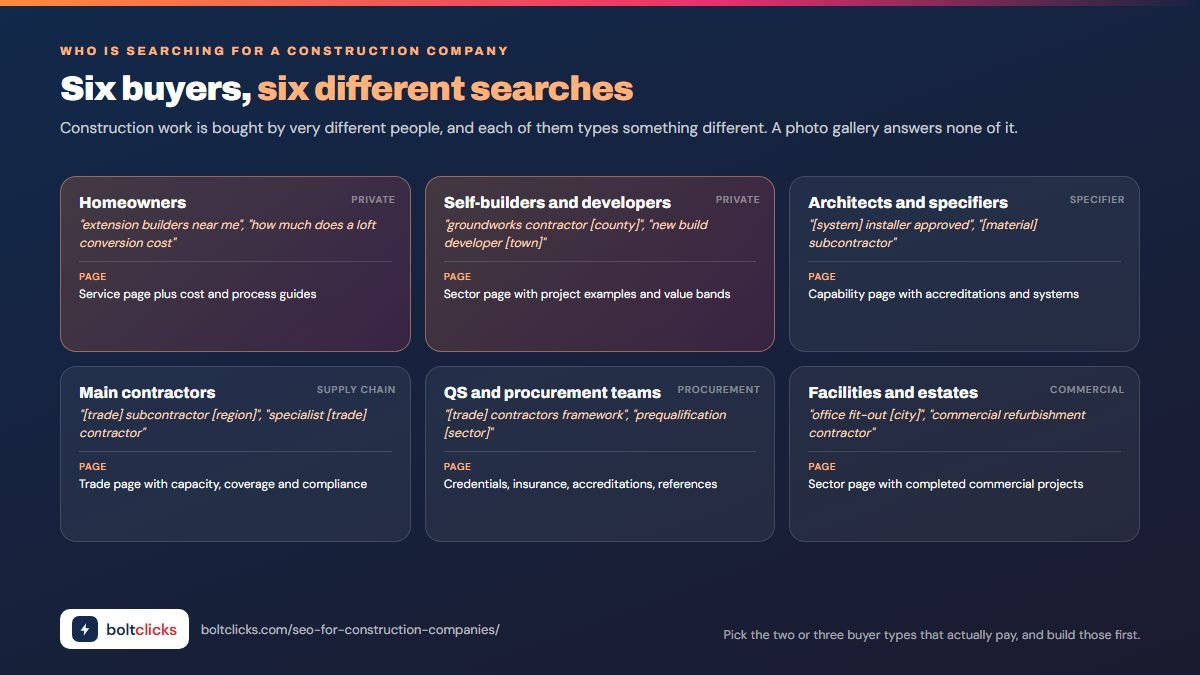
A construction company is never selling to one kind of person. The homeowner pricing a side return, the developer costing a plot, the architect writing a specification and the main contractor hunting a groundworks package are all typing into the same search box, and none of them use the same words. Most construction websites answer only the first of those and lose the rest by default. The way out is to decide which buyers you actually want, then build a page for each search they make, rather than one services page that gestures at everything. The table below sets out the ten buyer types that show up in construction search, what each one types, what they are actually doing at that moment, and the page that should be waiting for them.
| Who is searching | What they type | Intent | Page that should answer it |
|---|---|---|---|
| Homeowners | “builders near me”, “house extension [town]”, “loft conversion [town]” | Ready to get two or three quotes, comparing local firms on trust | A domestic service page for that specific job, with a town page behind it |
| Self-builders and developers | “new build contractor [county]”, “groundworks contractor for development”, “plot enabling works” | Costing a scheme, wants a contractor who has built the type before | A new build and development page, supported by project pages for similar schemes |
| Architects and specifiers | “curtain walling contractor”, “specialist concrete finishes”, “structural glazing installer” | Checking whether anyone nearby can actually build what they have drawn | A capability page written in specification language, with tolerances, build-ups and detail photography |
| Main contractors seeking subcontractors | “groundworks subcontractor [region]”, “steel erection subcontractor available”, “[trade] package contractor” | Filling a package on a live job, needs scope, accreditation and spare capacity now | A subcontract page stating the packages taken, typical package values and travel radius |
| Quantity surveyors and procurement | “[trade] contractors tender list [region]”, “prequalification questionnaire”, “approved contractor list” | Building a list of firms to invite, screening before anyone is contacted | A prequalification page carrying company details, insurance levels, policies and turnover band in one place |
| Facilities managers | “planned maintenance contractor [city]”, “reactive building repairs commercial”, “small works contractor” | Placing a term contract or finding someone for repeat call-outs | A maintenance and small works page with response arrangements and how call-outs are priced |
| Commercial clients wanting fit-out | “office fit out [city]”, “retail fit out contractor”, “cat B fit out” | Has a lease and a date, needs a firm that can work around an occupied building | A fit-out page split by sector, explaining phasing, out-of-hours working and handover |
| Trade plus town | “bricklayers [town]”, “roofing contractors [town]”, “underpinning [town]” | Local and immediate, usually comparing map results before websites | One page per trade per town, written about that town, not a duplicated template with the name swapped |
| Material or system searches | “timber frame builder”, “SIPs contractor”, “lime render specialist”, “insulated raft foundation” | Already chosen a method and needs someone who genuinely works in it | A method page explaining where the system suits a project and where it does not |
| Cost and timescale questions | “how much does a single storey extension cost”, “how long does underpinning take”, “what is a schedule of works” | Early research, weeks or months away from appointing anyone | A guide giving honest cost bands and programmes, linking through to the service page |
Pick two or three, not ten: chasing every buyer type at once spreads a budget so thin that none of them ever find you. Decide which two or three actually pay — the ones with the margin you want and the work you want to still be doing in two years — and build those pages properly before anything else is touched.
How the work is delivered, step by step
- Free audit summaryI look at the site, the searches it currently shows for and the local listings, then send a short written summary of what is losing you enquiries. No charge, and no obligation to carry on afterwards.
- Full audit and keyword mapOnce we start, every page gets crawled and every search worth having gets mapped to a single page. You see which pages exist, which are missing, and which ones are quietly competing against each other.
- Technical and speed foundationCrawl errors, broken redirects, duplicate pages, thin templates and slow galleries get fixed first. Construction sites carry heavy photography, so image handling and mobile loading usually take the largest share of this stage.
- Service and sector pagesEach package of work gets its own page, written in the language of the buyer it is aimed at, covering scope, typical value, programme and the questions people ask before they invite anyone to price.
- Project pages and proofCompleted jobs become individual pages instead of gallery thumbnails. Each one names the sector, the place, the value band and the problem solved, which is what turns finished work into something that can actually rank.
- Local presence and trade authorityYour Google Business Profile, service areas and town pages get built out properly, alongside the trade and industry listings that carry weight. Nobody controls distance in local results, so everything else is made to count.
- Measure, report and re-planEvery week you get a written report: what changed, what moved, what enquiries came in and what happens next. The following month’s plan is set by what the numbers did, not by a fixed checklist.
Turning completed projects into pages that rank
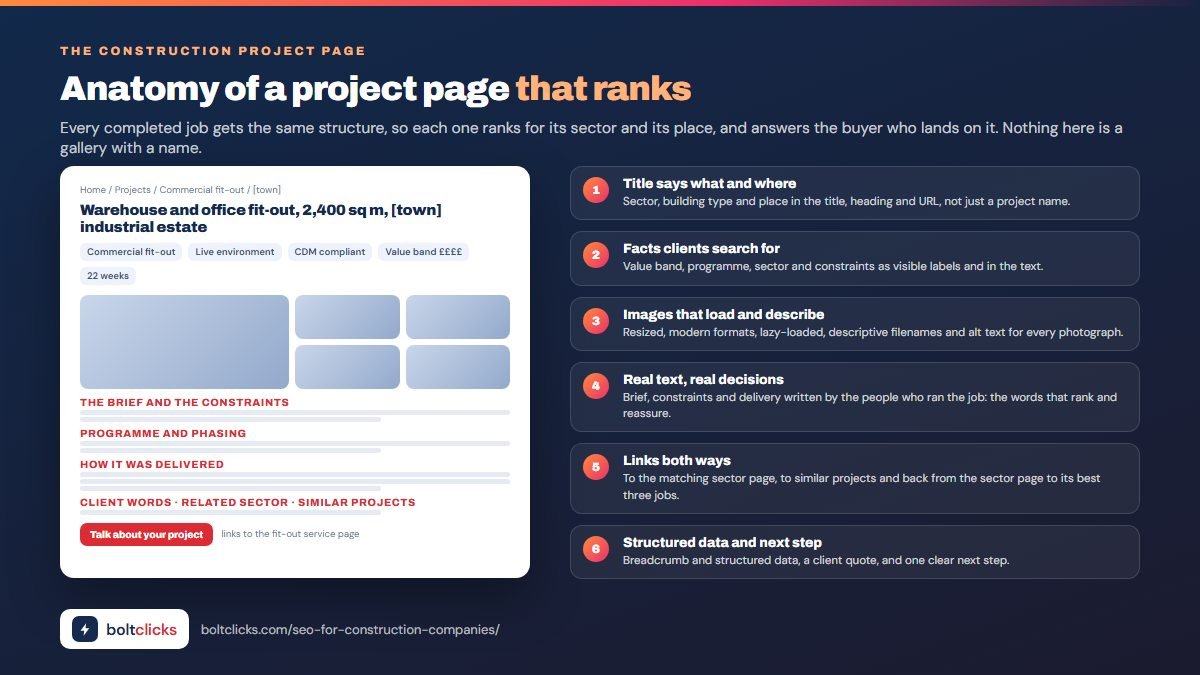
Most construction websites put their completed work in a gallery: a grid of photographs, a lightbox, perhaps a caption. A gallery ranks for nothing. There is no heading a search engine can read, no place name, no sector, no description of the problem the job solved, and usually no words at all beyond a file name. The work that proves you can do the job is invisible to the very people searching for it. A project page fixes that. One page per completed job, with the sector, the town, the value band, the duration, the constraint and the way it was handled written out in full, gives you a page that can rank for a specific search and a page a quantity surveyor can read before deciding whether to add you to a tender list.
What each project page carries
- The sector and job type in the heading, with the town named rather than implied
- A value band and a duration, given as ranges where a client would rather exact figures were not published
- The constraint that made the job awkward: an occupied building, restricted access, a party wall, poor ground, a fixed handover date
- How that constraint was solved, written so a client who has never built anything can follow it
- Photographs with alt text that describes the work in the frame, not the camera’s file number
- The materials, systems and trades involved, named plainly so specification searches can find them
- A link up to the service page the job belongs to, and one clear next step at the bottom
How the projects link together
- Every project links up to its parent service page, and that service page links back down to its strongest projects
- Projects in the same town gather on the town page, giving it the local proof it needs to compete
- Projects in the same sector feed a sector index that can rank in its own right
- Value bands let a prospective client filter straight to work at the size of their own job
- Each new project page gives the site something genuine to index every month, without inventing content
- The internal links move authority from the pages that attract traffic towards the pages that win work
Fast pages and clean structure on an image-heavy site
Construction websites are heavy by nature. A single site photograph straight off a phone can be six or eight megabytes, and a gallery of thirty of them will stall on a 4G connection in a van. Much of the technical SEO service on a construction site is unglamorous: resizing and compressing every image without losing the detail that sells the job, loading galleries only as someone scrolls to them, and cutting the scripts that slow the first view of a page. The rest is structure. Search engines need to see separate pages for separate services and separate sectors, they need consistent contact details for every depot, and they need the markup that tells them what a project page actually describes. None of it is visible to a visitor, and all of it decides whether the page is found.
| Problem found on most construction sites | Effect | Fix |
|---|---|---|
| Huge unoptimised site photographs | Pages take eight or ten seconds to become usable on a phone, and the visitor is gone before the first image finishes drawing. | Every photograph resized to the dimensions it is actually displayed at, compressed to a modern format, and served with correct width and height so the layout stops jumping while it loads. |
| Project galleries with no text | A page of twenty images carries almost nothing a search engine can read, so a job worth showing off ranks for nothing at all. | Descriptive file names and alt text on every image, plus a short written account of the scheme around the gallery covering the client type, the scope, the location and the constraints. |
| Every service on one page | Groundworks, steel frame, fit-out and maintenance compete with each other on a single URL, so none of them ranks for its own search. | One page per service, each written to cover that service properly, linked from a parent services page and from the relevant project work. |
| No sector pages | A buyer searching for a contractor with schools experience, or warehouse experience, finds a generic page and cannot tell whether the firm has done it before. | Dedicated pages for the sectors the business actually serves, each one setting out the specific requirements of that sector and pointing to matching projects. |
| Slow on mobile on site | Site managers, architects and homeowners all look on a phone, often on a weak signal. A page that only works on office broadband loses those enquiries silently. | Pages tested on a throttled mobile connection rather than a desktop, with render-blocking scripts removed, fonts loaded properly and galleries deferred until needed. |
| No structured data | Search engines have to guess what the business does, where it operates and what a project page represents, so listings show less and qualify worse. | Structured data for the organisation, each location, each service and the questions answered on the page, kept accurate and matched to the visible content rather than stuffed. |
| Old project pages deleted | Years of accumulated links and history are thrown away at every site rebuild, and anyone following an old link lands on an error page. | A full map of what existed before, redirects from every retired URL to its closest replacement, and worthwhile old projects rewritten and kept rather than removed. |
| Contact details inconsistent across depots | Different addresses, phone numbers and trading names appear in different places, which weakens every location’s chance of showing in local results. | One agreed format for the name, address and phone number of each depot, applied across the site, the business profiles and every listing that can be corrected. |
Content that reaches buyers before the tender
A construction business does not have one buyer. A homeowner extending a kitchen, a practice architect specifying a subcontractor, a facilities manager renewing a maintenance contract and a developer assembling a tender list all arrive with different questions and different vocabulary. Writing one page for all of them produces a page that convinces none of them. The work is to give each buyer their own page in their own language: what the job involves, what it usually costs, how long it takes, who is on site, what happens when the ground survey comes back badly. Specificity is what separates a page that ranks from a page that reads like a brochure. A quantity surveyor will recognise vague writing instantly, and a homeowner will simply leave and ask someone else. For domestic work, the guide to SEO for builders follows the homeowner from the first cost question to the last check before they sign.
The architects who specify your work have a search vocabulary of their own; SEO keywords for architects lists it by project type, place and licensure.
Before anything new is written, everything already published gets read and scored. Most construction sites carry years of accumulated pages: service descriptions written by three different people, a blog that stopped four years ago, duplicate pages built for towns nobody works in any more, and genuinely useful material buried where no one links to it. The audit sorts each page into keep, rewrite, merge or retire, and records why. Thin pages that compete with each other are merged into one strong page with the redirects set. Strong pages get expanded rather than replaced. Retired pages are pointed somewhere sensible instead of being left to return an error. This often does more in the first months than any amount of new writing, because those pages already have history behind them.
| Buyer stage | What they search | Content that wins it |
|---|---|---|
| Early research | Cost and feasibility questions asked in plain words, long before anyone is contacted: what a job of this type runs to, and whether it is worth doing at all. | An honest cost guide with real ranges and the factors that move them, written for the specific type of work rather than for construction in general. |
| Defining the job | Questions about permissions, surveys, party walls, building control and what has to happen before work can start. | A step-by-step explainer covering the sequence, who is responsible for each stage and how long each one realistically takes. |
| Comparing approaches | One method against another, one material against another, refurbishment against replacement. | A comparison page that gives both options a fair hearing, states where each one wins, and says plainly which situations suit which. |
| Checking compliance | Regulations, standards, insurance requirements and what a client is obliged to have in place. | A page explaining the requirement in plain terms and what it means practically for the programme, the cost and the paperwork. |
| Finding contractors locally | The trade plus the town, city or county, usually from a phone, often with urgency behind it. | A location page built on genuine coverage of that area, naming the work done there, with the depot details and a direct way to make contact. |
| Checking credibility | The company name on its own, alongside words such as reviews, projects or complaints, to see what turns up before anyone picks up the phone. | Detailed project pages with photographs and context, clear ownership of the work, and business profiles that match the site exactly. |
| Shortlisting and tender | Sector-specific and capability-specific phrases used by procurement: experience in a building type, a framework, a scale of contract. | A sector page that answers procurement’s questions directly, supported by matching project pages that prove the same work has been delivered before. |
Links a construction business can genuinely earn
Links to a construction website are earned in the physical world first. Every completed job involves a manufacturer whose product was installed, a consultant who specified it, a client who commissioned it and often a trade publication that would cover it if asked. Those relationships already exist; almost nobody asks them for a link. The work is systematic rather than clever: list every partner on every project from the past two years, check which of them publish case studies, approved-installer lists or project news, and approach them with something worth publishing rather than a request. A photograph set, a short write-up and a quote from the site manager is usually enough. That is a link from a page that real buyers read.
The pace is slow and deliberate. A handful of links a month from places connected to the actual business is worth more than a hundred bought in a batch, and it carries no risk of a penalty that takes a year to unwind. Progress appears in the weekly report: who was approached, what was sent, what was published and what went nowhere. Nothing is bought, and no scheme that depends on nobody looking closely is used. If a link would embarrass the business when a client asked where it came from, it is not pursued. That rule is simple to apply and it removes most of what the industry sells as link building.
Sources that work in construction
All of these come out of work the business has already done, which is why they hold up.
- Trade press covering the sectors the business builds in, approached with a completed scheme rather than a pitch
- Product manufacturers and their approved-installer or specifier listings, where installation work already qualifies the firm
- Professional bodies and trade associations the business is genuinely a member of, with the member profile completed properly
- Project partners and consultants, including architects, engineers and surveyors who publish the schemes they worked on
- Local and regional press, which will cover a visible scheme, a new depot or a notable site when given usable photographs
- Awards and shortlists entered on merit, where the entry itself is public and the outcome is reported honestly
- Supply-chain and framework listings the business is actually accepted onto, kept current rather than filled in once
- Guest articles written on a subject the business knows better than the publication does, placed where its buyers already read
What is refused
These are turned down whatever the price or the promised speed.
- Paid links of any description, including placements sold as editorial or as sponsored content with a follow link
- Link farms and directory networks built for search engines rather than for anyone looking for a contractor
- Reciprocal schemes and link exchanges arranged purely to inflate the count on both sides
- Paid-for awards presented on the website as though they were won on merit
- Anything that would not survive scrutiny if a client, a competitor or a search engine looked closely at how it came about
What construction SEO costs, in pounds and dollars
The work is priced as a fixed monthly fee, agreed before anything starts and invoiced in advance. Nothing is resold or marked up: one specialist does the work, and the fee covers that time rather than something bought in elsewhere. Advertising budget, when you run it, is paid straight to the platform and never passes through me.
SEO packages start at £299 a month on the pricing page (Basic £299, Standard £449, Professional £649, each a counted scope of keywords and blog posts); the monthly retainers in the table below start at £650.
| Plan | What it covers | UK | US |
|---|---|---|---|
| Free construction SEO audit | A read of your site as a contractor’s shortlist would see it: service pages, project pages, location coverage, technical health and local listings, written up in plain English with the three things worth fixing first. | Free | Free |
| SEO Foundation (one-off) | A single project to put the groundwork right: keyword map for your trades and patches, page structure and titles, technical clean-up, project page template, and Google Business Profile set up properly. No ongoing commitment afterwards. | £850 one-off | Quoted in USD |
| Starter | Ongoing SEO for a firm working one region or one trade: content and page work each month, technical maintenance, local visibility, and a written report showing what moved and what is next. | £650 per month | $800 per month |
| Growth: SEO plus paid search | Everything in Starter, plus Google Ads and Microsoft Ads managed alongside it, so tender-season and seasonal demand can be bought while the organic pages build. Wider keyword coverage and more content each month. | £1,200 per month | $1,500 per month |
| Full Stack | The whole search and advertising side handled as one job for larger contractors and multi-branch firms: deeper content programmes, multiple locations or divisions, Performance Max where it fits, and reporting built around enquiry quality rather than traffic. | from £4,000 per month | from $5,000 per month |
| Projects | Defined pieces of work with a start and an end: a site migration, a project portfolio rebuild, a location expansion, or a technical rescue after a redesign. Scoped and quoted before work begins. | Quoted | Quoted |
Terms: everything is month-to-month and invoiced in advance, and you can stop with a month’s notice if it is not earning its place. Access is granted as a partner or delegated user on your own accounts, so you keep ownership of everything and passwords are never shared or asked for. Full details are on the pricing page.
A specialist, a general agency, a directory or doing it in-house
| Option | Strengths | Weaknesses | Typical cost |
|---|---|---|---|
| A specialist who knows the sector (this service) | Understands how construction buyers actually search: trade plus town, tender wording, specification queries, and the difference between a homeowner and a main contractor’s buyer. Project pages, accreditations and coverage areas are treated as the selling assets they are. One person does the work and writes the report. | One specialist means finite capacity, so a small number of clients at a time and no overnight turnaround on large builds. No office to visit. | £299 to £4,000+ per month, or £850 one-off |
| A general SEO agency | Broad experience across industries, more hands available, and established processes for reporting and delivery. | Construction gets treated like any other service business. Trade terminology, tender cycles and project portfolios are usually missed, and the person writing your pages may never have seen a site programme or a specification. | Monthly retainer, usually on a fixed-term contract |
| Construction lead-generation platforms and tender portals | Enquiries and tender notices arrive without you building anything. Useful for filling gaps in a quiet quarter and for seeing what is being let in your region. | You rent the audience rather than own it, the same enquiry often goes to several firms at once, and price becomes the deciding factor. Stop paying and the enquiries stop the same week. None of it builds your own visibility. | Subscription plus per-lead or per-tender fees |
| The web designer who built the site | Knows the site, can make changes quickly, and is already trusted. Fine for small fixes and keeping things running. | Design and search are different jobs. Sites often look right and rank badly, because nobody has mapped what buyers type, written for it, or kept the technical side maintained after launch. | Hourly, or folded into a hosting and maintenance fee |
| A marketing person in-house | On site, immersed in the business, able to gather project photos and details as jobs complete, and available for everything else marketing-related. | SEO is one part of a job that also covers social, print, exhibitions and the phone. Keeping current with search alone is a full-time discipline, and the role takes time to recruit and longer to replace. | Salary, plus tools and training |
| Doing nothing and relying on repeat business | Costs nothing, and for an established firm with loyal clients and word of mouth it can hold steady for years. | Repeat work ends when a client is taken over, a contact retires, or a development pipeline pauses. There is nothing to replace it with, and the firms that did invest are already sitting on the searches your next client will make. | Nothing upfront; it shows up as quiet quarters |
How results are measured and when to expect them
| Measure | Source | Why it matters |
|---|---|---|
| Rankings for the keyword map | Position tracking against the agreed list of trade, service and location terms | Shows whether the specific searches your buyers make are moving, rather than a vanity average across terms nobody types. The map is agreed at the start so there is nothing to argue about later. |
| Impressions and clicks by page | Search Console | Impressions move first and tell you a page is being considered before it wins clicks. Broken down by page, it shows which services and which towns are gaining ground and which need more work. |
| Enquiries and calls | Form submissions and call records on your own systems, with analytics showing the page each one came from | The only number that pays wages. Tying an enquiry back to the page that produced it is what turns SEO from a cost into a traceable source of work. |
| Enquiry quality and fit | Your own notes on what came in, reviewed together each month | Twenty enquiries for jobs you do not want is worse than three that match your size, sector and margin. If the wrong work is arriving, the targeting and the page wording get changed. |
| Project page performance | Analytics: entries, time on page, and enquiries starting from each project | Project pages are what a buyer reads before deciding you are credible. Knowing which ones get read and which are skipped tells you what to photograph and write up next. |
| Core Web Vitals | Search Console field data and page testing | Much of your traffic is a site manager on a phone with poor signal. A page that loads slowly or jumps as it loads loses the enquiry before the content is read. |
| Links and mentions | Manual checks across trade press, suppliers, client sites, industry bodies and local coverage | Earned mentions are what make search engines treat a contractor’s site as established rather than new. They are counted honestly, including the ones that came from work already completed. |
| AI answer visibility | The same buyer questions asked repeatedly in AI assistants and checked by hand | A growing share of early research never reaches a results page. Whether your firm gets named when someone asks an assistant who does this work in your area is now worth tracking. |
Technical fixes and new project pages usually start showing in impressions within four to eight weeks; movement on competitive service and location terms tends to build from month three. Construction buys slowly. A homeowner may sit on an extension for a year, and a commercial fit-out can run several quarters from first search to signed order. So early progress shows up as impressions, calls and shortlist invitations well before revenue. No timeline is a promise, and nobody controls distance in local results, so the honest measure is the whole picture over two or three quarters.
What changes from one construction sector to the next
| Sector | How buyers search | Where the work goes |
|---|---|---|
| Residential building and extensions | Homeowners search by job and town, then by cost and process: what an extension involves, how long it takes, whether planning is needed. Searches happen on phones, often in the evening, and the same person returns several times over months. | Local visibility, service pages written for people who have never run a build before, finished project pages with before-and-after photography, and clear answers on timescales and what happens after the enquiry. |
| Commercial fit-out | Searches come from agents, office managers and project consultants using sector and city wording, and increasingly by category of space. Several people look at the same site before anyone makes contact. | Sector pages for the space types you fit out, project pages that name the scale and programme, evidence of working in occupied buildings out of hours, and content that survives being forwarded to a finance director. |
| Groundworks and civil engineering | Buyers are main contractors and developers searching by discipline and region, often checking a firm named on a tender list rather than looking for one cold. | Capability pages by discipline, plant and workforce detail, accreditation and compliance pages, and a portfolio a pre-qualification team can verify quickly without ringing you. |
| Roofing and cladding | A split audience: urgent repair searches with immediate intent, and specification-led searches on systems, materials and warranties from contractors and building owners. | Separate paths for emergency repair and planned work, system and material pages that match how specifiers write, warranty and safety content, and strong local coverage for the reactive side. |
| M and E and building services | Searches lean technical: systems, compliance, commissioning, maintenance contracts and energy performance. Buyers are consultants and facilities managers who already know the vocabulary. | Depth over breadth. Discipline pages, compliance and certification content, maintenance and service contract pages, and technical writing that reads as though an engineer produced it rather than a copywriter. |
| Scaffolding and access | Fast, practical searches by type of access, town and availability, frequently from a site with a start date already fixed. Response speed decides the job. | Local pages across the whole travel radius, access type pages, design and compliance credentials, and a site that makes calling or messaging effortless on a phone. |
| Plant hire | Searches by machine, size, and hire period plus location, with buyers comparing several suppliers in one sitting and checking availability before price. | A page per machine category with specifications, clear hire terms and delivery radius, location coverage across the depot catchment, and content that answers operator, transport and attachment questions. |
| Construction products and materials suppliers | Specifiers, merchants and contractors search by product, standard and application, often starting from a technical requirement rather than a brand. | Product and application pages built around the standards and specifications buyers cite, downloadable technical detail, distribution and lead-time information, and content that gets your products named at specification stage. |
What the first ninety days actually look like
Construction firms rarely get a straight answer about sequencing, so here is the order the work runs in and what lands on your desk at each stage. Everything below is one specialist doing the work, delivered remotely on UK hours, reported in writing every week.
| Period | Work | What you see |
|---|---|---|
| Week 1 to 2 | Partner access set up to Search Console, Google Business Profile, analytics and the CMS, so no password ever changes hands. Full crawl of the site, redirect and duplicate check, server response and mobile rendering review. Every existing service, sector and project page is listed against the trades and disciplines you actually sell. First draft of the keyword map, split by buyer type: main contractor procurement, developer, architect, facilities manager, homeowner or private client. | The crawl findings written out in plain language with severity, the page inventory, and the draft keyword map for you to mark up. Week one and week two reports. |
| Week 3 to 6 | Technical faults cleared in priority order: broken redirect chains, missing or duplicated title tags, thin pages, uncontrolled URL parameters, images served at full camera resolution, render blocking scripts. Core service pages rewritten with real mechanics, plant, accreditations, contract sizes and coverage. Organisation and service structured data added. A repeatable project page template is built so case work can be published without a developer every time. | Specifications handed to your developer where code access is needed, rewritten pages sent for sign off before publishing, and Core Web Vitals figures before and after. |
| Week 7 to 10 | Sector pages built out for the markets you want more of, such as industrial, healthcare, education, water, rail or residential. Project pages published for completed schemes with scope, value band, programme and constraints. Internal structure tidied so sector, service and project pages support each other. Google Business Profile categories, services, service areas and photos corrected. Conversion tracking set up for enquiry forms, phone taps and tender document downloads. | Live sector and project pages, a tracking setup you can check yourself, and the first enquiry figures separated by page and by search term. |
| Week 11 to 13 | Authority work begins: trade body and scheme listings verified, supplier and manufacturer pages corrected where your name appears, client and consultant project write ups pursued for genuine mentions and links. First data review of impressions and click through rate by page, then a second pass on the pages that are being seen but not clicked. | A list of every mention or link gained with the page it points at, plus a written review of which terms moved, which did not, and what changes next quarter. |
What ninety days will not do: construction buying cycles are long. A framework place, a tender invitation or a groundworks package can sit nine to eighteen months between first search and signed contract, and a page published in week six may not produce a named enquiry until the following year. In ninety days you should expect indexation, rising impressions, early positions on specific long phrases and the first tracked enquiries. You should not expect a full pipeline, and nobody can promise a position on the broadest head terms. In the local map results, distance between the searcher and your registered address is a ranking factor that no one can change, so a yard in one county will not appear consistently in searches two counties away no matter how good the profile is.
What I handle, and what I need from you
Most of the work sits on this side, but a construction site produces things no writer can invent. Plan on an hour or two a month. That usually means photographs from live jobs, steel going up, a slab poured, a plant room finished, with rough notes on where, when and for whom. It means answering short questions about a scheme: contract value bands, the form of contract, the tonnage, the programme, what made the job awkward. It means saying which sectors you actually want more of, because a groundworks firm chasing residential developers needs different pages to one chasing industrial frameworks. And it means somebody with authority, marketing, or more often the commercial director, signing off wording that touches capability claims, accreditations and named clients before anything goes near the site.
- Specifications your developer can build from, not vague requests. Exact redirect rules, tag changes, schema blocks and image sizes, written so an in house developer or an external one can implement them in an afternoon and bill you for that time rather than for research.
- Nothing is published unseen. Every page, meta description, project write up and profile change goes to you before it goes live. If a claim about accreditation, contract value or client name is not something you can evidence, it does not get written.
- A written report every week, covering what was done, what moved, what did not, and what is next. It goes out whether the week was strong or flat, and it names the pages and terms rather than talking in averages.
- Every change is documented, with a dated log of pages edited, redirects added, structured data deployed and links gained. If we part ways, you keep the log, the access and the work, because it all sits in your own accounts.
- Honest advice when the site is not the bottleneck, including the times it is not. If enquiries are arriving and nobody is calling back for three days, or the tender documents are hard to find, or the real problem is pricing against a framework, I will say so rather than sell more pages.
The terms that appear in your reports
Reports are written in plain language, but a handful of technical terms cannot be avoided without losing precision. Here is what each one means in the context of a construction website.
| Term | Meaning |
|---|---|
| Keyword map | A spreadsheet that assigns every search phrase to exactly one page, so the piling page and the groundworks page are not competing for the same term. It is the plan the whole build follows. |
| Search intent | What the person typing actually wants. “Reinforced concrete frame contractor” is a buyer looking to procure; “how long does a concrete frame take to cure” is someone learning. The two need different pages and different calls to action. |
| Service page | A page about one thing you do, such as steel erection, RC frames, demolition or M and E installation. It covers method, plant, capacity, accreditations, contract sizes and geography. |
| Sector page | A page about one market you serve, such as healthcare, education, water, rail, data centres or industrial. Same trades, different constraints, compliance and buyers, so it earns its own page rather than a paragraph. |
| Project page | A page for a single completed scheme, with scope, value band, duration, client type, constraints and photographs. These win the searches where a buyer is checking whether you have done work like theirs before. |
| Impressions | The number of times one of your pages appeared in search results for a query, whether or not anybody clicked. Rising impressions with flat clicks means you are being found for the wrong terms or shown too low. |
| Click-through rate | Clicks divided by impressions, as a percentage. It is usually a title and description problem rather than a ranking problem, and it is one of the fastest things to fix on an established page. |
| Core Web Vitals | Google’s measurements of loading speed, visual stability and responsiveness on real visits. Construction sites fail these most often because of uncompressed site photography and heavy sliders on the homepage. |
| Structured data | Code added to a page that states plainly what it describes: an organisation, a service, an area covered, a frequently asked question. It does not change the visible page, it makes the page machine readable. |
| Canonical tag | A line in the page code naming the one official URL for that content. It stops the same project write up at three different addresses splitting its own value, which is common after a site migration. |
| Backlink | A link from another website to yours. A link from a main contractor’s project page, a trade association register or a manufacturer’s approved installer list is worth far more than a hundred directory entries. |
| Anchor text | The visible words a link is attached to. “Groundworks contractor in the Midlands” tells search engines what the destination page covers; “click here” tells them nothing. |
| Crawl and index | Crawling is a search engine reading your pages; indexing is deciding to store them. A page can be live, look perfect and still be unindexed, in which case it cannot rank for anything at all. |
| Conversion tracking | Recording what a visitor did: submitted an enquiry form, tapped the phone number, downloaded a capability statement or a tender pack. Without it, reporting is limited to rankings and traffic, which do not pay wages. |
| Partner access | Being added as a user on your own accounts, with permissions you grant and can revoke in a click. Passwords are never requested or held, and the accounts stay in your name. |
| AI Overviews | The generated summary that sometimes appears above the normal results. Pages with clear headings, direct answers and specific figures are the ones drawn on, which is one reason project detail and plain wording are worth the effort. |
What a client said, and what you can check
“Great communication and very helpful throughout the process. Took the time to explain everything clearly and set up the campaign professionally. Focused on quality results rather than just numbers. Highly recommended.”
This is one of three client reviews published so far; the other two, from a UK SEO client and a US Google Ads client, are on the home page. Every figure comes from the client’s own ad account, and a review goes on this site only when it is real.
What you can check before you pay
- Prices published in full on the pricing page, not hidden behind a sales call
- Month to month, with one month’s notice and no lock-in contract
- Every account, profile and file stays in your name; I work through partner access
- A written report every week, in plain English
- One specialist does the work, from the audit to the report
Construction SEO questions, answered plainly
What is SEO for construction companies?
It is the work of making your firm the one that appears when someone searches for the trade you do and the places you do it in. That covers the pages on your site, the way projects and sectors are described, your Google Business Profile, and the technical side that decides whether pages load and get indexed. The aim is enquiries from people ready to specify or buy, not visitor numbers.
Does SEO work when most of our work comes through tenders and repeat clients?
Yes, though it works differently. Tender panels and repeat clients still search you before they shortlist, and what they find decides whether you look like a safe pair of hands. Search also reaches the work that never goes to tender: the extension, the fit-out, the remedial job. The realistic view is that SEO adds a second channel alongside the relationships you already have, rather than replacing them.
How much does construction SEO cost?
There are three SEO packages, three monthly retainers and one fixed piece of work. SEO packages start at £299 a month on the pricing page, each a counted scope of keywords and blog posts. Monthly retainers start at £650: Starter is £650 a month, Growth is £1,200 a month, and Full Stack starts at £4,000 a month. There is also a one-off SEO Foundation at £850 if you want the groundwork done and nothing ongoing after it. Everything is invoiced in advance and billed month to month. The audit that comes before any of it is free.
How long does it take to see results?
Groundwork shows up in weeks; commercial results take longer. Construction sales cycles are long, so a contact made in March can become a signed job in September, and an enquiry that arrives in month three may not be invoiced until month nine. Expect early movement on smaller, specific searches first, and give it six to nine months before you judge whether the channel earns its place.
We only work locally. Is it still worth it?
Usually more so. Local searches carry high intent and less competition than national terms, and a firm with a well-kept Google Business Profile and pages built around its towns can do well without a large budget. What nobody controls is distance: map results are weighted by where the searcher is standing, so a yard on the far side of the county will not show for them however good the page is.
We work nationally. How does that change things?
The map results matter less and the written pages matter more. National work is usually won on sector and capability, so the site needs depth: what you build, what scale you handle, which procurement routes you work under, and which regions you cover from which base. It is a slower build with more pages and more competition, and it suits firms with a real portfolio behind the claims.
Can our project photos rank?
They can help, and more than most firms expect. Photographs of finished work attract image searches and, more importantly, keep people on the page long enough to believe you. The practical work is naming and describing files properly, compressing them so they load on site, adding captions that say what the job was and where, and putting them on a page with enough written detail to be found in the first place.
Do we need a new website first?
Often not. Many construction sites are structurally fine and simply thin on content, slow on mobile, or missing the pages buyers actually search for. The audit says which of those applies to you. If the site cannot be edited, cannot be made quick, or hides your work behind a gallery nobody can read, a rebuild is the honest answer, and I will say so before you spend on monthly work.
Should we write about every project?
No. A short line in a gallery for everything, and a proper page for the jobs that represent work you want more of. Ten detailed project pages covering the brief, the constraints, the method and the outcome will do more than sixty thin entries. Pick by sector, by value and by repeatability, and write the ones a buyer with the same problem would go looking for.
What about subcontractor work, where main contractors find us?
Main contractors search too, usually for a package and a region: the trade, the scale, the accreditation, the area. Those searches are narrow and low in volume, which is exactly why they are worth owning. The pages that win them read like a capability statement rather than a sales page, with certifications, insured limits, typical package values and the sites you can reach.
Do you work with construction product suppliers?
Yes. Supplier and merchant sites are a different job again, because buyers search by product, specification and application rather than by town. That means product and category pages with real detail, technical documents that can actually be found, and content aimed at the specifier as well as the buyer. The commercial logic is the same: fewer, better-qualified enquiries from people who already know what they need.
Will you need our passwords?
No. Everything runs on partner or delegated access, which you grant from inside your own accounts and withdraw whenever you like. That covers the website, the Google Business Profile, Search Console and any advertising account. You keep ownership of every asset, and nothing sits behind a login only I can reach. If a tool does not support delegated access, I will work around it rather than ask.
Where are you based?
I work remotely from Lahore, Pakistan, on UK hours, with US hours covered as well. There is no office to visit, and I would rather say that plainly than imply otherwise. In practice everything happens over calls, email, WhatsApp and shared documents, and you get a written report every week so you can see what was done without chasing me for it.
Is there a contract?
It is month to month, invoiced in advance, and you cancel with a month’s notice, so the longest you are ever committed is the month you have already paid for plus one. There is no lock-in and no minimum term. If the work is not producing anything by month six, that is a conversation to have rather than a contract to sit out.
Seven things worth weighing up before you buy construction SEO
1. Your portfolio is the asset, and right now it is invisible
Most construction firms have decades of finished work sitting in a folder on someone’s phone. Search cannot read a folder. Until each job has a page with a brief, a location, a method and photographs, the strongest thing about your business is the part that no buyer can find.
2. Trade plus place beats the generic term
Broad terms attract everyone and convert almost nobody. The searches that turn into jobs pair what you do with where you do it, and they are narrower than most firms are comfortable with. Winning fifty of those is worth more than fighting for one term everybody wants.
3. Buyers research long before the enquiry arrives
By the time someone rings, they have read your pages, looked at your work and compared you with two others. The site is not the last step before the enquiry, it is most of the decision. Write it for a buyer who is still quietly making up their mind.
4. Speed matters because your readers are on site, on a phone
Your audience is often standing on a site with one bar of signal and a cracked screen. A page weighed down by uncompressed project photographs will lose them before it loads. Fast, light pages are not a technical nicety here, they are the difference between an enquiry and a bounce.
5. Accreditation and trust signals belong on the page, not in the footer
Accreditations, insurance limits, memberships and safety records are the first things a serious buyer checks, and burying them wastes them. Put them where the decision happens: on the service page, on the project page, next to the claim they support. Stated plainly, they do more work than any slogan.
6. Measure enquiry quality, not traffic
A thousand extra visitors mean nothing if none of them can afford you. Track which searches produce enquiries, which enquiries turn into site visits, and which visits turn into jobs. A month with fewer enquiries and two of them worth quoting is the better month.
7. Sometimes the honest answer is that the website is not the bottleneck
If enquiries already come in and go unanswered for three days, more of them will not help. Sometimes the fix is a phone that gets picked up, a quote that goes out in two days, or a price that matches the work. I would rather say that than sell you a retainer.
Start with a free construction SEO audit
Send me your website and the two or three types of job you want more of. I will go through the pages, the local listings and the searches your buyers actually use, then come back with what is holding the site back and what I would do first. It costs nothing, and there is no obligation to carry on afterwards.