
Facebook ads agency Exeter: Meta campaigns built around Devon geography
I am Moeez Abbas, and I work on my own, remotely from Lahore in Pakistan, for businesses in the UK. There is no office in Devon and no team behind me — just the Meta platform work and the local research that decides whether it pays. This page is about how paid social actually behaves in Exeter: the student calendar at Streatham and St Luke’s, the summer through-flow on the M5, A30 and A38, and the difference between a Topsham resident and a caravan heading for Cornwall. If you want someone who can walk into your unit on Marsh Barton, hire locally instead.

What an Exeter business is actually buying when it stops boosting posts
I am Moeez Abbas. I work on my own, remotely from Lahore in Pakistan, for businesses in the UK, and much of that work is Facebook and Instagram advertising. There is no office in Devon and no team behind me. This page is about Exeter and the EX postcode area — how the geography, the calendar and the traffic flows change what a Meta campaign has to do here. Let me start with the thing that is most often sold badly.
The same research is written up for a much smaller West Country city: Facebook ads in Wells, where 12,105 people share the city with more than 300,000 cathedral visitors a year and there is no railway station.
Boosting a post is one button inside the Facebook app. It takes an organic post, hands Meta a small budget and a loose audience, and optimises for whatever the boost flow has decided is reasonable — usually engagement. It is not useless. It is just a different product from a campaign built in Meta Ads Manager, and confusing the two is why a business can spend a few pounds a day for eighteen months, collect likes, and conclude that Facebook “does not work”.
A properly built account gives you levers the boost flow simply does not expose:
- Campaign objective chosen on purpose — leads, sales, calls, WhatsApp or Messenger conversations, store traffic — rather than inherited from a button.
- Ad set level control of location, radius, the living-in versus recently-in setting, age, and budget pacing.
- Placement control across the Facebook feed, Instagram feed, Instagram Reels, Stories, Marketplace, Search results and the Audience Network, so you are not paying the same price for very different quality of attention.
- A Meta Pixel and a dataset in Events Manager that you own, feeding real conversion events rather than a proxy for clicks.
- Custom Audiences and Lookalike Audiences built from your own customer list, site visitors, Instagram engagers and video viewers.
- Creative testing that separates hook, format and offer instead of changing all three at once.
The other half of what you buy is discipline about geography, and in Exeter that matters more than in most cities of its size. This is a place where a meaningful share of the people physically present in July are not customers and never will be, because they are on the M5 heading for the A30 or the A38 with a caravan behind them. Paying to reach them is one of the easiest ways for an Exeter ad budget to leak, and it is invisible unless somebody is looking for it.
I do not promise positions, rankings or timescales, and I do not publish client counts or case studies. What I can do is show you the account structure, the targeting logic and the measurement setup before you spend anything, so you can judge the thinking rather than a claim.
Exeter is not one audience, it is three that barely overlap
Most cities give an advertiser one resident market and a modest visitor top-up. Exeter gives you three distinct pools, and they do not share a calendar, a postcode pattern or a price sensitivity.
The term-time population
The University of Exeter’s own Facts and Figures page puts its student body close to thirty thousand, spread across three campuses — Streatham and St Luke’s in Exeter, and Penryn in Cornwall. That third campus is the trap. Penryn sits near Falmouth, the far side of Devon and most of Cornwall, so any Exeter audience sizing that leans on a single headline student figure is counting several thousand people who will never walk down Sidwell Street. Check the current figure on the university’s page rather than on a directory site, because these numbers are restated every academic year.
The two Exeter campuses behave differently too. Streatham, the main campus, sits in north Exeter in EX4 near Pennsylvania, Prince of Wales Road and St James, with the Forum building, Reed Hall and the Great Hall on it. St Luke’s sits off Heavitree Road, much closer to the centre, and houses Sport and Health Sciences, the University of Exeter Medical School and the Academy of Nursing. Two campuses means two pins, not one, and a single radius drawn on the city centre weights them very unevenly.
Add Exeter College, the Exeter Students’ Guild calendar and a university staff base in the thousands, and you have a seasonal student market and a year-round staff market sitting inside the same postcodes and behaving nothing alike.
The resident and trade market
The Office for National Statistics mid-2024 estimate puts the Exeter local-authority population at roughly 138,000, inside a Devon that reaches about 1.2 million once Plymouth and Torbay are counted. For a Meta advertiser that is a small city, which is exactly why a small daily budget aimed at a three-mile circle hits punishing frequency within a fortnight. The resident pool is spread across St Thomas, Heavitree, Pinhoe, Whipton, Alphington, St Leonard’s, Newtown, Exwick, Wonford, Countess Wear, Mount Pleasant, Beacon Heath, Monkerton, Redhills, West Clyst and Whitestone, and out into Topsham, Exminster and the Clyst villages.
The visitor flow
Exeter sits where the M5 meets the A30 and the A38, which makes it the road gateway to most of Devon and much of Cornwall. Visit Exeter and Exeter City Council’s visitor strategy describe a season that builds from late spring, peaks in high summer and tapers through the autumn, with Easter as a shoulder peak. Some of those visitors stay in the city precisely to avoid a longer onward drive towards Okehampton, Torquay or Plymouth. They are worth money to a hotel on Cathedral Green and worth nothing to a boiler engineer on Marsh Barton.
Separating holiday traffic from real demand is the whole job here
Meta’s location targeting, set at ad set level under Audience, offers three behaviours: people living in or recently in a location, which is the default; people living in this location; and people recently in this location. Alongside that you can drop a pin and set a radius, documented in Meta’s help material as running from one mile, or 1.6 kilometres, up to fifty.
Accounts I am shown are almost always left on the default. For a hotel, a Quayside bar or a paddleboard hire business, “recently in” is the money setting from Easter onward. For a roofer in Alphington, an MOT centre on Marsh Barton, a dentist in Heavitree or a letting agent near Exeter Central, “living in this location” is the only sane choice, and switching it is free.
Why a tight radius misbehaves in Exeter
A three-mile pin on the Guildhall covers the High Street, Fore Street, Queen Street, Gandy Street, South Street, Princesshay, the Quay and most of EX1, EX2 and EX4 — and Streatham Campus, so a term-time audience dominates it. At ten miles you pick up Topsham, Exminster, Kenton, Broadclyst, Clyst St Mary, Woodbury, Newton St Cyres and Cranbrook, all genuinely Exeter-facing. At twenty you have swallowed Newton Abbot, Teignmouth, Honiton and most of the estuary, where shopper behaviour splits towards Torbay or Somerset. The radius tool does not know that.
Some third-party write-ups claim that the Advantage+ Audience layer can quietly widen a tight radius when it cannot fill impressions inside the boundary. I have not found that confirmed in Meta’s own Business Help Centre, so I treat it as unverified and simply read the delivery and audience-definition panels in Ads Manager on any tight-radius ad set rather than trusting either version of the story.
Resident-facing brief
Living in this location. Exclude the obvious visitor corridors. Lean on postcode and town lists rather than one circle. Schedule to local working patterns, not to holiday weeks.
Visitor-facing brief
Recently in this location, plus a separate set targeting people at home before they travel. Creative that answers “what is on today”, and a budget shape that climbs from March and falls back in October.
EX1 to EX6, and why “the EX postcode” is a dangerous shortcut
Royal Mail’s EX area covers dozens of districts across around thirty post towns, reaching well into north and east Devon: Barnstaple, Bideford, Ilfracombe, Okehampton, Honiton, Sidmouth, Seaton, Budleigh Salterton, Exmouth, Tiverton, Crediton, Cullompton, Ottery St Mary, Dawlish and even Lundy. An advertiser who types “EX” into a targeting box because it stands for Exeter has just bought North Devon. That is a fifty-mile error made in one keystroke.
The city and its immediate ring break down roughly like this.
| District | Covers | What it means for an ad set |
|---|---|---|
| EX1 | Eastern Exeter, northern Heavitree, Monkerton, Newtown, Pinhoe, West Clyst | Eastern residential belt plus the Exeter Business Park and FitzRoy Road side; strong for home services and family offers |
| EX2 | Southern Exeter, southern Heavitree, southern St Thomas, Countess Wear, Wonford, plus Marsh Barton and Sowton | The trade and industrial postcode — the right target for business-to-business, trade counters and motor services |
| EX3 | Topsham, Clyst St George, Ebford, Exton | Small, affluent, wholly Exeter-facing; worth its own set for premium services |
| EX4 | Northern Exeter, Exwick, northern St Thomas, Beacon Heath, Redhills, Pennsylvania, St James, Whitestone | Contains Streatham Campus and the densest student housing; separate it or your term-time data will distort everything |
| EX5 | Broadclyst, Bradninch, Clyst Honiton, Clyst St Mary, Cranbrook, Newton St Cyres, Silverton, Talaton, Whimple, Woodbury | Eastern village and commuter belt, including the new town of Cranbrook — rural but Exeter-facing |
| EX6 | Exminster, Kenton, Kennford, Cockwood, Starcross, Christow, Dunsford, Mamhead | The A38 and Teign Valley side; shoppers here split between Exeter and Newton Abbot |
Cullompton sits further north on the M5 at junction 28 in Mid Devon and falls in EX15, not in the city districts at all, which is a useful reminder that postcode order does not follow driving distance. Beyond the Haldon Hills and towards Dartmoor National Park the density falls away fast, and a radius that looks generous on a map delivers almost nothing.
The practical move is to build location lists from post towns and districts you can name out loud, then check the estimated audience size Ads Manager reports back. If the estimate leaps when you add one district, that district is doing something you did not intend — usually adding a campus, a trunk road or a resort.
The hinterland decides your spend more than your creative does
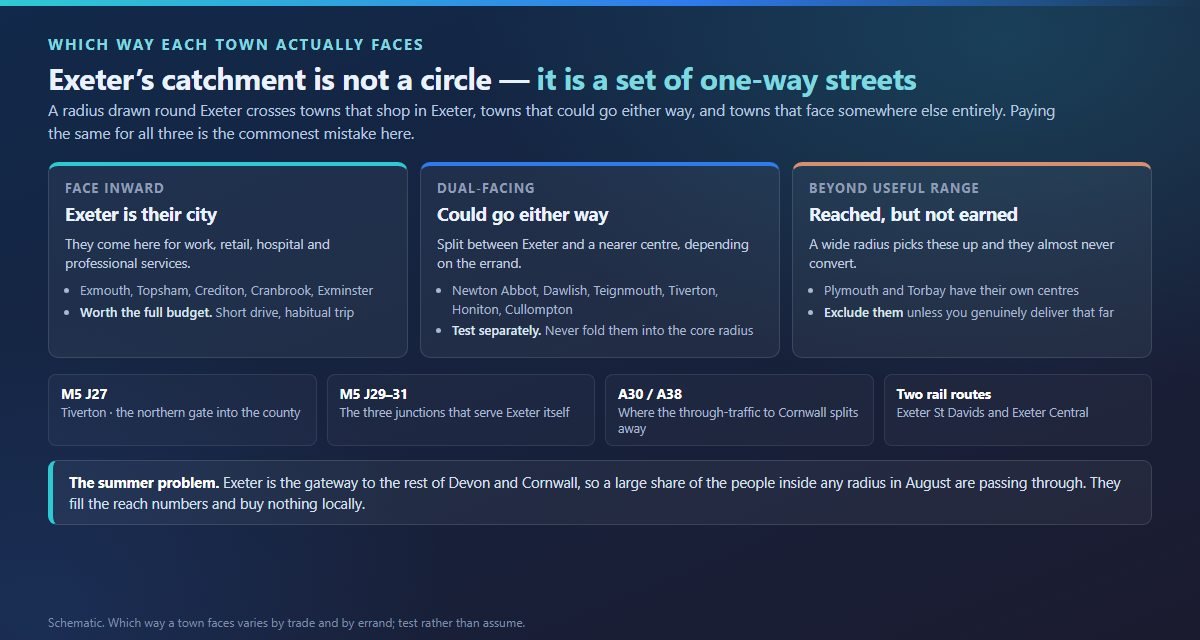
Exeter has a genuine catchment, but it is not concentric. Some towns look inward to the city for everything; others are pulled sideways by Torbay, Plymouth, Taunton or Yeovil. Getting this wrong is expensive in a quiet way: the ads deliver, the cost per click looks fine, and the enquiries never turn into jobs because the caller is forty minutes the wrong side of a dual carriageway.
Exmouth, at around 35,000 people on Census-based figures, is the largest town near the city, roughly eleven miles south-east at the mouth of the River Exe and joined to Exeter by the Avocet Line through Topsham, Lympstone and Exton. Its shoppers and commuters face Exeter, and its size usually justifies its own ad set rather than being folded into a circle. Topsham, at roughly 4,800 people and four miles out, sits inside the city boundary and is wholly Exeter-facing — walkable, affluent and a strong micro-target for premium services. Crediton, an ancient market town north-west on the Tarka Line and the birthplace of Saint Boniface, is a real commuter town with direct trains to Exeter Central and Exeter St Davids.
Then the ambiguous ones. Newton Abbot, in the mid-twenty-thousands and sitting on the A380 and A38 corridor, splits between Exeter and Torbay or Plymouth. Dawlish and Teignmouth, each around fifteen thousand, sit on the coast and face partly to Exeter and partly to Newton Abbot and Torquay, with a heavy seasonal overlay on top. Tiverton, in the low twenty-thousands, near M5 junction 27 and served by Tiverton Parkway, looks to Exeter but also to Taunton — junction 27 is roughly where the Somerset pull starts. Honiton, on the A30 near junction 29 and known first for lace and now for antiques, is the eastern edge; past it, spend leaks towards Taunton and Yeovil. Sidmouth and Ottery St Mary face Exeter for larger shopping but have their own gravity, and Axminster and Seaton sit beyond useful range for most city businesses. Population figures here are rounded from Census-based settlement estimates; if a number matters to your plan, take it from the Office for National Statistics directly.
How I turn that into structure:
- Core city set on EX1 to EX4 with living-in targeting, carrying the main budget.
- Inward-facing satellites — Exmouth, Topsham, Exminster, Crediton, Cranbrook, Broadclyst, Woodbury — grouped or separated by value per customer.
- Dual-facing towns tested separately and judged on booked work, never on clicks: Newton Abbot, Dawlish, Teignmouth, Tiverton, Honiton, Cullompton.
- Anything past the A30 towards Okehampton, or past junction 27, only when the margin genuinely supports the drive.
An Exeter ad calendar has two seasons running at once
The city runs on an academic clock and a tourism clock simultaneously, and they pull in opposite directions in June. Any budget plan that ignores one of them wastes money for weeks at a time.
The University of Exeter publishes its term dates and its Welcome Week dates well in advance, and they are the single most useful free document an Exeter advertiser can read. In broad shape, the autumn term starts in the second half of September, the spring term runs from early January to late March, and the summer term runs from late April to mid-June. Welcome Week falls immediately before the autumn term, with most arrivals in the preceding weekend. For takeaways, barbers, salons, gyms, phone repair shops, storage firms and student lettings, that arrival window concentrates more buying decisions into a fortnight than any other period in the Exeter year, and it is over before many advertisers have finished writing the ad. Take the exact dates from the university’s term dates page each year rather than from memory, because they move.
The mirror image is mid-June to late September, when a large part of the student population leaves. A food business near Streatham or in Pennsylvania that keeps the same daily budget through July is buying a thinner audience at the same price. Meanwhile the visitor clock is doing the opposite, building from March through the Easter shoulder to a high-summer peak, helped by a mild maritime climate that Visit Exeter fairly describes as supporting year-round visiting.
Dates that move local money
- Easter, as the first real visitor weekend and the start of outdoor trade at the Quay and along the Exe Estuary Trail towards Turf Locks and Powderham.
- The Devon County Show at Westpoint, Clyst St Mary, just off junction 30, which pulls farming, equestrian, food and rural trade audiences into the eastern edge of the city.
- Exeter Chiefs home fixtures at Sandy Park, which since the club’s move there in 2006 have driven parking, taxi and hospitality demand around Sandy Park Way and junction 30. Sandy Park also runs a substantial conference and exhibition business, which is a business-to-business audience in its own right.
- Exeter City matchdays at St James Park, a supporter-owned club through the Exeter City Supporters’ Trust, in a dense residential patch right beside St James Park railway station.
- Race days at Exeter Racecourse on Haldon, which draw from across the Teign valley and Torbay as well as the city.
- Sidmouth Folk Festival in the summer and the Ottery St Mary Tar Barrels on 5 November, both of which create sharp, short demand spikes in East Devon.
- The Christmas market on Cathedral Green and late-night trading at Princesshay and the Guildhall Shopping Centre, which compress a large share of city-centre retail into six weeks.
Budget shape therefore matters as much as targeting. I would rather ramp hard for ten days around the September arrival window and pull back in July than run a flat line all year and call it consistency.
Where Exeter actually works, estate by estate
Exeter’s business base is more white-collar than a city of this size usually is, and that changes what paid social can do. Exeter City Council’s own key business locations list names Marsh Barton Trading Estate, Sowton Industrial Estate with Park Five and Apple Lane, Exeter Business Park, Pynes Hill, Woodwater Park, Matford Business Park, Peninsula Park, Pinhoe Industrial Estate, Skypark and Exeter Science Park. Those are the words your customers use for where they are, and using them in ad copy does more for relevance than any amount of generic “local” language.
Marsh Barton is the largest trading estate in the city and one of the region’s biggest employment sites; Exeter City Council put the job figure at around 7,000 when the station opened. Motor retail, MOT and servicing, building supplies, print and light industry cluster there, and it gained its own railway station on 4 July 2023 — a Devon County Council project delivered with Network Rail and Great Western Railway, two platforms and no station buildings, served by local Exmouth to Paignton trains. Sowton sits between M5 junctions 29 and 30 with access to the A30 and A38, under three miles from the centre, which makes it the natural home of distribution, big-box retail and trade counters, with Digby & Sowton station on the Avocet Line at its edge.
Professional services sit at Pynes Hill, Woodwater Park and Exeter Business Park, which is also where the Met Office has its headquarters on FitzRoy Road, EX1 3PB. The Met Office is the UK’s national meteorological service, founded in 1854 under Vice-Admiral Robert FitzRoy, and it moved from Bracknell in Berkshire to a purpose-built headquarters at Exeter Business Park in 2003, relocating well over a thousand staff. Be careful with the supercomputing story. A separate building was completed at Exeter Science Park in 2017 for Cray XC40 systems, but operational supercomputing has since moved to a Microsoft Azure-hosted machine, and the Met Office has said publicly that it intends to dispose of the Science Park supercomputer and office buildings. Claiming the country’s most powerful computer sits in Exeter is a stale line that local readers notice.
Further east, the Exeter and East Devon Enterprise Zone covers Skypark, Exeter Science Park, Cranbrook town centre and Power Park, under the Exeter and East Devon Growth Point, with East Devon District Council involved. Skypark is a large office, industrial and distribution park next to Exeter Airport, with a hotel on site; Cranbrook, the new town, has its own railway station on the West of England Line and was supported by junction 29 improvements and a link road connecting the airport area to Skypark. For lead generation aimed at local firms, a tight radius on these estates with job-title and interest layers beats a city-wide blast, and it is one of the few cases where a one to three mile pin genuinely makes sense in Devon.
Two more employers shape the working-hours audience more than any estate does. Royal Devon University Healthcare NHS Foundation Trust runs the hospital at Wonford and employs clinical and administrative staff across the city, and the public sector adds Devon County Council, Exeter City Council, Devon and Cornwall Police, Devon and Somerset Fire and Rescue Service and South West Water. If your offer is a lunchtime one, those shift patterns matter more than any interest targeting you could add.
Ads that could only have been written by someone who looked at Exeter
Local proof in creative is not a photograph of a cathedral with your logo on it. It is a detail a resident recognises in half a second, because recognition is what stops a thumb.
Exeter Cathedral, properly the Cathedral Church of Saint Peter, has the longest continuous medieval stone vault in the world, running roughly 96 metres from the west end of the nave to the Great East Window, with several hundred carved roof bosses and a tierceron vault made possible because there is no central tower — the bells hang instead in the two Norman transept towers. In the north transept the astronomical clock is believed to date from 1484, with the upper dial added later, and the small hole cut in the door below it was for the cathedral cat. That cat door is worth more in a caption than any stock image, because people who live in Exeter know it and people who do not will ask.
The Quay gives you a second register. The Exeter Ship Canal was cut by John Trew between 1564 and 1566, the first canal built in Britain since Roman times and the first in England to use the pound lock; the Custom House, built in 1680 to 1681, was the first purpose-built custom house in England and is thought to be the oldest surviving brick building in the city, now open as a visitor centre run by Exeter City Council. The Royal Albert Memorial Museum and Art Gallery on Queen Street, founded in 1868 and built in Gothic Revival style in local New Red Sandstone, holds over a million objects and is free to enter — which makes it the all-weather footfall engine for the city centre, and a useful hook for family-facing creative. Add Rougemont Castle and Northernhay Gardens, the Underground Passages, St Nicholas Priory, Tuckers Hall, Mol’s Coffee House on Cathedral Green, the Exeter Phoenix and the Northcott Theatre on the Streatham campus, and you have more genuine local hooks than a year of posts needs.
Some references need care. The Royal Clarence Hotel on Cathedral Green was gutted by fire in October 2016, in a blaze that started in neighbouring buildings and took days to bring fully under control. It has not reopened since, and Exeter City Council has granted consent for a scheme that rebuilds the Cathedral Green frontage to match the former hotel, including its lettering and ironwork, with apartments and commercial space behind. Referring to it as an operating hotel in an ad is the kind of error that costs credibility instantly. The frequently repeated claim that it was England’s first building to use the word hotel is contested, so I would leave it out rather than try to hedge it in forty characters of ad copy. If you want the current planning position, look the application up on the council’s planning portal rather than quoting a news story.
Neighbourhood names carry tone too: St Leonard’s, Pennsylvania and Duryard read as affluent, Wonford and Whipton as value-led, Exwick, Alphington and St Thomas as family. Street names do the same work — Magdalen Road, Cowick Street, Fore Street in Heavitree, Sidwell Street and Blackboy Road all signal a different shopper.
Fewer ad sets, cleaner signal, and budget where the learning is
A small city punishes over-segmentation. Split an Exeter audience into nine ad sets and each one starves, sits in the learning phase and reports noise. My default structure is deliberately boring.
- One campaign per genuine objective. A leads campaign and a sales campaign do not belong in the same place, and neither does a brand-awareness experiment.
- Two or three ad sets at most in the early weeks: core city, inward-facing satellites, and either a retargeting set or a visitor set depending on the business.
- Three to five creatives per ad set, varying the hook rather than the whole concept, so a winner tells you something you can reuse.
- Retargeting kept honest: site visitors by time window, video viewers by watch depth, Instagram and Facebook engagers, and a customer list uploaded as a Custom Audience where the data protection basis for it is sound.
- Lookalikes only once a source audience is big enough to mean something, and built from buyers rather than from all traffic.
Advantage+ has its place. For an ecommerce business shipping from Exeter, the automated shopping setup often beats a hand-built structure because it has room to explore. For a service business staying inside a twelve-mile ring, I want manual control of placements and locations, with audience expansion off until I have seen what the constrained version does. Where automation and a hard geographic constraint disagree, the constraint wins, because a plumber cannot service Barnstaple.
On placements, Reels rewards native, fast, face-to-camera video and punishes repurposed landscape footage with a logo bumper. Stories needs the offer in the first second. Marketplace can be strong for anything trade or house-related. The Audience Network is where I look first when cost per result is cheap and quality is poor.
One rule I hold to: never optimise for a cheap event as a stand-in for a valuable one. Choosing landing page views because conversion volume is low teaches Meta to find people who like reading.
Pixel, Conversions API and the numbers that will not agree with each other
Tracking is where most local accounts quietly fail. The pixel fires on every page, one event is called Lead and covers four different things, and nobody can say which enquiries came from where.
The setup I want before spending anything meaningful:
- A Meta Pixel installed once, ideally through Google Tag Manager, with events named to match reality: Lead, Contact, Schedule, Purchase, Subscribe.
- The Conversions API sending server-side events for the same actions, deduplicated with a shared event ID, so browser-level blocking does not silently delete part of your data.
- Event Match Quality checked in Events Manager, because poor matching degrades optimisation long before it shows up in reporting.
- Domain verification completed in Business Manager (now called a business portfolio in Meta’s help centre), and the standard and custom conversion events checked in Events Manager, sent by both the Meta pixel and the Conversions API and deduplicated, so the account optimises for the actions that matter rather than for whatever was created first.
- UTM parameters on every ad so Google Analytics 4 can be read alongside Ads Manager rather than against it.
- Offline or CRM conversions imported where the real sale happens on the phone or on a site visit, which in Devon is most trades and most professional services.
Then the awkward conversation about attribution. Meta’s default attribution setting counts a conversion within seven days of a click or one day of a view. Google Analytics 4 uses a different model entirely and will usually credit less to paid social. Your own bookkeeping counts money. None of the three will match, and chasing agreement is a waste of a month.
The effect is largest when the consideration cycle is long, which describes a lot of Exeter trade. Someone choosing a private clinic, an architect, a wedding venue near the Exe Estuary or a solicitor at Pynes Hill does not decide inside a week. The click that started it may fall outside the window entirely, so the account under-reports and the owner concludes Facebook does not work. My answer is not a cleverer window but a second measurement line: a self-reported source field on the form, read weekly, plus a held-back area or a scheduled off-period to see what happens to total enquiries when spend stops. Cost per lead is the easiest metric to improve dishonestly, so qualify in the ad, feed booked jobs back as the conversion event, and watch frequency before the comments start telling you about it.
On compliance, the boring parts matter. UK GDPR and the Privacy and Electronic Communications Regulations govern the consent banner that controls when your pixel may fire at all, the Data Protection Act 2018 sits underneath them, the Information Commissioner’s Office is the regulator, and the Advertising Standards Authority and the CAP Code govern the claims in the ad itself. A consent banner set up badly can delete your data; an unsubstantiated claim in an ad can cost you the ad.
What spend has to cover before it can teach you anything
I will not quote a cost per lead for Exeter, because any number I gave you would be invented, and invented numbers are how this industry earns its reputation. What I can set out is the structure of the problem.
Media budget has to do three jobs at once: buy enough conversion events for Meta’s optimisation to have something to learn from, run long enough that a fortnight of bad weather or a quiet week does not look like a verdict, and stay inside a geography small enough that the audience does not exhaust. In a city with a resident base this size, those three pull against each other, and the honest resolution is usually fewer ad sets and a longer run rather than a bigger circle.
Before any of that, there is unpaid work worth more than a small budget: a complete Google Business Profile, a steady trickle of reviews on Google, Trustpilot or Checkatrade, Reels that still distribute to people who do not follow you, and a tidy site with Google Search Console attached. Organic Facebook page posts to your existing followers only look free — reach on a page post is a fraction of your audience and has been for years. Organic builds the material and paid decides who sees it, which is why I look at what you already post before discussing budget.
My own fees are fixed and published rather than negotiated per call: management at £650, £1,200 or from £4,000 a month depending on scope, or £750 as a one-off build (the Ads Launch package) if you want the account, tracking and first campaigns set up properly and then intend to run them yourself. For clients billing in dollars the equivalents are $800, $1,500 and $5,000. Media spend is separate and paid by you directly to Meta, on your own card, in your own ad account — never through me.
On what small spend can do, I have exactly one result I am willing to cite, and I will caveat it in the same breath. An independent UK artist spent £25 on Meta ads and saw more than 500 Spotify saves and ten new followers over five days, verified in a five-star Fiverr review. That is one small result, on a tiny budget, over a very short window, in a sector with an unusually low-friction action. It is not a benchmark, it is not a prediction for an Exeter business, and anyone presenting a single number like that as typical is selling you something.
The useful questions are these: what is a customer worth over a year, how many can you actually serve in a month between Honiton and Kennford, and how long can you fund a test? Answer those and the number falls out.
Ask these before you sign anything, including with me
The most damaging thing that happens to small advertisers is not bad targeting. It is discovering, two years in, that the ad account, the pixel data and the page belong to somebody else, and that leaving means starting from zero.
The arrangement I think is correct, and the one I work under:
- You own the Meta Business Manager. It is created under your business, with you as the primary admin, and it is never a sub-account of mine.
- You own the ad account and the payment method on it, so spend runs on your card and your invoices come from Meta.
- You own the pixel and the dataset in Events Manager. Every conversion event, every custom audience and every lookalike source stays with your business when the relationship ends.
- You own the Facebook page and the Instagram account, with me added as an advertiser or admin by assignment rather than by handing over a password.
- Access is removable in one click, no notice required, and nothing breaks when it is removed.
Questions worth asking any agency, with the answers you should want: who will be admin of the Business Manager? You. Whose card pays Meta? Yours. Do I keep the pixel history if I leave? Yes. Is there a minimum term? Not one you did not choose. Can I see the raw Ads Manager view rather than a rebuilt slide? Any day of the week.
For the record, the things I will not do: run ads from an account I control on your behalf, make ranking or revenue promises, or write a claim into an ad that neither of us could substantiate if the Advertising Standards Authority asked.
How this plays out differently across Exeter’s trades
The same platform behaves like several different products depending on what you sell in Exeter. A few patterns I would start from rather than discover slowly.
Hospitality and city-centre retail
Princesshay, directly behind the cathedral, carries several dozen retailers and restaurants, with national names including Zara, Next, New Look, River Island, Oliver Bonas, Lush, L’Occitane, Molton Brown, Rituals and Wagamama; the Guildhall Shopping Centre on the High Street is built around the medieval Guildhall, one of England’s oldest municipal buildings still in use. Check a tenant is still trading before you name it in an ad — high street line-ups change faster than anyone’s copy does. Two centres means two footfall nodes, so “city centre” should be two pins. Independents on Gandy Street and Fore Street and the cluster at the Quay, around Piazza Terracina and Haven Banks, play a different game, and for them the recently-in setting from Easter onward is often the whole strategy.
Trades and home services
These live or die on geography and response speed. Talk in junctions, because that is how Devon tradespeople describe their own patch: junction 28 for Cullompton, junction 29 for Honiton and the A30, junction 30 for Exmouth and the eastern estates, junction 31 where the M5 ends and flows into the A38 Devon Expressway. National Highways manages that network, and the Exeter Northern Bypass with the A377 Crediton and A396 Tiverton approaches carries a lot of cross-city movement, as do the Exe Bridges and Alphington Road. Radius in miles is a poor proxy for a van’s working day.
Clinics, professional services and education
Long cycles, high values, careful claims. The clinical workforce around Wonford, the university and Exeter College, and the council workforces at Devon County Council, Exeter City Council, Teignbridge District Council, Mid Devon District Council, East Devon District Council and Torbay Council together make a substantial weekday audience. For these advertisers, retargeting and credibility content matter more than offers, and lead forms should be harder rather than easier. Regulated sectors have their own rules on top: the Financial Conduct Authority for financial promotions, the Solicitors Regulation Authority for legal services, the General Dental Council and the Care Quality Commission for clinical claims.
Travel, tourism and events
Exeter Airport publishes its passenger numbers and route list each year, and recent releases describe growth, a second based TUI aircraft and routes that have included Alicante, Malaga, Tenerife, Lanzarote, Dublin, Edinburgh, Guernsey, Jersey, Manchester, Newcastle and a Ryanair service to Palma, alongside a daily KLM link to Amsterdam Schiphol. Take the current figures from the airport’s own press releases rather than from a blog, and never refer to Flybe as operating — it was once the dominant carrier at Exeter and collapsed in 2020. Rail matters as much: Great Western Railway runs Exeter St Davids to London Paddington via Taunton, Newbury and Reading on the Great Western Main Line, while South Western Railway runs from St Davids and Exeter Central to London Waterloo via Salisbury and Woking on the West of England Line, with Polsloe Bridge, Newcourt, Digby & Sowton, Pinhoe and Exeter St Thomas serving local catchments. Network Rail’s South West Rail Resilience Programme exists because a section of the Dawlish sea wall collapsed in February 2014, severing the line through Holcombe; the rebuilt sea wall between Boat Cove and the breakwater was completed in 2023, with a rockfall shelter at Parson’s Tunnel and extensive cliff stabilisation, and Network Rail publishes the phase costs if you need them.
What a client said, and what you can check
“Great communication and very helpful throughout the process. Took the time to explain everything clearly and set up the campaign professionally. Focused on quality results rather than just numbers. Highly recommended.”
This is one of three client reviews published so far; the other two, from a UK SEO client and a US Google Ads client, are on the home page. Every figure comes from the client’s own ad account, and a review goes on this site only when it is real.
What you can check before you pay
- Prices published in full on the pricing page, not hidden behind a sales call
- Month to month, with one month’s notice and no lock-in contract
- Every account, profile and file stays in your name; I work through partner access
- A written report every week, in plain English
- One specialist does the work, from the audit to the report
Questions worth asking before anything is agreed
Are you actually based in Exeter?
No. I work on my own, remotely from Lahore in Pakistan, for UK businesses, and I have no office in Devon or anywhere else in the UK. What I bring is the platform work and the geography research behind it. If having someone who can walk into your unit on Marsh Barton matters more, hire locally — that is a fair choice.
How do I stop paying to reach tourists in summer?
Change the location behaviour at ad set level from the default to people living in this location, then replace one wide radius with a list of postcodes and towns that genuinely face Exeter. If you do want visitor business, that becomes its own ad set with its own creative and its own budget, so you can see what each one costs instead of averaging them together.
Should I target the students?
Only if your offer suits them and you can cope with the calendar. Streatham and St Luke’s sit in different postcodes, the September arrival window is the sharpest demand of the year, and mid-June to late September is thin. Budget flat across the year and you overpay in July while underspending in the fortnight that would have paid for the quarter.
Is Facebook still worth it for a trade business in Devon?
It depends on job value and response speed more than on the platform. Paid social creates demand for work people were not searching for — driveways, garden rooms, windows — and is weaker for emergencies, where search intent wins.
Why do the numbers in Ads Manager not match my analytics?
Because they measure different things. Meta, Google Analytics 4 and your accounts each use a different attribution model and a different definition of a conversion, so they will never reconcile. Pick money as the arbiter, keep a self-reported source question on your enquiry form, and stop trying to make the other two agree.
Do you need access to my Facebook password?
No, and you should refuse anyone who asks. Access is assigned through Business Manager as a role on the page, the ad account and the dataset. It takes a minute to grant and a click to remove, and nothing in the account breaks when you remove it.
What if I already have an agency and want a second opinion?
Ask them for admin access to your own Business Manager first. If the ad account, the pixel or the page sits under someone else’s business, that is the finding, and it matters more than the performance data. After that, the structure, location settings and event setup usually tell the story within an hour.
Can you handle Instagram as well, or just Facebook?
They are the same ad system, bought through the same Ads Manager, so both are in scope along with Messenger, WhatsApp and Marketplace placements. The creative decision matters more than the platform one: Reels-first vertical video and feed-first static images are different crafts.
How long before I know whether it is working?
I will not put a date on results, and anyone who does is guessing. What I commit to is that the tracking, structure and geography are verifiable from day one, that you can open the account yourself whenever you like, and that the evidence which would count as failure is agreed in advance rather than argued about afterwards.
Do you work with businesses outside Exeter city?
Yes, across the Exe estuary towns, Mid Devon, East Devon and the Teign valley, and beyond Devon entirely. Serving Exeter properly means understanding that Honiton, Tiverton and Newton Abbot are not simply further-out Exeter, and the same care applies wherever the business sits. Local government in Devon is also under reorganisation, and the picture has changed more than once, so check the current Devon County Council notice before writing anything about councils into an ad.
Working across the county rather than Exeter alone? Devon is three separate markets — Exeter, Plymouth and the Torbay coast — and they search and buy differently.
Find out what your radius is actually reaching
Send the ad account, or the page you would advertise from if nothing is running yet. You get a written answer: which towns in your current radius genuinely face Exeter, how much of your reach in summer is people passing through, whether the tracking is recording anything usable, and what I would change first. It costs nothing and there is nothing to sign. If the honest answer is that the account is fine and the budget is the constraint, that is what the answer will say.