
SEO in Devon: three markets under one county name
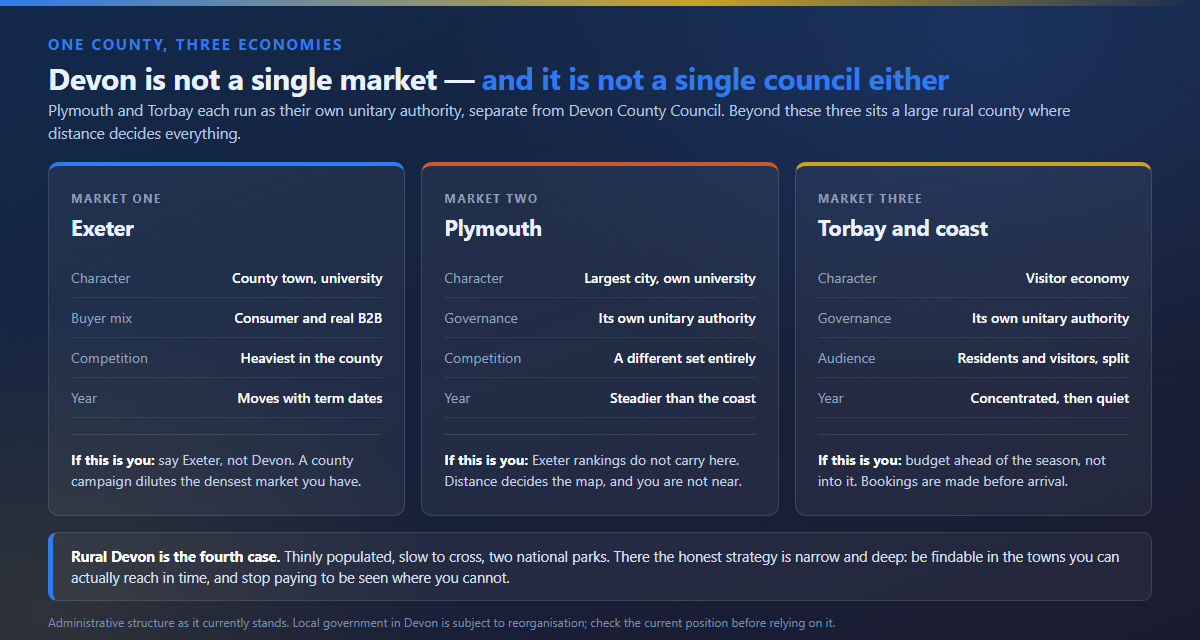
A business asking for SEO in Devon usually means one of three different things. The county is not even administratively single — Plymouth and Torbay each run as their own unitary authority. Those splits reflect three economies that buy and search differently, and treating them as one market is the most expensive mistake made here.

“Devon” is a word covering three separate markets
A business asking for SEO in Devon almost always means one of three quite different things, and which one decides nearly every choice that follows.
The county is not even administratively single. Plymouth and Torbay each run as their own unitary authority, providing their own services, separate from Devon County Council. That split is not a technicality: it reflects three economies that behave differently, buy differently and search differently.
Treating them as one market is the most common and most expensive mistake in Devon marketing. A campaign built for Exeter will underperform in Plymouth, and both will waste money in the rural west. This page is about telling them apart before you spend anything.
Exeter: professional, and the most competitive
Exeter is the county town and the commercial centre, with a large university and the concentration of professional services that follows one. It is where most of Devon’s agency competition sits, and where the search terms are fought over hardest.
What that means practically:
- Costs are higher here than the county average. More advertisers, more agencies bidding, and a business audience worth more per customer.
- B2B intent is real. A meaningful share of searches are from businesses buying from businesses, which behaves nothing like a homeowner looking for a tradesperson.
- The university shapes the seasons. Term dates move the resident population, and anything selling to students or to the businesses serving them has a calendar rather than a steady year.
If you sell to Exeter specifically, say Exeter, not Devon. A county-wide campaign dilutes the one market where the buyers are densest, and hands the difference to whoever was more specific.
Plymouth: the largest city, and genuinely separate
Plymouth is the biggest city in the county and runs itself. It has its own university, its own naval and maritime economy, and a search market that does not overlap with Exeter’s as much as the shared county name suggests.
Two consequences matter.
First, somebody in Plymouth searching for a service is generally looking for somebody in Plymouth. The map pack will show them what is near them, and an Exeter business is not near them. Distance is not negotiable, which means a Plymouth presence has to be earned rather than claimed.
Second, the competitive set is different. The agencies and businesses ranking in Plymouth are often not the ones ranking in Exeter. Checking your rankings from one city and assuming they hold across the county is how businesses convince themselves they cover Devon when they cover one end of it.
If both cities genuinely matter to you, they need separate pages, separate campaigns and separate measurement. Combining them produces an average that describes neither.
Torbay and the coast: a year with a shape
Torbay is the third unitary authority, and the coastal economy runs to a different rhythm entirely. Tourism is a major part of it, which changes both who is searching and when.
The practical differences are sharp.
Seasonality is real, and it is not evenly spread. A hospitality or visitor-facing business has a concentrated trading period and a long quiet one. Budget spread evenly across twelve months is budget wasted in the months nobody books.
Visitors are not residents. They search differently, they buy different things, and most of them will never return. A campaign that cannot separate the two is measuring a blend and optimising towards whichever is cheaper rather than whichever is worth more.
The quiet months are when the work gets done. Website fixes, profile corrections and content are best built out of season, so the visibility exists before the demand arrives. Starting in the busy period is starting three months late.
Rural Devon, where distance is the whole problem
Outside those three, Devon is large, thinly populated and slow to cross. Two national parks sit inside or on its edge, and journey times bear no relation to the distance on a map.
For a service business this is the constraint that overrides everything. The map pack ranks on distance from the searcher, so a business in Exeter will not appear for somebody in Barnstaple, whatever the website does. And a job an hour and a half away is often a job not worth taking.
So the honest strategy in rural Devon is narrow and deep rather than wide. Be genuinely findable in the towns you can actually reach in time. Where you cannot reach, do not pay to be seen — and if the work can be delivered remotely, stop marketing on geography altogether and market on the thing you do.
This is where county-wide promises fall apart, and where what actually decides local visibility matters more than any amount of content.
Pick one, then earn the next
The sequence that works for a small business here is unglamorous and it is the opposite of what most county-wide proposals suggest.
- Name the one market that pays you most today. Exeter, Plymouth, the bay, or a named set of towns. Not “Devon”.
- Get the Business Profile right for that market. Free, quick, and it decides which searches you are eligible for at all.
- Build one page that is genuinely about that place — what you do there, for whom, and what is different about it. Not a template with the town swapped, which is a pattern that tends to weaken the pages you already have.
- Measure from inside that market, not from your own desk, because rankings differ by where the searcher stands.
- Only then add the second market, with its own page and its own measurement.
If paid search is part of it, the same discipline applies: separate campaigns per market, because one blended campaign lets the cheaper geography quietly absorb the budget. Where you already sell into Exeter specifically, the paid social side of that city is covered separately, and the organic work itself follows the same order wherever it is done.
Across the Tamar, Newquay is the seasonal version of the same problem, a town that earns most of its year between April and September, and it has its own page: SEO Newquay.
What a client said, and what you can check
“Great communication and very helpful throughout the process. Took the time to explain everything clearly and set up the campaign professionally. Focused on quality results rather than just numbers. Highly recommended.”
This is one of three client reviews published so far; the other two, from a UK SEO client and a US Google Ads client, are on the home page. Every figure comes from the client’s own ad account, and a review goes on this site only when it is real.
What you can check before you pay
- Prices published in full on the pricing page, not hidden behind a sales call
- Month to month, with one month’s notice and no lock-in contract
- Every account, profile and file stays in your name; I work through partner access
- A written report every week, in plain English
- One specialist does the work, from the audit to the report
Devon SEO questions, answered plainly
Can one website rank across the whole of Devon?
In organic results, yes, with enough authority and genuinely distinct pages. In the map pack, no. That block ranks on distance from the searcher, so there is no single Devon ranking to win. Anybody promising county-wide map coverage is selling something that does not exist, and the honest version is strong visibility in the markets you can actually serve.
Should I build separate pages for Exeter, Plymouth and Torbay?
Only if each one says something a competitor could not copy by swapping the place name. Three genuinely different pages about three genuinely different markets is sound. Three near-identical pages differing by one word is the pattern Google’s spam policies describe, and it tends to weaken what you already have rather than add to it.
Why do my rankings look fine to me but customers say they cannot find me?
Because you are almost certainly checking from your own premises, where distance flatters you. Local results are calculated from wherever the searcher is standing. Check from the towns your customers are actually in, or use a tool that simulates other locations, and expect the picture to be worse than the one on your own screen.
Is Plymouth part of Devon for marketing purposes?
Geographically yes, commercially it behaves as its own city, and administratively it is a unitary authority running its own services separately from Devon County Council. For targeting, treat it as a separate market with its own competitive set. Assuming Exeter performance carries over to Plymouth is the most common misreading of this county.
How should a seasonal Devon business budget across the year?
Not evenly. Concentrate paid spend into the run-up to your trading period rather than into the period itself, because bookings are made before arrival, not during. Use the quiet months for the work that has a lag — the website, the profile, the content — so the visibility is already there when demand returns.
Is it worth targeting visitors as well as residents?
If visitors are real revenue for you, yes, but as a separate campaign. They search differently, convert on different things and almost never come back. Blended into one campaign they distort the numbers, and you end up optimising towards whichever group is cheaper to reach rather than whichever is worth more.
Do I need a Devon address to rank in Devon?
You need a presence you can legitimately claim: premises customers visit, or a real service area you genuinely operate in. Renting a mailbox to claim a town is against Google’s guidelines and is a common reason profiles get suspended. If you serve Devon from outside it, organic pages and paid search are the honest routes, because the map pack will keep showing people what is near them.
How long before SEO shows results in a market this size?
The free profile work can change which searches you are eligible for within days. Organic rankings take months and cannot be promised to a date, particularly in Exeter where the competition is heaviest. Anyone giving you a timetable for a specific position is guessing, because the result differs by searcher and by where they are standing.
Tell me which market you actually sell to
Send the website address and name the one market that pays you most today — Exeter, Plymouth, the bay, or a set of towns. You get a written answer: whether the profile makes you eligible for those searches, what the competition in that specific market looks like, and what I would do first. It costs nothing and there is nothing to sign. If the honest answer is that distance rules you out of the map and paid search is your route, that is what the answer will say.